
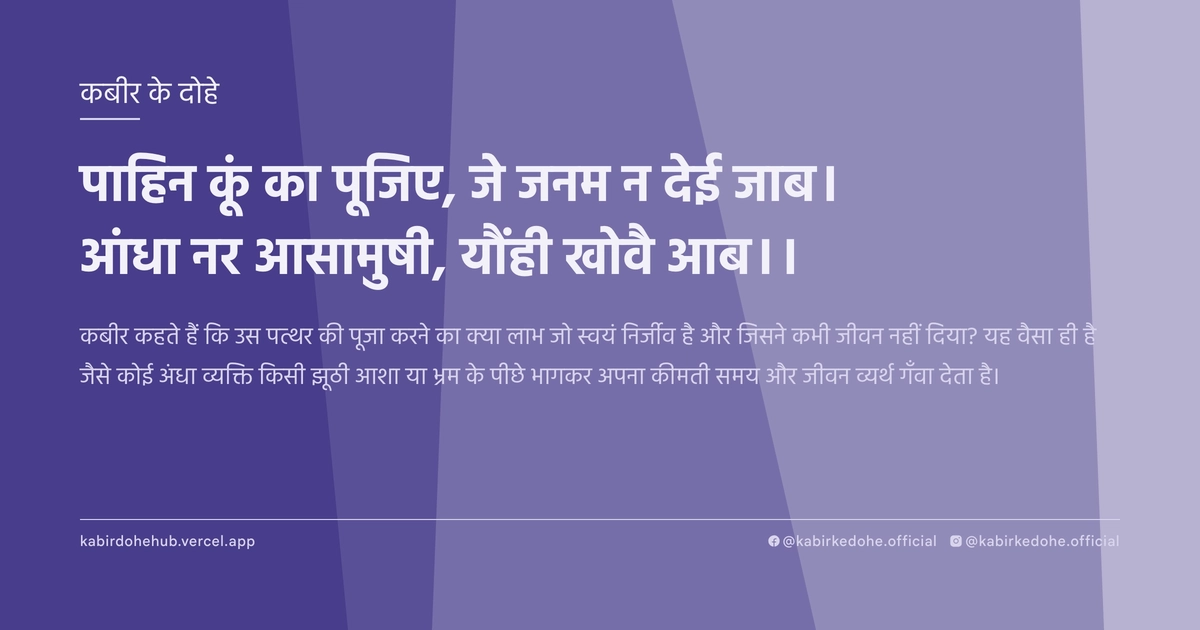
पाहिन कूं का पूजिए, जे जनम न देई जाब।
आंधा नर आसामुषी, यौंही खोवै आब।।
Pahin kun ka pujie, je janam na dei jaab. Andha nar asamushee, yaunhi khovaye aab.
इस पृष्ठ पर इस कबीर दोहे का अर्थ (meaning), हिंदी व्याख्या और अंग्रेज़ी अनुवाद, दार्शनिक विश्लेषण और व्यावहारिक जीवन सीख दी गई है। यह दोहा मूर्ति पूजा विरोध (Condemnation of Idolatry) विषय से जुड़ा है — Kabir doha meaning and explanation in Hindi and English.
अर्थ (Meaning):
कबीर कहते हैं कि उस पत्थर की पूजा करने का क्या लाभ जो स्वयं निर्जीव है और जिसने कभी जीवन नहीं दिया? यह वैसा ही है जैसे कोई अंधा व्यक्ति किसी झूठी आशा या भ्रम के पीछे भागकर अपना कीमती समय और जीवन व्यर्थ गँवा देता है।
Kabir questions the utility of worshipping a stone that is lifeless and incapable of granting birth or liberation. He likens such ritualistic devotion to a blind man chasing a mirage or a false hope, ultimately wasting the precious opportunity of human existence.
व्याख्या (Interpretation):
इस दोहे का शाब्दिक अर्थ मूर्ति पूजा के प्रति एक तीखा प्रहार है, परंतु इसका आध्यात्मिक अर्थ कहीं अधिक गहरा है। 'पाहिन' या पत्थर यहाँ केवल मूर्ति का प्रतीक नहीं है, बल्कि उस जड़ता का प्रतीक है जो हमारे भीतर है। जब हम बाहरी कर्मकांडों में उलझते हैं, तो हम वास्तव में अपनी चेतना को पत्थर जैसा बना लेते हैं। यह 'अंधा नर' वह साधक है जो सत्य को अपने भीतर खोजने के बजाय बाहर खोजता है। यह निरगुण भक्ति का मूल सिद्धांत है कि ईश्वर निराकार है और उसे किसी भौतिक वस्तु में सीमित नहीं किया जा सकता। माया का पर्दा हमें यह विश्वास दिलाता है कि मोक्ष किसी बाहरी अनुष्ठान से मिलेगा, जबकि वास्तव में यह आत्मा और परमात्मा के अभेद संबंध (अद्वैत) को पहचानने में निहित है।
Literally, this couplet is a sharp critique of idol worship, yet its spiritual resonance delves deeper. The 'stone' represents not just a physical idol, but the spiritual inertia and rigidity within the human psyche. When we cling to external rituals, we inadvertently petrify our own consciousness. The 'blind man' symbolizes the seeker who looks outward for truth, ignoring the internal spark. This aligns with Nirgun Bhakti, asserting that the Divine is formless and cannot be confined to material objects. The veil of Maya creates the illusion that liberation is found in external rites, whereas it actually lies in realizing the non-duality (Advaita) of the Atman and Brahman, recognizing that the seeker and the sought are one.
दार्शनिक विश्लेषण (Philosophical Analysis):
कबीर का यह दृष्टिकोण उनके समय के सामाजिक और धार्मिक परिवेश की प्रतिक्रिया है, जहाँ कर्मकांड और जातिगत श्रेष्ठता चरम पर थी। वे तर्क देते हैं कि यदि पत्थर में जीवन नहीं है, तो वह मनुष्य को जीवन का मार्ग कैसे दिखा सकता है? यह विचार सूफी मत के 'वहदत-अल-वजूद' (अस्तित्व की एकता) और अद्वैत वेदांत के करीब है, जहाँ बाहरी प्रतीकों के बजाय आंतरिक अनुभव को प्राथमिकता दी जाती है।
कबीर का प्रहार केवल मूर्तियों पर नहीं, बल्कि उस मानसिक गुलामी पर है जो मनुष्य को प्रश्न करने से रोकती है। वे ritualism (अनुष्ठानवाद) को एक बाधा मानते हैं जो साधक को वास्तविक सत्य से दूर ले जाता है। उनके लिए भक्ति का अर्थ है 'प्रेम' और 'जागरूकता', न कि भय या परंपरा का पालन।
मनोवैज्ञानिक स्तर पर, यह दोहा 'प्रोजेक्शन' की प्रक्रिया को दर्शाता है। मनुष्य अपनी आंतरिक शून्यता को भरने के लिए बाहरी वस्तुओं में दिव्यता आरोपित करता है। कबीर इस भ्रम को तोड़कर व्यक्ति को अपनी स्वयं की चेतना की ओर मोड़ते हैं।
यहाँ 'अंधापन' अज्ञानता का प्रतीक है। यह वह अज्ञान है जो हमें यह विश्वास दिलाता है कि सत्य कहीं बाहर स्थित है। जब अहंकार (Ego) यह मान लेता है कि वह किसी बाहरी माध्यम से ईश्वर को पा सकता है, तो वह वास्तव में अपने विनाश का मार्ग प्रशस्त करता है।
अंततः, कबीर यह स्पष्ट करते हैं कि आध्यात्मिक प्रगति केवल तभी संभव है जब हम जड़ता (Inertia) को त्यागकर चैतन्यता (Consciousness) को अपनाएं। पत्थर की पूजा करना आसान है क्योंकि इसमें प्रयास नहीं लगता, लेकिन स्वयं के भीतर उतरना कठिन है क्योंकि इसमें अहंकार का विसर्जन करना पड़ता है।
Kabir's perspective is a visceral reaction to the socio-religious climate of his era, characterized by rigid ritualism and caste hierarchies. He posits a logical challenge: if a stone lacks the breath of life, how can it guide a living soul toward liberation? This philosophy mirrors the Sufi concept of 'Wahdat-al-Wujud' (Unity of Existence) and Advaita Vedanta, prioritizing internal experiential realization over external symbolic worship.
His critique extends beyond idols to the mental servitude that prevents humans from questioning. He views ritualism as a spiritual detour—a distraction that keeps the seeker tethered to the material plane. For Kabir, true devotion is rooted in 'Prem' (Love) and 'Jagrukta' (Awareness), not in the mechanical repetition of traditions or fear-based piety.
Psychologically, this doha addresses the mechanism of 'projection.' Humans often project divinity onto external objects to fill an internal void. Kabir dismantles this illusion, urging the individual to pivot their gaze inward to find the source of light.
'Blindness' here serves as a metaphor for Avidya (ignorance). It is the spiritual blindness that convinces the seeker that Truth is a destination to be reached or an object to be acquired, rather than a state of being to be realized. When the ego believes it can 'purchase' or 'earn' salvation through rites, it only deepens its own entrapment.
Ultimately, Kabir asserts that spiritual evolution requires the transition from inertia to consciousness. Worshipping a stone is effortless because it demands no internal change; however, diving into the self is arduous as it requires the complete annihilation of the ego (Fana).
मूल संदेश (Core Message):
- बाहरी प्रतीकों का मोह आध्यात्मिक अंधापन है।
- सत्य किसी वस्तु में नहीं, बल्कि चेतना में है।
- जड़ता का त्याग कर चैतन्यता को अपनाएं।
- मानवता की सेवा ही वास्तविक ईश्वर पूजा है।
- अहंकार का विसर्जन ही मोक्ष का एकमात्र द्वार है।
- Attachment to external symbols is spiritual blindness.
- Truth resides not in objects, but in consciousness.
- Shed the inertia of ritual to embrace the vibrancy of being.
- Serving humanity is the highest form of divine worship.
- The dissolution of ego is the only gateway to liberation.
व्यावहारिक उदाहरण (Practical Example):
वाराणसी के घाटों पर रहने वाले एक वृद्ध विधवा, जानकी, का जीवन केवल एक छोटे से मंदिर की पत्थर की मूर्ति की सेवा में बीत रहा था। वह मानती थी कि यदि वह दिन भर मूर्ति को साफ करेगी और उसके सामने दीये जलाएगी, तो उसके पिछले जन्मों के पाप धुल जाएंगे और उसे मोक्ष मिलेगा।
वह इतनी तल्लीन थी कि अपने आस-पास के दुखी लोगों की अनदेखी करती थी। उसके पास आने वाले भूखे बच्चों को वह यह कहकर हटा देती कि वह 'ईश्वर की सेवा' में व्यस्त है। वह मानती थी कि पत्थर की मूर्ति ही उसकी एकमात्र शरण है।
एक दिन, एक फकीर उसके पास आया और उसने जानकी से पूछा, "माता, इस पत्थर में कौन सा ऐसा रहस्य है जो तुम्हारी आँखों के सामने खड़े इस भूखे बच्चे में नहीं है?"
जानकी ने उत्तर दिया, "यह मूर्ति साक्षात ईश्वर है, और यह बच्चा केवल एक साधारण मानव है।"
फकीर मुस्कुराया और बोला, "यदि ईश्वर पत्थर में है और मनुष्य में नहीं, तो तुम्हारा ईश्वर मृत है। यदि वह जीवित है, तो वह इस बच्चे की भूख में तड़प रहा है। तुम पत्थर को पूज रही हो, जबकि जीवित ईश्वर तुम्हारे सामने खड़ा है।"
यह बात जानकी के हृदय पर बिजली की तरह गिरी। उसे अचानक महसूस हुआ कि वह वर्षों से एक मृत वस्तु के सामने सिर झुका रही थी, जबकि जीवन की वास्तविक सेवा उसके सामने थी।
उसने उस दिन से मूर्ति की पूजा छोड़ दी और अपना समय और संसाधन उन अनाथ बच्चों की देखभाल में लगाने लगी जो घाटों पर भटकते थे।
उसने पाया कि जब वह किसी भूखे को भोजन कराती, तो उसे वही शांति और आनंद मिलता था जो वह मंदिर की मूर्ति में खोज रही थी।
उसका 'अंधापन' समाप्त हो गया था। उसने समझा कि पत्थर की पूजा केवल एक मानसिक सहारा था, जबकि मानवता की सेवा ही वास्तविक मोक्ष का मार्ग है।
जानकी अब केवल एक भक्त नहीं, बल्कि एक जागृत आत्मा बन गई थी, जिसने पत्थर की जड़ता को त्यागकर जीवन की चैतन्यता को गले लगाया था।
Janaki, an elderly widow living on the ghats of Varanasi, spent her entire existence serving a small stone idol in a shrine. She believed that by meticulously cleaning the idol and lighting lamps all day, her past karmas would be erased and she would attain salvation.
She was so consumed by this ritual that she ignored the suffering around her. When hungry children approached her, she would dismiss them, claiming she was 'busy serving the Divine.' To her, the stone idol was the only true sanctuary.
One day, a wandering fakir approached her and asked, "Mother, what secret does this stone hold that is not present in this hungry child standing before you?"
Janaki replied, "This idol is the living God, while this child is merely a common human."
The fakir smiled and said, "If God is in the stone and not in the human, then your God is dead. If He is alive, He is shivering in the hunger of this child. You worship a stone, while the living Divine stands before you."
These words struck Janaki like a bolt of lightning. She suddenly realized she had spent years bowing to a lifeless object while ignoring the pulse of life right in front of her.
From that day forward, she ceased her ritualistic worship and dedicated her time and meager resources to caring for the orphaned children wandering the ghats.
She discovered that when she fed a hungry child, she felt the same peace and ecstasy she had spent decades searching for in the stone idol.
Her 'blindness' had vanished. She understood that the idol was merely a psychological crutch, and that serving humanity was the actual path to liberation.
Janaki was no longer just a devotee; she became an awakened soul who had traded the inertia of stone for the vibrancy of conscious living.
अभ्यास मार्गदर्शन (Practice Guidance):
- दैनिक चिंतन: प्रतिदिन 15 मिनट मौन बैठें और विचार करें कि आप किन बाहरी प्रतीकों या आदतों पर अत्यधिक निर्भर हैं जो आपको आपके आंतरिक सत्य से दूर ले जा रही हैं।
- आत्म-पूछताछ जर्नल: एक डायरी लिखें जिसमें उन क्षणों का विवरण हो जब आपने किसी बाहरी मान्यता के कारण अपनी अंतरात्मा की आवाज़ को दबाया।
- व्यवहार परिवर्तन: किसी भी धार्मिक अनुष्ठान को करने से पहले स्वयं से पूछें, "क्या यह कार्य मेरी करुणा बढ़ा रहा है या केवल मेरे अहंकार को संतुष्ट कर रहा है?"
- डायग्नोस्टिक चेकलिस्ट: (1) क्या मैं दूसरों की मदद करने के बजाय कर्मकांडों को प्राथमिकता देता हूँ? (2) क्या मैं सत्य को केवल किताबों या मूर्तियों में खोज रहा हूँ? (3) क्या मेरी भक्ति मुझे दूसरों के प्रति कठोर बना रही है? यदि हाँ, तो आप 'पत्थर' की पूजा कर रहे हैं।
- Daily Contemplation: Spend 15 minutes in silence daily, reflecting on the external symbols or habits you rely upon that may be distancing you from your internal truth.
- Self-Inquiry Journal: Maintain a journal documenting moments where you suppressed your inner voice in favor of an external dogma or social expectation.
- Behavioral Shift: Before performing any ritual, ask yourself: "Is this action expanding my compassion, or is it merely feeding my ego's need for spiritual validation?"
- Diagnostic Checklist: (1) Do I prioritize rituals over helping a fellow being? (2) Am I seeking truth exclusively in books or idols? (3) Does my devotion make me rigid or judgmental toward others? If yes, you are currently 'worshipping the stone'.
चिंतन प्रश्न (Reflection Questions):
- मेरे जीवन में वह 'पत्थर' क्या है जिसे मैं सत्य मानकर पूज रहा हूँ, जबकि वह वास्तव में निर्जीव है?
- क्या मेरी धार्मिक पहचान मुझे वास्तव में मुक्त कर रही है, या यह केवल एक नया सामाजिक मुखौटा है?
- मैं अपनी डिजिटल पहचान और सार्वजनिक छवि को बनाए रखने के लिए अपनी आंतरिक शांति का कितना बलिदान देता हूँ?
- यदि आज सभी मंदिर और तीर्थ समाप्त हो जाएं, तो क्या मेरे पास ईश्वर तक पहुँचने का कोई आंतरिक मार्ग बचेगा?
- क्या मैं वास्तव में सत्य की खोज कर रहा हूँ, या मैं केवल अपनी पूर्व-निर्धारित मान्यताओं की पुष्टि चाहता हूँ?
- What is the 'stone' in my life—the lifeless belief or habit—that I mistake for the ultimate truth?
- Is my religious or spiritual identity truly liberating me, or is it just another social mask I wear?
- How much of my internal peace do I sacrifice to maintain my digital persona and public image?
- If all temples and pilgrimage sites vanished today, would I possess an internal map to reach the Divine?
- Am I genuinely seeking the truth, or am I merely seeking confirmation of my pre-existing biases?