
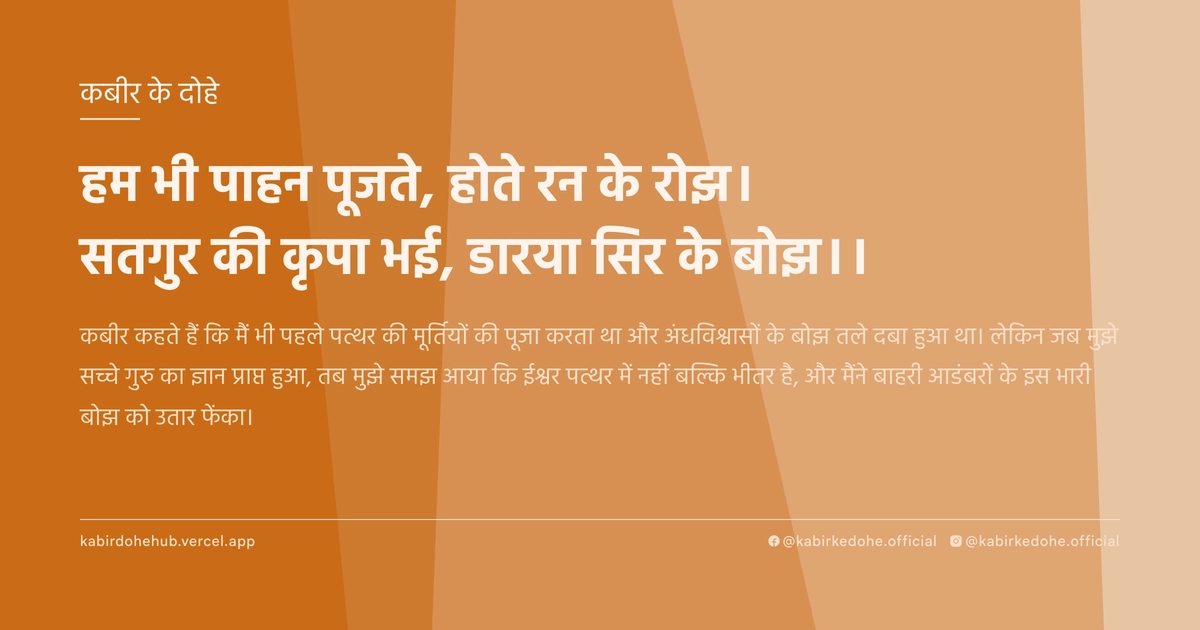
हम भी पाहन पूजते, होते रन के रोझ।
सतगुर की कृपा भई, डारया सिर के बोझ।।
Hum bhi pahan pujte, hote ran ke rojh. Satgur ki kripa bhayi, darya sir ke bojh.
इस पृष्ठ पर इस कबीर दोहे का अर्थ (meaning), हिंदी व्याख्या और अंग्रेज़ी अनुवाद, दार्शनिक विश्लेषण और व्यावहारिक जीवन सीख दी गई है। यह दोहा गुरु महत्व (The Guru's Importance) विषय से जुड़ा है — Kabir doha meaning and explanation in Hindi and English.
अर्थ (Meaning):
कबीर कहते हैं कि मैं भी पहले पत्थर की मूर्तियों की पूजा करता था और अंधविश्वासों के बोझ तले दबा हुआ था। लेकिन जब मुझे सच्चे गुरु का ज्ञान प्राप्त हुआ, तब मुझे समझ आया कि ईश्वर पत्थर में नहीं बल्कि भीतर है, और मैंने बाहरी आडंबरों के इस भारी बोझ को उतार फेंका।
Kabir confesses that he too once spent his life worshipping stone idols, burdened by the weight of ritualistic blindness. However, upon receiving the grace of a True Guru, he realized that the Divine resides within, allowing him to cast off the heavy psychological and spiritual burden of external formalities.
व्याख्या (Interpretation):
इस दोहे का शाब्दिक अर्थ मूर्ति पूजा के त्याग से है, परंतु गहरा अर्थ चेतना के जागरण से है। 'पाहन' या पत्थर केवल मूर्ति नहीं, बल्कि वह जड़ता है जो मनुष्य के विवेक को ढक लेती है। 'रन के रोझ' उस मानसिक संघर्ष और थकान को दर्शाता है जो व्यर्थ के कर्मकांडों से पैदा होती है। यहाँ 'सतगुर' वह प्रकाश है जो अज्ञान के पर्दे को हटाता है। यह निरगुण भक्ति का सार है, जहाँ ईश्वर को किसी आकार में नहीं, बल्कि एक सार्वभौमिक ऊर्जा के रूप में देखा जाता है। यह अद्वैत वेदांत की उस स्थिति की ओर संकेत है जहाँ साधक यह जान लेता है कि वह और उसका आराध्य अलग नहीं हैं। अंततः, 'बोझ' का उतरना अहंकार और सामाजिक कंडीशनिंग की समाप्ति है।
Literally, the verse addresses the abandonment of idol worship, but metaphorically, it speaks of the awakening of consciousness. 'Paahan' or stone represents not just an idol, but the spiritual inertia and rigidity that cloud human intuition. The 'burden' refers to the psychic exhaustion born from mindless adherence to rituals. The 'Satgur' (True Guru) acts as the catalyst for enlightenment, stripping away the veil of Maya. This aligns with Nirgun Bhakti, where the Divine is perceived as formless and omnipresent rather than localized in an object. It echoes Advaita Vedanta's non-duality, asserting that the seeker and the sought are one. The 'casting off of the load' symbolizes the annihilation of the ego and the liberation from societal conditioning.
दार्शनिक विश्लेषण (Philosophical Analysis):
कबीर का यह कथन उनके समय के सामाजिक और धार्मिक परिवेश पर एक तीखा प्रहार है। 15वीं शताब्दी में भारत में कर्मकांड और जातिगत श्रेष्ठता चरम पर थी। कबीर ने देखा कि लोग ईश्वर को खोजने के लिए बाहरी यात्राएं करते हैं और पत्थरों को पूजते हैं, जबकि उनके भीतर का मनुष्य मर रहा है। उनका दर्शन 'सहज मार्ग' का है, जो किसी मंदिर या मस्जिद का मोहताज नहीं है।
दार्शनिक स्तर पर, यह दोहा सूफीवाद के 'फना' (अहंकार का विलीनीकरण) और वेदांत के 'माया' के सिद्धांत से जुड़ता है। जब तक मनुष्य बाहरी प्रतीकों को सत्य मानता है, वह माया के जाल में फंसा रहता है। कबीर तर्क देते हैं कि सत्य 'अनुभव' का विषय है, 'विश्वास' का नहीं। वे ritualism को एक मानसिक बोझ मानते हैं जो आत्मा की उड़ान को रोकता है।
यहाँ 'बोझ' शब्द अत्यंत महत्वपूर्ण है। यह केवल धार्मिक बोझ नहीं, बल्कि वह सांस्कृतिक बोझ है जो हमें बताता है कि पवित्रता केवल विशिष्ट स्थानों या वस्तुओं में होती है। कबीर इस धारणा को तोड़कर पवित्रता को अंतर्मन में स्थापित करते हैं।
उनका दृष्टिकोण यह है कि ईश्वर 'अगोचर' है, जिसे इंद्रियों से नहीं बल्कि अंतःकरण से महसूस किया जा सकता है। यह विचार उस समय के रूढ़िवादी ब्राह्मणवादी और मौलवी वर्ग के लिए चुनौतीपूर्ण था क्योंकि यह मध्यस्थों (पुजारियों) की आवश्यकता को समाप्त कर देता था।
अंततः, यह दोहा मनोवैज्ञानिक रूपांतरण की बात करता है। जब एक व्यक्ति यह महसूस करता है कि वह स्वयं पूर्ण है, तो वह बाहरी सहारे की तलाश छोड़ देता है। यह 'स्व' से 'सर्व' की यात्रा है, जहाँ व्यक्ति अपनी पहचान को सीमित दायरे से निकालकर ब्रह्मांडीय चेतना में विलीन कर देता है।
Kabir's assertion is a piercing critique of the socio-religious climate of the 15th century, where ritualism and caste-based superiority were pervasive. He observed a profound irony: people traveled vast distances and worshipped inanimate stones to find God, while the living spirit within them remained neglected. His philosophy centers on the 'Sahaj Marg' (the Natural Path), which transcends the boundaries of temples and mosques.
Philosophically, this verse intersects with the Sufi concept of 'Fana' (annihilation of the ego) and the Vedantic theory of 'Maya' (illusion). As long as a seeker perceives external symbols as the ultimate truth, they remain trapped in the illusion of duality. Kabir argues that Truth is a matter of direct 'experience' (Anubhava), not blind 'belief' (Vishwas). He views ritualism as a psychological weight that impedes the soul's ascent.
The term 'burden' (bojh) is pivotal here. It represents not just religious dogma, but the cultural conditioning that suggests sanctity exists only in specific locations or objects. Kabir dismantles this notion, relocating sanctity from the altar to the inner heart.
His perspective posits that the Divine is 'Agochar'—beyond the reach of the senses—perceivable only through the awakened intuition. This was revolutionary and subversive, as it eliminated the need for intermediaries like priests or clerics, democratizing spirituality.
Ultimately, the verse describes a psychological metamorphosis. Once an individual realizes their inherent wholeness, the craving for external validation and spiritual crutches vanishes. It is a journey from the 'I' to the 'All,' where the limited identity is dissolved into the cosmic consciousness.
मूल संदेश (Core Message):
- बाहरी प्रतीकों की पूजा केवल मानसिक जड़ता को बढ़ाती है।
- सच्चा ज्ञान बाहरी आडंबरों के बोझ को उतार फेंकता है।
- ईश्वर किसी पत्थर में नहीं, बल्कि चेतना के भीतर है।
- गुरु की कृपा अज्ञान के पर्दे को हटाकर सत्य से मिलाती है।
- अहंकार का त्याग ही वास्तविक आध्यात्मिक मुक्ति है।
- Worshipping external symbols only reinforces mental inertia.
- True enlightenment casts off the burden of ritualistic vanity.
- The Divine is not localized in stone, but resides in consciousness.
- The Guru's grace dissolves the veil of ignorance to reveal Truth.
- The annihilation of ego is the only authentic spiritual liberation.
व्यावहारिक उदाहरण (Practical Example):
वाराणसी के एक पुराने मोहल्ले में माधव नाम का एक वृद्ध व्यक्ति रहता था, जो जीवन भर केवल एक ही नियम पर चला—कि ईश्वर को प्रसन्न करने के लिए कठिन तप और महंगे अनुष्ठान जरूरी हैं। वह अपनी meager कमाई का बड़ा हिस्सा मूर्तियों के श्रृंगार और पंडितों के दान में खर्च करता था। उसका मानना था कि यदि वह पर्याप्त पत्थर पूजेगा और कठिन व्रत रखेगा, तो उसके पाप धुल जाएंगे।
माधव का जीवन तनावपूर्ण था। वह हमेशा इस डर में रहता था कि कहीं कोई विधि गलत न हो जाए। उसके चेहरे पर शांति नहीं, बल्कि एक निरंतर चिंता थी। वह अपने परिवार से कटा हुआ था क्योंकि वह उन्हें 'अधर्मी' मानता था जो केवल बाहरी दिखावे को नहीं मानते थे।
एक दिन उसकी मुलाकात एक साधारण से बुनकर से हुई, जो शांत और आनंदित था। उस बुनकर ने माधव से पूछा, "बाबा, आप इस भारी पत्थर को ढोने की कोशिश कर रहे हैं, लेकिन क्या आपने कभी उस पत्थर को देखा है जो आपके हृदय के भीतर है?"
माधव को पहले तो गुस्सा आया, लेकिन बुनकर की आंखों की शांति ने उसे सोचने पर मजबूर कर दिया। बुनकर ने कहा, "ईश्वर पत्थर में नहीं, उस प्रेम में है जिससे आप दूसरों की सेवा करते हैं। आपका बोझ पूजा का नहीं, बल्कि इस अहंकार का है कि आप अकेले ही पवित्र हैं।"
यह बात माधव के भीतर बिजली की तरह कौंधी। उसने महसूस किया कि जिस 'पवित्रता' के पीछे वह भाग रहा था, उसने उसे अपनों से दूर कर दिया था। उसने पहली बार महसूस किया कि वह धर्म के नाम पर एक मानसिक बोझ ढो रहा था।
अगले कुछ महीनों में माधव ने अपना व्यवहार बदला। उसने महंगे अनुष्ठान छोड़ दिए और उस पैसे से मोहल्ले के गरीब बच्चों के लिए किताबें खरीदना शुरू किया। उसने पाया कि जब वह किसी भूखे को खाना खिलाता है, तो उसे वही शांति मिलती है जो वह घंटों मंदिर में बैठकर खोजता था।
उसका क्रोध शांत हो गया और वह अपने परिवार के करीब आया। उसने समझा कि सच्ची पूजा पत्थर की मूर्ति की नहीं, बल्कि जीवित मनुष्य के भीतर की दिव्यता की पहचान करना है।
माधव अब भी मंदिर जाता था, लेकिन अब वह वहां पत्थर पूजने नहीं, बल्कि उस शांति का अनुभव करने जाता था जो उसके भीतर थी। उसने 'सिर का बोझ' उतार दिया था और अब वह वास्तव में स्वतंत्र था।
In a narrow alley of Varanasi lived an elderly man named Madhav, who spent his entire life adhering to a single conviction: that God could only be pleased through rigorous penance and expensive rituals. He spent the majority of his meager earnings on decorating idols and donating to priests, believing that the more stones he worshipped and the stricter his fasts, the more his sins would be cleansed.
Madhav's life was fraught with tension. He lived in constant fear that he might commit a ritualistic error. His face bore no peace, only a perpetual shadow of anxiety. He had become estranged from his own family, viewing them as 'unrighteous' because they did not share his obsession with external formalities.
One day, he encountered a simple weaver who radiated an aura of profound serenity. The weaver asked Madhav, "Baba, you are struggling to carry this heavy stone of ritual, but have you ever looked at the stone of inertia that resides within your own heart?"
Initially, Madhav was offended, but the stillness in the weaver's eyes compelled him to listen. The weaver continued, "God is not in the stone, but in the love with which you serve others. Your burden is not that of worship, but the ego that tells you that you alone are holy."
These words struck Madhav like a bolt of lightning. He realized that the 'sanctity' he had been chasing had actually alienated him from humanity. He recognized that he had been carrying a psychological burden in the name of religion.
Over the following months, Madhav transformed his life. He abandoned the costly rituals and began using that money to buy books for the underprivileged children of his neighborhood. He discovered that feeding a hungry child brought him a peace that hours of temple chanting never could.
His anger subsided, and he reconciled with his family. He understood that true worship is not the adoration of a stone idol, but the recognition of the divine spark within every living being.
Madhav still visited the temple, but no longer to worship a stone; he went to experience the silence that now resided within him. He had finally cast off the 'burden from his head' and was truly free.
अभ्यास मार्गदर्शन (Practice Guidance):
- दैनिक चिंतन: प्रतिदिन 15 मिनट मौन बैठें और विचार करें कि आप किन बाहरी प्रतीकों या सामाजिक मान्यताओं को 'सत्य' मानकर अपना मानसिक बोझ बढ़ा रहे हैं।
- आत्म-पूछताछ जर्नल: लिखें कि 'यदि मैं सभी धार्मिक पहचान और रीति-रिवाजों को छोड़ दूँ, तो मेरे भीतर क्या बचेगा?'
- व्यवहारिक परिवर्तन: किसी ऐसे व्यक्ति की निस्वार्थ सेवा करें जिसे समाज 'अछूत' या 'निम्न' मानता है, ताकि आप बाहरी पवित्रता के भ्रम को तोड़ सकें।
- निदान चेकलिस्ट: क्या आप पूजा के बाद भी अशांत महसूस करते हैं? क्या आप दूसरों की आस्था को तुच्छ समझते हैं? यदि हाँ, तो आप अभी भी 'बोझ' ढो रहे हैं।
- Daily Contemplation: Spend 15 minutes in silence, reflecting on which external symbols or societal beliefs you mistake for 'Truth,' thereby increasing your mental burden.
- Self-Inquiry Journaling: Write a response to the prompt: 'If I stripped away all religious identities and rituals, what remains of my essence?'
- Behavioral Shift: Perform selfless service for someone marginalized by society to break the illusion of 'ritual purity' and recognize the inherent divinity in all.
- Diagnostic Checklist: Do you feel restless despite performing rituals? Do you judge others' paths as inferior? If yes, you are still carrying the 'burden' of ego.
चिंतन प्रश्न (Reflection Questions):
- मेरा 'पत्थर' क्या है—वह कौन सी रूढ़ि है जिसे मैं सत्य मानकर ढो रहा हूँ?
- क्या मेरी धार्मिकता मुझे दूसरों के प्रति अधिक दयालु बनाती है या अधिक निर्णयशील?
- मैं अपनी पहचान को बाहरी लेबल्स (जाति, धर्म, पद) से कितना जोड़ता हूँ?
- क्या मैं ईश्वर को खोजने के लिए बाहर भटक रहा हूँ क्योंकि मैं अपने भीतर झांकने से डरता हूँ?
- मेरे जीवन में 'सतगुर' कौन है—कोई व्यक्ति, या मेरी अपनी जागृत अंतरात्मा?
- What is my 'stone'—which rigid dogma am I carrying as an absolute truth?
- Does my spirituality make me more compassionate toward others, or more judgmental?
- To what extent is my identity tied to external labels like caste, religion, or status?
- Am I searching for the Divine externally because I am afraid to face the silence within?
- Who is the 'Satgur' in my life—an external figure, or my own awakened intuition?