
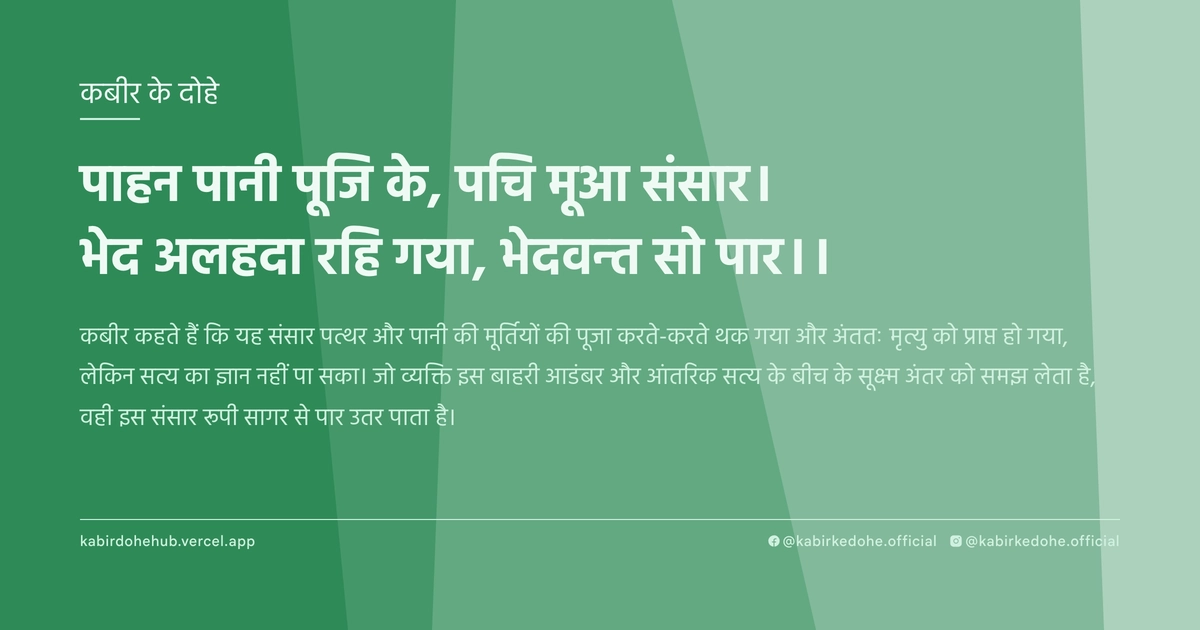
पाहन पानी पूजि के, पचि मूआ संसार।
भेद अलहदा रहि गया, भेदवन्त सो पार।।
Pahan paani pooji ke, pachi mooa sansaar. Bhed alhada rahi gaya, bhedvant so paar.
इस पृष्ठ पर इस कबीर दोहे का अर्थ (meaning), हिंदी व्याख्या और अंग्रेज़ी अनुवाद, दार्शनिक विश्लेषण और व्यावहारिक जीवन सीख दी गई है। यह दोहा मूर्ति पूजा विरोध (Condemnation of Idolatry) विषय से जुड़ा है — Kabir doha meaning and explanation in Hindi and English.
अर्थ (Meaning):
कबीर कहते हैं कि यह संसार पत्थर और पानी की मूर्तियों की पूजा करते-करते थक गया और अंततः मृत्यु को प्राप्त हो गया, लेकिन सत्य का ज्ञान नहीं पा सका। जो व्यक्ति इस बाहरी आडंबर और आंतरिक सत्य के बीच के सूक्ष्म अंतर को समझ लेता है, वही इस संसार रूपी सागर से पार उतर पाता है।
Kabir asserts that the world has exhausted itself in the worship of stone and water, meeting death without ever realizing the Truth. Only those who discern the fundamental difference between external ritualism and the internal realization of the Divine are able to cross the ocean of worldly existence.
व्याख्या (Interpretation):
शाब्दिक रूप से, यह दोहा मूर्ति पूजा और कर्मकांडों की व्यर्थता पर प्रहार करता है। रूपक के स्तर पर, 'पाहन' (पत्थर) जड़ता और अज्ञान का प्रतीक है, जबकि 'पानी' अस्थिरता और माया का। कबीर यहाँ निर्गुण भक्ति का समर्थन कर रहे हैं, जहाँ ईश्वर किसी आकार में नहीं बल्कि कण-कण में व्याप्त है। 'भेद' शब्द यहाँ दो अर्थों में है: पहला, वह भेद जो हमें ईश्वर से अलग करता है (द्वैत), और दूसरा, वह विवेक (discernment) जो सत्य और असत्य को अलग करता है। अद्वैत वेदांत के अनुसार, जब तक साधक स्वयं को शरीर या पत्थर की मूर्ति में सीमित मानता है, वह माया के जाल में फंसा रहता है। मुक्ति तब मिलती है जब वह यह जान ले कि पूजने वाला और पूजनीय एक ही चेतना के दो रूप हैं।
Literally, this couplet critiques the futility of idol worship and ritualistic piety. Metaphorically, 'stone' symbolizes spiritual inertia and ignorance, while 'water' represents the fluidity and instability of Maya. Kabir advocates for Nirgun Bhakti, where the Divine is formless and omnipresent rather than confined to an image. The term 'Bhed' (difference/secret) operates on two levels: the duality that separates the self from the Divine, and the spiritual discernment required to distinguish truth from illusion. According to Advaita Vedanta, as long as the seeker perceives the Divine as an external object or a physical statue, they remain trapped in Maya. Liberation occurs only when the seeker realizes that the worshiper and the worshiped are manifestations of the same singular Consciousness.
दार्शनिक विश्लेषण (Philosophical Analysis):
कबीर का यह दोहा उस युग की उपज है जब धर्म केवल बाहरी कर्मकांडों, जातिगत श्रेष्ठता और मंदिर-मस्जिद के विवादों में सिमट गया था। कबीर ने साहसपूर्वक यह तर्क दिया कि ईश्वर को किसी भौतिक वस्तु में कैद करना मानवीय अज्ञानता की पराकाष्ठा है। उनका दृष्टिकोण सूफी मत के 'वहदत-अल-वुजूद' (अस्तित्व की एकता) और वेदांत के 'अहं ब्रह्मास्मि' के करीब है, जहाँ बाहरी दुनिया केवल एक प्रतिबिंब है।
यहाँ ritualism का विरोध केवल सामाजिक नहीं, बल्कि मनोवैज्ञानिक है। जब मनुष्य किसी बाहरी वस्तु पर निर्भर होता है, तो वह अपनी आंतरिक शक्ति को त्याग देता है। यह निर्भरता अहंकार को बढ़ाती है क्योंकि व्यक्ति को लगता है कि वह 'विशेष' पूजा विधि के कारण मोक्ष पाएगा। कबीर इस 'धार्मिक अहंकार' को नष्ट करने की बात करते हैं।
निर्गुण भक्ति का दर्शन यह है कि परमात्मा 'अनाम' और 'निराकार' है। यदि आप पत्थर में ईश्वर खोज रहे हैं, तो आप सत्य को सीमित कर रहे हैं। यह सीमा ही दुख का कारण है। कबीर का 'भेद' वह आध्यात्मिक जागृति है जो व्यक्ति को यह बताती है कि सत्य बाहर नहीं, बल्कि भीतर है।
सूफीवाद के संदर्भ में, यह 'फना' होने की प्रक्रिया है—जहाँ व्यक्ति अपनी सीमित पहचान (ego) को मिटाकर उस अनंत सत्य में विलीन हो जाता है। पत्थर की पूजा करना एक मानसिक अवरोध है जो आत्मा को उसकी अपनी दिव्यता से मिलने से रोकता है।
अंततः, कबीर यह समझाते हैं कि मोक्ष किसी तीर्थ या मूर्ति के स्पर्श से नहीं, बल्कि चेतना के रूपांतरण से मिलता है। जब साधक यह जान लेता है कि पूरा ब्रह्मांड ही वह एक तत्व है, तब वह 'भेदवन्त' (विवेकशील) होकर संसार के बंधनों से मुक्त हो जाता है।
This couplet emerged from an era where religion had devolved into rigid rituals, caste hierarchies, and sectarian conflicts between temples and mosques. Kabir courageously argued that attempting to confine the Divine within a physical object is the pinnacle of human ignorance. His perspective aligns closely with the Sufi concept of 'Wahdat-al-Wujud' (Unity of Existence) and the Vedantic 'Aham Brahmasmi', where the external world is viewed as a mere reflection of a higher Truth.
The critique of ritualism here is not merely social, but profoundly psychological. When a human relies on an external object for salvation, they surrender their innate spiritual power. This dependency often fuels a subtle ego, where the practitioner believes they are superior due to their adherence to specific, complex rituals. Kabir seeks to annihilate this 'religious ego'.
The philosophy of Nirgun Bhakti posits that the Divine is 'Anam' (nameless) and 'Nirakar' (formless). To seek God in a stone is to limit the Infinite. This limitation is the root cause of suffering and spiritual stagnation. The 'Bhed' mentioned by Kabir is the spiritual awakening that reveals Truth as internal rather than external.
In the context of Sufism, this relates to the process of 'Fana'—the annihilation of the limited self to merge with the Absolute. Idolizing a physical form creates a mental barrier that prevents the soul from recognizing its own inherent divinity.
Ultimately, Kabir teaches that liberation is not achieved through the touch of a relic or a pilgrimage, but through a transformation of consciousness. Once the seeker realizes that the entire universe is composed of that one singular Essence, they become 'Bhedvant' (discerning) and transcend the bonds of worldly existence.
मूल संदेश (Core Message):
- बाहरी प्रतीकों को सत्य समझने की भूल न करें।
- ईश्वर किसी पत्थर में नहीं, बल्कि आपकी अपनी चेतना में है।
- कर्मकांड केवल माध्यम हैं, गंतव्य नहीं।
- अहंकार का त्याग ही वास्तविक ज्ञान का द्वार है।
- विवेक वह कुंजी है जो माया के बंधन तोड़ती है।
- सत्य को खोजने के लिए बाहर नहीं, भीतर मुड़ें।
- Do not mistake external symbols for the ultimate Truth.
- The Divine resides not in stone, but in your own consciousness.
- Rituals are merely vehicles, not the destination.
- The surrender of ego is the only gateway to real knowledge.
- Discernment is the key that breaks the chains of Maya.
- To find the Truth, turn inward rather than searching outward.
व्यावहारिक उदाहरण (Practical Example):
वाराणसी के एक पुराने घाट पर रामदीन नाम का एक वृद्ध नाविक रहता था। उसका पूरा जीवन गंगा की लहरों और पत्थर की सीढ़ियों के बीच बीता था। रामदीन बहुत धार्मिक था; वह हर सुबह घंटों मूर्तियों के सामने सिर झुकाता और महंगे चढ़ावे चढ़ाता, इस उम्मीद में कि उसकी गरीबी मिट जाएगी और उसे मोक्ष मिलेगा।
वह अक्सर अन्य नाविकों को उपदेश देता कि बिना कठोर अनुष्ठानों के ईश्वर नहीं मिलते। लेकिन उसके मन में एक गहरी बेचैनी थी। उसे लगता था कि उसकी प्रार्थनाएं पत्थर की दीवारों से टकराकर वापस आ रही हैं, लेकिन उसके जीवन की कड़वाहट कम नहीं हो रही थी।
एक दिन, उसकी नाव एक ऐसे साधु से टकराई जो बिना किसी माला या तिलक के, केवल मौन में लीन था। रामदीन ने उससे पूछा, 'महाराज, मैं जीवन भर इन पत्थरों की पूजा करता रहा, फिर भी शांति क्यों नहीं मिली?'
साधु ने मुस्कुराकर रामदीन को नाव के पानी में अपना हाथ डालने को कहा। जब रामदीन ने हाथ डाला, तो साधु ने पूछा, 'क्या यह पानी पत्थर है?' रामदीन ने कहा, 'नहीं, यह तो बहता हुआ जल है।'
साधु ने कहा, 'जैसे यह जल बह रहा है, वैसे ही ईश्वर भी तुम्हारे भीतर बह रहा है। तुम पत्थर को पूज रहे हो, लेकिन उस पत्थर को बनाने वाले और तुम्हें चलाने वाले उस प्राण तत्व को भूल गए हो। पत्थर केवल एक इशारा है, मंजिल नहीं।'
रामदीन को एक गहरा झटका लगा। उसे समझ आया कि वह अब तक केवल प्रतीकों की पूजा कर रहा था, जबकि प्रतीक जिस सत्य की ओर इशारा करते हैं, उसे उसने कभी देखा ही नहीं था।
उस दिन के बाद, रामदीन ने मूर्तियों को पूजना नहीं छोड़ा, लेकिन उसका नजरिया बदल गया। अब वह मंदिर जाता था, लेकिन वहां वह पत्थर को नहीं, बल्कि उस पत्थर के भीतर छिपी अपनी ही चेतना को खोजने लगा।
उसने देखा कि जब वह दूसरों की सेवा करता है, जब वह किसी डूबते हुए को बचाता है, तो उसे वही शांति मिलती है जो वह घंटों मूर्तियों के सामने ढूंढ रहा था।
उसका अहंकार कि वह 'सबसे बड़ा भक्त' है, टूट गया। वह अब एक विनम्र नाविक था जो जानता था कि ईश्वर घाट की सीढ़ियों में नहीं, बल्कि हर उस इंसान की सांसों में है जिसे वह अपनी नाव में बिठाता था।
रामदीन अब 'भेदवन्त' हो गया था। उसने जान लिया था कि बाहरी आडंबर केवल एक पर्दा है, और असली मंदिर तो हृदय के भीतर है।
On an ancient ghat in Varanasi lived an elderly boatman named Ramdeen. His entire life had been spent between the ripples of the Ganges and the stone steps of the city. Ramdeen was deeply religious; he spent hours every morning bowing before idols and offering expensive gifts, hoping his poverty would vanish and he would attain salvation.
He often lectured other boatmen that God could not be reached without rigorous rituals. Yet, a deep restlessness gnawed at him. He felt as though his prayers were bouncing off the stone walls, leaving the bitterness of his life untouched.
One day, his boat encountered a monk who wore no beads, bore no tilak, and sat in profound silence. Ramdeen asked him, 'Maharaj, I have worshipped these stones my whole life, yet why have I found no peace?'
The monk smiled and asked Ramdeen to dip his hand into the river water. When he did, the monk asked, 'Is this water a stone?' Ramdeen replied, 'No, it is flowing water.'
The monk said, 'Just as this water flows, the Divine flows within you. You worship the stone, but you have forgotten the Vital Breath that created the stone and sustains you. The stone is merely a signpost, not the destination.'
Ramdeen felt a profound shock. He realized he had been worshipping symbols, while completely ignoring the Truth that those symbols were meant to point toward.
After that day, Ramdeen did not stop visiting the temples, but his perspective shifted. He no longer looked at the stone; he looked for the consciousness within the stone and within himself.
He discovered that when he served others, or saved a drowning stranger, he felt the same peace he had spent hours searching for in front of an idol.
His ego—the belief that he was the 'greatest devotee'—crumbled. He became a humble boatman who recognized that God was not in the steps of the ghat, but in the breath of every human being he carried in his boat.
Ramdeen had become 'Bhedvant'. He understood that external pomp was merely a veil, and the true temple resided within the heart.
अभ्यास मार्गदर्शन (Practice Guidance):
- प्रतिदिन 20 मिनट मौन ध्यान करें, जहाँ आप किसी भी बाहरी छवि या विचार के बजाय केवल अपनी सांसों और आंतरिक उपस्थिति पर ध्यान केंद्रित करें।
- एक 'जागरूकता पत्रिका' (Journal) लिखें: दिन भर में उन क्षणों को नोट करें जब आपने किसी बाहरी मान्यता या परंपरा को बिना सोचे-समझे अपनाया, और विश्लेषण करें कि क्या वह वास्तव में आपके आंतरिक सत्य से मेल खाता था।
- व्यवहार परिवर्तन: किसी भी धार्मिक अनुष्ठान को करने से पहले स्वयं से पूछें, 'क्या मैं यह डर या अहंकार के कारण कर रहा हूँ, या प्रेम और समर्पण के कारण?'
- निदान चेकलिस्ट (Diagnostic Checklist): यदि आप अभी भी यह महसूस करते हैं कि आपकी आध्यात्मिक प्रगति किसी बाहरी वस्तु, व्यक्ति या स्थान पर निर्भर है, तो आप अभी भी 'पाहन' (जड़ता) के प्रभाव में हैं। यदि आप हर जीव में उसी एक तत्व को देखते हैं, तो आप 'भेदवन्त' होने की राह पर हैं।
- Practice 20 minutes of silent meditation daily, focusing not on external images or concepts, but solely on your breath and internal presence.
- Maintain an 'Awareness Journal': Note moments during the day when you followed a tradition or belief blindly, and analyze whether it aligned with your internal truth.
- Behavioral Shift: Before performing any ritual, ask yourself, 'Am I doing this out of fear or ego, or out of genuine love and surrender?'
- Diagnostic Checklist: If you still feel that your spiritual progress depends on an external object, person, or place, you are still under the influence of 'Pahan' (inertia). If you perceive the same singular Essence in every living being, you are on the path to becoming 'Bhedvant'.
चिंतन प्रश्न (Reflection Questions):
- मेरे जीवन में वे कौन से 'पत्थर' (मान्यताएं या आदतें) हैं जिन्हें मैं सत्य मानकर पकड़े हुए हूँ?
- क्या मेरी धार्मिकता दूसरों को नीचा दिखाने या स्वयं को श्रेष्ठ सिद्ध करने का एक साधन बन गई है?
- यदि मुझसे मेरे सभी बाहरी धार्मिक प्रतीक छीन लिए जाएं, तो क्या मेरे भीतर कोई ईश्वर बचेगा?
- मैं अपनी पहचान को अपनी जाति, धर्म या पद से कितना जोड़ता हूँ, और यह जुड़ाव मुझे सत्य से कैसे दूर करता है?
- क्या मैं वास्तव में सत्य की खोज कर रहा हूँ, या मैं केवल अपनी मान्यताओं की पुष्टि (confirmation bias) चाहता हूँ?
- What are the 'stones' (beliefs or habits) in my life that I am clinging to, mistaking them for the Truth?
- Has my religiosity become a tool to belittle others or to prove my own superiority?
- If all my external religious symbols were stripped away, would any sense of the Divine remain within me?
- How tightly is my identity bound to my caste, religion, or status, and how does this attachment distance me from the Truth?
- Am I truly seeking the Truth, or am I merely seeking confirmation of my existing biases?