
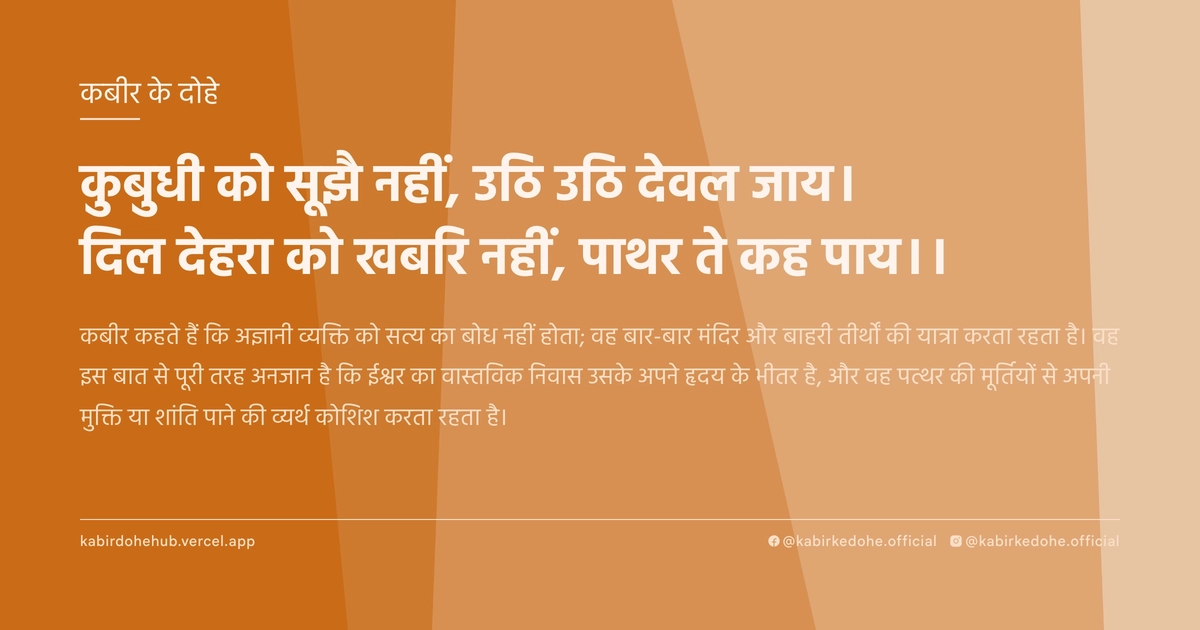
कुबुधी को सूझै नहीं, उठि उठि देवल जाय।
दिल देहरा को खबरि नहीं, पाथर ते कह पाय।।
Kubudhi ko sujhai nahi, uthi uthi deval jaaye. Dil dehra ko khabari nahi, paathar te kah paaye.
इस पृष्ठ पर इस कबीर दोहे का अर्थ (meaning), हिंदी व्याख्या और अंग्रेज़ी अनुवाद, दार्शनिक विश्लेषण और व्यावहारिक जीवन सीख दी गई है। यह दोहा मूर्ति पूजा विरोध (Condemnation of Idolatry) विषय से जुड़ा है — Kabir doha meaning and explanation in Hindi and English.
अर्थ (Meaning):
कबीर कहते हैं कि अज्ञानी व्यक्ति को सत्य का बोध नहीं होता; वह बार-बार मंदिर और बाहरी तीर्थों की यात्रा करता रहता है। वह इस बात से पूरी तरह अनजान है कि ईश्वर का वास्तविक निवास उसके अपने हृदय के भीतर है, और वह पत्थर की मूर्तियों से अपनी मुक्ति या शांति पाने की व्यर्थ कोशिश करता रहता है।
Kabir asserts that the spiritually ignorant fail to perceive the truth; they tirelessly visit temples and external shrines in search of the divine. They remain oblivious to the fact that the true sanctuary is within their own heart, mistakenly believing that a stone idol can provide the liberation or spiritual solace they seek.
व्याख्या (Interpretation):
इस दोहे का शाब्दिक अर्थ बाहरी पूजा की निरर्थकता को दर्शाता है। यहाँ 'कुबुधी' वह है जिसकी बुद्धि माया के प्रभाव में भ्रमित है। कबीर 'देवल' (मंदिर) और 'पाथर' (पत्थर) के माध्यम से यह समझाते हैं कि परमात्मा निर्गुण है, जिसका कोई भौतिक आकार नहीं होता। जब साधक अपने भीतर के 'दिल देहरा' (हृदय रूपी मंदिर) को अनदेखा करता है, तो वह केवल एक भौतिक वस्तु से संवाद करता है। यह द्वैतवाद की पराकाष्ठा है जहाँ मनुष्य स्वयं को ईश्वर से अलग मानकर बाहर खोजता है, जबकि अद्वैत वेदांत के अनुसार आत्मा और परमात्मा एक ही हैं।
The literal meaning highlights the futility of external ritualism. 'Kubudhi' refers to the one whose intellect is clouded by Maya (illusion). Through the contrast between 'Deval' (temple) and 'Paathar' (stone), Kabir explains that the Divine is Nirgun (formless) and cannot be confined to a physical shape. When a seeker ignores the 'Dil Dehra' (the temple of the heart), they are merely communicating with a material object. This represents the peak of duality, where man perceives himself as separate from God, whereas Advaita Vedanta posits that Atman and Brahman are non-dual and identical.
दार्शनिक विश्लेषण (Philosophical Analysis):
कबीर का यह प्रहार उस युग की सामाजिक और धार्मिक जड़ता पर है जहाँ धर्म केवल कर्मकांडों और बाहरी दिखावे तक सीमित हो गया था। वे स्पष्ट रूप से मूर्तिपूजा और तीर्थाटन का विरोध करते हैं, क्योंकि उनका मानना है कि ये क्रियाएँ अहंकार को बढ़ाती हैं न कि उसे मिटाती हैं। उनके अनुसार, मंदिर जाना एक मनोवैज्ञानिक पलायन है, जहाँ व्यक्ति अपनी आंतरिक रिक्तता को बाहरी आडंबरों से भरने की कोशिश करता है।
दार्शनिक स्तर पर, यह सूफी मत के 'अनल हक़' (मैं सत्य हूँ) और वेदांत के 'अहम् ब्रह्मास्मि' के करीब है। कबीर का तर्क है कि यदि ईश्वर सर्वव्यापी है, तो वह सबसे पहले स्वयं साधक के भीतर होना चाहिए। बाहरी खोज वास्तव में एक भ्रम है जो साधक को उसके वास्तविक केंद्र से दूर ले जाती है।
यहाँ 'पत्थर' केवल मूर्ति का प्रतीक नहीं है, बल्कि उस जड़ता का प्रतीक है जिसमें मनुष्य अपनी चेतना को कैद कर लेता है। जब तक व्यक्ति अपनी आंतरिक चेतना (Inner Consciousness) को जागृत नहीं करता, वह केवल मृत पदार्थों से प्रार्थना करता रहेगा।
कबीर का दृष्टिकोण मनोवैज्ञानिक रूपांतरण पर केंद्रित है। वे चाहते हैं कि साधक 'बाहर' से 'भीतर' की यात्रा करे। यह विस्थापन ही अहंकार का विनाश है, क्योंकि जब व्यक्ति यह अनुभव करता है कि वह स्वयं वह सत्य है जिसे वह खोज रहा था, तो 'खोजने वाला' और 'खोजे जाने वाला' का भेद समाप्त हो जाता है।
अंततः, यह दोहा हमें सिखाता है कि सच्ची भक्ति किसी स्थान या वस्तु की मोहताज नहीं है। यह एक आंतरिक अनुभूति है। जो व्यक्ति अपने हृदय की पवित्रता और मौन को पहचान लेता है, उसे किसी पत्थर के सामने झुकने की आवश्यकता नहीं रहती, क्योंकि वह स्वयं जीवित मंदिर बन जाता है।
Kabir's critique targets the social and religious inertia of his era, where spirituality had devolved into mere ritualism and outward display. He explicitly rejects idol worship and pilgrimages, arguing that these practices inflate the ego rather than annihilating it. To Kabir, visiting a temple is often a psychological escape, an attempt to fill an internal void with external pageantry.
Philosophically, this aligns with the Sufi concept of 'Ana al-Haqq' (I am the Truth) and the Vedantic 'Aham Brahmasmi' (I am Brahman). Kabir argues that if the Divine is omnipresent, it must first reside within the seeker. The external search is a delusion that distracts the seeker from their own center.
In this context, the 'stone' is not merely a statue but a symbol of the spiritual stagnation in which humans imprison their consciousness. Until one awakens their inner awareness, they are merely praying to inanimate matter.
Kabir's approach focuses on psychological transformation. He urges the seeker to shift their gaze from the 'outer' to the 'inner'. This shift is the essence of ego-death; when the seeker realizes they are the very Truth they sought, the distinction between the seeker and the sought vanishes.
Ultimately, this Doha teaches that true devotion is not dependent on any location or object. It is an internal realization. One who recognizes the purity and silence of their own heart no longer needs to bow before a stone, for they have become a living temple themselves.
मूल संदेश (Core Message):
- बाहरी कर्मकांड केवल मन का भ्रम हैं, सत्य भीतर है।
- पत्थर की मूर्तियों में नहीं, अपनी चेतना में ईश्वर को खोजें।
- अहंकार हमें बाहरी खोज की ओर धकेलता है, समर्पण भीतर ले जाता है।
- प्रेम और करुणा ही वास्तविक पूजा और सबसे बड़ा मंदिर हैं।
- जब 'मैं' मिटता है, तब हृदय का मंदिर प्रकट होता है।
- External rituals are but delusions of the mind; Truth resides within.
- Seek the Divine not in stone idols, but in your own consciousness.
- Ego drives us toward external searches; surrender leads us inward.
- Love and compassion are the only true worship and the greatest temple.
- When the 'I' vanishes, the temple of the heart reveals itself.
व्यावहारिक उदाहरण (Practical Example):
वाराणसी के एक पुराने घाट पर रहने वाले माधव नाम के एक वृद्ध बुनकर थे। माधव का पूरा जीवन धर्म के नाम पर बीता था। वे हर सुबह सूर्योदय से पहले उठते, गंगा में डुबकी लगाते और शहर के सबसे बड़े मंदिर में घंटों माथा टेकते। उनका मानना था कि जितना अधिक वे मंदिर जाएंगे और जितनी महंगी पूजा करेंगे, उनके जीवन के दुख उतने ही कम होंगे।
माधव के घर में उनकी एक छोटी पोती थी, जो बहुत बीमार रहती थी। माधव ने अपनी सारी जमापूंजी बड़े-बड़े पंडितों को दान कर दी और दुर्लभ पत्थरों की मूर्तियों के सामने मन्नतें मांगीं, लेकिन उनकी पोती की हालत में कोई सुधार नहीं हुआ। वे निराश होकर मंदिर की सीढ़ियों पर बैठ गए, यह सोचते हुए कि ईश्वर उनकी पुकार क्यों नहीं सुन रहा है।
एक दिन, घाट पर एक फकीर आया जिसने माधव की व्यथा सुनी। फकीर ने माधव से कहा, 'तुम उस पत्थर से क्या मांग रहे हो जिसे तुमने खुद वहां रखा है? क्या तुमने कभी उस बच्चे की आंखों में देखा है जिसे तुम बचाने की कोशिश कर रहे हो?'
माधव को पहले यह बात अजीब लगी, लेकिन उस रात उन्होंने पहली बार मंदिर जाने के बजाय अपनी पोती के पास बैठकर उसकी सांसों को महसूस किया। उन्होंने महसूस किया कि जिस करुणा और प्रेम की तलाश वे मंदिर में कर रहे थे, वह वास्तव में उनकी पोती के प्रति उनके निस्वार्थ प्रेम में मौजूद था।
उन्होंने महसूस किया कि वे ईश्वर को एक इमारत में खोज रहे थे, जबकि ईश्वर उस सेवा और प्रेम में था जो वे अपनी पोती को दे सकते थे। माधव ने बाहरी अनुष्ठानों को छोड़कर अपनी पोती की देखभाल और सेवा में अपना पूरा समय लगाना शुरू किया।
उन्होंने अपनी बची हुई जमापूंजी से एक योग्य वैद्य को बुलाया और उसकी सेवा में लग गए। जैसे-जैसे माधव का ध्यान बाहरी दिखावे से हटकर आंतरिक करुणा और वास्तविक सेवा की ओर बढ़ा, उनके मन की अशांति समाप्त होने लगी।
धीरे-धीरे उनकी पोती की सेहत में सुधार होने लगा। माधव ने पाया कि जब वे मंदिर की भीड़ में खोए रहते थे, तो वे वास्तव में अकेले थे, लेकिन जब उन्होंने अपने भीतर के प्रेम को पहचाना, तो वे पूरे ब्रह्मांड से जुड़ गए।
अब माधव मंदिर तो जाते थे, लेकिन अब वे पत्थर से कुछ मांगते नहीं थे। वे बस वहां जाकर उस शांति का अनुभव करते थे जो उन्होंने अपने भीतर पा ली थी। उन्होंने जान लिया था कि हृदय ही असली मंदिर है और प्रेम ही असली पूजा है।
माधव का जीवन अब एक प्रदर्शन नहीं, बल्कि एक प्रार्थना बन गया था। उन्होंने अपने मोहल्ले के अन्य लोगों को भी सिखाया कि ईश्वर को ढूंढने के लिए कहीं जाने की जरूरत नहीं, बस अपने भीतर की मानवता को जगाने की जरूरत है।
इस प्रकार, एक पत्थर की मूर्ति के प्रति अंधविश्वास से मुक्त होकर, माधव ने अपने भीतर के 'दिल देहरा' को खोज लिया और वास्तविक शांति प्राप्त की।
In the ancient ghats of Varanasi lived an elderly weaver named Madhav. Madhav's entire life was consumed by religious observance. He would wake before dawn, bathe in the Ganges, and spend hours bowing before the city's largest temple. He believed that the more he visited temples and performed expensive rituals, the more his life's sorrows would diminish.
Madhav had a young granddaughter who was chronically ill. He spent all his savings donating to high priests and making vows before rare stone idols, yet his granddaughter's condition did not improve. He sat on the temple steps in despair, wondering why God was not answering his pleas.
One day, a wandering dervish arrived at the ghat and heard Madhav's grief. The dervish asked, 'What are you asking from that stone which you yourself have placed there? Have you ever looked into the eyes of the child you are trying to save?'
Madhav found this strange at first, but that night, instead of going to the temple, he sat by his granddaughter and felt her breath. He realized that the compassion and love he was searching for in the temple existed within his own selfless love for her.
He understood that he had been searching for God in a building, while God resided in the service and love he could offer his child. Madhav stopped the external rituals and dedicated his entire time to the care and service of his granddaughter.
Using his remaining savings, he summoned a skilled physician and focused entirely on the healing process. As Madhav's attention shifted from external display to internal compassion and genuine service, the turmoil in his mind began to fade.
Gradually, his granddaughter's health improved. Madhav discovered that when he was lost in the temple crowds, he was actually alone, but when he recognized the love within, he felt connected to the entire universe.
Now, Madhav still visited the temple, but he no longer asked the stone for anything. He went there simply to experience the peace he had found within himself. He had learned that the heart is the true temple and love is the true worship.
Madhav's life ceased to be a performance and became a prayer. He taught others in his neighborhood that there is no need to travel far to find God; one only needs to awaken the humanity within.
Thus, liberating himself from the blind faith in a stone idol, Madhav discovered the 'Dil Dehra' within and attained genuine peace.
अभ्यास मार्गदर्शन (Practice Guidance):
- दैनिक मौन अभ्यास: प्रतिदिन 20 मिनट पूर्ण मौन में बैठें। बाहरी शोर को शांत करें और अपना ध्यान अपनी सांसों और हृदय की धड़कन पर केंद्रित करें, यह महसूस करते हुए कि परमात्मा इसी क्षण आपके भीतर है।
- आत्म-पूछताछ जर्नल: हर रात लिखें कि आज आपने कितनी बार बाहरी प्रशंसा या बाहरी समाधानों की तलाश की, और कितनी बार आपने अपनी अंतरात्मा की आवाज सुनी।
- सेवा का संकल्प: सप्ताह में एक बार किसी ऐसे व्यक्ति की निस्वार्थ सेवा करें जिससे आपका कोई संबंध न हो। यह अभ्यास आपको यह समझने में मदद करेगा कि ईश्वर किसी मंदिर में नहीं, बल्कि पीड़ित मानवता की सेवा में है।
- निदान चेकलिस्ट: यदि आप अभी भी यह महसूस करते हैं कि आपकी शांति किसी बाहरी स्थान, व्यक्ति या वस्तु पर निर्भर है, तो आप अभी भी 'कुबुधी' की स्थिति में हैं। यदि आप अकेलेपन में भी पूर्णता महसूस करते हैं, तो आप अपने आंतरिक मंदिर में प्रवेश कर रहे हैं।
- Daily Silence Practice: Sit in complete silence for 20 minutes daily. Quiet the external noise and focus your attention on your breath and heartbeat, realizing that the Divine is within you in this very moment.
- Self-Inquiry Journaling: Every night, record how many times you sought external validation or solutions, and how many times you listened to the voice of your inner conscience.
- Vow of Service: Once a week, perform selfless service for someone with whom you have no connection. This practice helps you realize that God is not in a temple, but in the service of suffering humanity.
- Diagnostic Checklist: If you still feel that your peace depends on an external place, person, or object, you are still in the state of 'Kubudhi'. If you feel wholeness even in solitude, you are entering your inner temple.
चिंतन प्रश्न (Reflection Questions):
- मैं किन बाहरी प्रतीकों या आदतों के पीछे अपनी आध्यात्मिक शांति को छिपा रहा हूँ?
- क्या मेरी धार्मिकता वास्तव में ईश्वर के प्रति है, या यह केवल मेरी सामाजिक छवि को बनाए रखने का एक तरीका है?
- यदि दुनिया के सभी मंदिर और प्रार्थना स्थल समाप्त हो जाएं, तो क्या मेरे पास ईश्वर से जुड़ने का कोई रास्ता बचेगा?
- मेरे जीवन का वह कौन सा 'पत्थर' (जड़ विचार) है जिसे मैं सत्य मानकर उससे चिपका हुआ हूँ?
- क्या मैं अपनी आंतरिक रिक्तता को भरने के लिए बाहरी शोर का सहारा ले रहा हूँ?
- Behind which external symbols or habits am I hiding my spiritual peace?
- Is my religiosity truly directed toward the Divine, or is it merely a way to maintain my social image?
- If all the temples and places of worship in the world vanished, would I have any way left to connect with God?
- What is that 'stone' (rigid belief) in my life that I am clinging to, mistaking it for the Truth?
- Am I using external noise to mask and fill my internal void?