
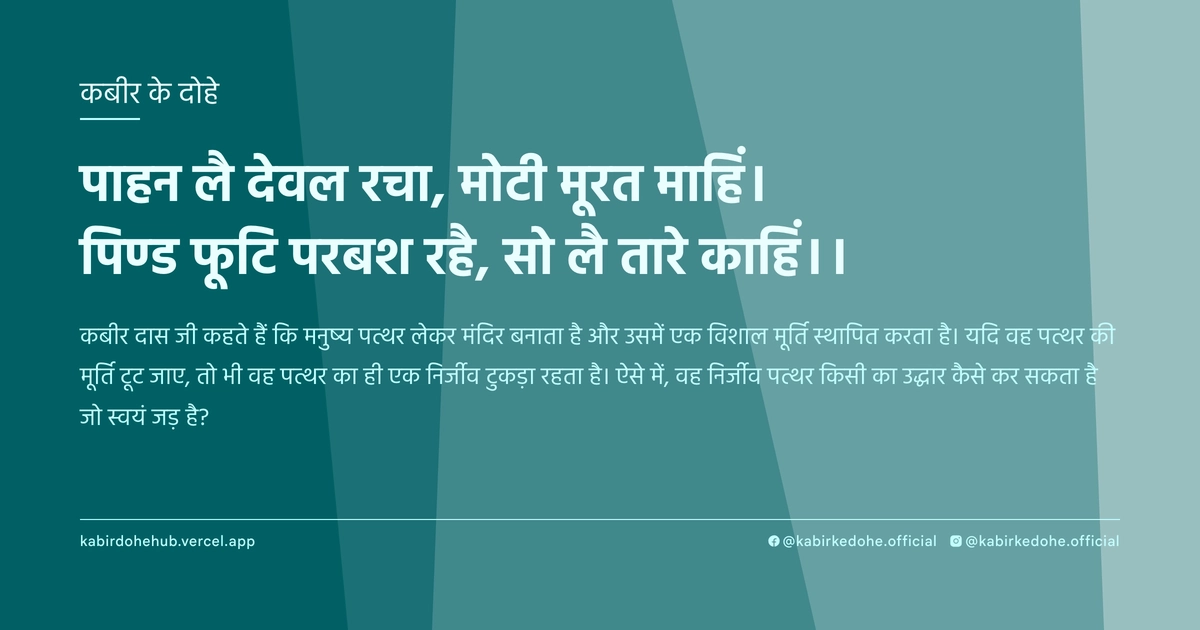
पाहन लै देवल रचा, मोटी मूरत माहिं।
पिण्ड फूटि परबश रहै, सो लै तारे काहिं।।
Pahan lai deval racha, moti murat mahin. Pind phooti parbash rahai, so lai tare kahin.
इस पृष्ठ पर इस कबीर दोहे का अर्थ (meaning), हिंदी व्याख्या और अंग्रेज़ी अनुवाद, दार्शनिक विश्लेषण और व्यावहारिक जीवन सीख दी गई है। यह दोहा मूर्ति पूजा विरोध (Condemnation of Idolatry) विषय से जुड़ा है — Kabir doha meaning and explanation in Hindi and English.
अर्थ (Meaning):
कबीर दास जी कहते हैं कि मनुष्य पत्थर लेकर मंदिर बनाता है और उसमें एक विशाल मूर्ति स्थापित करता है। यदि वह पत्थर की मूर्ति टूट जाए, तो भी वह पत्थर का ही एक निर्जीव टुकड़ा रहता है। ऐसे में, वह निर्जीव पत्थर किसी का उद्धार कैसे कर सकता है जो स्वयं जड़ है?
Kabir questions the futility of idol worship, noting that humans carve temples and install massive stone idols. He argues that if the stone idol breaks, it remains merely a piece of lifeless rock. Therefore, he asks how a lifeless, inert object can possibly lead a sentient soul toward spiritual liberation.
व्याख्या (Interpretation):
इस दोहे का शाब्दिक अर्थ मूर्ति पूजा की निरर्थकता को दर्शाता है, लेकिन इसका गहरा आध्यात्मिक अर्थ 'माया' और 'अज्ञान' के बंधनों को तोड़ना है। कबीर यहाँ 'पत्थर' को उस जड़ता का प्रतीक मानते हैं जो मनुष्य के भीतर अहंकार और बाहरी कर्मकांडों के रूप में जमी हुई है। निर्गुण भक्ति के अनुसार, ईश्वर किसी आकार या मूर्ति में सीमित नहीं है, बल्कि वह सर्वव्यापी और निराकार है। जब मनुष्य बाहरी प्रतीकों में ईश्वर को खोजता है, तो वह वास्तव में अपनी आत्मा (Atman) और परमात्मा (Brahman) के बीच की दूरी को बढ़ाता है। यह विरोधाभास है कि मनुष्य उस पत्थर की पूजा करता है जिसे उसने स्वयं बनाया है, जबकि वह जीवित ईश्वर को अपने भीतर खोजने में असमर्थ है। यह दोहा हमें यह समझने के लिए प्रेरित करता है कि मुक्ति बाहरी वस्तुओं से नहीं, बल्कि आंतरिक जागरण से आती है।
While the literal meaning critiques idolatry, the deeper metaphorical layer addresses the shackles of 'Maya' (illusion) and ignorance. Kabir uses 'stone' as a symbol for the spiritual inertia and ego that harden within a human, often reinforced by external rituals. In the tradition of Nirgun Bhakti, the Divine is not confined to a form or image but is omnipresent and formless. By seeking God in external symbols, the seeker inadvertently widens the gap between the Atman (individual soul) and Brahman (universal consciousness). The central paradox lies in the human tendency to worship a creation of their own hands while remaining blind to the living Divinity within. This verse urges a transition from the 'Sagun' (with attributes) to the 'Nirgun' (without attributes), emphasizing that liberation is an internal awakening rather than an external acquisition.
दार्शनिक विश्लेषण (Philosophical Analysis):
कबीर का यह दृष्टिकोण उनके समय के सामाजिक और धार्मिक परिवेश की एक तीखी प्रतिक्रिया था, जहाँ धर्म केवल बाहरी आडंबरों, जातिगत भेदभाव और कठोर कर्मकांडों तक सीमित हो गया था। वे इस विचार को चुनौती देते हैं कि ईश्वर किसी विशेष स्थान या वस्तु में निवास करता है। उनका दर्शन अद्वैत वेदांत के करीब है, जो यह मानता है कि आत्मा और परमात्मा एक ही हैं; इसलिए, किसी बाहरी माध्यम की आवश्यकता नहीं है।
सूफीवाद के प्रभाव में, कबीर 'इश्क-ए-हकीकी' (ईश्वर के प्रति सच्चा प्रेम) की बात करते हैं, जो किसी मंदिर या मस्जिद की दीवारों में कैद नहीं हो सकता। उनके लिए, सच्ची भक्ति वह है जो अहंकार का विसर्जन करे। जब तक मनुष्य 'मैं' और 'मेरा' के भाव में रहता है, वह पत्थर की तरह जड़ बना रहता है।
यहाँ 'पत्थर' केवल मूर्ति का प्रतीक नहीं है, बल्कि उस मानसिक जड़ता का भी है जो हमें सत्य को देखने से रोकती है। कबीर का तर्क है कि यदि हम एक निर्जीव वस्तु से मुक्ति की उम्मीद करते हैं, तो हम अपनी चेतना का अपमान कर रहे हैं। वे मनुष्य को 'जीवंत' होने का आह्वान करते हैं, न कि परंपराओं का अंधानुकरण करने का।
यह विश्लेषण स्पष्ट करता है कि कबीर का विरोध मूर्तियों से नहीं, बल्कि उस 'मोह' से था जो मनुष्य को सत्य के मार्ग से भटकाता है। वे चाहते थे कि मनुष्य अपनी अंतरात्मा की गहराई में उतरकर उस निराकार तत्व का अनुभव करे जो हर कण में व्याप्त है।
अंततः, यह दोहा मनोवैज्ञानिक रूपांतरण की बात करता है। यह हमें सिखाता है कि जब तक हम बाहरी सहारे खोजते रहेंगे, हम अपनी आंतरिक शक्ति को कभी नहीं पहचान पाएंगे। मुक्ति का मार्ग बाहरी पूजा से नहीं, बल्कि आंतरिक शुद्धिकरण और अहंकार के विनाश से होकर गुजरता है।
Kabir's perspective was a visceral reaction to the socio-religious climate of his era, where spirituality had devolved into superficial rituals, caste hierarchies, and rigid dogmas. He challenged the notion that the Divine is localized within a specific object or sanctuary. His philosophy aligns closely with Advaita Vedanta, asserting the fundamental non-duality of the Atman and Brahman, rendering external intermediaries obsolete.
Influenced by Sufism, Kabir emphasized 'Ishq-e-Haqiqi' (Divine Love), which cannot be confined within the walls of a temple or mosque. For him, authentic devotion requires the annihilation of the ego. As long as a human clings to the notions of 'I' and 'Mine,' they remain as inert and unresponsive as the stone they worship.
In this context, 'stone' is not merely a physical idol but a metaphor for the mental rigidity and spiritual blindness that obscure the truth. Kabir argues that expecting liberation from a lifeless object is a denial of one's own conscious potential. He calls for a shift from blind adherence to tradition toward a living, breathing spirituality.
It is crucial to understand that Kabir's critique was not directed at the stone itself, but at the 'attachment' (Moha) that leads humans away from the Truth. He urged seekers to dive deep into their own consciousness to experience the formless element that permeates every atom of existence.
Ultimately, this verse advocates for a psychological transformation. It teaches that as long as we rely on external crutches, we will never discover our inherent strength. Liberation is not achieved through the act of worshiping a form, but through the process of internal purification and the dissolution of the false self.
मूल संदेश (Core Message):
- बाहरी प्रतीकों का मोह आध्यात्मिक प्रगति में सबसे बड़ी बाधा है।
- सच्ची पूजा पत्थर को चमकाना नहीं, बल्कि हृदय की जड़ता को मिटाना है।
- ईश्वर किसी आकार में नहीं, बल्कि हर जीवित प्राणी की करुणा में है।
- अहंकार का विसर्जन ही वास्तविक मोक्ष का एकमात्र द्वार है।
- निराकार सत्य को खोजने के लिए पहले साकार भ्रम का त्याग करना होगा।
- Attachment to external symbols is the greatest hurdle to spiritual growth.
- True worship is not polishing stone, but dissolving the inertia of the heart.
- The Divine resides not in a form, but in the compassion of every living being.
- The dissolution of the ego is the only gateway to genuine liberation.
- To find the Formless Truth, one must first renounce the illusion of form.
व्यावहारिक उदाहरण (Practical Example):
एक समय की बात है, वाराणसी के घाटों पर रहने वाला एक वृद्ध विधवा, जिसे सब 'काकी' कहते थे, अपना पूरा दिन मंदिर की सीढ़ियों पर बैठकर पत्थर की मूर्तियों की सफाई करने और उनकी पूजा करने में बिताती थी। वह मानती थी कि यदि वह मूर्तियों को जितना अधिक चमकाएगी, उसके पाप उतने ही कम होंगे और उसे मोक्ष मिलेगा। वह अपनी पूरी जमापूंजी मूर्तियों के श्रृंगार पर खर्च कर देती थी, जबकि उसके पड़ोस में एक अनाथ बच्चा भूख से तड़पता रहता था।
एक दिन, एक घुमक्कड़ संत वहां आए और उन्होंने देखा कि काकी एक टूटी हुई मूर्ति के टुकड़े को पकड़कर रो रही थी क्योंकि वह मूर्ति खंडित हो गई थी। संत ने मुस्कुराते हुए पूछा, 'काकी, यदि यह पत्थर टूट गया, तो क्या इसके भीतर का ईश्वर भी टूट गया?' काकी निरुत्तर थी।
संत ने आगे कहा, 'तुम इस पत्थर को चमकाने में जीवन बिता रही हो, लेकिन क्या तुमने कभी अपने भीतर के उस पत्थर को देखा है जो दया और करुणा को रोककर बैठा है? यह पत्थर तो जड़ है, यह तुम्हें पार नहीं लगाएगा। लेकिन वह बच्चा, जो भूख से रो रहा है, वह जीवित ईश्वर है।'
काकी को पहली बार अपनी गलती का अहसास हुआ। उसे समझ आया कि वह केवल एक पत्थर की सेवा कर रही थी, जबकि वास्तविक सेवा उस जीवित आत्मा की थी जो उसके सामने थी।
उस दिन के बाद, काकी ने मूर्तियों की अत्यधिक पूजा छोड़ दी। उसने अपनी छोटी सी कुटिया को एक साझा रसोई में बदल दिया जहाँ वह गरीब बच्चों को भोजन खिलाने लगी।
उसने महसूस किया कि जब वह किसी भूखे को रोटी खिलाती थी, तो उसे वही शांति और आनंद मिलता था जो वह वर्षों तक मंदिर में ढूंढ रही थी।
उसका अहंकार, जो इस बात पर टिका था कि वह 'सबसे बड़ी भक्त' है, धीरे-धीरे मिट गया। वह अब किसी मूर्ति की नहीं, बल्कि मानवता की सेवा करने लगी।
काकी का जीवन अब बाहरी दिखावे से मुक्त होकर आंतरिक संतोष से भर गया था। उसने जान लिया था कि पत्थर कभी तार नहीं सकता, केवल प्रेम और करुणा ही आत्मा को मुक्त कर सकते हैं।
यह 'कबीर ट्विस्ट' था—एक बाहरी पत्थर का टूटना, जिससे भीतर की चेतना जाग गई। काकी अब केवल एक भक्त नहीं, बल्कि एक जागृत आत्मा बन चुकी थी।
उसका मोक्ष अब किसी मृत्यु के बाद मिलने वाला वादा नहीं था, बल्कि हर उस मुस्कान में था जो उसने किसी और के चेहरे पर लाई थी।
Once, on the ghats of Varanasi, lived an elderly widow known as 'Kaki.' She spent her entire existence scrubbing the stone idols of the temple and decorating them with expensive silks. She believed that the more she polished the statues, the more her sins would vanish and the closer she would get to salvation. She spent her meager savings on ornaments for the idols, while an orphaned child in her neighborhood suffered from chronic hunger.
One day, a wandering mystic arrived and observed Kaki weeping over a chipped piece of a stone idol that had accidentally broken. The mystic smiled and asked, 'Kaki, if this stone has broken, has the God within it also broken?' Kaki was speechless.
The mystic continued, 'You spend your life polishing this stone, but have you ever looked at the stone within yourself—the one that blocks compassion and kindness? This stone is inert; it cannot ferry you across the ocean of existence. But that child, crying from hunger, is the living God.'
For the first time, Kaki realized the futility of her actions. She understood that she had been serving a lifeless object while ignoring the living soul right in front of her.
From that day forward, Kaki ceased her obsessive ritualism. She converted her small hut into a community kitchen where she fed the neighborhood's impoverished children.
She discovered that the peace and bliss she had sought for decades in the temple were found in the simple act of feeding a hungry child.
Her ego, which was built on the pride of being the 'most devoted worshiper,' slowly dissolved. She no longer served a statue; she served humanity.
Kaki's life shifted from external performance to internal contentment. She realized that stone cannot liberate; only love and compassion can set the soul free.
This was the 'Kabir Twist'—the breaking of an external idol led to the awakening of her internal consciousness. Kaki was no longer just a devotee; she became an awakened soul.
Her salvation was no longer a promise for the afterlife, but a reality found in every smile she brought to another's face.
अभ्यास मार्गदर्शन (Practice Guidance):
- प्रतिदिन 15 मिनट मौन बैठें और यह विचार करें कि क्या आप अपनी खुशी के लिए बाहरी वस्तुओं या व्यक्तियों पर निर्भर हैं।
- एक 'अहंकार पत्रिका' (Ego Journal) बनाएँ, जिसमें उन क्षणों को लिखें जब आपने अपनी धार्मिक या नैतिक श्रेष्ठता का प्रदर्शन किया।
- व्यवहार परिवर्तन: सप्ताह में एक बार किसी ऐसे व्यक्ति की निस्वार्थ मदद करें जिससे आपका कोई व्यक्तिगत संबंध न हो, बिना किसी फल की इच्छा के।
- नैदानिक चेकलिस्ट: क्या मैं किसी परंपरा का पालन इसलिए कर रहा हूँ क्योंकि वह सही है, या इसलिए क्योंकि मुझे डर है कि लोग क्या कहेंगे? क्या मेरी भक्ति मुझे दूसरों के प्रति अधिक दयालु बना रही है या अधिक निर्णयशील?
- Spend 15 minutes in daily silence, contemplating whether your happiness is dependent on external objects or the validation of others.
- Maintain an 'Ego Journal' to record moments where you felt spiritually or morally superior to others.
- Behavioral Shift: Once a week, perform a selfless act of service for a stranger with zero expectation of reward or recognition.
- Diagnostic Checklist: Am I following this ritual because it aligns with Truth, or because of social fear? Does my spirituality make me more compassionate or more judgmental of others?
चिंतन प्रश्न (Reflection Questions):
- मेरे जीवन में वे कौन से 'पत्थर' (मान्यताएं/आदतें) हैं जिन्हें मैं सत्य मानकर पकड़े हुए हूँ?
- क्या मेरी धार्मिक पहचान मुझे वास्तव में विनम्र बनाती है, या यह मेरे अहंकार को एक नया मुखौटा दे रही है?
- यदि मेरे सभी बाहरी धार्मिक चिन्ह छीन लिए जाएं, तो मेरे भीतर क्या बचेगा?
- मैं दूसरों की मदद इसलिए करता हूँ क्योंकि मैं दयालु हूँ, या इसलिए ताकि मैं खुद को 'अच्छा' महसूस करा सकूँ?
- क्या मैं उस ईश्वर को खोज रहा हूँ जो मेरी इच्छाओं को पूरा करे, या उस सत्य को जो मेरे अहंकार को नष्ट कर दे?
- What are the 'stones' (beliefs/habits) in my life that I am clinging to as absolute truths?
- Does my religious identity truly make me humble, or is it providing a new mask for my ego?
- If all my external religious symbols were stripped away, what would remain within me?
- Do I help others because I am genuinely compassionate, or to reinforce my self-image as a 'good person'?
- Am I seeking a God who fulfills my desires, or a Truth that annihilates my ego?