
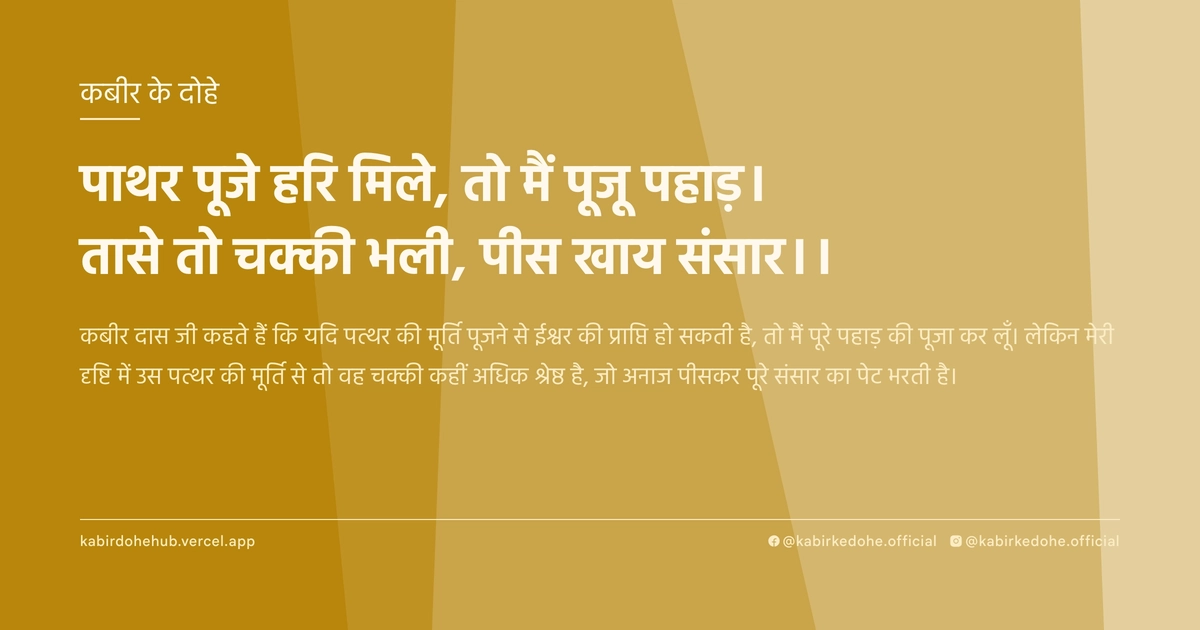
पाथर पूजे हरि मिले, तो मैं पूजू पहाड़।
तासे तो चक्की भली, पीस खाय संसार।।
Pathar pooje Hari mile, to main pooju pahaad. Taase to chakki bhali, pees khay sansaar.
इस पृष्ठ पर इस कबीर दोहे का अर्थ (meaning), हिंदी व्याख्या और अंग्रेज़ी अनुवाद, दार्शनिक विश्लेषण और व्यावहारिक जीवन सीख दी गई है। यह दोहा मूर्ति पूजा विरोध (Condemnation of Idolatry) विषय से जुड़ा है — Kabir doha meaning and explanation in Hindi and English.
अर्थ (Meaning):
कबीर दास जी कहते हैं कि यदि पत्थर की मूर्ति पूजने से ईश्वर की प्राप्ति हो सकती है, तो मैं पूरे पहाड़ की पूजा कर लूँ। लेकिन मेरी दृष्टि में उस पत्थर की मूर्ति से तो वह चक्की कहीं अधिक श्रेष्ठ है, जो अनाज पीसकर पूरे संसार का पेट भरती है।
Kabir asserts that if worshipping a stone idol could truly lead to the realization of the Divine, he would rather worship an entire mountain. He argues that a grinding stone (chakki), which serves a practical purpose by providing food for the world, is far more virtuous than an idol that remains inert.
व्याख्या (Interpretation):
यह दोहा मूर्ति पूजा की निरर्थकता और कर्म की प्रधानता पर प्रहार करता है। कबीर यहाँ 'पाथर' (पत्थर) को जड़ता और बाहरी आडंबरों का प्रतीक मानते हैं। वे तर्क देते हैं कि यदि ईश्वर केवल एक भौतिक वस्तु में सीमित है, तो वह सर्वव्यापी नहीं हो सकता। यह निर्गुण भक्ति का मार्ग है, जहाँ ईश्वर को किसी आकार या प्रतिमा में नहीं, बल्कि अपनी अंतरात्मा और मानवता की सेवा में खोजा जाता है। यहाँ 'चक्की' केवल एक उपकरण नहीं, बल्कि 'परहित' (दूसरों की भलाई) का प्रतीक है। कबीर संकेत करते हैं कि वास्तविक आध्यात्मिकता वह है जो जीवन को संवारती है, न कि वह जो मनुष्य को अंधविश्वासों के जाल में फँसाकर निष्क्रिय बना दे। यह अद्वैत वेदांत के उस विचार से मेल खाता है जहाँ ब्रह्म सर्वव्यापी है और उसे किसी बाहरी ढांचे की आवश्यकता नहीं है।
This couplet strikes at the futility of idol worship and emphasizes the primacy of selfless action. Kabir uses 'Paathar' (stone) as a symbol of inertia and external ritualism. He argues that if the Divine were confined to a physical object, the concept of omnipresence would be void. This is the essence of Nirgun Bhakti, where God is not sought in a form or image, but within the soul and through service to humanity. The 'chakki' (grinding stone) is not merely a tool, but a metaphor for 'Parhit' (the welfare of others). Kabir suggests that true spirituality is that which sustains life and alleviates suffering, rather than that which traps the seeker in blind faith and spiritual stagnation. It aligns with the Advaita Vedanta perspective that Brahman is all-pervading and transcends all material boundaries.
दार्शनिक विश्लेषण (Philosophical Analysis):
कबीर का यह प्रहार उस समय के सामाजिक और धार्मिक परिवेश की प्रतिक्रिया था, जहाँ धर्म केवल कर्मकांडों और बाहरी दिखावे तक सीमित हो गया था। उन्होंने देखा कि लोग पत्थर की मूर्तियों के सामने सिर झुकाते हैं, लेकिन अपने पास बैठे भूखे इंसान की उपेक्षा करते हैं। यह दृष्टिकोण सूफीवाद के 'वहदत-उल-वजूद' (अस्तित्व की एकता) और भारतीय अद्वैतवाद के करीब है, जहाँ ईश्वर को किसी मंदिर या मस्जिद में नहीं, बल्कि हर जीवित प्राणी के भीतर देखा जाता है।
कबीर का तर्क केवल मूर्ति पूजा के विरुद्ध नहीं है, बल्कि उस 'अहंकार' के विरुद्ध है जो मनुष्य को यह विश्वास दिलाता है कि वह कुछ विशेष अनुष्ठान करके ईश्वर को 'नियंत्रित' या 'प्राप्त' कर सकता है। वे कहते हैं कि ईश्वर 'निर्गुण' है—बिना किसी गुण, रंग या आकार के। जब हम ईश्वर को एक पत्थर में सीमित करते हैं, तो हम वास्तव में अपनी चेतना को सीमित कर रहे होते हैं।
यहाँ 'चक्की' का उदाहरण देना एक क्रांतिकारी कदम था। चक्की एक साधारण, घरेलू वस्तु है जो मेहनत और उपयोगिता का प्रतीक है। कबीर यह स्थापित करना चाहते थे कि एक ऐसा पत्थर जो समाज का पेट भरता है, वह उस पत्थर से कहीं अधिक 'पवित्र' है जिसे केवल पूजा जाता है। यह उपयोगितावाद और आध्यात्मिकता का एक अनूठा संगम है।
यह दर्शन हमें सिखाता है कि वास्तविक भक्ति 'सेवा' में निहित है। जब हम दूसरों के दुखों को दूर करते हैं, तो हम वास्तव में उसी परमात्मा की सेवा कर रहे होते हैं जो सबमें व्याप्त है। यह कर्मयोग का वह मार्ग है जहाँ कार्य ही पूजा बन जाता है।
अंततः, कबीर हमें बाहरी खोज से हटाकर आंतरिक खोज की ओर ले जाते हैं। वे चाहते हैं कि मनुष्य अपनी आँखें बंद कर उस 'अनाहत नाद' को सुने, न कि बाहरी मूर्तियों में अपनी मुक्ति खोजे। यह अहंकार का विसर्जन है, जहाँ 'मैं' और 'मेरा ईश्वर' का भेद मिट जाता है और केवल एक अनंत चेतना शेष रहती है।
Kabir's critique was a direct response to the socio-religious climate of his era, where religion had devolved into mere ritualism and external display. He observed a profound irony: people would bow before stone idols while ignoring the suffering of a hungry human being beside them. This perspective resonates with the Sufi concept of 'Wahdat-ul-Wujood' (Unity of Existence) and the Indian Advaita Vedanta, where the Divine is perceived not in temples or mosques, but within every living entity.
Kabir's argument is not merely against idol worship, but against the 'ego' that convinces a person that God can be 'controlled' or 'attained' through specific rituals. He posits that God is 'Nirgun'—without attributes, color, or form. By confining the Divine to a stone, the seeker inadvertently limits their own consciousness and perception of the infinite.
The use of the 'chakki' (grinding stone) as an example was a revolutionary act. The grinding stone is a mundane, domestic object symbolizing labor and utility. Kabir establishes that a stone that feeds the world is infinitely more 'sacred' than a stone that is merely worshipped. This is a sophisticated synthesis of utilitarianism and spirituality.
This philosophy teaches us that true devotion is embedded in 'Seva' (selfless service). When we alleviate the suffering of others, we are in essence serving the same Universal Consciousness that permeates all existence. This is the path of Karma Yoga, where the act of service itself becomes the highest form of worship.
Ultimately, Kabir redirects the seeker from the external search to the internal exploration. He urges the individual to close their eyes and listen to the 'Anahata Nada' (the unstruck sound) rather than seeking liberation through external imagery. It is a process of ego-annihilation, where the duality between 'I' and 'My God' dissolves, leaving only a single, infinite consciousness.
मूल संदेश (Core Message):
- बाहरी प्रतीकों का मोह आध्यात्मिक प्रगति में सबसे बड़ी बाधा है।
- सच्ची भक्ति कर्मकांडों में नहीं, बल्कि करुणा और सेवा में निहित है।
- ईश्वर किसी पत्थर में कैद नहीं, बल्कि संपूर्ण अस्तित्व में व्याप्त है।
- उपयोगिता और मानवता ही वास्तविक पवित्रता की कसौटी है।
- अहंकार का विसर्जन ही परमात्मा से मिलन का एकमात्र मार्ग है।
- Attachment to external symbols is the greatest obstacle to spiritual growth.
- True devotion lies not in rituals, but in compassion and selfless service.
- The Divine is not imprisoned in stone but permeates the entire existence.
- Utility and humanity are the only true benchmarks of sanctity.
- The dissolution of the ego is the only path to union with the Universal Truth.
व्यावहारिक उदाहरण (Practical Example):
वाराणसी के एक पुराने मोहल्ले में रामदीन नाम का एक वृद्ध बुनकर रहता था। रामदीन का पूरा जीवन कबीर की विचारधारा से प्रभावित था, लेकिन उसके आस-पास के लोग उसे 'अजीब' मानते थे क्योंकि वह कभी किसी मंदिर में नहीं जाता था।
उसी मोहल्ले में एक बहुत बड़ा मंदिर था, जहाँ लोग सोने के गहने चढ़ाते थे और घंटों लंबी कतारों में खड़े होकर मूर्ति के दर्शन करते थे। रामदीन अक्सर उन लोगों को देखता और मुस्कुराता, लेकिन वह चुप रहता।
एक बार शहर में भीषण अकाल पड़ा। अनाज की कमी हो गई और लोग भूख से तड़पने लगे। मंदिर के पुजारी ने घोषणा की कि यदि सब मिलकर विशेष पूजा और अनुष्ठान करेंगे, तो देवता बारिश करेंगे और अनाज की कमी दूर होगी।
हजारों लोग मंदिर में जमा हुए, महंगे चढ़ावे चढ़ाए और दिन-रात मंत्रोच्चार किया। लेकिन बारिश नहीं हुई और भूख और बढ़ती गई। लोग और अधिक निराश होकर मंदिर की मूर्ति के सामने गिड़गिड़ाने लगे।
उसी समय, रामदीन ने अपने घर के कोने में रखी अपनी पुरानी चक्की निकाली और अपने पास बचा हुआ सारा अनाज उस चक्की में डाल दिया। उसने दिन-रात मेहनत करके आटा पीसा और मोहल्ले के उन गरीब बच्चों और बुजुर्गों में बाँटना शुरू किया जिनके पास खाने को कुछ नहीं था।
जब पुजारी ने रामदीन को यह करते देखा, तो उन्होंने उसे टोका, "अरे मूर्ख! तू इस पत्थर की चक्की से क्या कर रहा है? मंदिर चल, वहाँ प्रार्थना कर, शायद ईश्वर तेरी सुन ले।"
रामदीन ने शांति से उत्तर दिया, "महाराज, आपकी मूर्ति सुंदर है, लेकिन वह भूख नहीं मिटाती। मेरी यह चक्की पत्थर की ही है, लेकिन यह पेट भर रही है। यदि ईश्वर पत्थर में है, तो वह इस चक्की में भी है, क्योंकि यह जीवन दे रही है।"
पुजारी स्तब्ध रह गए। उन्हें पहली बार अहसास हुआ कि जिस ईश्वर को वे पत्थर की दीवारों में खोज रहे थे, वह वास्तव में रामदीन की सेवा और करुणा में जीवित था।
धीरे-धीरे मोहल्ले के अन्य लोग भी रामदीन की इस सोच से प्रभावित हुए। उन्होंने केवल प्रार्थना करना नहीं, बल्कि एक-दूसरे की मदद करना शुरू किया।
रामदीन ने बिना किसी उपदेश के, केवल अपने कर्म से यह सिद्ध कर दिया कि वास्तविक पूजा वह है जो मानवता के काम आए।
In an ancient neighborhood of Varanasi lived an elderly weaver named Ramdeen. Ramdeen's entire life was influenced by Kabir's philosophy, though the people around him considered him 'strange' because he never visited any temple.
In that same neighborhood stood a magnificent temple where people offered gold ornaments and waited in long queues for hours just to glimpse the idol. Ramdeen would often watch these people and smile, but he remained silent.
Once, a severe famine struck the city. Grain became scarce, and people began to starve. The temple priest announced that if everyone performed special prayers and rituals, the deity would bring rain and end the food shortage.
Thousands gathered at the temple, offering expensive gifts and chanting mantras day and night. However, the rain did not come, and the hunger only intensified. People grew more desperate, pleading before the stone idol.
During this time, Ramdeen took out the old grinding stone (chakki) kept in the corner of his house. He put all the remaining grain he had into the chakki and worked tirelessly day and night to grind flour, which he then distributed to the poor children and elderly of the neighborhood who had nothing to eat.
When the priest saw Ramdeen doing this, he reprimanded him, "You fool! What are you doing with that stone grinder? Come to the temple and pray; perhaps God will listen to you."
Ramdeen replied calmly, "Maharaj, your idol is beautiful, but it does not satisfy hunger. My grinder is also made of stone, but it fills stomachs. If God resides in stone, He resides in this grinder too, for it sustains life."
The priest was stunned. For the first time, he realized that the God he was searching for within stone walls was actually alive in Ramdeen's service and compassion.
Gradually, other residents of the neighborhood were influenced by Ramdeen's perspective. They stopped merely praying and started helping one another.
Without a single sermon, Ramdeen proved through his actions that true worship is that which serves humanity.
अभ्यास मार्गदर्शन (Practice Guidance):
- प्रतिदिन 15 मिनट मौन बैठें और विचार करें कि आपकी 'आंतरिक मूर्ति' (अहंकार) क्या है जिसे आप पूज रहे हैं।
- एक 'सेवा डायरी' बनाएँ: प्रतिदिन एक ऐसा कार्य करें जिससे किसी अजनबी को भौतिक या मानसिक लाभ हो, बिना किसी प्रशंसा की इच्छा के।
- जब भी आप किसी बाहरी रीति-रिवाज में उलझें, खुद से पूछें: "क्या यह कार्य मेरी चेतना को जगा रहा है या केवल मेरी आदत को संतुष्ट कर रहा है?"
- निदान चेकलिस्ट: यदि आप दूसरों की मदद करने के बाद श्रेष्ठता महसूस करते हैं, तो आप अभी भी 'मूर्ति' (अहंकार) की पूजा कर रहे हैं। यदि आप केवल शांति महसूस करते हैं, तो आप मार्ग पर हैं।
- Sit in silence for 15 minutes daily and contemplate what 'internal idol' (ego) you are currently worshipping.
- Maintain a 'Service Diary': Perform one act daily that provides physical or mental relief to a stranger, without any desire for recognition.
- Whenever you find yourself entangled in external rituals, ask: "Is this action awakening my consciousness or merely satisfying a habit?"
- Diagnostic Checklist: If you feel a sense of superiority after helping others, you are still worshipping the 'idol' of ego. If you feel only peace, you are on the right path.
चिंतन प्रश्न (Reflection Questions):
- मेरे जीवन में वे कौन सी 'मानसिक मूर्तियाँ' (पूर्वाग्रह या धारणाएँ) हैं जिन्हें मैं सत्य मानकर पूज रहा हूँ?
- क्या मेरी धार्मिकता दूसरों के प्रति मेरी संवेदनशीलता को बढ़ाती है, या मुझे उनसे अलग करती है?
- यदि मेरे सभी बाहरी धार्मिक पहचान छीन ली जाएँ, तो मेरी आत्मा की वास्तविकता क्या बचेगी?
- मैं अपनी डिजिटल पहचान (सोशल मीडिया इमेज) को किस हद तक एक 'मूर्ति' की तरह पूज रहा हूँ?
- क्या मैं ईश्वर को खोजने के लिए उन लोगों की उपेक्षा कर रहा हूँ जिन्हें वास्तव में मेरी मदद की ज़रूरत है?
- What are the 'mental idols' (prejudices or assumptions) in my life that I worship as absolute truths?
- Does my religiosity increase my sensitivity toward others, or does it create a wall of separation?
- If all my external religious identities were stripped away, what would remain of my soul's reality?
- To what extent am I worshipping my digital identity (social media image) as a modern-day idol?
- Am I ignoring the people who truly need my help in my quest to 'find' God?