
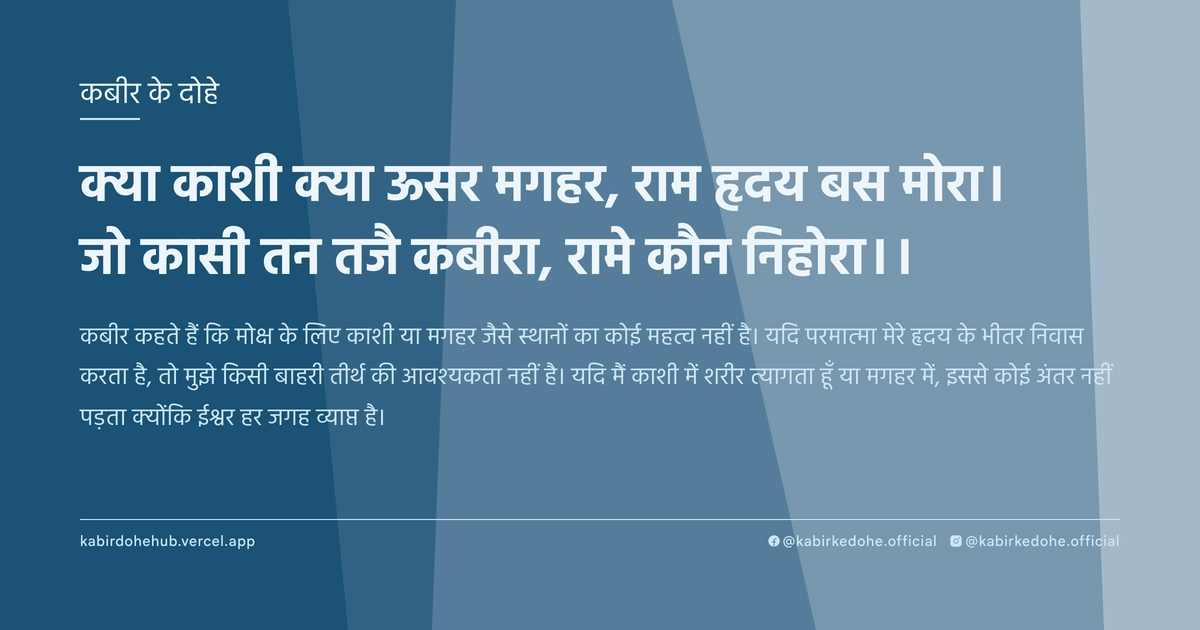
क्या काशी क्या ऊसर मगहर, राम हृदय बस मोरा।
जो कासी तन तजै कबीरा, रामे कौन निहोरा।।
Kya kashi kya usar maghar, ram hridaya bas mora. Jo kasi tan tajai kabira, rame kaun nihora.
इस पृष्ठ पर इस कबीर दोहे का अर्थ (meaning), हिंदी व्याख्या और अंग्रेज़ी अनुवाद, दार्शनिक विश्लेषण और व्यावहारिक जीवन सीख दी गई है। यह दोहा मूर्ति पूजा विरोध (Condemnation of Idolatry) विषय से जुड़ा है — Kabir doha meaning and explanation in Hindi and English.
अर्थ (Meaning):
कबीर कहते हैं कि मोक्ष के लिए काशी या मगहर जैसे स्थानों का कोई महत्व नहीं है। यदि परमात्मा मेरे हृदय के भीतर निवास करता है, तो मुझे किसी बाहरी तीर्थ की आवश्यकता नहीं है। यदि मैं काशी में शरीर त्यागता हूँ या मगहर में, इससे कोई अंतर नहीं पड़ता क्योंकि ईश्वर हर जगह व्याप्त है।
Kabir asserts that sacred cities like Kashi or the desolate lands of Maghar hold no inherent power over salvation. Since the Divine resides within the sanctuary of the heart, external pilgrimages are redundant. Whether one breathes their last in the holy city of Kashi or the shunned soil of Maghar, it matters not, for the Eternal is omnipresent.
व्याख्या (Interpretation):
यह दोहा बाहरी कर्मकांडों और भौगोलिक पवित्रता के भ्रम पर प्रहार करता है। कबीर 'काशी' (मोक्ष का द्वार) और 'मगहर' (मृत्यु का अशुभ स्थान) के द्वैत को समाप्त करते हैं। यहाँ 'राम' दशरथ पुत्र नहीं, बल्कि निर्गुण ब्रह्म हैं जो आत्मा के रूप में हृदय में स्थित हैं। यह अद्वैत वेदांत के उस सत्य को दर्शाता है जहाँ जीव और ब्रह्म एक हैं। माया हमें विश्वास दिलाती है कि मुक्ति किसी विशेष स्थान पर निर्भर है, जबकि वास्तविक मुक्ति अहंकार के विसर्जन और आंतरिक साक्षात्कार में है। कबीर का यह विरोधाभास यह स्पष्ट करता है कि पवित्रता स्थान में नहीं, बल्कि चेतना की अवस्था में होती है।
This couplet strikes at the heart of the illusion regarding external rituals and geographical sanctity. Kabir collapses the duality between 'Kashi' (the gateway to liberation) and 'Maghar' (a place traditionally shunned as unlucky for death). Here, 'Ram' refers not to the historical king, but to the Nirgun Brahman—the formless Absolute residing as the soul within the heart. This aligns with Advaita Vedanta, emphasizing the non-duality of the Atman and Brahman. Maya tricks the seeker into believing liberation depends on a specific coordinate on a map, whereas true liberation is the dissolution of the ego. Kabir’s paradox clarifies that sanctity is not a property of a place, but a state of consciousness.
दार्शनिक विश्लेषण (Philosophical Analysis):
कबीर का यह वक्तव्य उनके समय के कट्टरपंथी धार्मिक ढांचे के विरुद्ध एक क्रांतिकारी विद्रोह था। मध्यकालीन भारत में यह मान्यता थी कि काशी में मृत्यु होने से मोक्ष मिलता है और मगहर में मृत्यु होने से पुनर्जन्म होता है। कबीर ने जानबूझकर मगहर में प्राण त्यागे ताकि वे इस अंधविश्वास को तोड़ सकें। यह दृष्टिकोण सूफीवाद के 'अनलहक' (मैं सत्य हूँ) और भक्ति मार्ग के 'सहज मार्ग' से मेल खाता है, जहाँ ईश्वर को खोजने के लिए मंदिर या मस्जिद जाने की आवश्यकता नहीं है।
दार्शनिक स्तर पर, यह दोहा 'स्थान-बद्धता' के मनोविज्ञान को चुनौती देता है। जब मनुष्य बाहरी प्रतीकों पर निर्भर होता है, तो वह अपनी आंतरिक शक्ति को नकार देता है। कबीर का तर्क है कि यदि परमात्मा सर्वव्यापी है, तो वह मगहर की धूल में भी उतना ही मौजूद है जितना काशी के गंगा तट पर। यह विचार व्यक्ति को धार्मिक दासता से मुक्त कर उसे आत्म-निर्भर बनाता है।
अद्वैत वेदांत के अनुसार, जगत एक माया है और केवल ब्रह्म सत्य है। यदि ब्रह्म ही एकमात्र सत्य है, तो भौगोलिक सीमाएं अर्थहीन हो जाती हैं। कबीर यहाँ 'राम' को एक व्यक्तिगत देवता के बजाय एक सार्वभौमिक ऊर्जा के रूप में प्रस्तुत करते हैं। यह 'निर्गुण भक्ति' का सार है—बिना किसी आकार, गुण या स्थान के ईश्वर की उपासना करना।
सामाजिक रूप से, यह दोहा जाति और वर्ग के उस अहंकार को नष्ट करता है जो खुद को 'पवित्र' स्थानों का स्वामी मानता था। कबीर यह संदेश देते हैं कि मोक्ष किसी विशेष विशेषाधिकार प्राप्त समूह या स्थान के लिए आरक्षित नहीं है। यह हर उस व्यक्ति के लिए उपलब्ध है जिसने अपने हृदय के भीतर झांकना शुरू किया है।
अंततः, यह विश्लेषण हमें सिखाता है कि आध्यात्मिक यात्रा 'बाहर से भीतर' की ओर है। जब तक हम बाहरी तीर्थों में शांति खोजते हैं, हम वास्तव में अपनी आत्मा से दूर भाग रहे होते हैं। अहंकार का विसर्जन ही वास्तविक 'काशी' है और अज्ञानता का अंधकार ही वास्तविक 'मगहर' है।
Kabir’s statement was a revolutionary rebellion against the rigid religious frameworks of his era. In medieval India, it was widely believed that dying in Kashi guaranteed liberation (Moksha), while dying in Maghar led to rebirth. Kabir deliberately chose to breathe his last in Maghar to shatter this superstition, proving that the soul's destination is determined by its state, not its location.
On a philosophical level, this couplet challenges the psychology of 'spatial attachment.' When a human relies on external symbols, they negate their own internal divinity. Kabir argues that if the Divine is omnipresent, He is as present in the dust of Maghar as He is on the banks of the Ganges in Kashi. This perspective liberates the individual from religious servitude and fosters spiritual autonomy.
According to Advaita Vedanta, the world is Maya (illusion) and only Brahman is the ultimate reality. If Brahman is the only truth, then geographical boundaries become meaningless. Kabir presents 'Ram' not as a personal deity, but as a universal energy. This is the essence of Nirgun Bhakti—the worship of the formless, attributeless, and spaceless Absolute.
Socially, this couplet dismantles the ego of the privileged classes who claimed ownership over 'sacred' spaces. Kabir messages that liberation is not reserved for a specific elite group or location; it is accessible to anyone who dares to look within. It democratizes spirituality by removing the middlemen of priesthood and ritual.
Ultimately, this analysis teaches us that the spiritual journey is a movement from the 'outer to the inner.' As long as we seek peace in external pilgrimages, we are essentially running away from our own souls. The dissolution of the ego is the true 'Kashi,' and the darkness of ignorance is the only true 'Maghar.'
मूल संदेश (Core Message):
- पवित्रता स्थान में नहीं, बल्कि चेतना की शुद्धता में होती है।
- बाहरी तीर्थ केवल मन का भ्रम हैं; वास्तविक तीर्थ हृदय है।
- ईश्वर सीमाओं और भूगोल का मोहताज नहीं, वह सर्वव्यापी है।
- अहंकार का त्याग ही वास्तविक मोक्ष का एकमात्र द्वार है।
- आंतरिक शांति की खोज बाहरी यात्राओं से नहीं, आत्म-साक्षात्कार से होती है।
- Sanctity lies not in a location, but in the purity of consciousness.
- External pilgrimages are illusions of the mind; the heart is the true shrine.
- The Divine is not bound by borders or geography; He is omnipresent.
- The surrender of the ego is the only true gateway to liberation.
- Inner peace is found through self-realization, not through external journeys.
व्यावहारिक उदाहरण (Practical Example):
एक समय की बात है, वाराणसी के घाटों पर रहने वाला एक वृद्ध नाविक था, जिसका नाम माधव था। माधव का पूरा जीवन तीर्थयात्रियों को गंगा पार कराने में बीता। वह खुद बहुत धार्मिक था और उसका मानना था कि जीवन के अंतिम क्षणों में काशी में होना ही मोक्ष का एकमात्र रास्ता है। वह हर दिन प्रार्थना करता कि वह इसी पवित्र नगरी में अपनी अंतिम सांस ले।
माधव का एक बेटा था, जो शहर जाकर पढ़ा था और अब एक साधारण क्लर्क था। वह अक्सर अपने पिता से कहता कि ईश्वर हमारे भीतर है, लेकिन माधव इसे अंधविश्वास मानता। वह कहता, 'बेटा, शास्त्रों में लिखा है कि काशी की मिट्टी में जादू है।'
एक बार माधव बहुत बीमार पड़ गया। उसकी हालत इतनी खराब थी कि वह चलने में असमर्थ था। उसी समय उसके बेटे को एक जरूरी काम से मगहर के एक छोटे से गांव जाना पड़ा और उसने अपने पिता को साथ ले लिया ताकि वे वहां के शांत वातावरण में आराम कर सकें। माधव बहुत दुखी था। उसे लगा कि वह 'अपवित्र' मगहर में जा रहा है और अब उसका मोक्ष छिन गया है।
मगहर पहुंचकर माधव एक छोटी सी कुटिया में रहने लगा। वहां उसकी मुलाकात एक साधारण बुनकर से हुई, जो कबीर की वाणी गाता था। वह बुनकर माधव को देखता और मुस्कुराता। एक दिन बुनकर ने कहा, 'माधव भाई, आप इस मिट्टी से डर रहे हैं या उस डर से जो आपके भीतर है?'
माधव ने रोते हुए कहा, 'मैं मोक्ष खो चुका हूँ क्योंकि मैं काशी से दूर हूँ।' बुनकर ने शांति से उत्तर दिया, 'यदि आपका राम आपके हृदय में है, तो क्या वह काशी की सीमा पर रुक जाता है? क्या वह इतना छोटा है कि एक शहर के बाहर उसका प्रभाव खत्म हो जाए?'
यह बात माधव के हृदय पर बिजली की तरह गिरी। उसने पहली बार सोचा कि उसने जीवन भर गंगा की लहरों को देखा, लेकिन कभी अपने भीतर की लहरों को नहीं समझा। उसने महसूस किया कि वह जिस 'पवित्रता' को बाहर खोज रहा था, वह वास्तव में उसके अपने प्रेम और करुणा में छिपी थी।
अगले कुछ दिनों में माधव का डर गायब हो गया। उसने महसूस किया कि मगहर की धूल भी उतनी ही पवित्र है जितनी काशी की आरती। उसने अपनी पूरी संपत्ति उन गरीबों में बांट दी जो वहां बीमार थे, और बिना किसी डर के सेवा में लग गया।
जब माधव की मृत्यु का समय आया, तो उसके चेहरे पर एक असीम शांति थी। वह अब काशी जाने के लिए तड़प नहीं रहा था, क्योंकि उसने पा लिया था कि वह स्वयं ही वह तीर्थ है जिसकी वह तलाश कर रहा था। उसने मगहर की मिट्टी में अपनी आंखें मूंद लीं, लेकिन उसकी आत्मा उस अनंत राम में विलीन हो गई जो सीमाओं से परे था।
Once, there was an elderly boatman named Madhav who lived on the ghats of Varanasi. Madhav had spent his entire life ferrying pilgrims across the Ganges. He was deeply religious and believed that spending one's final moments in Kashi was the only path to salvation. Every day, he prayed that he would breathe his last in this holy city.
Madhav had a son who had studied in the city and was now a simple clerk. The son often told his father that God resides within us, but Madhav dismissed this as naive. He would argue, 'Son, the scriptures say there is magic in the soil of Kashi.'
One day, Madhav fell gravely ill. His condition deteriorated to the point where he could no longer walk. Around the same time, his son had to travel to a small village in Maghar for urgent work and took his father along, hoping the quiet environment would help him recover. Madhav was devastated. He felt he was going to 'impure' Maghar and that his salvation was now lost.
Upon arriving in Maghar, Madhav stayed in a small hut. There, he met a simple weaver who sang the verses of Kabir. The weaver would look at Madhav and smile. One day, the weaver asked, 'Brother Madhav, are you afraid of this soil, or of the fear that lives inside you?'
Madhav wept and replied, 'I have lost my salvation because I am far from Kashi.' The weaver calmly answered, 'If your Ram is in your heart, does He stop at the borders of Kashi? Is He so small that His influence ends at the city limits?'
These words struck Madhav like a bolt of lightning. For the first time, he realized he had spent his life watching the ripples of the Ganges but had never understood the ripples within his own soul. He realized the 'purity' he sought externally was actually hidden in his own capacity for love and compassion.
Over the next few days, Madhav's fear vanished. He felt that the dust of Maghar was as sacred as the prayers of Kashi. He distributed his meager savings among the sick poor of the village and dedicated himself to their service.
When the time for Madhav's passing arrived, his face radiated an infinite peace. He was no longer longing for Kashi, for he had discovered that he himself was the pilgrimage he had been searching for. He closed his eyes in the soil of Maghar, but his soul merged into that eternal Ram who exists beyond all boundaries.
अभ्यास मार्गदर्शन (Practice Guidance):
- प्रतिदिन 20 मिनट मौन ध्यान करें, जहाँ आप अपना ध्यान बाहरी दुनिया से हटाकर हृदय के केंद्र पर केंद्रित करें।
- एक डायरी लिखें जिसमें आप उन सभी 'बाहरी प्रतीकों' की सूची बनाएं जिन्हें आप अपनी खुशी या मोक्ष के लिए आवश्यक मानते हैं, और फिर विचार करें कि क्या वे वास्तव में अनिवार्य हैं।
- व्यवहार परिवर्तन: किसी ऐसे व्यक्ति की सेवा करें जिसे समाज 'अपवित्र' या 'निम्न' मानता है, यह अनुभव करते हुए कि उनमें भी वही दिव्य प्रकाश है जो आपमें है।
- निदान चेकलिस्ट: यदि आप अभी भी मानते हैं कि किसी विशेष स्थान, वस्तु या अनुष्ठान के बिना आप ईश्वर तक नहीं पहुँच सकते, तो आप अभी भी 'माया' के प्रभाव में हैं।
- Practice 20 minutes of silent meditation daily, shifting your focus from the external world to the center of your heart.
- Maintain a journal listing all the 'external symbols' you believe are necessary for your happiness or salvation, then question if they are truly indispensable.
- Behavioral Change: Serve someone whom society deems 'impure' or 'lowly,' experiencing the same divine light in them that exists within you.
- Diagnostic Checklist: If you still believe that you cannot reach the Divine without a specific location, object, or ritual, you are still under the influence of 'Maya'.
चिंतन प्रश्न (Reflection Questions):
- मैं किन बाहरी प्रतीकों या पहचानों के पीछे अपनी आध्यात्मिक सच्चाई को छुपा रहा हूँ?
- क्या मेरा 'पवित्रता' का विचार वास्तव में ईश्वर के प्रति प्रेम है, या केवल सामाजिक कंडीशनिंग का परिणाम?
- यदि मेरा पूरा जीवन एक ऐसे स्थान पर बीते जिसे दुनिया 'अशुभ' मानती है, तो क्या मेरी आंतरिक शांति बनी रहेगी?
- मैं अपनी डिजिटल पहचान और सार्वजनिक छवि को बनाए रखने के लिए अपनी आत्मा की कितनी उपेक्षा करता हूँ?
- क्या मैं वास्तव में निर्गुण ब्रह्म को स्वीकार करता हूँ, या मुझे अभी भी एक 'आकार' की बैसाखी चाहिए?
- Which external symbols or identities am I using to hide my spiritual truth?
- Is my concept of 'purity' truly love for the Divine, or merely a result of social conditioning?
- If my entire life were spent in a place the world deems 'unlucky,' would my inner peace remain intact?
- How much of my soul do I neglect to maintain my digital identity and public image?
- Do I truly accept the formless Absolute, or do I still rely on the crutch of a 'form'?