
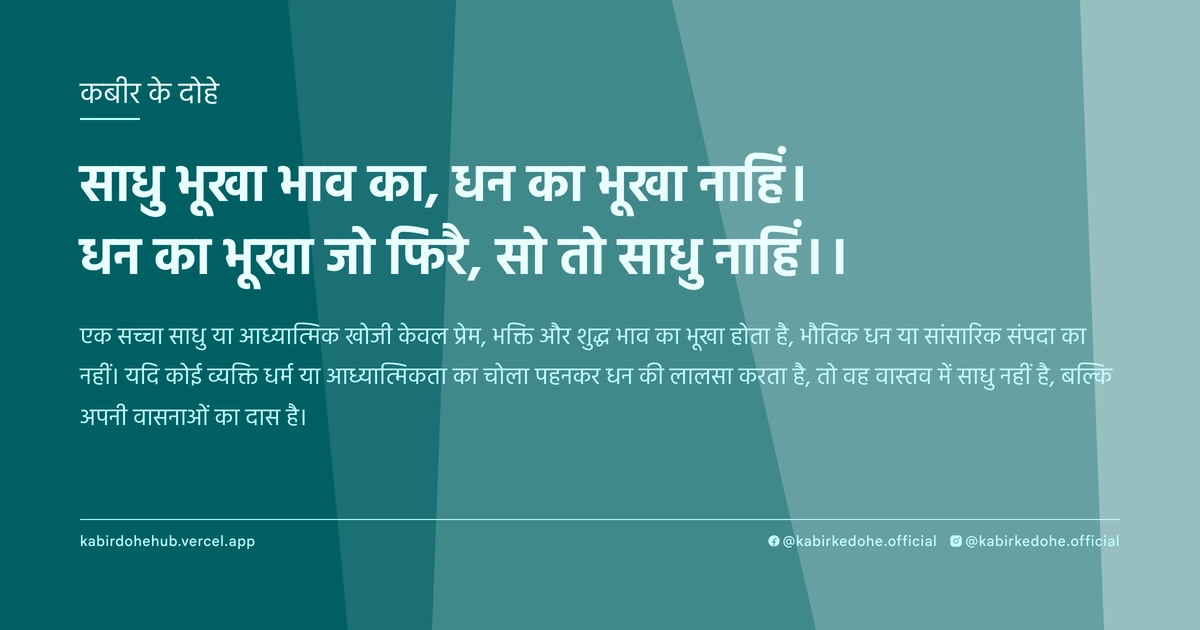
साधु भूखा भाव का, धन का भूखा नाहिं।
धन का भूखा जो फिरै, सो तो साधु नाहिं।।
Sadhu bhukhha bhaav ka, dhan ka bhukhha naahin. Dhan ka bhukhha jo phirai, so to sadhu naahin.
इस पृष्ठ पर इस कबीर दोहे का अर्थ (meaning), हिंदी व्याख्या और अंग्रेज़ी अनुवाद, दार्शनिक विश्लेषण और व्यावहारिक जीवन सीख दी गई है। यह दोहा संतोष (Contentment) विषय से जुड़ा है — Kabir doha meaning and explanation in Hindi and English.
अर्थ (Meaning):
एक सच्चा साधु या आध्यात्मिक खोजी केवल प्रेम, भक्ति और शुद्ध भाव का भूखा होता है, भौतिक धन या सांसारिक संपदा का नहीं। यदि कोई व्यक्ति धर्म या आध्यात्मिकता का चोला पहनकर धन की लालसा करता है, तो वह वास्तव में साधु नहीं है, बल्कि अपनी वासनाओं का दास है।
A true seeker or saint hungers only for pure emotion, love, and spiritual devotion, not for material wealth or worldly possessions. Anyone who wanders the earth seeking monetary gain while masquerading as a holy person is not a saint, but remains a slave to their own desires.
व्याख्या (Interpretation):
इस दोहे का शाब्दिक अर्थ है कि साधु की भूख भौतिक नहीं, बल्कि भावनात्मक और आध्यात्मिक होती है। यहाँ 'भाव' शब्द अत्यंत गहरा है, जो केवल भावना नहीं बल्कि ईश्वर के प्रति अनन्य प्रेम और समर्पण को दर्शाता है। यह निरगुण भक्ति की उस अवस्था की ओर संकेत करता है जहाँ साधक माया के मोह से पूरी तरह मुक्त हो जाता है। जब अहंकार मिटता है, तब केवल 'भाव' शेष रहता है, जो आत्मा और परमात्मा के बीच का सेतु है। यह द्वैत से अद्वैत की यात्रा है, जहाँ बाहरी दुनिया की चमक फीकी पड़ जाती है और आंतरिक प्रकाश ही एकमात्र लक्ष्य बन जाता है। यदि कोई साधु धन की इच्छा करता है, तो वह अभी भी 'माया' के जाल में फंसा है, जो उसे ब्रह्म से दूर रखता है।
Literally, the couplet asserts that a saint's hunger is not material but emotional and spiritual. The term 'Bhaav' is profound, representing not just emotion but an exclusive, selfless love and surrender to the Divine. This points toward the state of Nirgun Bhakti, where the seeker is entirely liberated from the allure of Maya (illusion). When the ego dissolves, only 'Bhaav' remains, serving as the bridge between the Atman (individual soul) and Brahman (universal consciousness). It is a journey from duality to non-duality, where the glitter of the external world fades, and internal illumination becomes the sole objective. If a saint craves wealth, they remain trapped in the web of Maya, which creates a veil of separation from the Absolute Truth.
दार्शनिक विश्लेषण (Philosophical Analysis):
कबीर का यह दोहा उस समय के सामाजिक और धार्मिक पाखंड पर एक तीखा प्रहार है, जहाँ धर्म के नाम पर शोषण आम था। कबीर ने देखा कि कैसे कई तथाकथित गुरु और साधु धर्म को एक व्यवसाय बना चुके थे। उनका विरोध केवल धन से नहीं, बल्कि उस 'लोभ' से था जो आध्यात्मिक प्रगति में सबसे बड़ी बाधा है।
अद्वैत वेदांत के परिप्रेक्ष्य में, धन की इच्छा 'अविद्या' या अज्ञान का परिणाम है। जब व्यक्ति स्वयं को शरीर और मन मानता है, तो वह बाहरी वस्तुओं में सुख खोजता है। लेकिन जब उसे यह बोध होता है कि वह स्वयं पूर्ण ब्रह्म है, तो बाहरी संपदा अर्थहीन हो जाती है। कबीर यहाँ 'साधु' को एक ऐसी स्थिति के रूप में परिभाषित कर रहे हैं जहाँ व्यक्ति ने अपनी पहचान को भौतिक आवश्यकताओं से ऊपर उठा लिया है।
सूफी मत के 'फना' (अहंकार का विनाश) के सिद्धांत से इसे जोड़कर देखा जा सकता है। जब तक 'मैं' और 'मेरा' जीवित है, तब तक सच्चा प्रेम (इश्क-ए-हकीकी) संभव नहीं है। धन की भूख वास्तव में 'अहंकार' की भूख है। कबीर तर्क देते हैं कि जो व्यक्ति धन के पीछे भाग रहा है, वह वास्तव में अपनी ही वासनाओं की पूजा कर रहा है, ईश्वर की नहीं।
यह शिक्षण हमें यह समझने पर मजबूर करता है कि आध्यात्मिकता का अर्थ केवल वस्त्र बदलना या माला जपना नहीं है, बल्कि चेतना का रूपांतरण है। भौतिकता का त्याग अनिवार्य नहीं है, लेकिन भौतिकता के प्रति 'आसक्ति' का त्याग अनिवार्य है। कबीर का मार्ग आंतरिक शुद्धि का मार्ग है, जहाँ हृदय की पवित्रता ही वास्तविक योग्यता है।
अंततः, यह दोहा हमें चेतावनी देता है कि हम बाहरी प्रतीकों (जैसे भगवा वस्त्र या तिलक) से किसी की आध्यात्मिक गहराई का आकलन न करें। वास्तविक साधु वह है जिसकी आंतरिक भूख केवल सत्य और प्रेम के लिए है, न कि सामाजिक प्रतिष्ठा या आर्थिक लाभ के लिए।
Kabir's couplet is a sharp critique of the social and religious hypocrisy of his era, where exploitation in the name of religion was rampant. Kabir observed how many so-called gurus and saints had turned spirituality into a business. His opposition was not to wealth itself, but to the 'greed' that acts as the primary obstacle to spiritual evolution.
From the perspective of Advaita Vedanta, the desire for wealth is a result of 'Avidya' or ignorance. When a person identifies solely with the body and mind, they seek happiness in external objects. However, once they realize they are the complete Brahman, external possessions become meaningless. Kabir defines a 'Sadhu' as one who has elevated their identity beyond material necessities.
This can be linked to the Sufi concept of 'Fana' (the annihilation of the ego). As long as 'I' and 'Mine' exist, true divine love (Ishq-e-Haqiqi) is impossible. The hunger for wealth is, in reality, the hunger of the ego. Kabir argues that one who chases money is actually worshipping their own desires, not the Divine.
This teaching forces us to understand that spirituality is not about changing clothes or chanting beads, but about a transformation of consciousness. The renunciation of material goods is not mandatory, but the renunciation of 'attachment' to them is essential. Kabir's path is one of inner purification, where the purity of the heart is the only true qualification.
Ultimately, the couplet warns us not to judge spiritual depth by external symbols such as saffron robes or tilaks. A true saint is one whose internal hunger is exclusively for Truth and Love, rather than social prestige or financial gain.
मूल संदेश (Core Message):
- लोभ आध्यात्मिक प्रगति का सबसे बड़ा अवरोध है।
- सच्ची तृप्ति बाहरी वस्तुओं में नहीं, आंतरिक प्रेम में है।
- आध्यात्मिकता का अर्थ भौतिकता का त्याग नहीं, बल्कि आसक्ति का अंत है।
- प्रेम और करुणा ही आत्मा की वास्तविक भूख है।
- अहंकार का विसर्जन ही वास्तविक साधुता की पहचान है।
- Greed is the greatest obstacle to spiritual evolution.
- True satisfaction lies in inner love, not in external objects.
- Spirituality is not the renunciation of matter, but the end of attachment.
- Love and compassion are the true hungers of the soul.
- The dissolution of ego is the hallmark of true sainthood.
व्यावहारिक उदाहरण (Practical Example):
वाराणसी के एक पुराने घाट पर माधव नाम का एक वृद्ध बुनकर रहता था। वह दिन भर सूत कातता और शाम को कबीर के भजनों में लीन रहता। माधव के पास बहुत कम धन था, लेकिन उसका हृदय करुणा से भरा था।
उसी शहर में एक प्रसिद्ध 'महात्मा' आए थे, जिनके चारों ओर हमेशा भीड़ रहती थी। वे बड़े-बड़े प्रवचन देते थे और बदले में शिष्यों से भारी दान की मांग करते थे। उनका आश्रम सोने और चांदी के बर्तनों से भरा था।
एक दिन वह महात्मा माधव की कुटिया के पास से गुजरे। उन्होंने देखा कि माधव एक भूखे कुत्ते को अपनी आखिरी रोटी खिला रहा है और चेहरे पर एक असीम शांति है। महात्मा ने माधव से पूछा, "तुम इतने गरीब हो, फिर भी इतने खुश कैसे हो? क्या तुम्हें धन की इच्छा नहीं है?"
माधव ने विनम्रता से उत्तर दिया, "महाराज, मेरी भूख रोटी की नहीं, बल्कि उस प्रेम की है जो मुझे इस सृष्टि के हर जीव में दिखता है। जब मैं किसी की मदद करता हूँ, तो मुझे जो तृप्ति मिलती है, वह दुनिया के किसी खजाने से नहीं मिल सकती।"
महात्मा को अपनी विलासिता पर अचानक शर्म महसूस हुई। उन्होंने देखा कि उनके पास धन तो बहुत था, लेकिन उनके मन में शांति नहीं थी। वे हमेशा और अधिक धन जुटाने की चिंता में रहते थे।
उस क्षण महात्मा को समझ आया कि वे केवल 'धन के भूखे' थे, जबकि माधव वास्तव में एक 'साधु' था, क्योंकि वह 'भाव' का भूखा था।
महात्मा ने अपना अहंकार त्याग दिया और अपनी संपत्ति का एक बड़ा हिस्सा गरीबों के लिए समर्पित कर दिया। उन्होंने बाहरी दिखावे को छोड़कर वास्तविक आंतरिक शांति की खोज शुरू की।
माधव की सादगी ने एक अहंकारी व्यक्ति को सत्य के मार्ग पर ला खड़ा किया। यह परिवर्तन किसी उपदेश से नहीं, बल्कि माधव के निस्वार्थ भाव और संतोष से आया।
अब वह महात्मा केवल प्रेम बांटते थे, धन नहीं मांगते थे। उन्होंने जान लिया कि सच्ची संपदा हृदय की करुणा है, बैंक का बैलेंस नहीं।
इस प्रकार, एक साधारण बुनकर ने एक बड़े विद्वान को सिखाया कि साधुता धन के संचय में नहीं, बल्कि भाव के विस्तार में है।
In the ancient ghats of Varanasi lived an elderly weaver named Madhav. He spent his days spinning yarn and his evenings immersed in the bhajans of Kabir. Madhav possessed very little wealth, but his heart overflowed with compassion.
In the same city, a famous 'Mahatma' had arrived, always surrounded by crowds. He delivered grand discourses and, in return, demanded heavy donations from his disciples. His ashram was filled with gold and silver vessels.
One day, the Mahatma passed by Madhav's humble hut. He saw Madhav feeding his last piece of bread to a hungry dog, with a look of infinite peace on his face. The Mahatma asked, "You are so poor, yet how are you so happy? Do you not desire wealth?"
Madhav replied humbly, "Maharaj, my hunger is not for bread, but for the love that I see in every living being of this creation. The satisfaction I feel when I help another cannot be found in any treasure in the world."
The Mahatma suddenly felt ashamed of his luxury. He realized that while he had immense wealth, he lacked peace. He was always anxious about accumulating more.
At that moment, the Mahatma understood that he was merely 'hungry for wealth,' whereas Madhav was a true 'Sadhu' because he hungered for 'Bhaav' (pure emotion/devotion).
The Mahatma renounced his ego and dedicated a large portion of his wealth to the poor. He abandoned external pretension and began the search for true inner peace.
Madhav's simplicity brought an arrogant man back to the path of truth. This transformation did not come from a sermon, but from Madhav's selfless love and contentment.
From then on, the Mahatma only distributed love; he no longer asked for money. He learned that true wealth is the compassion of the heart, not a bank balance.
Thus, a simple weaver taught a great scholar that sainthood lies not in the accumulation of wealth, but in the expansion of love.
अभ्यास मार्गदर्शन (Practice Guidance):
- प्रतिदिन 20 मिनट मौन बैठें और विचार करें कि आपकी कौन सी इच्छाएं 'जरूरत' हैं और कौन सी 'लोभ' (Ego-driven)।
- एक 'निस्वार्थ सेवा' डायरी लिखें: प्रतिदिन एक ऐसा कार्य करें जिससे किसी को लाभ हो, लेकिन उसके बदले में किसी भी प्रकार के भौतिक या मानसिक पुरस्कार की अपेक्षा न करें।
- आत्म-पूछताछ: जब भी आप किसी वस्तु के लिए तीव्र लालसा महसूस करें, खुद से पूछें, "क्या यह मेरी आत्मा की भूख है या मेरे अहंकार की?"
- निदान चेकलिस्ट: यदि आप दूसरों की मदद करते समय अपनी प्रशंसा की उम्मीद करते हैं, या अपनी आध्यात्मिक उपलब्धियों का प्रदर्शन करते हैं, तो आप अभी भी 'धन/प्रतिष्ठा के भूखे' हैं।
- Sit in silence for 20 minutes daily and contemplate which of your desires are genuine 'needs' and which are 'greed' (ego-driven).
- Maintain a 'Selfless Service' journal: Perform one act daily that benefits another, without expecting any material or mental reward in return.
- Self-Inquiry: Whenever you feel an intense craving for an object, ask yourself, "Is this the hunger of my soul or the hunger of my ego?"
- Diagnostic Checklist: If you expect praise while helping others, or display your spiritual achievements for validation, you are still 'hungry for wealth/prestige'.
चिंतन प्रश्न (Reflection Questions):
- क्या मेरी धार्मिक या आध्यात्मिक पहचान वास्तव में आंतरिक शांति के लिए है, या यह समाज में मेरी स्थिति को बेहतर बनाने का एक साधन है?
- यदि मुझसे मेरी सारी सामाजिक प्रतिष्ठा और संपत्ति छीन ली जाए, तो क्या मेरे पास ऐसा कुछ बचेगा जिसे मैं 'मैं' कह सकूँ?
- मैं दूसरों की मदद करते समय गुप्त रूप से कितनी प्रशंसा की उम्मीद करता हूँ?
- क्या मेरा 'दान' वास्तव में त्याग है, या यह केवल मेरे अपराधबोध (guilt) को कम करने का एक तरीका है?
- मेरे जीवन में 'भाव' (प्रेम) और 'वस्तु' (धन) के बीच का संतुलन क्या है, और कौन सा पक्ष हावी है?
- Is my religious or spiritual identity truly for inner peace, or is it a tool to improve my social standing?
- If all my social prestige and wealth were stripped away, would there be anything left that I could call 'I'?
- How much praise do I secretly expect when I help others?
- Is my 'charity' truly a sacrifice, or is it merely a way to alleviate my own guilt?
- What is the balance between 'Bhaav' (love) and 'Vastu' (material) in my life, and which side dominates?