
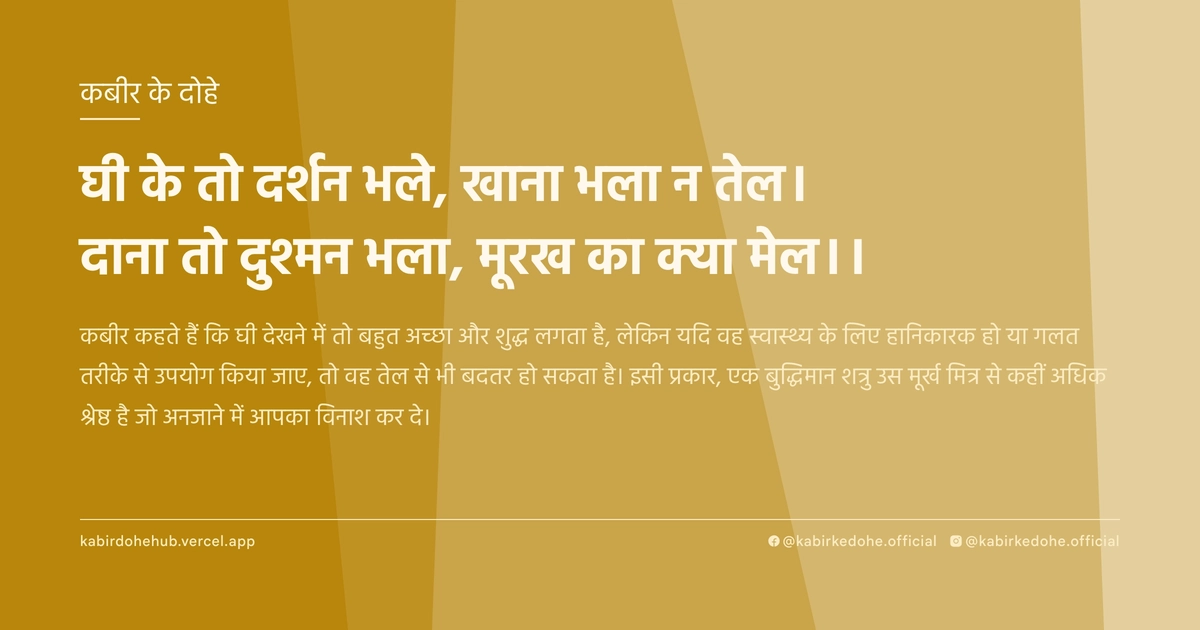
घी के तो दर्शन भले, खाना भला न तेल।
दाना तो दुश्मन भला, मूरख का क्या मेल।।
Ghee ke to darshan bhale, khana bhala na tel. Dana to dushman bhala, murakh ka kya mel.
इस पृष्ठ पर इस कबीर दोहे का अर्थ (meaning), हिंदी व्याख्या और अंग्रेज़ी अनुवाद, दार्शनिक विश्लेषण और व्यावहारिक जीवन सीख दी गई है। यह दोहा संतोष (Contentment) विषय से जुड़ा है — Kabir doha meaning and explanation in Hindi and English.
अर्थ (Meaning):
कबीर कहते हैं कि घी देखने में तो बहुत अच्छा और शुद्ध लगता है, लेकिन यदि वह स्वास्थ्य के लिए हानिकारक हो या गलत तरीके से उपयोग किया जाए, तो वह तेल से भी बदतर हो सकता है। इसी प्रकार, एक बुद्धिमान शत्रु उस मूर्ख मित्र से कहीं अधिक श्रेष्ठ है जो अनजाने में आपका विनाश कर दे।
Kabir suggests that while clarified butter (ghee) appears pure and appealing to the eye, its consumption is not always beneficial if it leads to imbalance, making simple oil preferable. Similarly, a wise enemy is far better than a foolish friend, for the former's hostility is predictable, while the latter's ignorance causes unintentional but devastating ruin.
व्याख्या (Interpretation):
यह दोहा बाहरी चमक और आंतरिक वास्तविकता के बीच के विरोधाभास को दर्शाता है। 'घी' यहाँ माया और सांसारिक आकर्षण का प्रतीक है जो ऊपर से पवित्र दिखता है लेकिन आत्मा को भारी करता है। 'मूर्ख' वह व्यक्ति है जो सत्य के बिना केवल परंपराओं का पालन करता है। निर्गुण भक्ति के अनुसार, बाहरी आडंबर (घी) की तुलना में सरल सत्य (तेल) अधिक मूल्यवान है। यह अद्वैत वेदांत के उस सिद्धांत को पुष्ट करता है जहाँ ज्ञान (विवेक) को सबसे ऊपर रखा गया है, चाहे वह शत्रु के रूप में ही क्यों न आए। आत्मा का वास्तविक मिलन केवल विवेकपूर्ण चेतना के साथ संभव है, न कि अज्ञानता के साथ।
This couplet illuminates the paradox between outward appearance and inner essence. 'Ghee' symbolizes the allure of Maya—the cosmic illusion—which appears pure and desirable but often burdens the soul with attachment. 'The Fool' represents those trapped in rote ritualism without spiritual discernment. In the context of Nirgun Bhakti, the simple, unrefined truth (oil) is superior to the polished facade of religious hypocrisy. It aligns with Advaita Vedanta by prioritizing 'Viveka' (discernment) above all else; a conscious enemy provides a mirror for growth, whereas a foolish ally creates a chaotic void. The central paradox is that the most 'attractive' paths are often the most obstructive to the Atman's realization of Brahman.
दार्शनिक विश्लेषण (Philosophical Analysis):
कबीर का यह कथन उनके युग के धार्मिक पाखंड और सामाजिक स्तरीकरण पर एक तीखा प्रहार है। उस समय, घी का उपयोग अक्सर यज्ञों और कर्मकांडों में पवित्रता के प्रतीक के रूप में किया जाता था, जिसे कबीर ने केवल बाहरी दिखावा माना। वे तर्क देते हैं कि यदि आंतरिक शुद्धि नहीं है, तो बाहरी सामग्री का कोई मूल्य नहीं है। यह सूफी मत के 'इश्क-ए-हकीकी' (दिव्य प्रेम) के समान है, जहाँ बाहरी स्वरूप के बजाय आंतरिक सच्चाई को महत्व दिया जाता है।
दार्शनिक स्तर पर, यह दोहा 'विवेक' और 'अज्ञान' के संघर्ष को दर्शाता है। एक बुद्धिमान शत्रु आपको चुनौती देता है, जिससे आप अपनी कमियों को पहचानकर विकसित होते हैं। इसके विपरीत, एक मूर्ख व्यक्ति, चाहे वह आपका मित्र ही क्यों न हो, आपको भ्रम के जाल में फँसाए रखता है। यह अहंकार के विलीनीकरण की प्रक्रिया है; जब हम यह समझ जाते हैं कि अज्ञानता सबसे बड़ा शत्रु है, तब हम वास्तव में आध्यात्मिक यात्रा शुरू करते हैं।
अद्वैत वेदांत के परिप्रेक्ष्य में, यह 'माया' के पर्दों को हटाने की बात है। घी की चमक वह माया है जो हमें सत्य से दूर ले जाती है। कबीर हमें सिखाते हैं कि सत्य अक्सर साधारण, कड़वा या अप्रिय (तेल की तरह) हो सकता है, लेकिन वही मुक्ति का मार्ग है। वे जाति और धर्म के बंधनों को तोड़कर केवल मानवीय विवेक और सत्य की खोज पर जोर देते हैं।
मनोवैज्ञानिक रूप से, यह दोहा हमें अपनी संगति के प्रति सचेत करता है। यह बताता है कि भावनात्मक लगाव (मित्रता) यदि विवेक शून्य हो, तो वह विनाशकारी है। यह 'अहं' के उस सूक्ष्म रूप पर प्रहार करता है जो सोचता है कि वह केवल 'अच्छे' लोगों के साथ रहकर आध्यात्मिक हो जाएगा, जबकि वास्तव में उसे चुनौती और सत्य की आवश्यकता है।
अंततः, कबीर का संदेश यह है कि सत्य की खोज में किसी भी प्रकार के समझौते नहीं होने चाहिए। चाहे वह शत्रु का कड़वा सच हो या मित्र का मीठा झूठ, चुनाव हमेशा सत्य के पक्ष में होना चाहिए। यह कर्मकांडीय धर्म से हटकर एक अनुभवजन्य धर्म की ओर संक्रमण है, जहाँ व्यक्तिगत अनुभव और विवेक ही एकमात्र प्रमाण हैं।
Kabir’s assertion is a sharp critique of the religious hypocrisy and social stratification of his era. During his time, ghee was frequently used in sacrificial fires and rituals as a symbol of purity, which Kabir dismissed as mere external theater. He argues that without internal purification, the external medium is devoid of value. This mirrors the Sufi concept of 'Ishq-e-Haqiqi' (Divine Love), where the internal state of the heart outweighs the outward performance of piety.
Philosophically, the couplet explores the tension between 'Viveka' (discernment) and 'Avidya' (ignorance). A wise enemy provides a catalyst for growth by challenging one's assumptions and exposing flaws. Conversely, a foolish friend, despite their affection, anchors the seeker in delusion. This is a lesson in the annihilation of the ego; recognizing that ignorance is the ultimate adversary allows the seeker to transcend the superficiality of social bonds.
From the lens of Advaita Vedanta, this is an instruction to pierce the veil of Maya. The shimmering quality of ghee represents the seductive nature of illusion, which distracts the soul from its non-dual reality. Kabir teaches that Truth is often unrefined, pungent, or unappealing—like oil—yet it is the only vehicle for liberation. He systematically dismantles the validity of caste and ritual, substituting them with the sovereignty of personal experience and reason.
Psychologically, the verse warns against the danger of emotional attachment devoid of intellectual clarity. It attacks the subtle ego that believes spiritual progress can be achieved simply by surrounding oneself with 'kind' people, ignoring the fact that growth requires the friction of truth. The 'fool' is not someone lacking education, but someone lacking the awareness of the Self.
Ultimately, Kabir advocates for an uncompromising pursuit of Truth. Whether it comes as a bitter pill from an enemy or a sweet lie from a friend, the choice must always favor the Truth. This marks a transition from a ritualistic religion to an experiential spirituality, where the only valid proof is the direct realization of the Divine within.
मूल संदेश (Core Message):
- बाहरी आकर्षण अक्सर आंतरिक रिक्तता को छुपाता है।
- विवेकहीन मित्रता विनाश का मार्ग प्रशस्त करती है।
- सत्य की कड़वाहट, झूठ की मिठास से श्रेष्ठ है।
- अहंकार को मिटाने के लिए आलोचना का स्वागत करें।
- आत्मा की शुद्धि कर्मकांडों से नहीं, विवेक से होती है।
- External allure often masks an internal void.
- Friendship without discernment paves the way to ruin.
- The bitterness of truth is superior to the sweetness of a lie.
- Welcome criticism as a tool to annihilate the ego.
- Soul purification comes through discernment, not rituals.
व्यावहारिक उदाहरण (Practical Example):
वाराणसी के एक पुराने घाट पर रामदीन नाम का एक वृद्ध बुनकर रहता था। वह अपनी सादगी और ईमानदारी के लिए जाना जाता था, लेकिन उसका एक मित्र था, शंभू, जो बहुत बातूनी और आत्म-मुग्ध था। शंभू हमेशा रामदीन को 'शॉर्टकट' से अमीर बनने के तरीके बताता था और कहता था कि मेहनत करना मूर्खों का काम है।
रामदीन, शंभू की मित्रता के कारण, उसकी बातों में आने लगा। शंभू ने उसे सलाह दी कि वह अपने कपड़ों की गुणवत्ता कम कर दे और उन्हें 'दिव्य' बताकर ऊँचे दामों पर बेचे। रामदीन ने मित्र के विश्वास पर यह किया, लेकिन जल्द ही उसके ग्राहकों ने उसे धोखा देने के लिए कहना शुरू कर दिया और उसका सम्मान खत्म हो गया।
उसी समय, रामदीन का एक पुराना प्रतिद्वंद्वी था, माधव, जो हमेशा रामदीन की गलतियों की आलोचना करता था। माधव उसे सबके सामने बताता था कि उसकी बुनाई में अब वह पहले जैसी बारीकी नहीं रही और वह लालच में गिर रहा है। रामदीन को माधव की बातें कड़वी लगती थीं और वह उसे अपना शत्रु मानता था।
एक दिन, जब रामदीन पूरी तरह टूट चुका था, उसने महसूस किया कि शंभू की 'मीठी' बातों ने उसे बर्बाद कर दिया, जबकि माधव की 'कड़वी' आलोचना ने उसे सच का आईना दिखाया था। शंभू का प्रेम वास्तव में अज्ञानता था, और माधव की शत्रुता वास्तव में एक प्रकार की ईमानदारी थी।
रामदीन को कबीर का यह दोहा याद आया। उसने समझा कि शंभू जैसा 'मूर्ख मित्र' उस 'बुद्धिमान शत्रु' से कहीं अधिक खतरनाक है जो आपको आपकी असलियत बताता है। उसने तुरंत शंभू की संगत छोड़ी और अपनी कला की शुद्धता पर वापस लौटा।
उसने माधव के प्रति अपनी नफरत को सम्मान में बदल दिया, क्योंकि उसने महसूस किया कि सत्य चाहे कितना भी कठोर क्यों न हो, वह विनाशकारी नहीं होता, बल्कि सुधारात्मक होता है।
रामदीन ने फिर से मेहनत शुरू की और अपनी कला को निखारा। उसने सीखा कि आध्यात्मिक और भौतिक उन्नति के लिए चापलूसी नहीं, बल्कि आलोचनात्मक विश्लेषण की आवश्यकता होती है।
अंत में, रामदीन न केवल एक सफल बुनकर बना, बल्कि उसने अपने जीवन में विवेक को प्राथमिकता देना सीखा। उसने जान लिया कि घी जैसी चमक वाली बातें हमेशा स्वास्थ्यवर्धक नहीं होतीं।
In the ancient ghats of Varanasi lived an elderly weaver named Ramdeen. He was known for his simplicity and honesty, but he had a close friend, Shambhu, who was loquacious and deeply narcissistic. Shambhu constantly urged Ramdeen to find 'shortcuts' to wealth, claiming that hard work was for the foolish.
Out of loyalty to their friendship, Ramdeen began to listen. Shambhu advised him to reduce the quality of his fabric and sell it at exorbitant prices by labeling it as 'divinely blessed.' Trusting his friend, Ramdeen complied, but soon his genuine customers felt cheated, and his reputation plummeted.
Simultaneously, Ramdeen had a long-standing rival, Madhav, who openly criticized every mistake Ramdeen made. Madhav would tell him publicly that his weaving had lost its precision and that he was succumbing to greed. Ramdeen found Madhav's words bitter and viewed him as a malicious enemy.
One day, completely broken, Ramdeen realized that Shambhu's 'sweet' words had led him to ruin, while Madhav's 'bitter' criticisms had provided a mirror to his soul. Shambhu's affection was rooted in ignorance, whereas Madhav's hostility was rooted in an uncompromising honesty.
Ramdeen recalled Kabir's couplet. He understood that a 'foolish friend' like Shambhu was far more dangerous than a 'wise enemy' like Madhav, who forced him to face his reality.
He immediately severed ties with Shambhu and returned to the purity of his craft. He transformed his hatred for Madhav into respect, recognizing that truth, no matter how harsh, is corrective rather than destructive.
Ramdeen resumed his hard work and refined his art. He learned that both spiritual and material growth require critical analysis rather than flattery.
Eventually, Ramdeen became a successful weaver again, but more importantly, he learned to prioritize discernment over attachment. He realized that things with the shimmer of ghee are not always nourishing for the soul.
अभ्यास मार्गदर्शन (Practice Guidance):
- प्रतिदिन 15 मिनट मौन बैठें और विचार करें कि आपके जीवन में कौन से 'मीठे' संबंध वास्तव में आपकी प्रगति में बाधक हैं।
- एक डायरी लिखें जिसमें आप उन लोगों की सूची बनाएं जिन्होंने आपकी कठोर आलोचना की, और विश्लेषण करें कि उनमें से कितनी बातें सत्य थीं।
- व्यवहार परिवर्तन: जब कोई आपकी चापलूसी करे, तो तुरंत रुकें और स्वयं से पूछें—'क्या यह सत्य है या केवल घी की चमक?'
- निदान चेकलिस्ट: क्या आप केवल उन लोगों के साथ रहते हैं जो आपकी हाँ में हाँ मिलाते हैं? यदि हाँ, तो आप अज्ञानता के जाल में हैं। क्या आप सत्य सुनने पर क्रोधित होते हैं? यदि हाँ, तो आपका अहंकार अभी भी हावी है।
- Spend 15 minutes in daily silence, contemplating which 'sweet' relationships in your life are actually hindering your spiritual and personal growth.
- Maintain a journal listing people who have harshly criticized you; analyze how many of those criticisms were objectively true and helpful.
- Behavioral Shift: Whenever you encounter flattery, pause and ask yourself—'Is this Truth, or is it merely the shimmer of ghee?'
- Diagnostic Checklist: Do you surround yourself only with 'yes-men'? If so, you are trapped in ignorance. Do you react with anger when faced with a harsh truth? If so, your ego is still dominating your consciousness.
चिंतन प्रश्न (Reflection Questions):
- क्या मेरी वर्तमान मित्रताएँ मुझे सत्य की ओर ले जा रही हैं, या वे केवल मेरे अहंकार को पोषण दे रही हैं?
- मैं अपने उन शत्रुओं के प्रति कैसा व्यवहार करता हूँ जो मुझे मेरी कमियाँ दिखाते हैं?
- मेरे जीवन में 'घी' (दिखावा) क्या है जिसे मैं सत्य मानकर पकड़े हुए हूँ?
- क्या मैं अपनी डिजिटल पहचान (सोशल मीडिया) के माध्यम से एक 'मूर्ख मित्र' की छवि बना रहा हूँ जो केवल प्रशंसा चाहता है?
- यदि मेरा सबसे प्रिय व्यक्ति मुझे मेरा सबसे कड़वा सच बता दे, तो क्या मैं उसे स्वीकार करने का साहस रखता हूँ?
- Are my current friendships leading me toward Truth, or are they merely feeding my ego?
- How do I treat those 'enemies' who are honest enough to point out my flaws?
- What is the 'ghee' (superficiality) in my life that I am clinging to, mistaking it for Truth?
- Am I creating a 'foolish friend' persona through my digital identity, seeking only validation and praise?
- If my most loved person told me my harshest truth, would I have the courage to accept it without resentment?