
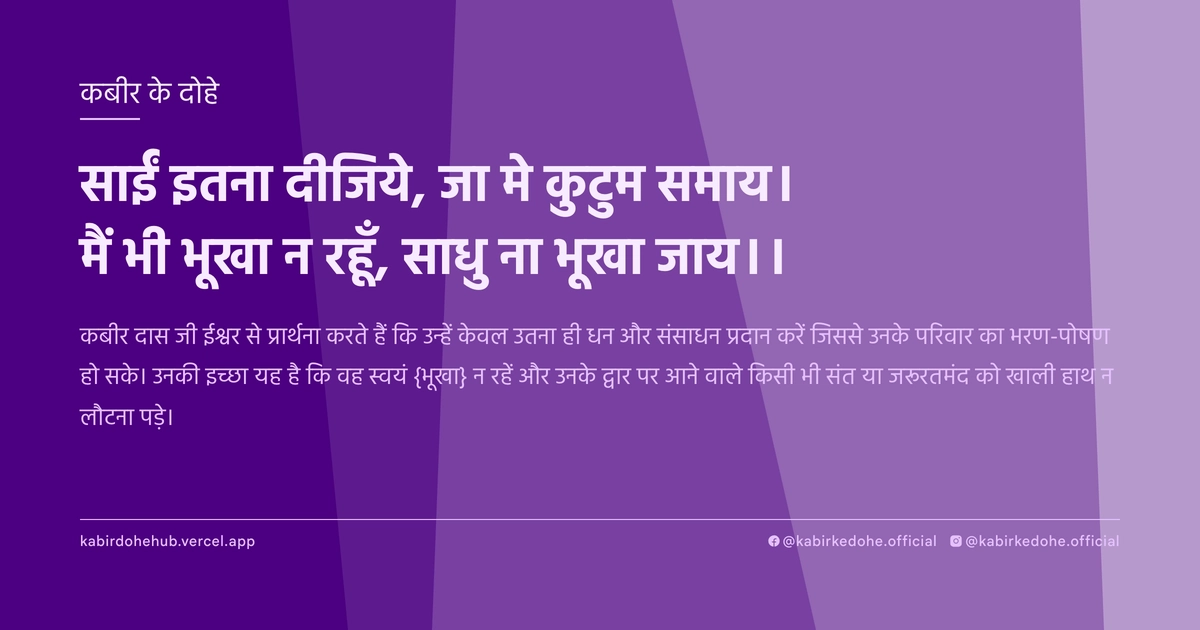
साईं इतना दीजिये, जा मे कुटुम समाय।
मैं भी भूखा न रहूँ, साधु ना भूखा जाय।।
Sai itna deejiye, ja me kutum samaye. Main bhi bhukha na rahun, sadhu na bhukha jaaye.
इस पृष्ठ पर इस कबीर दोहे का अर्थ (meaning), हिंदी व्याख्या और अंग्रेज़ी अनुवाद, दार्शनिक विश्लेषण और व्यावहारिक जीवन सीख दी गई है। यह दोहा संतोष (Contentment) विषय से जुड़ा है — Kabir doha meaning and explanation in Hindi and English.
अर्थ (Meaning):
कबीर दास जी ईश्वर से प्रार्थना करते हैं कि उन्हें केवल उतना ही धन और संसाधन प्रदान करें जिससे उनके परिवार का भरण-पोषण हो सके। उनकी इच्छा यह है कि वह स्वयं {भूखा} न रहें और उनके द्वार पर आने वाले किसी भी संत या जरूरतमंद को खाली हाथ न लौटना पड़े।
Kabir prays to the Divine for only as much sustenance as is necessary to support his family. His plea is for a balanced life where his own basic needs are met, and he possesses enough surplus to ensure that no seeker or needy soul who visits his door departs hungry.
व्याख्या (Interpretation):
शाब्दिक अर्थ में यह एक साधारण प्रार्थना है, परंतु आध्यात्मिक स्तर पर यह 'अपरिग्रह' (non-possessiveness) का उद्घोष है। कबीर यहाँ भौतिक अभाव की नहीं, बल्कि मानसिक तृप्ति की बात कर रहे हैं। यह दोहा निरगुण भक्ति के उस मार्ग को दर्शाता है जहाँ साधक संसार में रहते हुए भी उससे अनासक्त रहता है। यहाँ 'कुटुंब' केवल रक्त संबंधों को नहीं, बल्कि संपूर्ण मानवता को दर्शाता है। माया का जाल तब शुरू होता है जब 'पर्याप्त' की परिभाषा समाप्त हो जाती है और 'अधिक' की लालसा जन्म लेती है। यह विरोधाभास है कि वास्तविक समृद्धि संचय में नहीं, बल्कि वितरण में है। आत्मा जब यह जान लेती है कि वह ब्रह्म का अंश है, तो वह व्यक्तिगत स्वामित्व के भ्रम से मुक्त होकर सार्वभौमिक करुणा को अपनाती है।
Literally, this is a humble prayer for sustenance, but metaphorically, it is a profound manifesto on 'Aparigraha' (non-possessiveness). Kabir is not addressing material scarcity but rather the attainment of psychological contentment. This verse embodies the path of Nirgun Bhakti, where the seeker exists within the world yet remains detached from its lures. Here, 'family' transcends biological kinship to encompass all of humanity. The trap of Maya begins where the concept of 'enough' ends and the craving for 'more' commences. It presents the spiritual paradox that true abundance lies not in accumulation, but in the act of sharing. When the Atman realizes its non-duality with Brahman, it sheds the illusion of individual ownership and embraces universal compassion.
दार्शनिक विश्लेषण (Philosophical Analysis):
कबीर का यह दोहा उस युग की प्रतिक्रिया है जहाँ धार्मिक पाखंड और भौतिक संग्रह को पुण्य माना जाता था। उन्होंने कर्मकांडीय धर्म का विरोध किया और यह स्थापित किया कि ईश्वर की प्राप्ति मंदिर या मस्जिद में नहीं, बल्कि सेवा और संतोष में है। यह विचार अद्वैत वेदांत के करीब है, जहाँ 'मैं' और 'तू' का भेद मिट जाता है; यदि मैं और साधु एक ही चेतना के अंश हैं, तो उसकी भूख मेरी अपनी भूख है।
सूफी मत के 'फना' (अहंकार का विनाश) के सिद्धांत की तरह, कबीर यहाँ अपनी इच्छाओं को सीमित कर रहे हैं। जब मनुष्य अपनी आवश्यकताओं को न्यूनतम करता है, तो उसका अहंकार (Ego) क्षीण होने लगता है। संग्रह की प्रवृत्ति वास्तव में मृत्यु के भय और असुरक्षा की भावना से उपजती है।
कबीर यह स्पष्ट करते हैं कि अत्यधिक संपत्ति आध्यात्मिक प्रगति में बाधा है। जब संसाधन आवश्यकता से अधिक हो जाते हैं, तो वे मनुष्य को 'स्वामी' बना देते हैं और वह स्वयं संसाधनों का 'दास' बन जाता है। यह मनोवैज्ञानिक बंधन आत्मा को परमात्मा से दूर ले जाता है।
यहाँ 'साधु' केवल गेरुए वस्त्र पहनने वाले को नहीं, बल्कि उस शुद्ध चेतना को कहा गया है जो सत्य की खोज में है। साधु की सेवा करना वास्तव में अपने भीतर के दैवीय अंश की सेवा करना है। यह कर्मयोग का उच्चतम रूप है जहाँ फल की इच्छा नहीं, बल्कि कर्तव्य का बोध प्रधान है।
अंततः, यह दोहा उपभोक्तावाद की आधुनिक संस्कृति पर एक प्रहार है। यह सिखाता है कि मानसिक शांति बाहरी संपदा से नहीं, बल्कि आंतरिक संतुलन और परोपकार से आती है। यह भौतिकता और आध्यात्मिकता के बीच एक सेतु का निर्माण करता है।
Kabir's verse is a direct reaction to an era where ritualistic piety and material accumulation were often conflated with spiritual merit. He rejected the performative nature of organized religion, asserting that the Divine is encountered not in temples or mosques, but through selfless service and contentment. This aligns closely with Advaita Vedanta, where the duality between 'self' and 'other' dissolves; if the seeker and the saint are manifestations of the same consciousness, the saint's hunger is fundamentally one's own.
Mirroring the Sufi concept of 'Fana' (the annihilation of the ego), Kabir seeks to limit his desires. By minimizing personal needs, the practitioner weakens the grip of the ego. The impulse to hoard is rooted in a primal fear of death and a deep-seated sense of insecurity, which keeps the soul tethered to the material plane.
Kabir posits that excessive wealth is an impediment to spiritual evolution. When resources exceed necessity, the human transforms from a master of tools into a slave of possessions. This psychological bondage creates a veil of Maya, distancing the Atman from its source, Brahman.
In this context, the 'Sadhu' is not merely a cloistered ascetic but represents the pure consciousness seeking Truth. Serving the Sadhu is an act of serving the divine spark within oneself. This is the pinnacle of Karma Yoga, where the focus shifts from the fruit of action to the purity of the duty itself.
Ultimately, this Doha serves as a critique of modern consumerism. It teaches that serenity is not a product of external acquisition but a result of internal equilibrium and altruism. It constructs a bridge between the material necessity of survival and the spiritual necessity of liberation.
मूल संदेश (Core Message):
- अत्यधिक इच्छाएं आत्मा की शांति का सबसे बड़ा अवरोध हैं।
- संतोष ही सबसे बड़ा धन और वास्तविक समृद्धि है।
- स्वयं की पूर्ति तब होती है जब हम दूसरों की पूर्ति का माध्यम बनते हैं।
- भौतिक संचय अहंकार को बढ़ाता है, जबकि त्याग उसे मिटाता है।
- ब्रह्मांडीय सत्य यह है कि हम केवल ट्रस्टी हैं, मालिक नहीं।
- Excessive desire is the primary obstacle to the soul's tranquility.
- Contentment is the greatest wealth and the only true prosperity.
- Self-fulfillment is achieved only when we become a conduit for others' well-being.
- Material accumulation fuels the ego, while detachment dissolves it.
- The universal truth is that we are mere trustees of resources, not owners.
व्यावहारिक उदाहरण (Practical Example):
आर्यन एक उच्च पदस्थ कॉर्पोरेट मैनेजर था, जिसकी आय लाखों में थी, फिर भी वह हमेशा तनाव में रहता था।
उसका जीवन 'और अधिक' की अंतहीन दौड़ में बीता, जहाँ नए गैजेट्स और बड़ी गाड़ियाँ उसकी पहचान बन गई थीं।
एक दिन उसने महसूस किया कि उसकी इस डिजिटल ईगो और भौतिक संपदा के बावजूद, वह भीतर से पूरी तरह खाली और अकेला था।
वह एक सप्ताहांत एक छोटे गाँव गया, जहाँ उसने एक वृद्ध व्यक्ति को देखा जो बहुत कम में खुश था और दूसरों की मदद करता था।
उस वृद्ध ने आर्यन से कहा, 'बेटा, बर्तन जितना बड़ा होगा, उसे भरने की चिंता उतनी ही बढ़ेगी।'
यह 'कबीर ट्विस्ट' आर्यन के लिए एक जागृति की तरह था; उसने महसूस किया कि उसकी भूख भौतिक नहीं, बल्कि आध्यात्मिक थी।
उसने अपनी जीवनशैली बदली, विलासिता का त्याग किया और अपनी आय का एक बड़ा हिस्सा शिक्षा और स्वास्थ्य के लिए दान करना शुरू किया।
उसने पाया कि जब उसने 'संग्रह' की जगह 'साझा' करना शुरू किया, तो उसका मानसिक तनाव गायब हो गया।
अब वह केवल उतना कमाता है जिससे उसकी बुनियादी जरूरतें पूरी हों और वह समाज के काम आ सके।
आर्यन की पहचान अब उसके पद से नहीं, बल्कि उसकी करुणा और संतोष से जुड़ी है, जिससे उसे वास्तविक शांति मिली।
Aryan was a high-flying corporate manager earning millions, yet he lived in a state of perpetual anxiety and restlessness.
His life was an endless race for 'more,' where the latest gadgets and luxury cars became the primary markers of his identity.
Despite his digital ego and material wealth, he realized he was internally hollow, experiencing a profound sense of existential loneliness.
During a weekend retreat to a remote village, he encountered an elderly man who lived with minimal possessions but radiated immense joy.
The old man told Aryan, 'Son, the larger the vessel you carry, the greater the anxiety of keeping it full.'
This 'Kabir Twist' acted as a spiritual awakening; Aryan realized that his hunger was not material, but a misplaced spiritual longing.
He fundamentally restructured his life, shedding unnecessary luxuries and dedicating a significant portion of his income to grassroots education and healthcare.
He discovered that as he shifted from 'accumulation' to 'contribution,' his chronic stress and insomnia vanished almost overnight.
He now maintains a lifestyle that covers his basic needs while ensuring he has a surplus to uplift others in his community.
Aryan's identity is no longer tied to his corporate title, but to his capacity for compassion, granting him a peace that money could never buy.
अभ्यास मार्गदर्शन (Practice Guidance):
- दैनिक चिंतन: प्रतिदिन 10 मिनट मौन बैठें और विचार करें कि आपकी कौन सी इच्छाएं वास्तविक आवश्यकता हैं और कौन सी केवल सामाजिक दबाव (Digital Ego) हैं।
- स्व-पूछताछ जर्नल: लिखें कि 'यदि मेरे पास आज केवल बुनियादी जरूरतें हों, तो क्या मैं खुश रहूँगा?' और इसके पीछे के डर का विश्लेषण करें।
- व्यवहार परिवर्तन: महीने में एक बार अपनी किसी ऐसी वस्तु का दान करें जिसकी आपको आवश्यकता नहीं है, ताकि 'अपरिग्रह' का अभ्यास हो सके।
- निदान चेकलिस्ट: यदि आप भविष्य की चिंता में वर्तमान का आनंद खो रहे हैं या दूसरों की प्रगति से ईर्ष्या कर रहे हैं, तो समझें कि आप 'संतोष' के मार्ग से भटक गए हैं।
- Daily Contemplation: Spend 10 minutes in silence, discerning which of your desires are genuine needs and which are merely projections of social pressure or 'digital ego'.
- Self-Inquiry Journaling: Write a reflection on the prompt: 'If I possessed only my basic necessities today, would I be content?' Analyze the fear that arises from this question.
- Behavioral Shift: Once a month, consciously donate an item of value that you no longer need, practicing the art of 'Aparigraha' (non-attachment).
- Diagnostic Checklist: Recognize you have strayed from the path of contentment if you are sacrificing present joy for future accumulation or feeling envy toward another's prosperity.
चिंतन प्रश्न (Reflection Questions):
- आपकी 'पर्याप्त' की परिभाषा क्या है, और वह समय के साथ कैसे बदलती रही है?
- क्या आपका सार्वजनिक व्यक्तित्व (Public Image) आपकी आंतरिक शांति की कीमत पर बनाया गया है?
- यदि आपकी सारी भौतिक उपलब्धियां छीन ली जाएं, तो आपकी पहचान का क्या बचेगा?
- आप दूसरों की मदद करते समय वास्तव में उनकी सेवा कर रहे हैं या अपने 'दाता' होने के अहंकार को संतुष्ट कर रहे हैं?
- वह कौन सा डर है जो आपको 'कम' में खुश रहने से रोकता है?
- क्या आप अपनी जरूरतों और अपनी लालसाओं के बीच अंतर कर सकते हैं?
- What is your personal definition of 'enough,' and how has it evolved over time?
- Has your public identity been constructed at the expense of your internal peace?
- If all your material achievements were stripped away, what would remain of your identity?
- When you help others, are you truly serving them, or are you feeding the ego of being a 'provider'?
- What is the specific fear that prevents you from finding joy in simplicity?
- Can you honestly distinguish between your actual needs and your psychological cravings?