
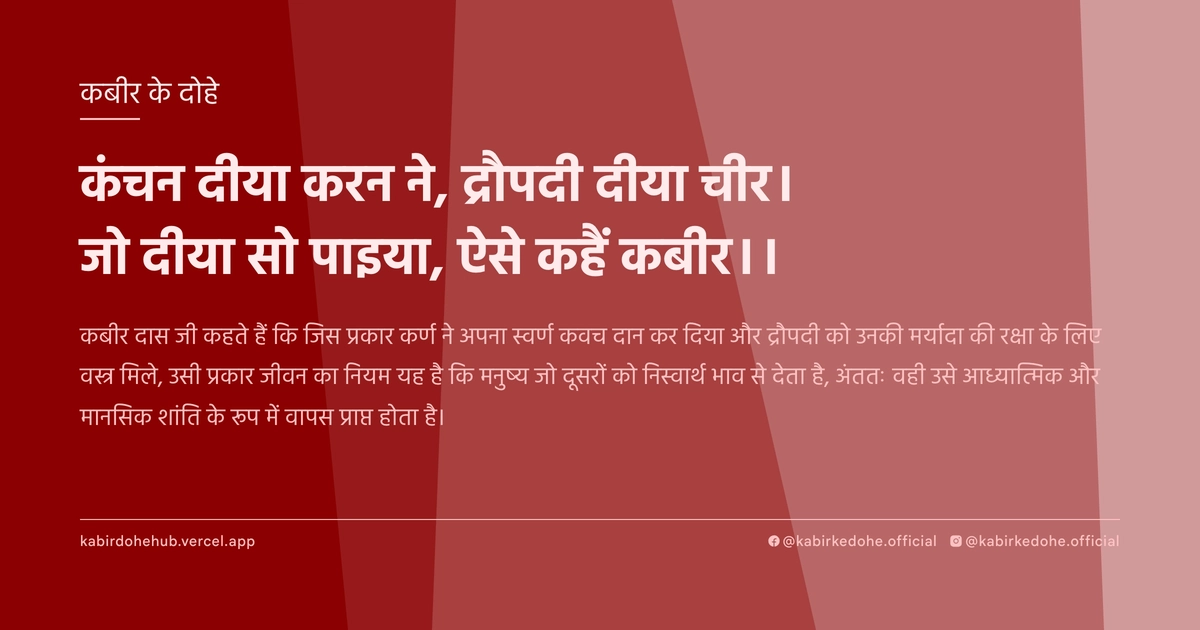
कंचन दीया करन ने, द्रौपदी दीया चीर।
जो दीया सो पाइया, ऐसे कहैं कबीर।।
Kanchan diya karan ne, Draupadi diya cheer. Jo diya so paiya, aise kahein Kabir.
इस पृष्ठ पर इस कबीर दोहे का अर्थ (meaning), हिंदी व्याख्या और अंग्रेज़ी अनुवाद, दार्शनिक विश्लेषण और व्यावहारिक जीवन सीख दी गई है। यह दोहा कर्म (Karma) विषय से जुड़ा है — Kabir doha meaning and explanation in Hindi and English.
अर्थ (Meaning):
कबीर दास जी कहते हैं कि जिस प्रकार कर्ण ने अपना स्वर्ण कवच दान कर दिया और द्रौपदी को उनकी मर्यादा की रक्षा के लिए वस्त्र मिले, उसी प्रकार जीवन का नियम यह है कि मनुष्य जो दूसरों को निस्वार्थ भाव से देता है, अंततः वही उसे आध्यात्मिक और मानसिक शांति के रूप में वापस प्राप्त होता है।
Kabir asserts that just as Karna sacrificed his golden armor and Draupadi was granted the endless cloth for her honor, the universal law of existence is that whatever one gives selflessly to others is exactly what one eventually receives in the form of spiritual abundance and inner peace.
व्याख्या (Interpretation):
यह दोहा दान और त्याग की पराकाष्ठा को दर्शाता है। शाब्दिक अर्थ में यह पौराणिक पात्रों के माध्यम से उदारता की बात करता है, लेकिन आध्यात्मिक स्तर पर यह 'अहंकार के विसर्जन' का संकेत है। कंचन (सोना) यहाँ केवल धातु नहीं, बल्कि सांसारिक मोह और अहंकार का प्रतीक है। जब साधक अपने 'स्व' को दूसरों की सेवा में समर्पित करता है, तो वह वास्तव में अपनी सीमित पहचान को मिटाकर अनंत ब्रह्म में विलीन हो रहा होता है। यह निर्गुण भक्ति का सार है जहाँ ईश्वर किसी मूर्ति में नहीं, बल्कि मानवता की सेवा और निस्वार्थ प्रेम में निवास करता है। माया का पर्दा तभी हटता है जब 'देने' की क्रिया में 'मैं' का भाव समाप्त हो जाए।
This couplet illustrates the pinnacle of sacrifice and detachment. While literally referencing mythological figures to highlight generosity, on a spiritual plane, it signals the 'dissolution of the ego.' The 'golden armor' (Kanchan) is not merely a physical object but a symbol of worldly attachments and the protective shell of the ego. When a seeker dedicates their 'self' to the service of others, they are effectively erasing their limited identity to merge with the infinite Brahman. This is the essence of Nirgun Bhakti, where the Divine resides not in idols, but in selfless love and service to humanity. The veil of Maya is lifted only when the act of giving is stripped of the 'I-ness' or the sense of agency.
दार्शनिक विश्लेषण (Philosophical Analysis):
कबीर का यह दृष्टिकोण तत्कालीन समाज में व्याप्त कर्मकांडीय दान के विरुद्ध एक प्रहार था। उस समय दान केवल पुण्य कमाने या सामाजिक प्रतिष्ठा के लिए किया जाता था, लेकिन कबीर 'त्याग' को एक आंतरिक मनोवैज्ञानिक रूपांतरण के रूप में देखते हैं। वे अद्वैत वेदांत के इस सिद्धांत को पुष्ट करते हैं कि जब देने वाला और लेने वाला एक ही चेतना का हिस्सा हों, तो दान वास्तव में स्वयं को स्वयं को ही देना है।
सूफी मत के 'फना' (अहंकार का विनाश) के समान, कबीर यहाँ यह समझाते हैं कि जब तक मनुष्य अपने पास मौजूद 'स्वर्ण' (अहंकार और संपत्ति) को पकड़े रहता है, वह बंधन में रहता है। जैसे ही वह इसे छोड़ता है, वह मुक्त हो जाता है। यह भौतिक वस्तुओं का त्याग नहीं, बल्कि उनके प्रति आसक्ति का त्याग है।
कबीर जाति और धर्म की सीमाओं को तोड़ते हुए यह संदेश देते हैं कि सच्ची भक्ति मंदिर या मस्जिद में नहीं, बल्कि उस करुणा में है जो एक मनुष्य को दूसरे के दुःख से जोड़ती है। वे ritualism को नकारते हुए 'सहज मार्ग' की बात करते हैं, जहाँ हृदय की शुद्धता ही सबसे बड़ा धर्म है।
मनोवैज्ञानिक स्तर पर, यह दोहा 'प्रतिफल की इच्छा' (Expectation) को समाप्त करने की बात करता है। जब हम यह सोचकर देते हैं कि हमें वापस मिलेगा, तो वह व्यापार है, दान नहीं। कबीर का 'जो दीया सो पाइया' एक आध्यात्मिक प्रतिध्वनि है—जो शांति आप दूसरों को देते हैं, वही शांति आपके भीतर जन्म लेती है।
अंततः, यह विश्लेषण हमें इस निष्कर्ष पर ले जाता है कि ब्रह्मांड एक दर्पण की तरह है। यदि हम अभाव और क्रोध बांटते हैं, तो वही लौटकर आता है। यदि हम करुणा और त्याग बांटते हैं, तो हम उसी अनंत चेतना का हिस्सा बन जाते हैं जिसने हमें बनाया है।
Kabir's perspective here is a direct critique of the ritualistic charity prevalent in his era. At that time, giving was often a tool for accumulating merit (punya) or social prestige, but Kabir views 'sacrifice' as an internal psychological transformation. He reinforces the Advaita Vedanta principle that if the giver and the receiver are part of the same universal consciousness, then giving is essentially the Self giving to the Self.
Similar to the Sufi concept of 'Fana' (annihilation of the ego), Kabir explains that as long as a person clings to their 'gold' (ego and possessions), they remain in bondage. The moment they let go, they attain liberation. This is not a call to abandon physical objects, but to abandon the attachment to them.
Breaking the barriers of caste and creed, Kabir suggests that true devotion is not found in temples or mosques, but in the compassion that binds one human to another's suffering. He rejects ritualism in favor of the 'Sahaj Marg' (the natural path), where purity of heart is the highest religion.
On a psychological level, this couplet addresses the eradication of 'expectation.' When we give with the hope of a return, it is a transaction, not a sacrifice. Kabir's 'Jo diya so paiya' is a spiritual echo—the peace you bestow upon others is the very peace that blossoms within you.
Ultimately, this analysis leads to the conclusion that the universe is a mirror. If we distribute scarcity and anger, that is what returns. If we distribute compassion and detachment, we merge with the infinite consciousness that created us.
मूल संदेश (Core Message):
- अहंकार का त्याग ही वास्तविक प्राप्ति है।
- निस्वार्थ सेवा ही ईश्वर की सच्ची पूजा है।
- जो हम दूसरों को देते हैं, वही हमारे भीतर विकसित होता है।
- भौतिक आसक्ति आत्मा की स्वतंत्रता में सबसे बड़ी बाधा है।
- करुणा और त्याग ही मनुष्य को ब्रह्म के करीब ले जाते हैं।
- The surrender of the ego is the only true acquisition.
- Selfless service is the highest form of worship to the Divine.
- What we bestow upon others is what blossoms within us.
- Material attachment is the greatest hurdle to spiritual liberation.
- Compassion and sacrifice are the bridges leading the soul to Brahman.
व्यावहारिक उदाहरण (Practical Example):
एक समय की बात है, वाराणसी के घाटों पर रामू नाम का एक वृद्ध नाई रहता था। वह बहुत गरीब था, लेकिन उसका हृदय करुणा से भरा था।
रामू के पास केवल एक पुरानी साइकिल और कुछ पुराने बर्तन थे, जो उसकी पूरी जमापूंजी थी।
एक दिन उसने देखा कि एक युवा छात्र, जो शहर से पढ़ने आया था, भूख और बीमारी के कारण सड़क किनारे बेहोश पड़ा है।
रामू के पास उस समय केवल एक वक्त की रोटी और कुछ सिक्के थे, जो उसने अपनी दवा के लिए बचाए थे।
बिना सोचे, रामू ने अपनी रोटी उस छात्र को खिलाई और अपने बचे हुए सिक्कों से उसके लिए दवा खरीदी।
उसने अपनी साइकिल भी एक स्थानीय डॉक्टर को दे दी ताकि वह उस बीमार छात्र को अस्पताल पहुँचा सके।
रामू के पास अब कुछ नहीं बचा था, लेकिन उसके चेहरे पर एक अजीब सी शांति और संतोष था।
महीनों बाद, वह छात्र ठीक होकर एक बड़ा डॉक्टर बना और उसने रामू के लिए एक छोटा सा क्लिनिक और घर बनवाया।
लेकिन रामू के लिए असली 'प्राप्ति' वह भौतिक घर नहीं था, बल्कि वह आंतरिक आनंद था जो उसने उस दिन त्याग के समय महसूस किया था।
रामू ने सीखा कि जब उसने अपना 'कंचन' (सिक्के और साइकिल) दिया, तो उसे बदले में 'शांति' और 'प्रेम' मिला, जो किसी भी धन से बड़ा था।
Once, on the ghats of Varanasi, lived an elderly barber named Ramu. He was very poor, but his heart was overflowing with compassion.
Ramu owned nothing but an old bicycle and a few worn-out utensils, which constituted his entire life's savings.
One day, he noticed a young student, who had come to the city for studies, lying unconscious by the roadside due to hunger and illness.
At that moment, Ramu had only one meal's worth of bread and a few coins he had saved for his own medicine.
Without a second thought, Ramu fed his bread to the student and used his remaining coins to buy the necessary medicine.
He even gave his bicycle to a local doctor so that the ailing student could be transported to the hospital quickly.
Ramu now had nothing left to his name, yet a strange sense of peace and contentment radiated from his face.
Months later, the student recovered and became a successful doctor, eventually building a small clinic and a home for Ramu.
However, for Ramu, the true 'gain' was not the physical house, but the internal bliss he experienced at the moment of sacrifice.
Ramu realized that when he gave away his 'gold' (coins and bicycle), he received in return 'peace' and 'love,' which were far more valuable than any material wealth.
अभ्यास मार्गदर्शन (Practice Guidance):
- दैनिक अभ्यास: प्रतिदिन एक ऐसा कार्य करें जिसमें आपका कोई निजी लाभ न हो, केवल दूसरे की सहायता हो।
- आत्म-चिंतन: रात को सोने से पहले विचार करें कि आज आपने अपनी किस 'आसक्ति' या 'अहंकार' का त्याग किया।
- व्यवहार परिवर्तन: जब भी आप किसी की मदद करें, तो यह भूल जाएं कि आपने मदद की है; इसे एक स्वाभाविक कर्तव्य मानें।
- डायग्नोस्टिक चेकलिस्ट: क्या मदद करने के बाद आप प्रशंसा की उम्मीद करते हैं? (यदि हाँ, तो अभी भी अहंकार मौजूद है)। क्या आप देने के बाद रिक्तता महसूस करते हैं या पूर्णता? (पूर्णता का अनुभव ही वास्तविक त्याग है)।
- Daily Practice: Perform one act every day that offers no personal gain, focusing solely on the benefit of another.
- Self-Inquiry: Before sleeping, reflect on which specific 'attachment' or 'ego-driven desire' you surrendered today.
- Behavioral Shift: When helping someone, consciously erase the memory of the act; treat it as a natural duty rather than a favor.
- Diagnostic Checklist: Do you expect praise after helping? (If yes, the ego is still present). Do you feel a sense of void or fullness after giving? (Experiencing fullness is the sign of true sacrifice).
चिंतन प्रश्न (Reflection Questions):
- क्या मेरा दान वास्तव में त्याग है, या यह मेरी सामाजिक छवि को सुधारने का एक तरीका है?
- यदि मुझे पता हो कि मुझे कभी कुछ वापस नहीं मिलेगा, तो क्या मैं तब भी दूसरों की मदद करूँगा?
- मेरे जीवन का वह 'कंचन' (स्वर्ण कवच) क्या है जिसे मैं पकड़े हुए हूँ और जो मुझे वास्तव में मुक्त होने से रोक रहा है?
- क्या मैं अपनी डिजिटल पहचान (सोशल मीडिया) पर अपनी उदारता का प्रदर्शन करके उसे प्रदूषित कर रहा हूँ?
- जब मैं किसी की मदद करता हूँ, तो क्या मैं खुद को 'दाता' और दूसरे को 'याचक' मानकर श्रेष्ठता का अनुभव करता हूँ?
- Is my charity truly a sacrifice, or is it merely a tool to polish my social image?
- If I knew for certain that I would never receive anything in return, would I still help others?
- What is the 'golden armor' in my life that I am clinging to, which is actually preventing my liberation?
- Am I polluting my acts of kindness by showcasing them through my digital identity on social media?
- When I help someone, do I subconsciously view myself as the 'giver' and the other as the 'beggar,' thereby feeding my sense of superiority?