
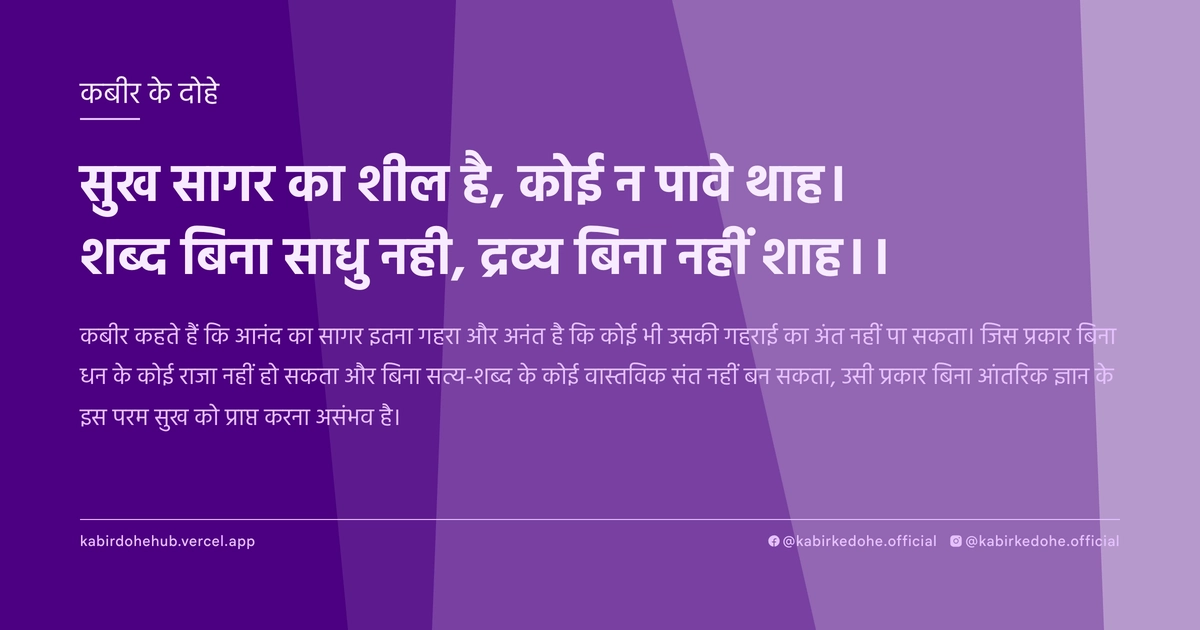
सुख सागर का शील है, कोई न पावे थाह।
शब्द बिना साधु नही, द्रव्य बिना नहीं शाह।।
Sukh sagar ka sheel hai, koi na paave thaah. Shabd bina sadhu nahi, dravya bina nahi shah.
इस पृष्ठ पर इस कबीर दोहे का अर्थ (meaning), हिंदी व्याख्या और अंग्रेज़ी अनुवाद, दार्शनिक विश्लेषण और व्यावहारिक जीवन सीख दी गई है। यह दोहा संतोष (Contentment) विषय से जुड़ा है — Kabir doha meaning and explanation in Hindi and English.
अर्थ (Meaning):
कबीर कहते हैं कि आनंद का सागर इतना गहरा और अनंत है कि कोई भी उसकी गहराई का अंत नहीं पा सकता। जिस प्रकार बिना धन के कोई राजा नहीं हो सकता और बिना सत्य-शब्द के कोई वास्तविक संत नहीं बन सकता, उसी प्रकार बिना आंतरिक ज्ञान के इस परम सुख को प्राप्त करना असंभव है।
Kabir asserts that the ocean of bliss is so profound and infinite that no one can find its bottom. Just as a king cannot exist without wealth and a true saint cannot exist without the divine Word (Shabd), one cannot attain the ultimate state of joy without the realization of the inner Truth.
व्याख्या (Interpretation):
यह दोहा भौतिक और आध्यात्मिक समृद्धि के बीच एक समानांतर तुलना करता है। 'सुख-सागर' यहाँ निर्वाण या ब्रह्म-अवस्था का प्रतीक है, जो असीम है। कबीर स्पष्ट करते हैं कि जिस प्रकार सांसारिक सत्ता के लिए 'द्रव्य' (संपत्ति) अनिवार्य है, उसी प्रकार आध्यात्मिक सत्ता के लिए 'शब्द' (गुरु द्वारा दिया गया मंत्र या आंतरिक ध्वनि) अनिवार्य है। यहाँ 'शब्द' केवल भाषा नहीं, बल्कि वह नाद है जो साधक को माया के भ्रम से मुक्त कर आत्म-साक्षात्कार की ओर ले जाता है। यह निर्गुण भक्ति का सार है, जहाँ ईश्वर किसी मूर्ति में नहीं बल्कि चेतना के सूक्ष्म स्पंदन में निहित है। अंततः, यह मनुष्य को यह समझाने का प्रयास है कि बाहरी आडंबरों से शांति नहीं मिलती, बल्कि आंतरिक अनुशासन और शब्द-साधना से ही उस अनंत सागर की गहराई में उतरा जा सकता है।
This couplet draws a parallel between material prosperity and spiritual attainment. The 'Ocean of Bliss' symbolizes Nirvana or the state of Brahman, which is boundless. Kabir clarifies that just as 'dravya' (wealth) is essential for worldly sovereignty, the 'Shabd' (the divine Word or inner sound transmitted by a Guru) is essential for spiritual sovereignty. Here, 'Shabd' refers not to mere language, but to the primordial vibration that liberates the seeker from the illusions of Maya. This is the essence of Nirgun Bhakti, where the Divine is not found in idols but in the subtle vibrations of consciousness. Ultimately, it emphasizes that peace is not achieved through external rituals, but through internal discipline and the practice of the Word, allowing one to plunge into the depths of that infinite ocean.
दार्शनिक विश्लेषण (Philosophical Analysis):
कबीर का यह दृष्टिकोण उनके समय के कट्टरपंथी धार्मिक वातावरण के विरुद्ध एक सशक्त प्रहार था। उन्होंने देखा कि लोग केवल तीर्थयात्राओं और कर्मकांडों के माध्यम से मोक्ष पाने की कोशिश कर रहे थे, जबकि वास्तविक रूपांतरण आंतरिक था। यह दोहा अद्वैत वेदांत के उस सिद्धांत से मेल खाता है जहाँ आत्मा और परमात्मा की एकता को पहचाना जाता है, लेकिन इस एकता तक पहुँचने का मार्ग 'शब्द' या 'ज्ञान' है।
सूफी मत के 'ज़िक्र' (ईश्वर का निरंतर स्मरण) के समान, कबीर का 'शब्द' साधक को अहंकार के विसर्जन की ओर ले जाता है। जब तक साधक 'मैं' और 'मेरा' के दायरे में रहता है, वह सुख-सागर की गहराई को नहीं छू सकता। द्रव्य का उदाहरण देकर कबीर यह समझाते हैं कि जैसे बिना पूंजी के व्यापार संभव नहीं, वैसे ही बिना आध्यात्मिक पात्रता के ज्ञान संभव नहीं है।
यहाँ 'साधु' का अर्थ केवल गेरुआ वस्त्र पहनने वाला व्यक्ति नहीं, बल्कि वह है जिसने अपनी इंद्रियों पर विजय प्राप्त कर ली है। कबीर जाति और वर्ग के भेदभाव को पूरी तरह नकारते हैं; उनके लिए पात्रता का पैमाना केवल 'शब्द' के प्रति समर्पण है। यह एक मनोवैज्ञानिक रूपांतरण की प्रक्रिया है जहाँ बाहरी शोर शांत होता है और आंतरिक मौन गूँजने लगता है।
दार्शनिक स्तर पर, यह दोहा द्वैत (Dualism) से अद्वैत (Non-dualism) की यात्रा है। 'थाह' न पाना इस बात का संकेत है कि परमात्मा सीमित नहीं है; वह अनंत है। जो व्यक्ति स्वयं को सीमित मानता है, वह कभी भी उस अनंतता का अनुभव नहीं कर सकता।
अंततः, कबीर यह संदेश देते हैं कि आध्यात्मिक यात्रा में शॉर्टकट नहीं होते। जिस प्रकार एक राजा को अपनी संपत्ति अर्जित करनी पड़ती है, उसी प्रकार एक साधक को अपने भीतर के अंधकार को मिटाकर 'शब्द' की ज्योति जलानी पड़ती है। यह साधना ही उसे उस सुख-सागर का स्वामी बनाती है।
Kabir's perspective is a powerful critique of the dogmatic religious environment of his era. He observed people attempting to attain salvation through mere pilgrimages and rituals, while true transformation remained internal. This couplet aligns with the Advaita Vedanta principle of recognizing the unity of Atman and Brahman, asserting that the path to this realization is 'Shabd' or spiritual knowledge.
Similar to the Sufi practice of 'Zikr' (constant remembrance of God), Kabir's 'Shabd' leads the seeker toward the annihilation of the ego. As long as the seeker remains within the boundaries of 'I' and 'mine,' they cannot touch the depths of the ocean of bliss. By using the example of 'dravya' (wealth), Kabir explains that just as trade is impossible without capital, spiritual enlightenment is impossible without spiritual merit.
In this context, a 'Sadhu' is not merely someone wearing saffron robes, but one who has conquered their senses. Kabir completely rejects caste and class distinctions; for him, the only criterion for eligibility is devotion to the 'Shabd.' This is a process of psychological transformation where external noise fades and internal silence begins to resonate.
Philosophically, this couplet represents the journey from Duality to Non-duality. The inability to find the 'bottom' (thaah) indicates that the Divine is not limited; it is infinite. One who perceives themselves as limited can never experience this infinity.
Ultimately, Kabir conveys that there are no shortcuts in the spiritual journey. Just as a king must accumulate wealth, a seeker must extinguish their inner darkness to ignite the light of the 'Shabd.' This disciplined practice is what makes one the master of the ocean of bliss.
मूल संदेश (Core Message):
- बाहरी आडंबर केवल एक मुखौटा हैं, वास्तविक सत्य भीतर है।
- बिना आंतरिक रूपांतरण के कोई भी धार्मिक पहचान व्यर्थ है।
- परम आनंद असीम है और इसे केवल समर्पण से पाया जा सकता है।
- शब्द (सत्य) ही वह कुंजी है जो आत्मा के द्वार खोलती है।
- अहंकार का विसर्जन ही अनंतता में विलीन होने का एकमात्र मार्ग है।
- External rituals are mere masks; true reality resides within.
- Any religious identity is void without internal transformation.
- Ultimate bliss is infinite and attainable only through surrender.
- The Word (Truth) is the only key that unlocks the doors of the soul.
- The dissolution of ego is the sole path to merging with the infinite.
व्यावहारिक उदाहरण (Practical Example):
वाराणसी के घाटों पर रहने वाली एक वृद्ध विधवा, जानकी, का जीवन केवल दूसरों की सेवा और मंदिर की सीढ़ियों पर बिताए गए घंटों तक सीमित था। वह मानती थी कि केवल मंत्रों का जाप और कठिन उपवास ही उसे मोक्ष दिलाएंगे। वह हर दिन घंटों तक माला जपती, लेकिन उसके मन में अभी भी अपने परिवार के प्रति गहरी कड़वाहट और समाज के प्रति शिकायतें थीं।
एक दिन उसकी मुलाकात एक फकीर से हुई, जिसने उसे चुनौती दी कि वह अपनी माला को एक तरफ रख दे और केवल अपने भीतर की सांसों की आवाज़ को सुने। जानकी ने पहले तो इसे समय की बर्बादी माना, क्योंकि उसने जीवन भर केवल बाहरी अनुष्ठानों को ही 'धर्म' समझा था।
फकीर ने उससे कहा, 'तुम किनारे पर बैठकर लहरें गिन रही हो, जबकि खजाना समुद्र की गहराई में है। बिना शब्द के तुम केवल एक नाम हो, साधु नहीं।' जानकी को यह बात चुभी, लेकिन उसने पहली बार अपनी आंतरिक रिक्तता को महसूस किया।
उसने अगले कुछ महीनों तक बाहरी शोर से दूरी बनाई और केवल अपने भीतर उठने वाले विचारों और उनकी गूँज का निरीक्षण करना शुरू किया। उसने पाया कि उसकी माला का जाप केवल एक यांत्रिक क्रिया थी, जिसमें आत्मा का कोई स्पर्श नहीं था।
धीरे-धीरे, उसने महसूस किया कि जिस 'ईश्वर' को वह मंदिर की मूर्तियों में खोज रही थी, वह वास्तव में उसके भीतर की शांति में निहित है। उसकी कड़वाहट धीरे-धीरे करुणा में बदलने लगी।
एक दिन, जब वह एक बीमार व्यक्ति की सेवा कर रही थी, उसे अचानक एक ऐसा अनुभव हुआ जैसे वह स्वयं उस व्यक्ति के दुख में विलीन हो गई हो। उसे महसूस हुआ कि वह अब अलग नहीं है, बल्कि उसी अनंत सागर का हिस्सा है।
उसने अब उपवास करना बंद नहीं किया, लेकिन अब वह उपवास शरीर को कष्ट देने के लिए नहीं, बल्कि मन को शुद्ध करने के लिए करती थी। उसकी भक्ति अब प्रदर्शन नहीं, बल्कि एक आंतरिक अनुभव बन गई थी।
जानकी का रूपांतरण यह था कि उसने 'अनुष्ठान' को 'अनुभूति' में बदल दिया। वह अब केवल एक धार्मिक महिला नहीं थी, बल्कि एक ऐसी आत्मा बन गई थी जिसने सुख-सागर की गहराई को छू लिया था।
Janaki, an elderly widow living on the ghats of Varanasi, spent her life in the service of others and hours on the temple steps. She believed that only the chanting of mantras and rigorous fasting would grant her salvation. Every day she spent hours with her prayer beads, yet her heart remained filled with deep bitterness toward her family and grievances against society.
One day, she met a wandering fakir who challenged her to set aside her beads and simply listen to the sound of her own breath. Janaki initially viewed this as a waste of time, as she had spent her entire life equating 'religion' with external rituals.
The fakir told her, 'You are counting waves while sitting on the shore, but the treasure lies in the depths of the ocean. Without the Word, you are merely a name, not a saint.' This stung Janaki, but for the first time, she felt her own internal emptiness.
Over the next few months, she distanced herself from external noise and began observing the thoughts and echoes arising within her. She realized that her chanting had become a mechanical act, devoid of any soulful connection.
Gradually, she discovered that the 'God' she had been seeking in temple idols actually resided in the peace within her. Her bitterness slowly transformed into compassion.
One day, while tending to a sick person, she suddenly felt as if she had merged into that person's suffering. She realized she was no longer separate, but a part of that same infinite ocean.
She did not stop her fasts, but she no longer fasted to torture the body; she fasted to purify the mind. Her devotion was no longer a performance, but an internal experience.
Janaki's transformation was that she turned 'ritual' into 'realization.' She was no longer just a religious woman, but a soul that had touched the depths of the ocean of bliss.
अभ्यास मार्गदर्शन (Practice Guidance):
- प्रतिदिन 20 मिनट 'अनाहत नाद' (आंतरिक ध्वनि) का ध्यान करें। बाहरी शोर को बंद कर केवल अपनी सांसों और हृदय की धड़कन पर ध्यान केंद्रित करें।
- आत्म-पूछताछ जर्नल: प्रतिदिन लिखें कि आज आपने कितनी बार अपनी प्रतिक्रियाओं में 'अहंकार' (Ego) को महसूस किया और कितनी बार 'शब्द' (सत्य) को प्राथमिकता दी।
- व्यवहारिक परिवर्तन: किसी भी धार्मिक कार्य को करने से पहले खुद से पूछें, 'क्या मैं इसे फल की इच्छा या प्रदर्शन के लिए कर रहा हूँ, या यह मेरी आंतरिक शांति का विस्तार है?'
- निदान चेकलिस्ट: यदि आप अभी भी दूसरों के न्याय करने में लगे हैं, तो आप किनारे पर हैं। यदि आप दूसरों के दुख में स्वयं को देखते हैं, तो आप सुख-सागर की गहराई में उतर रहे हैं।
- Practice 'Anahata Nada' (inner sound) meditation for 20 minutes daily. Silence all external noise and focus solely on your breath and heartbeat.
- Self-Inquiry Journal: Record daily instances where you felt 'Ego' driving your reactions versus when you prioritized the 'Shabd' (Truth).
- Behavioral Shift: Before performing any religious act, ask yourself, 'Am I doing this for reward or show, or is this an expansion of my inner peace?'
- Diagnostic Checklist: If you are still judging others, you are on the shore. If you see yourself in the suffering of others, you are descending into the depths of the ocean of bliss.
चिंतन प्रश्न (Reflection Questions):
- क्या मेरी आध्यात्मिक पहचान मेरे वास्तविक चरित्र से अधिक मेरी सामाजिक छवि पर आधारित है?
- मैं किन 'शब्दों' या विश्वासों के पीछे भाग रहा हूँ, और क्या वे मुझे वास्तव में मुक्त कर रहे हैं या नए बंधन बना रहे हैं?
- मेरे जीवन में 'द्रव्य' (संपत्ति) का क्या स्थान है, और क्या यह मेरी आध्यात्मिक प्रगति में बाधा बन रहा है?
- यदि कल मेरी सभी धार्मिक पहचानें छीन ली जाएं, तो मेरे भीतर क्या बचेगा?
- मैं अपनी शांति के लिए बाहरी परिस्थितियों पर कितना निर्भर हूँ, और मैं आंतरिक गहराई में उतरने से क्यों डरता हूँ?
- Is my spiritual identity based more on my social image than on my actual character?
- Which 'Words' or beliefs am I chasing, and are they truly liberating me or creating new bonds?
- What is the role of 'dravya' (wealth) in my life, and is it hindering my spiritual progress?
- If all my religious identities were stripped away tomorrow, what would remain within me?
- How dependent am I on external circumstances for my peace, and why do I fear descending into inner depths?