
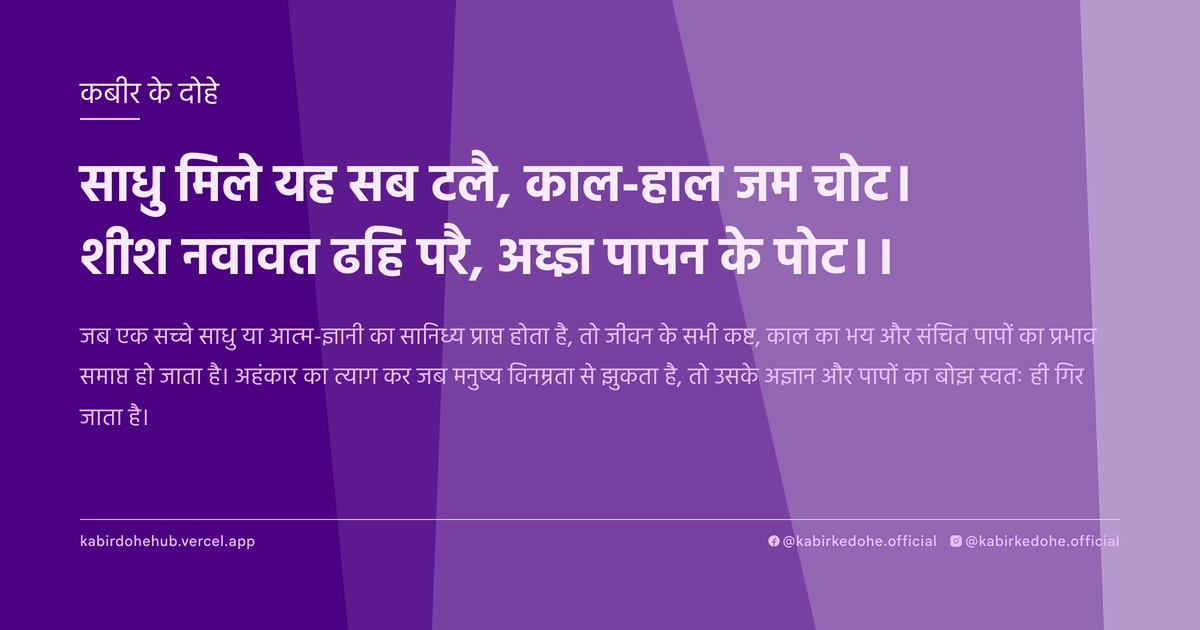
साधु मिले यह सब टलै, काल-हाल जम चोट।
शीश नवावत ढहि परै, अघ्ज्ञ पापन के पोट।।
Sadhu mile yeh sab talai, kaal-haal jam chot. Sheesh navavat dhahi parai, aghya paapan ke pot.
इस पृष्ठ पर इस कबीर दोहे का अर्थ (meaning), हिंदी व्याख्या और अंग्रेज़ी अनुवाद, दार्शनिक विश्लेषण और व्यावहारिक जीवन सीख दी गई है। यह दोहा गुरु महत्व (The Guru's Importance) विषय से जुड़ा है — Kabir doha meaning and explanation in Hindi and English.
अर्थ (Meaning):
जब एक सच्चे साधु या आत्म-ज्ञानी का सानिध्य प्राप्त होता है, तो जीवन के सभी कष्ट, काल का भय और संचित पापों का प्रभाव समाप्त हो जाता है। अहंकार का त्याग कर जब मनुष्य विनम्रता से झुकता है, तो उसके अज्ञान और पापों का बोझ स्वतः ही गिर जाता है।
When one encounters a true Sadhu or an enlightened soul, all worldly sufferings, the dread of time, and the impact of accumulated karmas are dissolved. By bowing the head in genuine humility, the heavy burden of ignorance and sin, carried by the unaware, finally falls away.
व्याख्या (Interpretation):
इस दोहे का शाब्दिक अर्थ है कि गुरु के मिलने से दुखों का अंत होता है। लेकिन गहरा आध्यात्मिक अर्थ यह है कि 'साधु' केवल एक व्यक्ति नहीं, बल्कि वह 'चेतना' है जो हमें हमारे वास्तविक स्वरूप से परिचित कराती है। 'काल-हाल' समय और परिस्थिति के उस प्रहार को दर्शाता है जो अहंकार से ग्रस्त व्यक्ति को तोड़ देता है। जब साधक 'शीश नवाता' है, तो यह केवल शारीरिक क्रिया नहीं, बल्कि 'अहंकार' (Ego) का विसर्जन है। Nirgun Bhakti के अनुसार, जब तक 'मैं' (I-ness) जीवित है, तब तक माया का पर्दा बना रहता है। जैसे ही अहंकार गिरता है, अज्ञान का वह 'पोट' या थैला फट जाता है जिसमें हमने जन्मों के संचित संस्कार और पाप भर रखे थे। यह अद्वैत वेदांत की उस स्थिति को दर्शाता है जहाँ जीव और ब्रह्म के बीच का अंतर मिट जाता है, और केवल शुद्ध चैतन्य शेष रहता है।
Literally, the verse suggests that a saint's presence removes misery. Metaphorically, the 'Sadhu' represents the awakened consciousness or the inner guide that mirrors our true nature. 'Kaal-haal' refers to the crushing blow of time and circumstance that inevitably strikes those anchored in the ego. The act of 'bowing the head' is not a ritual of subservience but the symbolic annihilation of the 'I-concept.' In the tradition of Nirgun Bhakti, the ego is the primary veil of Maya; as long as the individual perceives themselves as separate from the Whole, they remain prisoners of karma. When the ego collapses, the 'pot'—the psychic reservoir of accumulated sins and ignorance—bursts open. This aligns with Advaita Vedanta, where the realization of non-duality (Atman-Brahman) dissolves the illusion of the sinful, limited self, replacing it with the infinite, stainless light of pure awareness.
दार्शनिक विश्लेषण (Philosophical Analysis):
कबीर का यह दर्शन उस समय के कट्टरपंथी धार्मिक ढांचे के विरुद्ध एक सशक्त प्रहार था, जहाँ मोक्ष केवल कठिन अनुष्ठानों या जातिगत श्रेष्ठता से जुड़ा था। कबीर ने 'साधु' की परिभाषा को बदल दिया; उनके लिए साधु वह नहीं जो गेरुआ वस्त्र पहने, बल्कि वह है जिसने अपनी इंद्रियों को जीत लिया है। यह दृष्टिकोण सूफीवाद के 'पीर' या 'मुर्शिद' की अवधारणा के समान है, जहाँ गुरु का मार्गदर्शन आत्मा को परमात्मा (Ishq-e-Haqiqi) से मिलाने का एकमात्र सेतु है।
दार्शनिक स्तर पर, यह दोहा 'अहंकार' और 'मुक्ति' के बीच के व्युत्क्रमानुपाती संबंध को स्पष्ट करता है। जब तक मनुष्य स्वयं को कर्ता मानता है, वह अपने पापों के बोझ तले दबा रहता है। कबीर यहाँ 'शरणगति' की बात कर रहे हैं, जो वास्तव में स्वयं के मिथ्या अहंकार को सत्य के समक्ष समर्पित करने की प्रक्रिया है। यह मानसिक रूपांतरण है, जहाँ 'पाप' को बाहरी दंड के रूप में नहीं, बल्कि आंतरिक अज्ञान के रूप में देखा जाता है।
अद्वैत वेदांत के परिप्रेक्ष्य में, पाप और पुण्य केवल माया के खेल हैं। जब साधु (ज्ञान) का प्रकाश आता है, तो यह स्पष्ट हो जाता है कि न तो कोई पापी था और न ही कोई पुण्य करने वाला; केवल एक अज्ञान था जिसने स्वयं को शरीर मान लिया था। कबीर यहाँ कर्मकांडीय शुद्धि के बजाय 'बोध' की शुद्धि पर बल देते हैं।
यह दोहा मनोवैज्ञानिक रूप से 'कैथार्सिस' या भावनात्मक विरेचन की बात करता है। जब एक व्यक्ति पूरी तरह से समर्पित होता है, तो उसका मानसिक प्रतिरोध समाप्त हो जाता है, जिससे वह उन गहरे घावों और ग्लानियों को छोड़ पाता है जिन्हें वह वर्षों से ढो रहा था। यह समर्पण ही उसे 'काल' (मृत्यु और समय) के भय से मुक्त करता है।
अंततः, कबीर यह संदेश देते हैं कि मुक्ति किसी बाहरी तीर्थ या मंदिर में नहीं, बल्कि उस आंतरिक विनम्रता में है जो हमें सत्य के सामने झुकना सिखाती है। यह झुकाव ही वास्तव में ऊपर उठने की पहली सीढ़ी है।
Kabir’s philosophy serves as a potent critique of the rigid religious structures of his era, where liberation was often gatekept by complex rituals or caste hierarchies. He redefines the 'Sadhu' not as a wearer of saffron robes, but as one who has conquered the senses. This mirrors the Sufi concept of the 'Pir' or 'Murshid,' where the guide is the essential bridge connecting the fragmented soul to the Divine Truth (Ishq-e-Haqiqi).
Philosophically, the verse elucidates the inverse relationship between the ego and liberation. As long as the individual identifies as the 'doer' (Karta), they remain burdened by the weight of their karmic debts. Kabir advocates for 'Sharanagati' (surrender), which is not an act of weakness but a conscious process of dissolving the false identity into the Absolute Truth.
From the lens of Advaita Vedanta, sin and merit are mere fluctuations within the realm of Maya. When the light of a true guide (Jnana) intervenes, it becomes evident that there was never a 'sinner' or a 'virtuous one'—only a profound ignorance that mistook the limited body for the infinite Self. Kabir emphasizes the purity of 'awareness' over the purity of 'ritual.'
Psychologically, this process represents a form of spiritual catharsis. Total surrender removes the mental resistance and defensive barriers of the ego, allowing the individual to release the deep-seated guilt and trauma they have carried for lifetimes. This surrender is the only mechanism that renders the fear of 'Kaal' (Time/Death) obsolete.
Ultimately, Kabir asserts that liberation is not found in external pilgrimages or temples, but in the internal humility that allows one to bow before the Truth. This act of bowing is, paradoxically, the only way to truly rise above the human condition.
मूल संदेश (Core Message):
- अहंकार ही वह सबसे बड़ा पर्दा है जो सत्य को ओझल करता है।
- सच्चा गुरु वह है जो हमें हमारे अपने भीतर के अंधेरे से परिचित कराए।
- विनम्रता कमजोरी नहीं, बल्कि उच्चतम आध्यात्मिक शक्ति है।
- जब तक 'मैं' है, तब तक बंधन है; जब 'मैं' मिटता है, तब मुक्ति है।
- पाप बाहरी नहीं, बल्कि आंतरिक अज्ञान और अलगाव की स्थिति है।
- The ego is the primary veil that obscures the radiance of Truth.
- A true guide is one who introduces us to the darkness within ourselves.
- Humility is not a weakness, but the highest form of spiritual power.
- As long as the 'I' exists, bondage remains; when the 'I' dissolves, liberation dawns.
- Sin is not an external stain, but a state of internal ignorance and separation.
व्यावहारिक उदाहरण (Practical Example):
एक समय की बात है, वाराणसी के घाटों पर माधव नाम का एक वृद्ध कुम्हार रहता था। माधव अपने काम में निपुण था, लेकिन उसका स्वभाव अत्यंत क्रोधी और अहंकारी था। वह मानता था कि उसके बनाए मिट्टी के बर्तन पूरे शहर में सबसे श्रेष्ठ हैं और वह किसी की सलाह सुनना पसंद नहीं करता था। उसका यह अहंकार उसे उसके परिवार और पड़ोसियों से दूर कर चुका था, और वह भीतर ही भीतर एक गहरी बेचैनी और अकेलेपन से जूझ रहा था।
एक दिन, घाट के किनारे एक शांत और तेजस्वी संन्यासी आए। उन्होंने माधव को मिट्टी के बर्तन बनाते देखा और मंद मुस्कान के साथ कहा, 'मिट्टी जब तक झुकती नहीं, तब तक वह आकार नहीं लेती; और जब वह आकार ले लेती है, तो वह सबको जल पिलाती है।'
माधव को पहले तो यह बात चुभी, लेकिन संन्यासी की आँखों में एक ऐसी करुणा थी जिसने माधव के भीतर के क्रोध को शांत कर दिया। माधव ने महसूस किया कि वह अपनी कला के अहंकार में इतना अंधा हो गया था कि वह जीवन के वास्तविक आनंद को भूल गया था।
उस रात माधव सो नहीं सका। उसे लगा कि वह जिस 'श्रेष्ठता' का बोझ ढो रहा है, वह वास्तव में उसके लिए एक मानसिक जेल बन गया है। उसने महसूस किया कि उसका क्रोध और घमंड ही उसके जीवन के 'पाप' और 'कष्ट' हैं।
अगली सुबह, माधव संन्यासी के पास गया। उसने पहली बार अपने जीवन में किसी के सामने अपना सिर झुकाया। यह केवल सम्मान में झुकना नहीं था, बल्कि अपने उस अहंकारी व्यक्तित्व को विसर्जित करना था जिसने उसे वर्षों से जकड़े रखा था।
जैसे ही उसने अपना शीश नवाया, उसे एक अजीब सी हल्कापन महसूस हुआ। उसे ऐसा लगा जैसे उसके कंधों से कोई भारी पत्थर हट गया हो। वह 'पाप का पोट' जिसे वह घमंड और क्रोध के रूप में ढो रहा था, अचानक फट गया।
माधव के व्यवहार में क्रांतिकारी परिवर्तन आया। अब वह अपनी कला का उपयोग दूसरों की सेवा के लिए करने लगा। उसने गरीब बच्चों को मुफ्त में कुम्हारी सिखानी शुरू की और अपने पड़ोसियों से क्षमा मांगी।
उसका घर, जो कभी सन्नाटे से भरा रहता था, अब हंसी और प्रेम से गूंजने लगा। माधव ने सीखा कि असली श्रेष्ठता बर्तन बनाने में नहीं, बल्कि स्वयं को मिट्टी की तरह विनम्र बनाने में है।
संन्यासी की एक छोटी सी बात और माधव के समर्पण ने उसे उस मानसिक कारागार से मुक्त कर दिया, जहाँ वह वर्षों से कैद था।
यह 'कबीर ट्विस्ट' था—जहाँ झुकने की क्रिया ने उसे वास्तव में ऊपर उठा दिया।
Once, on the ghats of Varanasi, lived an elderly potter named Madhav. Madhav was a master of his craft, but his nature was profoundly arrogant and irritable. He believed his clay vessels were the finest in the city and refused to listen to anyone's advice. This ego had alienated him from his family and neighbors, leaving him in a state of chronic restlessness and profound loneliness.
One day, a serene and luminous monk arrived at the ghats. Watching Madhav work, the monk smiled and said, 'Clay does not take shape until it bends; and once it takes shape, it serves the thirst of all.'
Initially, Madhav felt stung by the remark, but there was a depth of compassion in the monk's eyes that silenced Madhav's anger. He suddenly realized that in his obsession with being 'the best,' he had forgotten how to actually live.
That night, Madhav could not sleep. He felt that the 'superiority' he clung to was not a badge of honor, but a mental prison. He recognized that his pride and rage were the very 'sins' and burdens that were suffocating his soul.
The next morning, Madhav approached the monk. For the first time in his life, he bowed his head deeply. This was not a ritualistic bow of respect, but a conscious surrender of the arrogant persona he had constructed over decades.
As he bowed, he felt an extraordinary lightness. It was as if a massive boulder had been lifted from his shoulders. The 'pot of sins'—the accumulated weight of ego and resentment—finally burst open.
Madhav's behavior underwent a radical transformation. He began using his art to serve others, teaching pottery to underprivileged children for free and seeking forgiveness from those he had wronged.
His home, once filled with a heavy silence, began to echo with laughter and love. Madhav learned that true mastery lay not in shaping the clay, but in making himself as humble as the clay itself.
The monk's simple observation and Madhav's willingness to surrender liberated him from the mental dungeon where he had been imprisoned for years.
This was the 'Kabir Twist'—where the act of bowing down became the only way to truly rise.
अभ्यास मार्गदर्शन (Practice Guidance):
- दैनिक आत्म-अवलोकन: प्रतिदिन 15 मिनट मौन बैठें और विचार करें कि आज दिन भर में किन क्षणों में 'मैं' (अहंकार) ने आपकी प्रतिक्रियाओं को नियंत्रित किया।
- समर्पण अभ्यास: किसी ऐसे व्यक्ति के प्रति कृतज्ञता व्यक्त करें जिससे आपका मतभेद रहा हो। यह आपके अहंकार के 'पोट' को हल्का करने का व्यावहारिक तरीका है।
- साक्षी भाव: जब क्रोध या श्रेष्ठता का भाव आए, तो उसे एक तीसरे व्यक्ति की तरह देखें। स्वयं से पूछें, 'यह कौन है जो श्रेष्ठ महसूस करना चाहता है?'
- निदान चेकलिस्ट: यदि आप दूसरों की आलोचना अधिक कर रहे हैं, छोटी बातों पर अपमानित महसूस कर रहे हैं, या स्वयं को दूसरों से ऊपर पा रहे हैं, तो समझ लें कि आपका 'अहंकार का पोट' फिर से भर रहा है।
- Daily Self-Observation: Spend 15 minutes in silence daily, reflecting on the moments where the 'I' (ego) dictated your reactions and emotional triggers.
- Surrender Practice: Express genuine gratitude toward someone with whom you have a conflict. This is a practical method to lighten the 'pot' of your ego.
- Witness Consciousness: When feelings of anger or superiority arise, observe them as a third party. Ask yourself, 'Who is this entity that seeks to feel superior?'
- Diagnostic Checklist: If you find yourself criticizing others frequently, feeling easily offended, or perceiving yourself as superior, recognize that your 'pot of ego' is filling up again.
चिंतन प्रश्न (Reflection Questions):
- मेरे जीवन में वह कौन सा 'अहंकार' है जिसे मैं अपनी योग्यता या उपलब्धि मानकर ढो रहा हूँ?
- क्या मैं वास्तव में किसी के सामने झुकता हूँ, या केवल अपनी सामाजिक छवि को बचाने के लिए नाटक करता हूँ?
- मेरे भीतर का वह कौन सा 'पाप का पोट' है जिसे मैं दुनिया से छिपाकर रखता हूँ, लेकिन वह मुझे भीतर से खोखला कर रहा है?
- यदि मेरी सारी उपलब्धियां और पद छीन लिए जाएं, तो मेरे पास ऐसा क्या बचेगा जिसे मैं 'मैं' कह सकूँ?
- क्या मेरी भक्ति वास्तव में समर्पण है, या यह केवल एक और तरीका है जिससे मैं अपनी 'धार्मिक श्रेष्ठता' सिद्ध करना चाहता हूँ?
- What is the specific 'ego' I am carrying, disguised as a merit or a professional achievement?
- Do I truly bow before the Truth, or am I merely performing humility to protect my social image?
- What is the 'pot of sins' I hide from the world, which is silently hollowing me out from within?
- If all my titles, achievements, and possessions were stripped away, what would remain that I could call 'I'?
- Is my spirituality a genuine surrender, or is it just another tool I use to establish my 'religious superiority'?