
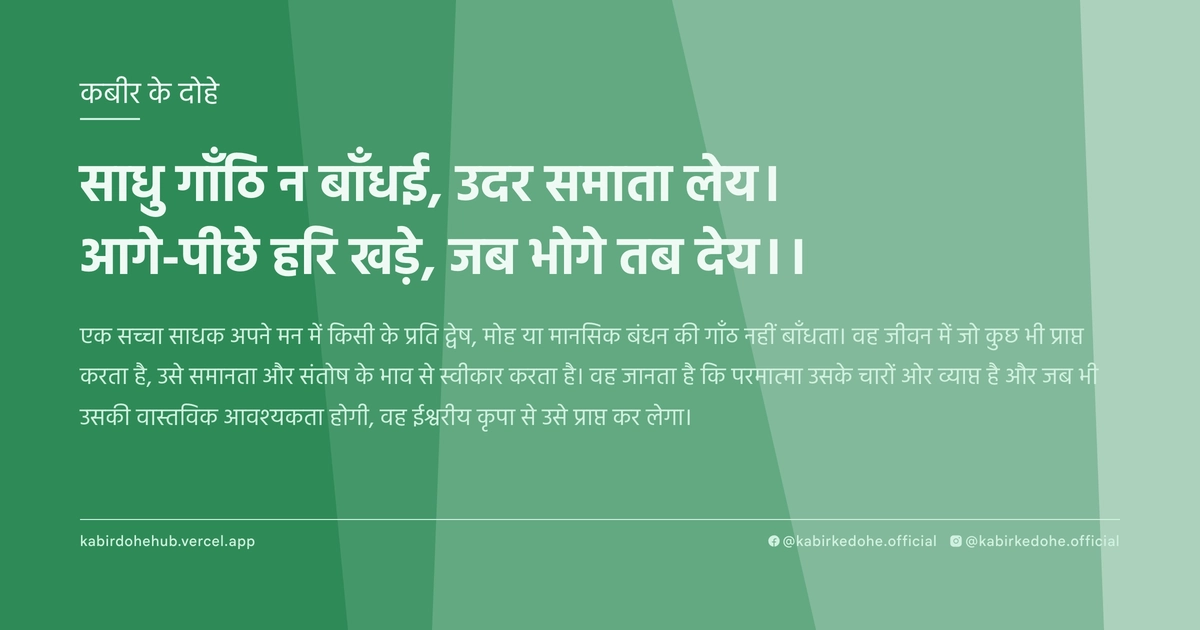
साधु गाँठि न बाँधई, उदर समाता लेय।
आगे-पीछे हरि खड़े, जब भोगे तब देय।।
Sadhu gaanthi na baandhai, udar samata ley. Aage-piche Hari khade, jab bhoge tab dey.
इस पृष्ठ पर इस कबीर दोहे का अर्थ (meaning), हिंदी व्याख्या और अंग्रेज़ी अनुवाद, दार्शनिक विश्लेषण और व्यावहारिक जीवन सीख दी गई है। यह दोहा संतोष (Contentment) विषय से जुड़ा है — Kabir doha meaning and explanation in Hindi and English.
अर्थ (Meaning):
एक सच्चा साधक अपने मन में किसी के प्रति द्वेष, मोह या मानसिक बंधन की गाँठ नहीं बाँधता। वह जीवन में जो कुछ भी प्राप्त करता है, उसे समानता और संतोष के भाव से स्वीकार करता है। वह जानता है कि परमात्मा उसके चारों ओर व्याप्त है और जब भी उसकी वास्तविक आवश्यकता होगी, वह ईश्वरीय कृपा से उसे प्राप्त कर लेगा।
A true seeker does not tie knots of attachment, grudge, or expectation within the heart. They accept whatever life provides with a sense of equanimity and balance. Aware that the Divine permeates every direction, they remain poised in faith, knowing that sustenance and grace will manifest precisely when truly needed.
व्याख्या (Interpretation):
यहाँ 'गाँठ' का अर्थ केवल भौतिक बंधन नहीं, बल्कि मानसिक संकोच, अहंकार और दूसरों के प्रति कड़वाहट है। साधु वह है जो चित्त को शून्य कर देता है, जिससे द्वैत समाप्त हो जाता है। 'उदर समाता' का अर्थ है कि वह अपनी आवश्यकताओं को न्यूनतम और संतुलित रखता है। जब साधक स्वयं को परमात्मा के साथ एकाकार कर लेता है, तो उसे यह अनुभव होता है कि 'हरि' (परमात्मा) उसके अत्यंत निकट है। यह निर्गुण भक्ति का चरम है जहाँ भक्त और भगवान के बीच की दूरी मिट जाती है और विश्वास ही एकमात्र सेतु बन जाता है। यह स्थिति अद्वैत वेदांत के उस सत्य को दर्शाती है जहाँ आत्मा और ब्रह्म एक ही हैं, और भय केवल अज्ञानता का परिणाम है।
The 'knot' here symbolizes not physical ties, but the psychological entanglements of resentment, ego, and emotional clinging. A 'Sadhu' is one who has untied these knots, achieving a state of mental fluidity. 'Udar samata' refers to the practice of equanimity and minimalism in desire. By dissolving the ego, the seeker realizes that 'Hari' (the Divine) is not a distant entity but an omnipresent reality surrounding them. This reflects the essence of Nirgun Bhakti, where the formless Divine is accessed through inner stillness rather than external ritual. It aligns with Advaita Vedanta, suggesting that when the illusion of separation (Maya) vanishes, the soul recognizes its non-duality with the Absolute, transforming anxiety into absolute surrender.
दार्शनिक विश्लेषण (Philosophical Analysis):
कबीर का यह दोहा तत्कालीन समाज में व्याप्त कर्मकांडीय जटिलताओं और संचय की प्रवृत्ति पर एक गहरा प्रहार है। उनके समय में धर्म को बाहरी आडंबरों और कठोर नियमों से जोड़ा गया था, लेकिन कबीर ने 'सहज' मार्ग का प्रतिपादन किया। वे कहते हैं कि मोक्ष किसी कठिन तपस्या में नहीं, बल्कि मन की सरलता और अनासक्ति में है।
दार्शनिक स्तर पर, यह सूफी मत के 'फना' (अहंकार का विनाश) और वेदांत के 'साक्षी भाव' का संगम है। जब मनुष्य अपनी पहचान को 'मैं' और 'मेरा' से मुक्त कर देता है, तो वह ब्रह्मांडीय चेतना के साथ लयबद्ध हो जाता है। संचय की इच्छा ही दुख का मूल कारण है क्योंकि यह अभाव की भावना से उपजती है।
कबीर जाति और वर्ग के भेदों को नकारते हुए यह समझाते हैं कि आध्यात्मिक पात्रता केवल हृदय की पवित्रता से आती है। एक बुनकर होकर भी उन्होंने यह जाना कि जो धागा मन को बाँधता है, वही बंधन है। यह विश्लेषण स्पष्ट करता है कि 'गाँठ न बाँधना' वास्तव में मनोवैज्ञानिक मुक्ति है, जहाँ व्यक्ति अतीत की कड़वाहट और भविष्य की चिंता से मुक्त होकर वर्तमान में स्थित होता है।
यह शिक्षण हमें सिखाता है कि ईश्वर कोई बाहरी व्यक्ति नहीं जो पुरस्कार देता है, बल्कि वह एक अंतर्निहित ऊर्जा है। जब हम अपनी पात्रता (worthiness) बढ़ाते हैं और अहंकार घटाते हैं, तो वह ऊर्जा स्वाभाविक रूप से प्रवाहित होती है। यह एक ऐसी मानसिक अवस्था है जहाँ 'माँगना' प्रार्थना नहीं, बल्कि एक सहज समर्पण है।
अंततः, यह दोहा भौतिकवाद के विरुद्ध एक आध्यात्मिक घोषणापत्र है। यह तर्क देता है कि वास्तविक सुरक्षा बैंक खातों या सामाजिक संबंधों में नहीं, बल्कि उस सार्वभौमिक विश्वास में है जो हमें यह भरोसा दिलाता है कि हम इस अस्तित्व में कभी अकेले या अभावग्रस्त नहीं हो सकते।
Kabir’s couplet serves as a profound critique of the ritualistic complexities and the compulsive hoarding tendencies prevalent in his era. During a time when religion was often reduced to external displays and rigid dogmas, Kabir advocated for the path of 'Sahaja'—the natural, effortless state of being. He posits that liberation is found not in grueling austerities, but in simplicity and non-attachment.
Philosophically, this is a confluence of the Sufi concept of 'Fana' (the annihilation of the ego) and the Vedantic 'Sakshi' (witness consciousness). When a human transcends the notions of 'I' and 'Mine,' they synchronize with the cosmic consciousness. The desire to accumulate is rooted in a perceived sense of lack; by untying the 'knot' of desire, the seeker removes the root cause of suffering.
Kabir, as a weaver, used the metaphor of threads to illustrate spiritual bondage. He rejected caste and class hierarchies, asserting that spiritual eligibility is derived solely from the purity of the heart. To 'not tie a knot' is a psychological liberation—a state where one is no longer anchored by past resentments or future anxieties, residing fully in the present moment.
This teaching clarifies that the Divine is not an external deity dispensing rewards, but an immanent energy. When we diminish the ego and increase our inner receptivity, this energy flows naturally. Here, 'asking' is not a plea of desperation but a gesture of aligned surrender, recognizing the inherent abundance of the universe.
Ultimately, this verse is a spiritual manifesto against materialism. It argues that true security does not lie in accumulated wealth or social validation, but in the unwavering faith that we are eternally supported by the Absolute. It transforms the human condition from one of scarcity to one of divine sufficiency.
मूल संदेश (Core Message):
- मानसिक बंधन ही वास्तविक दुख का कारण हैं।
- संतोष और समानता ही आंतरिक शांति की कुंजी है।
- अहंकार का त्याग ही परमात्मा से मिलन का मार्ग है।
- विश्वास रखें कि ब्रह्मांड आपकी वास्तविक आवश्यकताओं को पूरा करेगा।
- क्षमा केवल दूसरों के लिए नहीं, स्वयं की मुक्ति के लिए है।
- Mental entanglements are the primary source of human suffering.
- Equanimity and contentment are the keys to inner stillness.
- The dissolution of ego is the only path to Divine union.
- Trust that the Universe provides for every genuine need.
- Forgiveness is not for the other, but for one's own liberation.
व्यावहारिक उदाहरण (Practical Example):
वाराणसी के एक पुराने घाट पर रामदीन नाम का एक वृद्ध नाविक रहता था। उसका जीवन अत्यंत सरल था, लेकिन उसके मन में एक गहरी गाँठ थी—उसके छोटे भाई ने वर्षों पहले उसकी जमीन हड़प ली थी। रामदीन हर दिन नाव चलाते समय उस धोखे को याद करता और क्रोध की अग्नि में जलता। उसकी नाव तो चलती थी, लेकिन उसका मन भारी था।
एक दिन उसने एक फकीर को देखा जो केवल एक फटे कंबल और एक कटोरे के साथ खुश था। रामदीन ने पूछा, 'महाराज, आपके पास कुछ नहीं है, फिर भी आप इतने शांत कैसे हैं?' फकीर ने मुस्कुराकर कहा, 'मैंने अपने मन की सारी गाँठें खोल दी हैं। जो गया वह मेरा था ही नहीं, और जो आएगा वह ईश्वर की कृपा होगी।'
रामदीन को कबीर की यह बात याद आई कि साधु गाँठ नहीं बाँधता। उसने महसूस किया कि वह जमीन खोने का दुख नहीं मना रहा था, बल्कि उस 'गाँठ' को पकड़कर बैठा था जिसने उसे उसके भाई से और स्वयं की शांति से दूर कर दिया था।
उस रात रामदीन ने एक कठिन निर्णय लिया। उसने अपनी आँखें बंद कीं और मानसिक रूप से अपने भाई को क्षमा कर दिया। उसने कल्पना की कि वह क्रोध की गाँठ धीरे-धीरे खुल रही है। जैसे ही उसने क्षमा किया, उसे एक अजीब सी हल्कापन महसूस हुआ।
अगले दिन, जब वह नाव चला रहा था, उसने देखा कि उसका भाई, जो अब बूढ़ा और बीमार था, घाट पर अकेला बैठा है। रामदीन के मन में अब क्रोध नहीं, बल्कि करुणा थी। वह उसके पास गया और बिना कुछ कहे उसका हाथ थाम लिया।
भाई फूट-फूट कर रो पड़ा और उसने अपनी सारी जमीन के कागजात वापस करने की इच्छा जताई। लेकिन रामदीन ने मुस्कुराकर मना कर दिया। उसने कहा, 'मुझे अब जमीन नहीं, शांति चाहिए, और वह मुझे मिल गई है।'
रामदीन ने अब अपनी नाव को केवल जीविका का साधन नहीं, बल्कि सेवा का माध्यम बना लिया। वह उन यात्रियों की मदद करता जो रास्ता भटक गए थे, बिना किसी लालच के।
उसका जीवन अब 'उदर समाता' का उदाहरण था। वह कम में संतुष्ट था और हर परिस्थिति में शांत रहता था। उसे अब इस बात का डर नहीं था कि कल क्या होगा, क्योंकि उसे अनुभव हो गया था कि परमात्मा उसके साथ है।
इस 'कबीर ट्विस्ट' ने रामदीन को एक कड़वाहट भरे वृद्ध से एक प्रकाशमय साधक में बदल दिया। उसने सीखा कि जब हम दूसरों को मुक्त करते हैं, तो वास्तव में हम स्वयं को मुक्त करते हैं।
आज भी वाराणसी के उस घाट पर लोग रामदीन की शांति की चर्चा करते हैं, जो यह सिखाता है कि क्षमा ही सबसे बड़ी आध्यात्मिक उपलब्धि है।
On an ancient ghat in Varanasi lived an elderly boatman named Ramdeen. His life was simple, but his heart harbored a deep 'knot'—his younger brother had cheated him out of his ancestral land years ago. Every day, while rowing his boat, Ramdeen would dwell on this betrayal, his mind consumed by a simmering fire of resentment. His boat moved forward, but his spirit remained anchored in pain.
One day, he encountered a wandering dervish who possessed nothing but a tattered blanket and a wooden bowl, yet radiated an aura of profound peace. Ramdeen asked, 'Master, you have nothing to your name, yet you are so serene. How?' The dervish smiled and replied, 'I have simply untied all the knots in my heart. What was lost was never truly mine, and what comes is but the grace of the Divine.'
These words echoed Kabir’s wisdom in Ramdeen’s mind: a seeker ties no knots. He realized that he wasn't mourning the loss of land, but was clinging to the 'knot' of hatred, which had alienated him from his brother and his own inner stillness.
That night, Ramdeen made a conscious decision. Closing his eyes, he mentally forgave his brother. He visualized the tight knot of anger slowly unraveling and dissolving into the void. As he let go, a sudden, inexplicable lightness washed over him.
The next morning, while rowing, he noticed his brother sitting alone on the ghat, now aged and frail. Instead of the usual surge of anger, Ramdeen felt a wave of compassion. He approached him and silently held his hand.
Overwhelmed, the brother broke down in tears and offered to return all the land documents. But Ramdeen smiled and declined. He said, 'I no longer seek the land; I sought peace, and I have found it.'
From that day on, Ramdeen transformed his boat into a vessel of service. He helped stranded travelers and the needy without expecting a single coin in return.
His life became a testament to 'udar samata'—equanimity in all things. He lived with minimal needs and maximum contentment, no longer fearing the uncertainty of tomorrow because he felt the Divine presence surrounding him.
This 'Kabir Twist' transformed Ramdeen from a bitter old man into a luminous seeker. He learned that by liberating others through forgiveness, one actually liberates oneself.
Even today, people on that ghat speak of Ramdeen’s serenity, reminding everyone that forgiveness is the highest spiritual achievement.
अभ्यास मार्गदर्शन (Practice Guidance):
- प्रतिदिन 20 मिनट मौन ध्यान करें, जहाँ आप अपने मन में बंधी सभी भावनात्मक गाँठों (क्रोध, ईर्ष्या, मोह) को केवल एक साक्षी के रूप में देखें और उन्हें धीरे-धीरे विसर्जित करें।
- एक 'अनासक्ति जर्नल' बनाएँ। हर रात लिखें कि आज आपने किस बात पर अपनी पकड़ ढीली की और कहाँ आपने 'समानता' का अभ्यास किया।
- व्यवहार परिवर्तन: दिन में कम से कम एक बार ऐसी स्थिति का सामना करें जहाँ आप सही हैं, लेकिन शांति के लिए अपनी जीत का त्याग कर दें।
- डायग्नोस्टिक चेकलिस्ट: क्या आप अभी भी पुराने झगड़ों को याद कर रहे हैं? क्या आप भविष्य की चिंता में वर्तमान की शांति खो रहे हैं? यदि हाँ, तो आपकी 'गाँठें' अभी भी बंधी हुई हैं।
- Practice 20 minutes of silent meditation daily, observing emotional 'knots' (anger, jealousy, attachment) as a witness and consciously releasing them into the void.
- Maintain a 'Non-Attachment Journal.' Each night, record one instance where you let go of a grudge or practiced equanimity in the face of adversity.
- Behavioral Shift: Once a day, intentionally step back from a conflict where you are 'right' to prioritize inner peace over external victory.
- Diagnostic Checklist: Do you still replay old arguments? Do you sacrifice present peace for future anxieties? If yes, your 'knots' are still tied.
चिंतन प्रश्न (Reflection Questions):
- मेरे जीवन में वह कौन सी 'गाँठ' है जिसे मैं सालों से पकड़ कर बैठा हूँ, जबकि वह अब निरर्थक है?
- क्या मेरी पहचान मेरी उपलब्धियों और संपत्तियों से जुड़ी है, या मैं उससे परे कुछ हूँ?
- जब मैं किसी की मदद करता हूँ, तो क्या मेरे मन में गुप्त रूप से प्रशंसा या प्रतिफल की इच्छा होती है?
- क्या मैं वास्तव में 'समानता' में जीता हूँ, या मैं केवल सुखद परिस्थितियों में ही शांत रहता हूँ?
- मेरे भीतर का वह कौन सा डर है जो मुझे पूरी तरह से परमात्मा पर भरोसा करने से रोकता है?
- What is the specific 'knot' I have been clutching for years, even though it no longer serves a purpose?
- Is my identity tied to my achievements and possessions, or am I something beyond them?
- When I help others, is there a hidden desire for praise or a subconscious expectation of return?
- Do I truly live in equanimity, or is my peace conditional upon favorable circumstances?
- What is the core fear within me that prevents total trust in the Divine providence?