
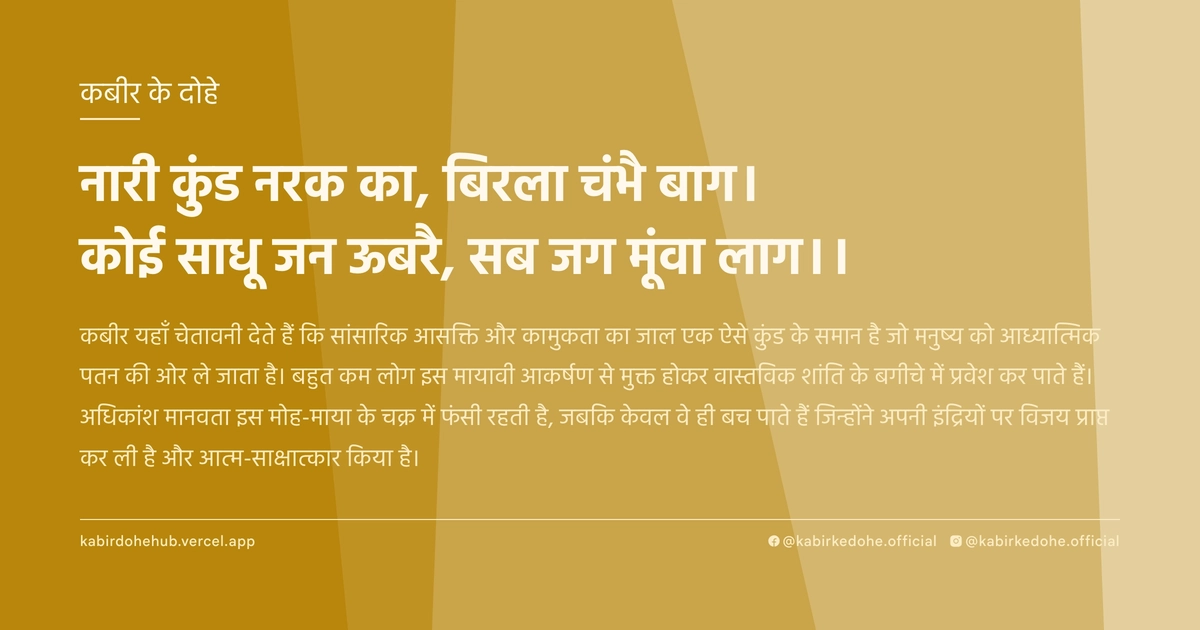
नारी कुंड नरक का, बिरला चंभै बाग।
कोई साधू जन ऊबरै, सब जग मूंवा लाग।।
Naari kund narak ka, birla chambhai baag. Koi sadhu jan ubrai, sab jag munwa laag.
इस पृष्ठ पर इस कबीर दोहे का अर्थ (meaning), हिंदी व्याख्या और अंग्रेज़ी अनुवाद, दार्शनिक विश्लेषण और व्यावहारिक जीवन सीख दी गई है। यह दोहा काम (Lust) विषय से जुड़ा है — Kabir doha meaning and explanation in Hindi and English.
अर्थ (Meaning):
कबीर यहाँ चेतावनी देते हैं कि सांसारिक आसक्ति और कामुकता का जाल एक ऐसे कुंड के समान है जो मनुष्य को आध्यात्मिक पतन की ओर ले जाता है। बहुत कम लोग इस मायावी आकर्षण से मुक्त होकर वास्तविक शांति के बगीचे में प्रवेश कर पाते हैं। अधिकांश मानवता इस मोह-माया के चक्र में फंसी रहती है, जबकि केवल वे ही बच पाते हैं जिन्होंने अपनी इंद्रियों पर विजय प्राप्त कर ली है और आत्म-साक्षात्कार किया है।
Kabir warns that worldly attachment and the pursuit of sensual pleasures are akin to a pit of hell that drags the soul toward spiritual decay. Very few possess the fortitude to cross this illusory attraction and enter the garden of true liberation. While the vast majority of humanity remains trapped in the cycle of desire and delusion, only those who have conquered their senses and realized the formless Divine manage to escape this spiritual entrapment.
व्याख्या (Interpretation):
इस दोहे का शाब्दिक अर्थ काम और मोह के प्रति चेतावनी प्रतीत होता है, परंतु गहरा आध्यात्मिक अर्थ 'माया' के स्वरूप से जुड़ा है। यहाँ 'नारी' केवल स्त्री का प्रतीक नहीं, बल्कि उस समस्त आकर्षण का प्रतीक है जो आत्मा को परमात्मा से दूर ले जाता है। 'कुंड' उस मानसिक स्थिति को दर्शाता है जहाँ व्यक्ति एक बार डूबने के बाद बाहर नहीं निकल पाता। यह निर्गुण भक्ति का वह मार्ग है जहाँ साधक को यह समझना होता है कि बाहरी दुनिया का सुख क्षणभंगुर है। जब साधक द्वैत (दो होने का भाव) को त्यागकर अद्वैत (एकता) में विलीन होता है, तभी वह 'बाग' यानी मोक्ष की प्राप्ति करता है। यह विरोधाभास है कि जिसे दुनिया सुख समझती है, वह वास्तव में बंधन है, और जिसे कठिन तपस्या माना जाता है, वही वास्तविक स्वतंत्रता है।
While the literal meaning appears as a warning against sensual desire, the deeper metaphysical interpretation centers on the nature of 'Maya' (illusion). Here, 'Naari' is not merely a reference to women, but a symbol for all worldly attractions that divert the soul from its source. The 'kund' or pit represents the psychological state of entrapment where the ego becomes submerged in transient pleasures. In the context of Nirgun Bhakti, this emphasizes that external gratifications are ephemeral. Only when the seeker transcends the duality of 'I' and 'Thou' and merges into the non-dual reality of Brahman does he enter the 'baag' or the garden of liberation. The central paradox lies in the fact that what the world perceives as pleasure is actually a shackle, and what is perceived as rigorous discipline is the only true path to freedom.
दार्शनिक विश्लेषण (Philosophical Analysis):
कबीर का यह दृष्टिकोण उनके समय के सामाजिक और धार्मिक पाखंड के विरुद्ध एक कड़ा प्रहार था। वे उस युग में थे जहाँ धर्म के नाम पर बाहरी कर्मकांडों और शारीरिक शुद्धता पर जोर दिया जाता था, जबकि आंतरिक शुद्धि की अनदेखी की जाती थी। कबीर ने स्पष्ट किया कि मोक्ष किसी बाहरी अनुष्ठान से नहीं, बल्कि इंद्रिय निग्रह और अहंकार के विसर्जन से मिलता है।
दार्शनिक स्तर पर, यह दोहा अद्वैत वेदांत के सिद्धांतों से मेल खाता है, जहाँ यह माना जाता है कि अविद्या (अज्ञान) ही बंधन का कारण है। जब तक मनुष्य स्वयं को शरीर और उसकी इच्छाओं के साथ जोड़कर देखता है, वह माया के कुंड में फंसा रहता है। सूफी मत के 'नफ्स' (निचली इच्छाओं) के दमन की प्रक्रिया यहाँ स्पष्ट रूप से झलकती है, जहाँ आत्मा को शुद्ध करने के लिए वासनाओं का त्याग अनिवार्य है।
कबीर का 'साधु' वह नहीं है जो गेरुआ वस्त्र पहने, बल्कि वह है जिसने अपनी वासनाओं को जीत लिया है। वे जाति और धर्म की सीमाओं को तोड़कर एक सार्वभौमिक सत्य की बात करते हैं: कि मुक्ति केवल आत्म-जागरूकता से संभव है। वे चेतावनी देते हैं कि यदि हम केवल भौतिक सुखों की खोज में रहे, तो हम उस भीड़ का हिस्सा बन जाएंगे जो आध्यात्मिक अंधकार में खो गई है।
यहाँ 'नरक' का अर्थ किसी भौगोलिक स्थान से नहीं, बल्कि मानसिक पीड़ा और पुनर्जन्म के अंतहीन चक्र से है। जब इच्छाएं पूरी नहीं होतीं, तो वे दुख पैदा करती हैं, और जब पूरी हो जाती हैं, तो वे और अधिक इच्छाओं को जन्म देती हैं। यही वह चक्र है जिसे कबीर 'मूंवा लाग' या डूबना कहते हैं।
अंततः, यह विश्लेषण हमें सिखाता है कि आध्यात्मिक प्रगति के लिए सबसे पहले अपनी आंतरिक कमजोरियों को पहचानना आवश्यक है। कबीर का मार्ग कठिन है क्योंकि यह आत्म-निरीक्षण की मांग करता है, न कि केवल मंदिर या मस्जिद जाने की। यह अहंकार के पूर्ण विनाश और परमात्मा के साथ एकाकार होने की यात्रा है।
Kabir's perspective serves as a rigorous critique of the social and religious hypocrisies of his era. He existed in a time when religion was often reduced to external rituals and physical purity, while inner transformation was neglected. Kabir asserts that liberation is achieved not through outward ceremonies, but through the mastery of senses and the dissolution of the ego.
Philosophically, this couplet aligns with the tenets of Advaita Vedanta, which posits that 'Avidya' (ignorance) is the root cause of bondage. As long as a human identifies themselves with the physical body and its cravings, they remain trapped in the pit of Maya. This mirrors the Sufi concept of conquering the 'Nafs' (the lower self), where the annihilation of worldly desires is a prerequisite for the soul's union with the Divine.
For Kabir, a 'Saadhu' is not defined by saffron robes, but by the internal victory over passion. He transcends caste and creed to present a universal truth: liberation is possible only through profound self-awareness. He warns that pursuing solely material gratifications leads one into the collective oblivion of a spiritually dormant society.
In this context, 'Hell' does not refer to a subterranean location, but to the psychological torment and the endless cycle of Samsara. Unfulfilled desires create suffering, and fulfilled desires create a craving for more. This recursive loop of longing is what Kabir describes as 'drowning' or being consumed by the world.
Ultimately, this analysis reveals that spiritual progress requires the courage to confront one's own internal shadows. Kabir's path is demanding because it necessitates rigorous self-inquiry rather than the passive performance of piety. It is a journey toward the total annihilation of the separate self to realize the singular, universal Truth.
मूल संदेश (Core Message):
- इंद्रिय सुख एक सुंदर भ्रम है जो आत्मा को जकड़े रखता है।
- सच्ची स्वतंत्रता बाहरी विलासिता में नहीं, बल्कि आंतरिक वैराग्य में है।
- अहंकार का विसर्जन ही मोक्ष के बगीचे का एकमात्र प्रवेश द्वार है।
- सांसारिक आसक्तियाँ आत्मा के लिए एक गहरे कुंड की तरह हैं।
- केवल आत्म-जागरूकता ही हमें माया के चक्र से मुक्त कर सकती है।
- शांति तब मिलती है जब हम 'पाने' की इच्छा को 'होने' के आनंद में बदल देते हैं।
- Sensual pleasure is a beautiful illusion that shackles the soul.
- True freedom lies not in external luxury, but in internal detachment.
- The dissolution of ego is the only gateway to the garden of liberation.
- Worldly attachments act as a deep pit for the ascending soul.
- Only profound self-awareness can liberate us from the cycle of Maya.
- Peace arrives when the desire to 'possess' transforms into the joy of 'being'.
व्यावहारिक उदाहरण (Practical Example):
वाराणसी के घाटों पर रहने वाले एक वृद्ध बुनकर, माधव, की कहानी है। माधव अपने जीवन के साठ साल केवल बेहतरीन रेशमी वस्त्र बनाने और धन संचय करने में बिता दिए। उनका पूरा अस्तित्व उनकी कला और उससे मिलने वाली प्रसिद्धि के इर्द-गिर्द घूमता था। वे मानते थे कि जितना अधिक वैभव उनके पास होगा, वे उतने ही सुखी होंगे।
माधव का एक बेटा था, जो उनकी इसी महत्वाकांक्षा की भेंट चढ़ गया। माधव ने उसे केवल धन कमाने की शिक्षा दी, जिससे उनके बीच भावनात्मक दूरी बढ़ गई। माधव के पास धन तो था, लेकिन उनके मन में एक निरंतर बेचैनी रहती थी। वे हर समय इस डर में रहते थे कि कोई उनकी कला की नकल न कर ले या उनकी संपत्ति कम न हो जाए।
एक दिन, माधव की मुलाकात एक फकीर से हुई जो घाट की सीढ़ियों पर मौन बैठे थे। फकीर के पास कुछ नहीं था, फिर भी उनके चेहरे पर एक ऐसी शांति थी जिसे माधव ने अपने करोड़ों रुपयों के वैभव में कभी नहीं पाया था। माधव ने उनसे पूछा, "बाबा, मेरे पास सब कुछ है, फिर भी मैं अशांत क्यों हूँ?"
फकीर ने मुस्कुराकर माधव के रेशमी वस्त्रों की ओर इशारा किया और कहा, "तुमने धागों को तो बहुत खूबसूरती से बुना है, लेकिन अपनी आत्मा के धागों को वासना और अहंकार के कुंड में उलझा लिया है। तुम जिसे सफलता कह रहे हो, वह वास्तव में एक सुंदर पिंजरा है।"
यह बात माधव के हृदय में गहरे तक उतर गई। उन्हें अहसास हुआ कि उनकी पूरी जिंदगी केवल 'संग्रह' करने में बीत गई, 'त्याग' करने में नहीं। उन्होंने महसूस किया कि उनकी पत्नी और पुत्र के प्रति उनका प्रेम भी एक तरह का स्वामित्व था, न कि निस्वार्थ स्नेह।
अगले कुछ महीनों में, माधव ने अपना जीवन बदलना शुरू किया। उन्होंने अपनी संपत्ति का एक बड़ा हिस्सा गरीबों और अनाथों के लिए समर्पित कर दिया। उन्होंने रेशम बुनना नहीं छोड़ा, लेकिन अब वे इसे अहंकार के लिए नहीं, बल्कि सेवा के भाव से करने लगे।
उन्होंने अपने पुत्र से माफी मांगी और उसे यह सिखाया कि जीवन की सार्थकता वस्तुओं में नहीं, बल्कि आंतरिक संतोष में है। माधव ने पाया कि जैसे-जैसे उनकी बाहरी पकड़ ढीली हुई, उनका आंतरिक बोझ हल्का होता गया।
अब माधव के पास वह पुराना वैभव नहीं था, लेकिन उनके पास वह 'बाग' था जिसकी बात कबीर ने की थी—एक ऐसा मानसिक स्थान जहाँ शांति और संतोष का वास था। उन्होंने जान लिया था कि वासनाओं का कुंड केवल डूबने के लिए होता है, जबकि संतोष का मार्ग ही मुक्ति का द्वार है।
Consider the story of Madhav, an elderly weaver living on the ghats of Varanasi. For sixty years, Madhav dedicated his life to crafting the finest silk garments and accumulating wealth. His entire identity revolved around his artistry and the prestige it brought him. He believed that the more opulence he possessed, the happier he would be.
Madhav had a son, who became a casualty of this same ambition. Madhav had taught him only the art of earning, creating a profound emotional void between them. Despite his riches, Madhav lived in a state of constant restlessness, terrified that someone would steal his techniques or that his wealth would diminish.
One day, Madhav encountered a wandering ascetic sitting in silence on the stone steps of the ghat. The ascetic possessed nothing, yet his face radiated a serenity that Madhav had never found in all his millions. Madhav asked, "Baba, I have everything, yet why am I so restless?"
The ascetic smiled, pointed to Madhav's luxurious silk robes, and said, "You have woven the threads of silk beautifully, but you have entangled the threads of your soul in the pit of desire and ego. What you call success is merely a gilded cage."
These words pierced Madhav's heart. He realized that his entire life had been spent in 'accumulation' rather than 'renunciation.' He saw that his love for his wife and son was actually a form of ownership, not selfless affection.
Over the following months, Madhav began to transform his life. He donated a significant portion of his wealth to the poor and orphans. He did not stop weaving silk, but he shifted his intention from pride to service.
He apologized to his son and taught him that the meaning of life lies not in possessions, but in inner contentment. Madhav discovered that as his grip on the material world loosened, his internal burden lightened.
Madhav no longer possessed the same outward splendor, but he had found the 'garden' Kabir spoke of—a mental sanctuary of peace and fulfillment. He understood that the pit of desire only leads to drowning, while the path of contentment is the only gateway to liberation.
अभ्यास मार्गदर्शन (Practice Guidance):
- दैनिक आत्म-निरीक्षण: प्रतिदिन 20 मिनट मौन बैठें और विचार करें कि आज किन इच्छाओं ने आपको विचलित किया। यह पहचानें कि क्या वह इच्छा वास्तव में आवश्यक थी या केवल अहंकार की तुष्टि थी।
- इच्छा-विश्लेषण जर्नल: एक डायरी लिखें जिसमें उन चीजों की सूची हो जिन्हें आप 'अनिवार्य' मानते हैं। फिर हर वस्तु के सामने लिखें कि यदि वह आपसे छिन जाए, तो क्या आपकी आत्मा की शांति नष्ट होगी?
- व्यवहारिक त्याग: सप्ताह में एक दिन ऐसा चुनें जब आप अपनी किसी प्रिय भौतिक वस्तु या आदत का स्वेच्छा से त्याग करें, ताकि आप यह अनुभव कर सकें कि आपकी खुशी बाहरी वस्तुओं पर निर्भर नहीं है।
- निदान चेकलिस्ट: स्वयं से पूछें—क्या मैं दूसरों की प्रशंसा के लिए कार्य करता हूँ? क्या मैं अपनी उपलब्धियों को अपनी पहचान मानता हूँ? क्या मैं किसी व्यक्ति या वस्तु के बिना अधूरा महसूस करता हूँ? यदि हाँ, तो आप अभी भी 'कुंड' में हैं।
- Daily Self-Observation: Spend 20 minutes in silence daily, observing which desires agitated you. Discern whether the desire was a genuine need or merely a tool for ego gratification.
- Desire-Analysis Journaling: Maintain a diary listing things you consider 'essential.' Beside each item, write whether your inner peace would truly vanish if that object were taken away.
- Practiced Renunciation: Choose one day a week to voluntarily give up a cherished material object or habit, experiencing the fact that your happiness is not contingent on external anchors.
- Diagnostic Checklist: Ask yourself—Do I act primarily for the praise of others? Do I equate my achievements with my identity? Do I feel incomplete without a specific person or object? If yes, you are still within the 'pit'.
चिंतन प्रश्न (Reflection Questions):
- आपकी वह कौन सी 'पसंदीदा' वस्तु है जिसके बिना आप अपनी पहचान अधूरा महसूस करते हैं?
- क्या आपका प्रेम वास्तव में निस्वार्थ है, या यह केवल आपकी अपनी भावनात्मक जरूरतों की पूर्ति का एक साधन है?
- आप समाज में अपनी जो छवि (Image) बनाए रखते हैं, वह आपके वास्तविक स्वरूप से कितनी अलग है?
- यदि आज आपकी सारी सामाजिक प्रतिष्ठा छीन ली जाए, तो आपके भीतर क्या बचेगा?
- क्या आप अपनी इच्छाओं के स्वामी हैं, या आपकी इच्छाएं आपकी स्वामी बन गई हैं?
- डिजिटल युग में, आपकी 'ऑनलाइन पहचान' आपके अहंकार को किस तरह पोषित कर रही है?
- Which 'favorite' possession makes you feel that your identity is incomplete without it?
- Is your love truly selfless, or is it merely a vehicle for fulfilling your own emotional needs?
- How different is the public image you maintain from your authentic internal self?
- If all your social prestige were stripped away today, what would remain within you?
- Are you the master of your desires, or have your desires become your master?
- In the digital age, how is your 'online persona' nourishing your ego?