
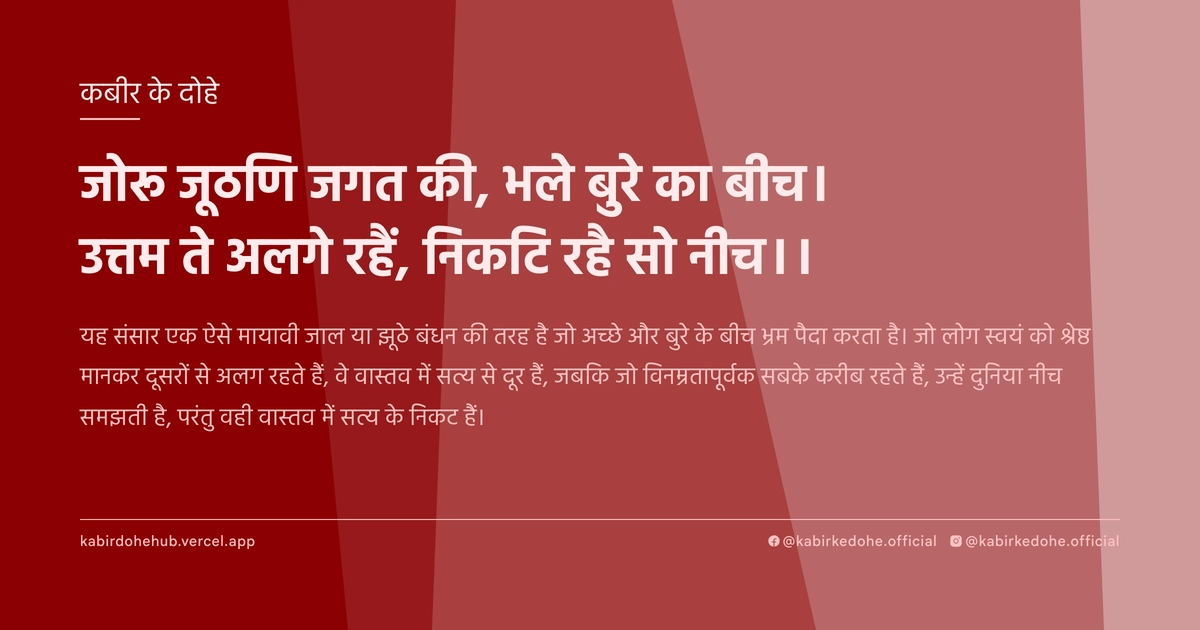
जोरू जूठणि जगत की, भले बुरे का बीच।
उत्तम ते अलगे रहैं, निकटि रहै सो नीच।।
Joru juthani jagat ki, bhale bure ka beech. Uttam te alge rahain, nikati rahai so neech.
इस पृष्ठ पर इस कबीर दोहे का अर्थ (meaning), हिंदी व्याख्या और अंग्रेज़ी अनुवाद, दार्शनिक विश्लेषण और व्यावहारिक जीवन सीख दी गई है। यह दोहा मोह (Attachment) विषय से जुड़ा है — Kabir doha meaning and explanation in Hindi and English.
अर्थ (Meaning):
यह संसार एक ऐसे मायावी जाल या झूठे बंधन की तरह है जो अच्छे और बुरे के बीच भ्रम पैदा करता है। जो लोग स्वयं को श्रेष्ठ मानकर दूसरों से अलग रहते हैं, वे वास्तव में सत्य से दूर हैं, जबकि जो विनम्रतापूर्वक सबके करीब रहते हैं, उन्हें दुनिया नीच समझती है, परंतु वही वास्तव में सत्य के निकट हैं।
This world is like a deceptive bond or a fraudulent illusion that creates a false dichotomy between the virtuous and the wicked. Those who isolate themselves in a prideful pursuit of perceived purity are distant from the Truth, while those who remain humble and close to the common folk are often labeled as lowly, yet they are the ones truly aligned with the Divine.
व्याख्या (Interpretation):
कबीर यहाँ 'जोरू' और 'जूठणि' शब्दों के माध्यम से संसार की क्षणभंगुरता और धोखे को दर्शाते हैं। शाब्दिक अर्थ में यह सामाजिक स्तरीकरण पर प्रहार है, लेकिन आध्यात्मिक स्तर पर यह 'माया' का विश्लेषण है। निरगुण भक्ति के अनुसार, ईश्वर किसी विशेष वर्ग या 'उत्तम' श्रेणी के लोगों में नहीं, बल्कि सर्वत्र व्याप्त है। जब मनुष्य स्वयं को 'उत्तम' मानकर दूसरों से अलग करता है, तो वह वास्तव में अपने अहंकार (Ahamkara) को पुष्ट कर रहा होता है, जो आत्मा और ब्रह्म के मिलन में सबसे बड़ी बाधा है। यह विरोधाभास है कि जिसे समाज 'नीच' कहता है, वह अपनी सरलता और अहंकार-शून्यता के कारण परमात्मा के अधिक करीब होता है। अद्वैत वेदांत के परिप्रेक्ष्य में, यह भेद केवल मन का भ्रम है; वास्तव में सब एक ही चेतना के अंश हैं।
Kabir utilizes the terms 'Joru' and 'Juthni' to symbolize the deceptive and transient nature of worldly attachments. While the literal meaning critiques social stratification, the spiritual essence analyzes 'Maya' (illusion). In the context of Nirgun Bhakti, the Divine is not reserved for a specific 'superior' class but is omnipresent. When an individual isolates themselves under the guise of being 'Uttam' (superior), they are merely reinforcing their 'Ahamkara' (ego), which acts as the primary veil between the Atman and Brahman. The central paradox presented is that the one labeled 'lowly' by society is often closer to the Truth due to their lack of pretension and ego. From the lens of Advaita Vedanta, this perceived hierarchy is a mental construct; in reality, all existences are manifestations of the same singular Consciousness.
दार्शनिक विश्लेषण (Philosophical Analysis):
कबीर का यह दोहा उस सामाजिक और धार्मिक कट्टरता के विरुद्ध एक सशक्त विद्रोह है जो उनके समय में व्याप्त थी। उन्होंने देखा कि कैसे धर्म के नाम पर लोग खुद को 'शुद्ध' और दूसरों को 'अशुद्ध' घोषित कर रहे थे। यह विश्लेषण केवल जाति व्यवस्था पर नहीं, बल्कि उस मानसिक श्रेष्ठता पर है जो मनुष्य को उसकी मानवता से अलग करती है। कबीर का दर्शन सूफीवाद के 'इश्क-ए-हकीकी' (ईश्वरीय प्रेम) और अद्वैत के 'अहं ब्रह्मास्मि' का संगम है, जहाँ प्रेम ही एकमात्र सेतु है।
अनुष्ठानों और बाहरी आडंबरों का विरोध करते हुए, कबीर तर्क देते हैं कि पवित्रता मंदिर या मस्जिद की दीवारों में नहीं, बल्कि हृदय की करुणा में है। जो व्यक्ति खुद को 'उत्तम' मानकर दूसरों से दूरी बनाता है, वह वास्तव में आध्यात्मिक अलगाव (Spiritual Isolation) का शिकार होता है। यह अहंकार उसे यह विश्वास दिलाता है कि वह सत्य का स्वामी है, जबकि वह केवल अपनी धारणाओं का कैदी होता है।
यहाँ 'नीच' शब्द का प्रयोग एक आध्यात्मिक विडंबना के रूप में किया गया है। सूफी मत में 'फना' (अहंकार का विनाश) की प्रक्रिया अनिवार्य है। जब व्यक्ति अपनी सामाजिक पहचान को पूरी तरह त्याग देता है और खुद को सबसे छोटा मान लेता है, तभी वह उस विराट सत्ता में विलीन हो सकता है। श्रेष्ठता का बोध वास्तव में एक आध्यात्मिक बीमारी है जो आत्मा को संकुचित कर देती है।
मनोवैज्ञानिक स्तर पर, यह दोहा 'कन्फर्मेशन बायस' और 'इन-ग्रुप/आउट-ग्रुप' मानसिकता पर प्रहार करता है। कबीर सिखाते हैं कि सत्य का मार्ग 'विशिष्टता' (Exclusivity) में नहीं, बल्कि 'समावेशिता' (Inclusivity) में है। जो व्यक्ति समाज के हाशिए पर रहने वालों के साथ खड़ा होता है, वह वास्तव में उस सार्वभौमिक सत्य का अनुभव करता है जो सीमाओं से परे है।
अंततः, यह शिक्षण हमें यह समझने के लिए प्रेरित करता है कि आध्यात्मिक प्रगति का पैमाना यह नहीं है कि हमने कितने लोगों को खुद से 'नीचे' देखा, बल्कि यह है कि हमने कितनी गहराई से खुद को दूसरों में देखा। यह अहंकार का पूर्ण विलोपन है, जहाँ 'मैं' और 'तू' का भेद समाप्त हो जाता है और केवल शुद्ध अस्तित्व शेष रहता है।
This couplet is a potent rebellion against the social and religious bigotry prevalent during Kabir's era. He observed how individuals used religion to label themselves as 'pure' and others as 'impure.' This analysis transcends mere caste critique; it targets the psychological superiority complex that alienates a human from their own humanity. Kabir's philosophy is a confluence of the Sufi 'Ishq-e-Haqiqi' (Divine Love) and the Advaitic 'Aham Brahmasmi,' where love is the only valid bridge to the Divine.
Rejecting rituals and external ostentations, Kabir argues that purity does not reside within the walls of temples or mosques, but within the compassion of the heart. The individual who distances themselves from others to maintain a facade of 'superiority' is actually suffering from spiritual isolation. This ego convinces them that they possess the Truth, while in reality, they are merely prisoners of their own assumptions.
The term 'Neech' (lowly) is employed here as a spiritual irony. In Sufism, the process of 'Fana' (annihilation of the ego) is essential. When a person completely relinquishes their social identity and perceives themselves as the smallest of all, they become capable of merging into the Infinite. The sense of superiority is, in fact, a spiritual ailment that constricts the soul.
Psychologically, this verse attacks the concepts of confirmation bias and the 'in-group/out-group' mentality. Kabir teaches that the path to Truth lies not in exclusivity, but in inclusivity. The person who stands with those on the margins of society experiences the universal truth that transcends all artificial boundaries.
Ultimately, this teaching urges us to realize that the metric of spiritual progress is not how many people we have viewed as 'inferior,' but how deeply we have seen ourselves in others. It is the total dissolution of the ego, where the distinction between 'I' and 'Thou' vanishes, leaving only pure, undifferentiated Existence.
मूल संदेश (Core Message):
- श्रेष्ठता का अहंकार सत्य की प्राप्ति में सबसे बड़ी बाधा है।
- पवित्रता बाहरी अनुष्ठानों में नहीं, बल्कि आंतरिक करुणा में बसती है।
- जो स्वयं को शून्य मानता है, वही अनंत से मिल सकता है।
- सामाजिक विभाजन केवल मन का भ्रम है, आत्मा एक ही है।
- विनम्रता वह द्वार है जिससे ईश्वर का साक्षात्कार होता है।
- The ego of superiority is the greatest obstacle to realizing the Truth.
- Purity resides not in external rituals, but in internal compassion.
- Only those who perceive themselves as zero can merge with the Infinite.
- Social divisions are mere illusions of the mind; the Soul is one.
- Humility is the gateway through which the Divine is encountered.
व्यावहारिक उदाहरण (Practical Example):
वाराणसी के एक पुराने घाट पर, पंडित शिवदत्त रहते थे, जिन्हें अपनी विद्वत्ता और शुद्धता पर अत्यधिक गर्व था। वे केवल उन्हीं लोगों से बात करते थे जो उनके समान उच्च कुल के थे और अछूतों या साधारण मजदूरों को अपनी दृष्टि से भी नहीं देखते थे। उनका मानना था कि उनकी तपस्या और शास्त्रों का ज्ञान उन्हें 'उत्तम' बनाता है, इसलिए वे आम जनता की 'अशुद्धता' से दूर रहते थे।
उसी घाट के किनारे, एक बूढ़ा मल्लाह रहता था जिसका नाम रामू था। रामू अनपढ़ था, दिन भर पसीना बहाता और हर किसी की मदद करता। वह समाज की नजर में 'नीच' था, लेकिन उसका हृदय प्रेम और करुणा से भरा था। वह अक्सर शिवदत्त को प्रणाम करता, लेकिन शिवदत्त उसे तुच्छ समझकर अनदेखा कर देते थे।
एक बार शहर में भीषण बाढ़ आई। गंगा का जलस्तर इतना बढ़ गया कि घाट के सभी ऊँचे मकान डूबने लगे। शिवदत्त का भव्य घर ढह गया और वे मलबे के बीच फंस गए। उनके 'उच्च कुल' के मित्र और विद्वान साथी अपनी जान बचाकर भाग चुके थे; किसी ने उनकी सुध नहीं ली क्योंकि वे सब अपनी 'शुद्धता' और सुरक्षा को प्राथमिकता दे रहे थे।
जब शिवदत्त डूब रहे थे, तब रामू मल्लाह अपनी छोटी सी नाव लेकर लहरों से लड़ते हुए पहुँचा। रामू ने बिना किसी संकोच के, अपनी जान जोखिम में डालकर शिवदत्त को बाहर निकाला और उन्हें अपनी नाव में सुरक्षित स्थान पर पहुँचाया।
नाव पर बैठे हुए शिवदत्त ने देखा कि जिस व्यक्ति को वे 'नीच' समझकर तिरस्कृत करते रहे, वही उनकी जान बचाने आया। वहीं, जिन 'उत्तम' लोगों पर उन्हें गर्व था, उन्होंने संकट के समय उनका साथ छोड़ दिया।
शिवदत्त को अचानक कबीर के शब्दों की याद आई कि 'उत्तम' होने का अहंकार वास्तव में एक अलगाव है। उन्होंने महसूस किया कि उनकी शास्त्र-विद्या केवल उनके अहंकार को बढ़ा रही थी, जबकि रामू की सरलता उसे ईश्वर के करीब ले गई थी।
रामू ने मुस्कुराते हुए कहा, "पंडित जी, पानी सबको एक जैसा भिगोता है, यहाँ न कोई उच्च है न नीच।"
उस दिन शिवदत्त का अहंकार टूट गया। उन्होंने अपनी किताबों को बंद किया और रामू के साथ बैठकर जीवन का वास्तविक पाठ सीखना शुरू किया। उन्होंने जाना कि सेवा और प्रेम ही वास्तविक पवित्रता है।
शिवदत्त ने अब घाट पर आने वाले हर व्यक्ति का सम्मान करना शुरू किया, चाहे वह किसी भी जाति या वर्ग का हो। उन्होंने अपनी 'श्रेष्ठता' का चोला उतार फेंका और एक साधारण मनुष्य बनकर जीना सीखा।
यह परिवर्तन उनके जीवन में एक असीम शांति लेकर आया, जिसे वे वर्षों की कठिन तपस्या और एकांत में भी नहीं पा सके थे।
On an ancient ghat in Varanasi lived Pandit Shivdutt, a man consumed by pride in his scholarship and ritual purity. He interacted only with those of high lineage and refused to even glance at the untouchables or common laborers. He believed his asceticism and mastery of scriptures made him 'Uttam' (superior), and thus he isolated himself from the 'impurity' of the masses.
By the same river lived an old boatman named Ramu. Ramu was illiterate, spent his days in grueling labor, and helped everyone he encountered. In the eyes of society, he was 'Neech' (lowly), yet his heart overflowed with love and compassion. He often bowed to Shivdutt, but the Pandit ignored him, viewing him as insignificant.
One year, a devastating flood struck the city. The Ganges rose so violently that the high houses of the ghats began to collapse. Shivdutt's grand residence crumbled, and he became trapped amidst the debris. His 'high-born' friends and scholarly peers had already fled to save themselves; no one looked back for him, as they prioritized their own 'purity' and safety.
As Shivdutt was drowning, Ramu the boatman arrived, fighting the fierce currents in his small boat. Without a second thought, risking his own life, Ramu pulled Shivdutt from the wreckage and brought him to safety.
Siting in the boat, Shivdutt realized that the man he had spent a lifetime despising as 'lowly' was the only one who had come to save him. Conversely, the 'superior' people he admired had abandoned him in his hour of need.
Suddenly, Kabir's words echoed in his mind: the pride of being 'superior' is actually a form of isolation. He realized that his scriptural knowledge had only served to inflate his ego, while Ramu's simplicity had brought him closer to the Divine.
Ramu smiled and said, "Pandit ji, the water drenches everyone equally; here, there is neither high nor low."
In that moment, Shivdutt's ego shattered. He closed his books and began to learn the true lesson of life from Ramu. He understood that service and love are the only authentic forms of purity.
Shivdutt began to respect every person who visited the ghat, regardless of their caste or status. He cast off the cloak of 'superiority' and learned to live as a simple human being.
This transformation brought an infinite peace into his life, a peace he had failed to find through years of rigorous asceticism and solitude.
अभ्यास मार्गदर्शन (Practice Guidance):
- दैनिक चिंतन: प्रतिदिन 15 मिनट इस विचार पर मनन करें कि आपकी कौन सी पहचान (पद, शिक्षा, जाति) आपको दूसरों से अलग या श्रेष्ठ महसूस कराती है।
- सक्रिय विनम्रता: सप्ताह में एक बार ऐसे व्यक्ति की निस्वार्थ सेवा करें जिसे समाज 'नीच' या उपेक्षित मानता है, और उसमें अपने स्वयं के स्वरूप को देखने का प्रयास करें।
- आत्म-पूछताछ जर्नल: लिखें कि जब आप किसी को 'निम्न' समझते हैं, तो वह वास्तव में आपकी किस आंतरिक असुरक्षा या अहंकार को दर्शाता है।
- निदान चेकलिस्ट: क्या आप दूसरों की सलाह को उनकी सामाजिक स्थिति के आधार पर खारिज करते हैं? क्या आप 'पवित्रता' के नाम पर लोगों से दूरी बनाते हैं? यदि हाँ, तो आप माया के प्रभाव में हैं।
- Daily Contemplation: Spend 15 minutes daily reflecting on which identity (rank, education, caste) makes you feel separate from or superior to others.
- Active Humility: Once a week, perform selfless service for someone whom society deems 'lowly' or neglected, and strive to see your own essence within them.
- Self-Inquiry Journal: Document instances where you perceive someone as 'inferior' and analyze which internal insecurity or ego-drive is fueling that judgment.
- Diagnostic Checklist: Do you dismiss advice based on a person's social status? Do you distance yourself from others in the name of 'purity'? If yes, you are operating under the influence of Maya.
चिंतन प्रश्न (Reflection Questions):
- क्या मेरी 'नैतिक श्रेष्ठता' वास्तव में करुणा है, या यह दूसरों को छोटा महसूस कराने का एक सूक्ष्म तरीका है?
- मैं किन लोगों से दूरी बनाकर रखता हूँ और वह दूरी मेरी किस मानसिक धारणा पर आधारित है?
- यदि मेरी सारी सामाजिक उपलब्धियाँ और पहचान छीन ली जाएँ, तो क्या मेरे पास देने के लिए कुछ बचेगा?
- क्या मैं अपनी डिजिटल पहचान (सोशल मीडिया) का उपयोग अपनी श्रेष्ठता सिद्ध करने के लिए कर रहा हूँ?
- मेरे जीवन का वह कौन सा 'अंधेरा' कोना है जिसे मैं अपनी 'पवित्र' छवि के पीछे छिपाता हूँ?
- क्या मैं वास्तव में समानता में विश्वास करता हूँ, या मैं केवल उन लोगों के साथ समानता चाहता हूँ जो मेरे जैसे हैं?
- Is my 'moral superiority' truly compassion, or is it a subtle way of making others feel inferior?
- From whom do I maintain a distance, and upon which mental construct is that distance based?
- If all my social achievements and identities were stripped away, would there be anything left of me to give?
- Am I using my digital identity (social media) as a tool to validate my own superiority?
- Which 'dark corner' of my life do I hide behind a carefully curated 'pure' image?
- Do I truly believe in equality, or do I only desire equality with those who are similar to me?