
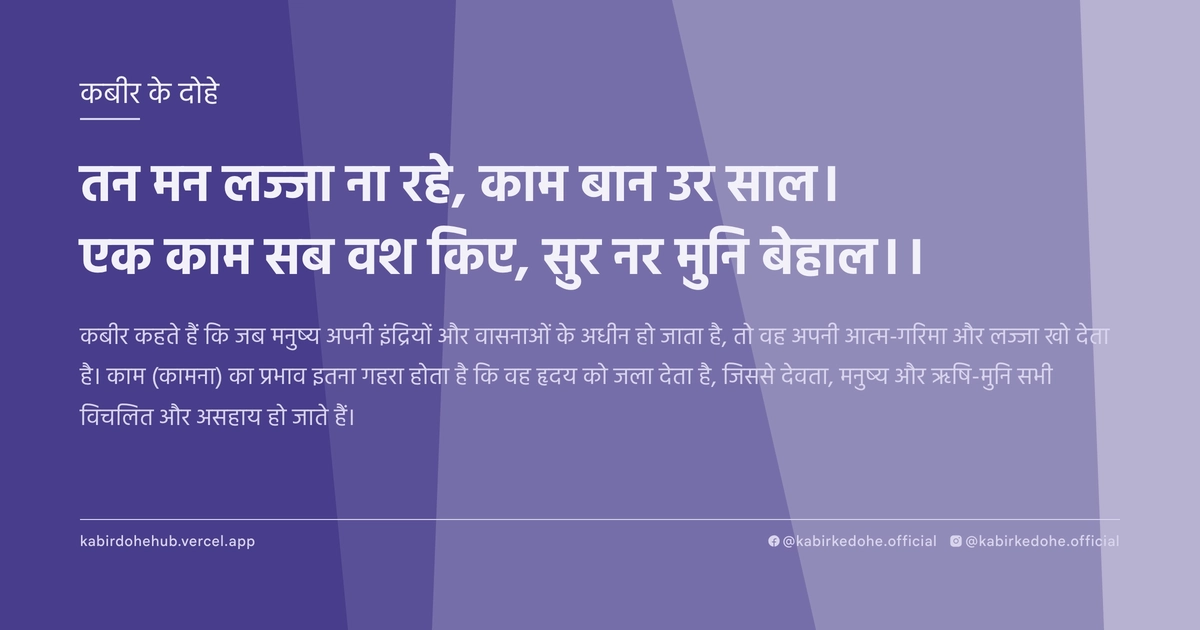
तन मन लज्जा ना रहे, काम बान उर साल।
एक काम सब वश किए, सुर नर मुनि बेहाल।।
Tan man lajja na rahe, kaam baan ur saal. Ek kaam sab vash kiye, sur nar muni behaal.
इस पृष्ठ पर इस कबीर दोहे का अर्थ (meaning), हिंदी व्याख्या और अंग्रेज़ी अनुवाद, दार्शनिक विश्लेषण और व्यावहारिक जीवन सीख दी गई है। यह दोहा काम (Lust) विषय से जुड़ा है — Kabir doha meaning and explanation in Hindi and English.
अर्थ (Meaning):
कबीर कहते हैं कि जब मनुष्य अपनी इंद्रियों और वासनाओं के अधीन हो जाता है, तो वह अपनी आत्म-गरिमा और लज्जा खो देता है। काम (कामना) का प्रभाव इतना गहरा होता है कि वह हृदय को जला देता है, जिससे देवता, मनुष्य और ऋषि-मुनि सभी विचलित और असहाय हो जाते हैं।
Kabir asserts that when a human becomes a slave to their sensory desires and cravings, they lose their innate spiritual dignity and shame. The fire of 'Kaam' (lust/desire) consumes the heart, leaving even the most enlightened beings—gods, humans, and sages—distressed and destabilized.
व्याख्या (Interpretation):
इस दोहे का शाब्दिक अर्थ कामेच्छा के विनाशकारी प्रभाव से है, लेकिन आध्यात्मिक स्तर पर यह 'माया' के जाल की व्याख्या है। यहाँ 'लज्जा' का अर्थ सामाजिक शर्म नहीं, बल्कि आत्मा की वह पवित्रता है जो अज्ञानता के कारण लुप्त हो जाती है। 'काम' केवल यौन इच्छा नहीं, बल्कि किसी भी प्रकार का आसक्तिपूर्ण लगाव है जो चित्त को विचलित करता है। यह निर्गुण भक्ति के उस सिद्धांत को दर्शाता है जहाँ मन की चंचलता ही ईश्वर प्राप्ति में सबसे बड़ी बाधा है। जब तक अहंकार और वासना का शासन रहता है, तब तक आत्मा और ब्रह्म की एकता (अद्वैत) का अनुभव असंभव है। यह विरोधाभास है कि जो स्वयं को नियंत्रित नहीं कर सकता, वह ब्रह्मांड के रहस्यों को जानने का दावा करता है। अंततः, यह दोहा हमें वासना के मनोविज्ञान से ऊपर उठकर आत्म-साक्षात्कार की ओर प्रेरित करता है।
Literally, the verse addresses the destructive nature of lust, but metaphorically, it dissects the trap of 'Maya' (illusion). Here, 'shame' does not refer to social embarrassment but to the loss of the soul's primordial purity due to ignorance. 'Kaam' is not limited to sexual desire; it encompasses any obsessive attachment that destabilizes the consciousness. This aligns with Nirgun Bhakti, where the restlessness of the mind is the primary obstacle to realizing the Formless Divine. Until the reign of ego and desire ends, the non-duality of Atman and Brahman remains obscured. It presents the paradox: one who cannot govern their own impulses cannot hope to understand the cosmic laws. Ultimately, the verse urges a transition from the psychology of craving to the stillness of self-realization.
दार्शनिक विश्लेषण (Philosophical Analysis):
कबीर का यह दोहा उस सामाजिक और धार्मिक पाखंड पर प्रहार करता है जहाँ बाहरी आडंबरों को आंतरिक शुद्धि से ऊपर रखा जाता था। उनके समय में, कई लोग स्वयं को उच्च जाति या धार्मिक गुरु मानते थे, फिर भी वे वासनाओं के दास थे। कबीर यहाँ स्पष्ट करते हैं कि आध्यात्मिक पतन किसी जाति या पद का मोहताज नहीं होता; एक मुनि भी यदि अपनी इंद्रियों पर नियंत्रण नहीं रखता, तो वह एक साधारण अज्ञानी से भिन्न नहीं है।
अद्वैत वेदांत के परिप्रेक्ष्य में, यह 'अविद्या' का चित्रण है। जब जीव स्वयं को शरीर और मन समझ लेता है, तो वह कामनाओं के चक्र में फंस जाता है। यह भ्रम ही उसे सत्य से दूर ले जाता है। कबीर का दृष्टिकोण सूफीवाद के 'नफ्स' (lower self) के संघर्ष से मिलता-जुलता है, जहाँ आत्मा को अपनी निम्न प्रवृत्तियों को मारकर 'इश्क-ए-हकीकी' (ईश्वरीय प्रेम) प्राप्त करना होता है।
यहाँ 'काम' को एक ऐसी शक्ति के रूप में दिखाया गया है जो विवेक को नष्ट कर देती है। जब विवेक मर जाता है, तो मनुष्य अपनी गरिमा खो देता है। यह मनोवैज्ञानिक रूपांतरण की मांग करता है—जहाँ व्यक्ति बाहरी दुनिया में खोजने के बजाय अपने भीतर के संघर्ष को पहचाने। कबीर का तर्क है कि ritualism (कर्मकांड) केवल एक मुखौटा है; वास्तविक धर्म वासनाओं का त्याग और मन की स्थिरता है।
यह विश्लेषण हमें बताता है कि अहंकार केवल 'मैं' कहने में नहीं है, बल्कि अपनी इच्छाओं को सत्य मानने में है। जब हम अपनी इच्छाओं को अपनी पहचान बना लेते हैं, तो हम अपनी वास्तविक दिव्य प्रकृति को भूल जाते हैं। यह 'बेहाली' या विचलित अवस्था ही मानव दुखों का मूल कारण है।
अंततः, कबीर यह संदेश देते हैं कि मुक्ति का मार्ग इंद्रिय निग्रह और साक्षी भाव (witness consciousness) से होकर गुजरता है। जब काम की अग्नि शांत होती है, तभी हृदय में वह शांति जन्म लेती है जिसे 'सहज' कहा गया है। यह केवल दमन नहीं, बल्कि उच्चतर चेतना के माध्यम से वासनाओं का विसर्जन है।
This verse is a sharp critique of the social and religious hypocrisy of Kabir's era, where external rituals were prioritized over internal purity. Many claimed high caste status or spiritual authority while remaining slaves to their impulses. Kabir clarifies that spiritual decay does not discriminate by rank; a sage who lacks mastery over his senses is no different from an ignorant layman.
From the lens of Advaita Vedanta, this is a depiction of 'Avidya' (ignorance). When the individual identifies with the body and mind, they become trapped in the cycle of craving. This illusion separates the self from the Ultimate Truth. Kabir's perspective mirrors the Sufi struggle with the 'Nafs' (the lower self), where the soul must transcend base instincts to achieve 'Ishq-e-Haqiqi' (Divine Love).
'Kaam' is presented here as a force that annihilates discernment (Viveka). Once discernment is lost, human dignity vanishes. This necessitates a psychological transformation—shifting focus from external conquests to the internal battle. Kabir argues that ritualism is merely a mask; true religion lies in the cessation of cravings and the stabilization of the mind.
This analysis reveals that ego is not just in saying 'I', but in mistaking one's desires for one's identity. When we equate our cravings with our existence, we forget our divine nature. This state of 'behaali' or distress is the root cause of all human suffering.
Ultimately, Kabir suggests that liberation is achieved through sensory restraint and the cultivation of the 'witness consciousness'. Only when the fire of desire is extinguished can the peace known as 'Sahaja' emerge. This is not mere suppression, but the dissolution of desire through a higher state of awareness.
मूल संदेश (Core Message):
- इच्छाएं आत्मा की गरिमा को लील जाती हैं।
- बाहरी पूजा तब तक व्यर्थ है जब तक आंतरिक वासना जीवित है।
- सच्ची शांति इच्छाओं के दमन में नहीं, बल्कि उनके विसर्जन में है।
- अहंकार और काम एक ही सिक्के के दो पहलू हैं।
- इंद्रियों का नियंत्रण ही वास्तविक स्वतंत्रता का द्वार है।
- दिव्यता का अनुभव केवल शांत चित्त में ही संभव है।
- Desires erode the innate dignity of the soul.
- External rituals are futile as long as internal cravings persist.
- True peace lies not in the suppression of desire, but in its dissolution.
- Ego and lust are two sides of the same coin.
- Mastery over the senses is the only gateway to real freedom.
- The Divine can only be experienced in a stilled consciousness.
व्यावहारिक उदाहरण (Practical Example):
एक समय की बात है, वाराणसी के घाटों पर माधव नाम का एक वृद्ध बुनकर रहता था। वह अपने काम में निपुण था, लेकिन उसका मन हमेशा दूसरों की संपत्ति और प्रशंसा की लालसा में रहता था। वह अक्सर अपने पड़ोसियों की समृद्धि देखकर ईर्ष्या करता और रात भर इस सोच में जागता कि वह और अधिक धन कैसे कमा सकता है।
माधव का यह स्वभाव उसके परिवार में तनाव पैदा कर रहा था। वह अपनी पत्नी और बच्चों पर चिल्लाता, जबकि वास्तव में वह अपनी ही अतृप्त इच्छाओं से परेशान था। उसकी लज्जा अब इस बात में नहीं थी कि वह गरीब है, बल्कि इस बात में थी कि वह अपनी लालसा को छिपाने के लिए धर्म का ढोंग करता था।
एक दिन, वह एक संत के पास गया और अपनी मानसिक अशांति का कारण पूछा। संत ने उसे एक साधारण सा कपड़ा बुनने को कहा, लेकिन शर्त यह थी कि वह हर धागे को पूरी जागरूकता के साथ छुए और यह सोचे कि यह धागा उसकी अपनी सांस है।
शुरुआत में माधव को यह मूर्खतापूर्ण लगा। लेकिन जैसे-जैसे उसने ध्यान केंद्रित किया, उसे महसूस हुआ कि उसकी बेचैनी बाहरी अभाव के कारण नहीं, बल्कि उसके भीतर की 'कभी न खत्म होने वाली चाह' के कारण थी।
उसे याद आया कि कैसे उसने अपनी इच्छाओं के कारण अपने रिश्तों को नजरअंदाज किया था। उसे अपनी स्थिति पर गहरी लज्जा महसूस हुई—वह लज्जा जो उसे अपनी वासनाओं के प्रति सचेत कर रही थी।
उसने महसूस किया कि वह 'काम' (इच्छा) के वश में था, जिसने उसे एक मानसिक जेल में कैद कर रखा था। उसने देखा कि उसके जैसे कई लोग थे जो धन के पीछे भाग रहे थे, लेकिन वास्तव में वे सभी 'बेहाल' थे।
माधव ने अपनी लालसा को त्यागने का निर्णय लिया। उसने अपनी कला को केवल धन कमाने का साधन नहीं, बल्कि ईश्वर की सेवा का माध्यम बनाया।
धीरे-धीरे उसका क्रोध शांत हुआ और उसके घर में शांति वापस आई। उसने पाया कि जब उसने 'पाने' की इच्छा छोड़ी, तो वह वास्तव में 'पूर्ण' हो गया।
उसका जीवन अब दूसरों की ईर्ष्या से नहीं, बल्कि अपनी आंतरिक संतुष्टि से संचालित था। उसने सीखा कि सच्ची गरिमा बाहरी संपत्ति में नहीं, बल्कि मन की स्थिरता में है।
यह 'कबीर ट्विस्ट' था—जहाँ एक साधारण बुनकर ने अपनी वासनाओं के विनाश के माध्यम से अपनी आत्मा की खोई हुई लज्जा और शांति को पुनः प्राप्त किया।
Once, in the ghats of Varanasi, lived an elderly weaver named Madhav. He was skilled in his craft, but his mind was perpetually consumed by a longing for the wealth and praise of others. He often looked at his neighbors' prosperity with envy, spending sleepless nights plotting how to acquire more gold.
Madhav's nature created immense tension within his family. He would lash out at his wife and children, though in reality, he was tormented by his own unquenchable desires. His 'shame' was no longer about his poverty, but about the hypocrisy of pretending to be religious while harboring greed.
One day, he approached a wandering saint and asked for the cause of his mental turmoil. The saint asked him to weave a simple piece of cloth, but with a condition: he must touch every thread with total awareness, imagining each thread as his own breath.
Initially, Madhav found this absurd. However, as he focused, he realized that his distress did not stem from external lack, but from the 'endless wanting' within him.
He recalled how his cravings had led him to neglect his loved ones. He felt a profound sense of shame—a spiritual shame that made him conscious of his bondage to desire.
He recognized that he was a slave to 'Kaam' (desire), which had imprisoned him in a mental cage. He observed that many around him were chasing wealth, yet they were all equally 'behaal' or distressed.
Madhav decided to renounce this craving. He stopped viewing his art as a mere tool for accumulation and began treating it as a medium of service to the Divine.
Slowly, his anger subsided, and peace returned to his home. He discovered that by letting go of the desire to 'possess', he actually became 'complete'.
His life was no longer driven by envy, but by inner contentment. He learned that true dignity lies not in material assets, but in the stillness of the mind.
This was the 'Kabir Twist'—where a simple weaver regained his lost spiritual dignity and peace by annihilating his cravings.
अभ्यास मार्गदर्शन (Practice Guidance):
- दैनिक अभ्यास: प्रतिदिन 20 मिनट मौन बैठें और अपने भीतर उठने वाली हर इच्छा (चाहे वह छोटी हो या बड़ी) को केवल एक साक्षी के रूप में देखें, बिना उसे पूरा किए या उसका विरोध किए।
- आत्म-पूछताछ जर्नल: हर रात लिखें—'आज मैंने किस इच्छा के कारण अपनी मानसिक शांति खोई?' और 'क्या वह इच्छा मेरी वास्तविक आवश्यकता थी या केवल अहंकार की तृप्ति?'
- व्यवहारिक परिवर्तन: दिन में कम से कम एक बार ऐसी स्थिति का सामना करें जहाँ आप अपनी पसंद को त्याग कर दूसरों की सुविधा को प्राथमिकता दें, ताकि 'मैं' और 'मेरा' का भाव कम हो।
- डायग्नोस्टिक चेकलिस्ट: यदि आप छोटी-छोटी बातों पर चिड़चिड़े हो रहे हैं, दूसरों की सफलता से जल रहे हैं, या निरंतर किसी चीज़ की कमी महसूस कर रहे हैं, तो समझें कि आप 'काम' के वश में हैं और आपको पुनः केंद्र में आने की आवश्यकता है।
- Daily Practice: Sit in silence for 20 minutes daily. Observe every arising desire—no matter how small—as a detached witness, without attempting to fulfill it or resist it.
- Self-Inquiry Journal: Every night, record: 'Which desire caused me to lose my mental peace today?' and 'Was that desire a genuine need or merely a craving of the ego?'
- Behavioral Shift: Once a day, consciously choose to sacrifice your preference for the convenience of another, thereby weakening the grip of 'I' and 'Mine'.
- Diagnostic Checklist: If you find yourself irritable over trivialities, envious of others' success, or feeling a chronic sense of lack, recognize that you are under the influence of 'Kaam' and need to return to your center.
चिंतन प्रश्न (Reflection Questions):
- मेरी कौन सी ऐसी 'गुप्त इच्छाएं' हैं जिन्हें मैं दुनिया से छिपाता हूँ, लेकिन वे मेरे निर्णयों को नियंत्रित करती हैं?
- क्या मेरी धार्मिक या आध्यात्मिक पहचान वास्तव में मेरी आंतरिक शुद्धि का परिणाम है, या यह केवल एक सामाजिक मुखौटा है?
- जब मैं दूसरों की आलोचना करता हूँ, तो क्या मैं वास्तव में उनके दोष देख रहा हूँ, या अपनी उन इच्छाओं को देख रहा हूँ जिन्हें मैं पूरा नहीं कर पाया?
- यदि आज मेरी सभी भौतिक इच्छाएं पूरी हो जाएं, तो क्या मैं वास्तव में शांत हो जाऊंगा, या मेरी वासनाएं नए लक्ष्य ढूंढ लेंगी?
- मेरे जीवन में 'लज्जा' का क्या अर्थ है—क्या यह समाज का डर है या अपनी आत्मा के प्रति ईमानदारी?
- What are the 'hidden desires' I conceal from the world, yet allow to govern my daily decisions?
- Is my religious or spiritual identity a result of actual internal purification, or is it merely a social mask?
- When I criticize others, am I seeing their flaws, or am I projecting the desires I failed to fulfill?
- If all my material desires were met today, would I truly find peace, or would my cravings simply find new targets?
- What does 'shame' mean in my life—is it a fear of social judgment or a commitment to honesty toward my soul?