
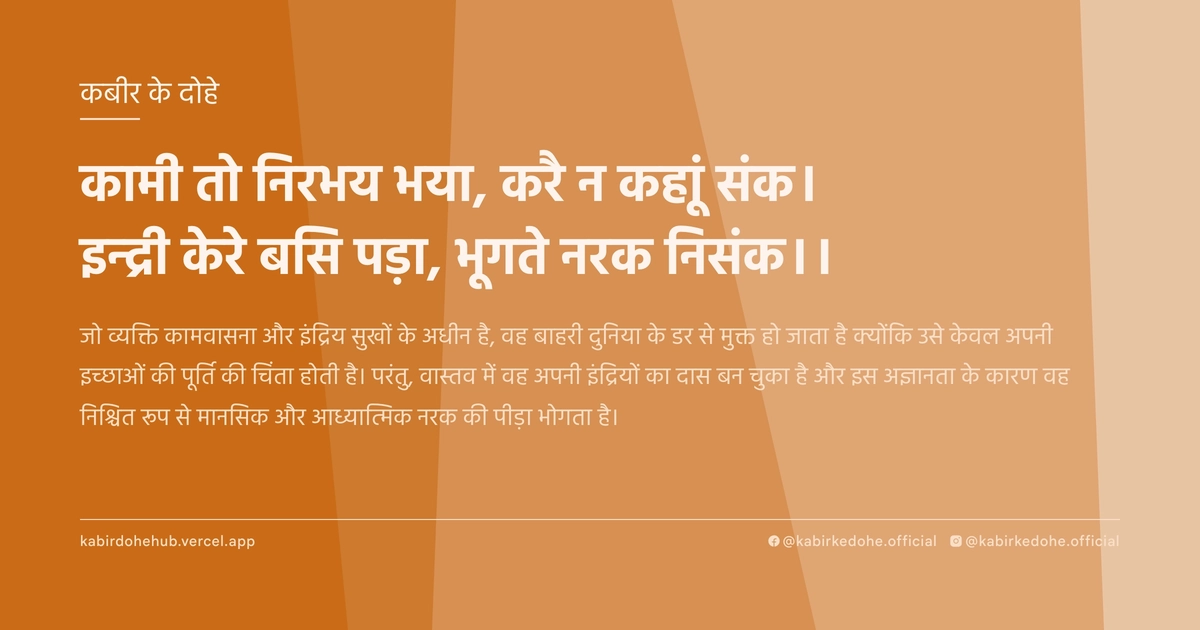
कामी तो निरभय भया, करै न कहाूं संक।
इन्द्री केरे बसि पड़ा, भूगते नरक निसंक।।
Kaami to nirbhay bhaya, karai na kahan sank. Indri kere basi pada, bhugate narak nisank.
इस पृष्ठ पर इस कबीर दोहे का अर्थ (meaning), हिंदी व्याख्या और अंग्रेज़ी अनुवाद, दार्शनिक विश्लेषण और व्यावहारिक जीवन सीख दी गई है। यह दोहा काम (Lust) विषय से जुड़ा है — Kabir doha meaning and explanation in Hindi and English.
अर्थ (Meaning):
जो व्यक्ति कामवासना और इंद्रिय सुखों के अधीन है, वह बाहरी दुनिया के डर से मुक्त हो जाता है क्योंकि उसे केवल अपनी इच्छाओं की पूर्ति की चिंता होती है। परंतु, वास्तव में वह अपनी इंद्रियों का दास बन चुका है और इस अज्ञानता के कारण वह निश्चित रूप से मानसिक और आध्यात्मिक नरक की पीड़ा भोगता है।
The one enslaved by lust and sensory desires becomes fearless of the external world, as they are blinded by the pursuit of gratification. However, by becoming a prisoner to their own senses, they unwittingly descend into a state of spiritual torment and mental hell, oblivious to their own bondage.
व्याख्या (Interpretation):
इस दोहे में कबीर एक गहरे विरोधाभास को उजागर करते हैं। पहली पंक्ति में 'निरभय' शब्द का प्रयोग व्यंग्य है; यहाँ निर्भयता आध्यात्मिक मुक्ति नहीं, बल्कि अज्ञानता जनित अंधता है। जब मनुष्य काम (desire) के वश में होता है, तो वह सामाजिक मर्यादाओं और नैतिक भय को भूल जाता है। दूसरी पंक्ति में कबीर इस स्थिति का वास्तविक विश्लेषण करते हैं। 'इन्द्रिय केरे बसि' का अर्थ है कि आत्मा अब शरीर की मालिक नहीं, बल्कि इंद्रियों की गुलाम है। यह स्थिति 'माया' का चरम रूप है, जहाँ व्यक्ति यह भ्रम पाल लेता है कि वह स्वतंत्र है, जबकि वह अपनी वासनाओं की जंजीरों में जकड़ा हुआ है। यह द्वैत (duality) की वह स्थिति है जहाँ व्यक्ति स्वयं को शरीर मानता है, न कि वह शुद्ध चेतना (Atman) जो ब्रह्म के साथ एक है।
In this couplet, Kabir employs a profound paradox. The term 'nirbhaya' (fearless) in the first line is used ironically; it is not the fearlessness of liberation, but the blindness of ignorance. When a person is consumed by 'Kaam' (lust/desire), they lose the capacity for moral dread or social caution. The second line unveils the tragedy: 'Indri kere basi' signifies that the soul is no longer the master of the body but a slave to the senses. This is the pinnacle of 'Maya' (illusion), where the individual mistakes the intensity of desire for freedom. It highlights the central paradox of the human condition: the belief in autonomy while being driven by biological and psychological compulsions. This state reinforces the duality between the ego and the universal consciousness, trapping the Atman in a cycle of perpetual dissatisfaction.
दार्शनिक विश्लेषण (Philosophical Analysis):
कबीर का यह दर्शन निर्गुण भक्ति और अद्वैत वेदांत के संगम पर स्थित है। वे यहाँ 'काम' को केवल शारीरिक इच्छा नहीं, बल्कि उस आसक्ति (attachment) के रूप में देखते हैं जो आत्मा को परमात्मा से अलग करती है। कबीर के समय में धर्म के नाम पर केवल बाहरी कर्मकांडों पर जोर था, लेकिन कबीर ने आंतरिक शुद्धि को प्राथमिकता दी। वे तर्क देते हैं कि जब तक इंद्रियाँ अनियंत्रित हैं, तब तक कोई भी तीर्थ या पूजा व्यर्थ है।
सूफी मत के 'नफ्स' (Nafs/Ego) के विचार से इसे जोड़ा जा सकता है, जहाँ निम्न स्तर की इच्छाओं का दमन और रूपांतरण ही ईश्वर तक पहुँचने का मार्ग है। कबीर यहाँ चेतावनी दे रहे हैं कि जो व्यक्ति अपनी इच्छाओं को ही अपना सत्य मान लेता है, वह वास्तव में एक मानसिक कारागार में है।
अद्वैत वेदांत के अनुसार, जब तक 'अहंकार' (Ego) जीवित है, तब तक ब्रह्म का अनुभव असंभव है। कामवासना अहंकार को पुष्ट करती है क्योंकि यह 'मैं' और 'मेरा' की भावना को बढ़ाती है। कबीर इस अहंकार के विलीनीकरण की बात करते हैं।
यहाँ 'नरक' किसी भौगोलिक स्थान का नाम नहीं है, बल्कि वर्तमान क्षण में अनुभव की जाने वाली मानसिक अशांति, ग्लानि और अतृप्ति है। यह एक मनोवैज्ञानिक विश्लेषण है कि कैसे अनियंत्रित इच्छाएं अंततः अवसाद और आंतरिक संघर्ष को जन्म देती हैं।
अंततः, कबीर का संदेश यह है कि वास्तविक निर्भयता इंद्रियों के दमन से नहीं, बल्कि उनके साक्षी (witness) बनने से आती है। जब साधक यह जान लेता है कि वह इंद्रियों से परे है, तभी वह वास्तविक मुक्ति या मोक्ष को प्राप्त करता है।
Kabir's philosophy here converges with Nirgun Bhakti and Advaita Vedanta. He views 'Kaam' not merely as physical lust, but as the overarching attachment that severs the soul's connection with the Formless Divine. In an era dominated by rigid ritualism and caste hierarchies, Kabir pivoted the spiritual discourse toward internal purification, asserting that external piety is meaningless if the internal senses remain ungoverned.
This aligns closely with the Sufi concept of 'Nafs' (the lower self/ego). In Sufism, the struggle against the lower desires is a prerequisite for achieving union with the Beloved. Kabir suggests that the person who identifies with their desires is trapped in a psychic prison, mistaking the noise of the ego for the voice of truth.
From the perspective of Advaita Vedanta, the 'Ahamkara' (ego) is the primary veil. Desire reinforces this ego by creating a perceived separation between the subject and the object. By chasing sensory pleasure, the individual strengthens the illusion of duality, moving further away from the realization that Atman and Brahman are one.
Crucially, Kabir redefines 'Narak' (Hell). He does not describe a subterranean realm of punishment, but rather a psychological state of perpetual unrest, guilt, and insatiable craving. Hell is the immediate experience of a mind fragmented by conflicting desires.
Ultimately, Kabir advocates for a shift from being a 'doer' (karta) driven by senses to becoming a 'witness' (sakshi). True fearlessness is not the absence of caution in the pursuit of lust, but the transcendence of the ego, leading to a state of equanimity and spiritual liberation.
मूल संदेश (Core Message):
- इच्छाओं की तृप्ति वास्तव में एक अंतहीन प्यास है।
- झूठी निर्भयता अज्ञानता का आवरण है।
- इंद्रियों का दास होना ही सबसे बड़ा बंधन है।
- मानसिक अशांति ही वर्तमान का वास्तविक नरक है।
- साक्षी भाव ही वासनाओं से मुक्ति का एकमात्र मार्ग है।
- आंतरिक अनुशासन ही वास्तविक स्वतंत्रता की कुंजी है।
- The gratification of desire is an endless thirst.
- False fearlessness is merely a veil of ignorance.
- Being a slave to the senses is the ultimate bondage.
- Mental turmoil is the true hell of the present moment.
- The state of the witness is the only path to liberation from lust.
- Internal discipline is the only key to authentic freedom.
व्यावहारिक उदाहरण (Practical Example):
एक समय की बात है, वाराणसी के घाटों पर रहने वाला एक वृद्ध बुनकर था, जिसका नाम माधव था। माधव अपने काम में निपुण था, लेकिन उसका मन हमेशा अधिक धन और विलासिता की चाह में भटकता रहता था। वह अक्सर अन्य बुनकरों की समृद्धि देखकर ईर्ष्या करता और रात-रात भर इस योजना में लगा रहता कि कैसे वह कम मेहनत में अधिक लाभ कमा सके।
उसकी यह लालसा उसे इतना अंधा कर चुकी थी कि उसने अपने परिवार की जरूरतों को नजरअंदाज करना शुरू कर दिया। वह समाज में अपनी प्रतिष्ठा बढ़ाने के लिए कर्ज लेने लगा और दिखावे की दुनिया में डूब गया। उसे लगता था कि वह बहुत साहसी है क्योंकि वह जोखिम लेने से नहीं डरता था, लेकिन वास्तव में वह अपनी लालसा का गुलाम था।
एक दिन, माधव की मुलाकात एक फकीर से हुई जिसने उसे एक साधारण सूती कपड़े का टुकड़ा दिखाया और पूछा, 'इस कपड़े में क्या है?' माधव ने कहा, 'सिर्फ धागे।' फकीर ने मुस्कुराते हुए कहा, 'जैसे इस कपड़े के पीछे धागे छिपे हैं, वैसे ही तुम्हारी इस साहस की चादर के पीछे तुम्हारी वासनाएं छिपी हैं। तुम निर्भय नहीं हो, तुम बस अंधे हो।'
यह बात माधव के हृदय में गहरे तक उतर गई। उसने महसूस किया कि जिस 'साहस' पर उसे गर्व था, वह वास्तव में उसकी इंद्रियों का उन्माद था जिसने उसे अपनों से दूर कर दिया था।
अगले कुछ महीनों तक, माधव ने मौन का अभ्यास किया। उसने अपनी इच्छाओं को दबाने के बजाय उन्हें देखना शुरू किया। जब भी उसे लालच आता, वह खुद से पूछता, 'यह इच्छा मेरी है या मेरी इंद्रियों की?'
धीरे-धीरे उसका दृष्टिकोण बदलने लगा। उसने महसूस किया कि असली सुख अधिक धन में नहीं, बल्कि अपने काम की शुद्धता और मन की शांति में है।
उसने अपने कर्ज चुकाए और अपनी कला को फिर से निखारा, लेकिन अब उसका उद्देश्य प्रसिद्धि नहीं, बल्कि संतोष था।
माधव अब वास्तव में निर्भय था, क्योंकि अब उसे किसी बाहरी वस्तु या व्यक्ति की प्रशंसा की आवश्यकता नहीं थी।
उसने पाया कि जब वह इंद्रियों के वश से मुक्त हुआ, तो उसका घर और मन दोनों स्वर्ग बन गए।
यह 'कबीर ट्विस्ट' था—अहंकार की झूठी निर्भयता से वास्तविक आत्म-बोध की शांति की ओर संक्रमण।
Once, in the bustling ghats of Varanasi, lived an elderly weaver named Madhav. Madhav was skilled in his craft, but his mind was perpetually adrift in a sea of greed and a longing for luxury. He spent his nights envying the prosperity of other weavers, obsessing over schemes to earn more wealth with minimal effort.
This craving blinded him to the point where he began neglecting his family's basic needs. He took loans to maintain a facade of prestige, believing himself to be a bold risk-taker. In reality, he was not brave; he was merely a puppet of his own insatiable desires.
One day, Madhav encountered a wandering mystic who showed him a simple piece of cotton cloth and asked, 'What is in this fabric?' Madhav replied, 'Only threads.' The mystic smiled and said, 'Just as the threads are hidden behind this cloth, your desires are hidden behind your cloak of courage. You are not fearless; you are simply blind.'
These words pierced Madhav's consciousness. He realized that the 'boldness' he prided himself on was actually a sensory frenzy that had alienated him from his loved ones and his own peace.
For the next few months, Madhav practiced silence. Instead of suppressing his desires, he began to observe them. Whenever greed surfaced, he would ask himself, 'Is this desire mine, or does it belong to my senses?'
Gradually, his perspective shifted. He discovered that true happiness lay not in accumulation, but in the purity of his work and the stillness of his mind.
He paid off his debts and refined his art, but his motivation had changed from seeking fame to seeking contentment.
Madhav became truly fearless—not because he lacked risk, but because he no longer depended on external validation or material possession for his identity.
He found that once he ceased to be a slave to his senses, both his home and his heart transformed into a sanctuary of peace.
This was the 'Kabir Twist'—the transition from the false fearlessness of the ego to the authentic serenity of self-realization.
अभ्यास मार्गदर्शन (Practice Guidance):
- दैनिक साक्षी भाव: दिन में तीन बार 10 मिनट के लिए बैठें और अपनी उभरती हुई इच्छाओं को बिना किसी निर्णय के देखें। यह पहचानें कि 'मैं' इच्छा नहीं हूँ, बल्कि 'देखने वाला' हूँ।
- आत्म-पूछताछ जर्नल: हर रात लिखें कि आज किस क्षण में मेरी इंद्रियों ने मेरा निर्णय प्रभावित किया? क्या वह निर्णय मेरी आत्मा की शांति के लिए था या केवल क्षणिक सुख के लिए?
- इंद्रिय उपवास: सप्ताह में एक दिन ऐसा चुनें जब आप किसी एक विशेष सुख (जैसे स्वाद या सोशल मीडिया) का त्याग करें, ताकि आप अपनी इच्छाशक्ति को पुनः प्राप्त कर सकें।
- निदान चेकलिस्ट: यदि आप बार-बार क्रोध, ईर्ष्या या अतृप्ति महसूस कर रहे हैं, तो यह संकेत है कि आप 'इंद्रिय केरे बसि' (इंद्रियों के वश) में हैं। यदि आप विपरीत परिस्थितियों में भी शांत हैं, तो आप वास्तविक निर्भयता की ओर बढ़ रहे हैं।
- Daily Witnessing: Sit for 10 minutes three times a day and observe emerging desires without judgment. Affirm: 'I am not the desire; I am the observer of the desire.'
- Self-Inquiry Journaling: Every night, record: 'In which moment today did my senses dictate my decision? Was that choice for my soul's peace or for fleeting gratification?'
- Sensory Fasting: Choose one day a week to abstain from a specific pleasure (e.g., gourmet food or digital scrolling) to reclaim the sovereignty of your will over your impulses.
- Diagnostic Checklist: If you frequently experience sudden anger, jealousy, or a sense of 'never enough,' you are likely 'Indri kere basi' (enslaved by senses). If you remain equanimous despite external chaos, you are moving toward authentic fearlessness.
चिंतन प्रश्न (Reflection Questions):
- मेरे जीवन के वे कौन से 'साहस' हैं जो वास्तव में मेरी अनियंत्रित इच्छाओं का परिणाम हैं?
- यदि मेरी सभी भौतिक इच्छाएं पूरी हो जाएं, तो क्या मेरा 'मैं' शांत होगा या और अधिक भूखा हो जाएगा?
- मैं अपनी सार्वजनिक छवि (Digital Ego) को बनाए रखने के लिए किन आंतरिक संघर्षों को अनदेखा कर रहा हूँ?
- क्या मैं वास्तव में स्वतंत्र हूँ, या मैं केवल अपनी आदतों और प्रवृत्तियों का एक पुतला हूँ?
- मेरे जीवन में 'नरक' के क्षण कौन से हैं, और वे मेरी किन इंद्रियों की अतृप्ति से जुड़े हैं?
- क्या मैं अपनी इच्छाओं का स्वामी हूँ, या मेरी इच्छाएं मेरी स्वामी हैं?
- Which 'bold moves' in my life were actually driven by ungoverned impulses rather than conscious wisdom?
- If all my material desires were fulfilled, would my 'ego' be silenced or would it become even hungrier?
- What internal conflicts am I ignoring to maintain my curated public identity (Digital Ego)?
- Am I truly free, or am I merely a puppet of my conditioned habits and biological drives?
- What are the 'hellish' moments in my daily life, and which unsatisfied sense is fueling them?
- Do I own my desires, or do my desires own me?