
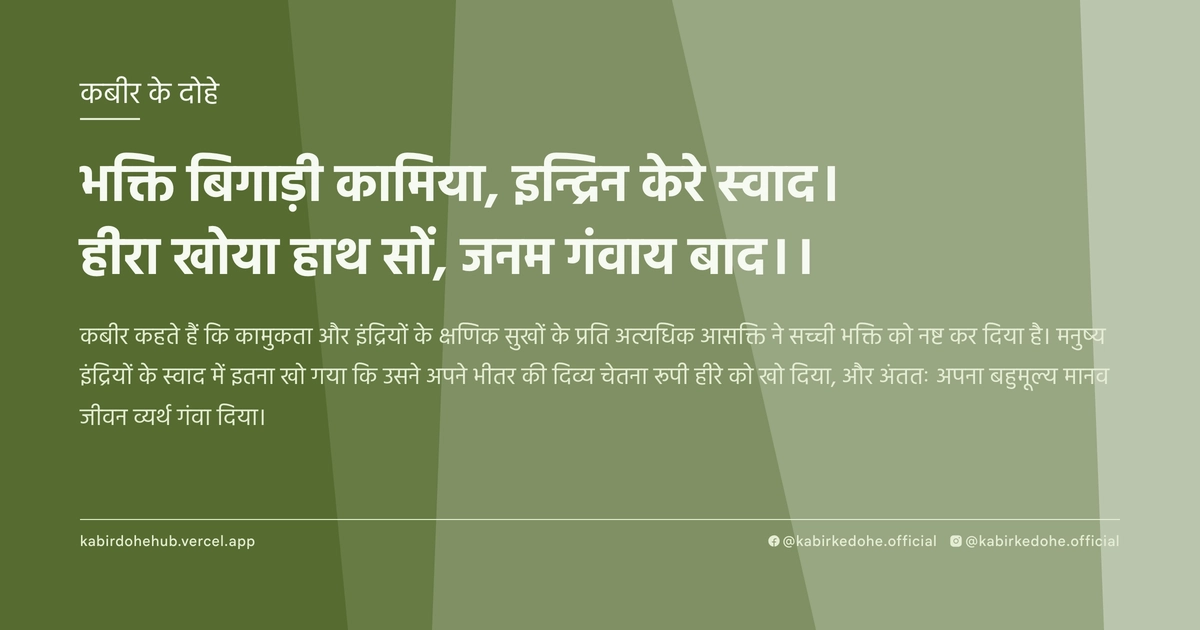
भक्ति बिगाड़ी कामिया, इन्द्रिन केरे स्वाद।
हीरा खोया हाथ सों, जनम गंवाय बाद।।
Bhakti bigadi kaamiya, indrin kere swaad. Heera khoya haath son, janam ganvay baad.
इस पृष्ठ पर इस कबीर दोहे का अर्थ (meaning), हिंदी व्याख्या और अंग्रेज़ी अनुवाद, दार्शनिक विश्लेषण और व्यावहारिक जीवन सीख दी गई है। यह दोहा काम (Lust) विषय से जुड़ा है — Kabir doha meaning and explanation in Hindi and English.
अर्थ (Meaning):
कबीर कहते हैं कि कामुकता और इंद्रियों के क्षणिक सुखों के प्रति अत्यधिक आसक्ति ने सच्ची भक्ति को नष्ट कर दिया है। मनुष्य इंद्रियों के स्वाद में इतना खो गया कि उसने अपने भीतर की दिव्य चेतना रूपी हीरे को खो दिया, और अंततः अपना बहुमूल्य मानव जीवन व्यर्थ गंवा दिया।
Kabir asserts that lust and the relentless pursuit of sensory pleasures have corrupted the essence of true devotion. By becoming enslaved to the fleeting tastes of the senses, the seeker has lost the priceless diamond of inner consciousness, ultimately squandering the rare opportunity of a human birth.
व्याख्या (Interpretation):
इस दोहे का शाब्दिक अर्थ है कि इंद्रिय सुखों ने भक्ति को बिगाड़ दिया है। आध्यात्मिक स्तर पर, 'कामिया' केवल शारीरिक वासना नहीं, बल्कि किसी भी ऐसी इच्छा का प्रतीक है जो आत्मा को परमात्मा से दूर करती है। 'हीरा' यहाँ आत्मा की शुद्धता और आत्म-साक्षात्कार का प्रतीक है। कबीर निर्गुण भक्ति के माध्यम से समझाते हैं कि जब तक मन बाहरी माया और इंद्रिय-तृप्तियों में उलझा रहता है, तब तक वह उस निराकार ब्रह्म का अनुभव नहीं कर सकता। यह द्वैतवाद की स्थिति है जहाँ मनुष्य स्वयं को शरीर और उसकी इच्छाओं के साथ जोड़ लेता है, जबकि वास्तव में वह शुद्ध चेतना है। इस प्रकार, इंद्रियों का स्वाद एक भ्रम (माया) है जो वास्तविक सत्य को ढक लेता है।
Literally, the verse warns that sensory indulgence ruins devotion. Metaphorically, 'Kaamiya' represents not just lust, but any craving that anchors the soul to the material plane. The 'Diamond' symbolizes the Atman—the pure, indestructible spark of divinity within. Kabir employs the lens of Nirgun Bhakti to illustrate that as long as the mind is tethered to the transient 'tastes' of the senses, it remains blind to the formless Brahman. This is the tragedy of Maya; the illusion of pleasure creates a veil of duality, making the seeker mistake the temporary vessel (the body) for the eternal essence. The paradox lies in the fact that the diamond is already in the hand, yet the seeker loses it by chasing shadows.
दार्शनिक विश्लेषण (Philosophical Analysis):
कबीर का यह दोहा उस युग की प्रतिक्रिया है जहाँ धर्म केवल कर्मकांडों और बाहरी आडंबरों तक सीमित हो गया था। वे यहाँ 'काम' (Desire) को भक्ति के मार्ग में सबसे बड़ी बाधा मानते हैं। यह विचार अद्वैत वेदांत के करीब है, जहाँ अविद्या (अज्ञान) के कारण जीव स्वयं को शरीर मानता है और इंद्रिय सुखों में लिप्त हो जाता है। कबीर का दृष्टिकोण सूफी मत के 'नफ्स' (अहंकार/इच्छा) के नियंत्रण जैसा है, जहाँ आत्मा की शुद्धि के लिए इंद्रियों का दमन नहीं, बल्कि उनका अतिक्रमण आवश्यक है।
वे स्पष्ट करते हैं कि भक्ति कोई बाहरी क्रिया नहीं, बल्कि आंतरिक रूपांतरण है। जब व्यक्ति इंद्रियों के स्वाद में डूबता है, तो वह 'साक्षी भाव' खो देता है। यह मनोवैज्ञानिक पतन है जहाँ सुख की खोज वास्तव में दुख का कारण बनती है क्योंकि इंद्रिय सुख क्षणिक होते हैं और उनकी तृप्ति कभी समाप्त नहीं होती।
कबीर जाति और धर्म के भेदभाव को नकारते हुए यह बताते हैं कि पतन का कारण सामाजिक स्थिति नहीं, बल्कि व्यक्तिगत वासना है। वे ritualism (कर्मकांड) का विरोध करते हैं क्योंकि मंदिर-मस्जिद जाना तब तक व्यर्थ है जब तक मन इंद्रियों का गुलाम है।
यहाँ 'हीरा खोना' एक गहरा रूपक है। हीरा दुर्लभ है, वैसे ही मानव जीवन दुर्लभ है। अद्वैत के अनुसार, ब्रह्म सत्य है और जगत मिथ्या। जब मनुष्य मिथ्या (इंद्रिय सुख) को सत्य मान लेता है, तो वह अपने वास्तविक स्वरूप (ब्रह्म) को भूल जाता है।
अंततः, कबीर का संदेश यह है कि मुक्ति का मार्ग इंद्रियों के स्वाद को त्यागकर अंतर्मुखी होने में है। यह अहंकार का विसर्जन है, जहाँ 'मैं' और 'मेरा' समाप्त होकर केवल वह 'एक' शेष रहता है।
Kabir’s verse emerges as a critique of an era where spirituality was reduced to superficial rituals. He identifies 'Kaam' (desire) as the primary antagonist to spiritual liberation. This aligns profoundly with Advaita Vedanta, where 'Avidya' (ignorance) leads the soul to misidentify with the physical body and its sensory cravings, thereby forgetting its non-dual nature as Brahman.
His philosophy mirrors the Sufi concept of 'Nafs'—the lower self or ego. For Kabir, the struggle is not about the violent suppression of senses, but their transcendence. He argues that true Bhakti is not a performance of piety but an internal alchemy. When the mind is consumed by sensory 'tastes,' it loses the state of 'Sakshi' (the witness), falling into the trap of psychological fragmentation.
By rejecting the caste-based and ritualistic structures of his time, Kabir emphasizes that spiritual failure is a universal human condition rooted in desire, regardless of social standing. He posits that the external pilgrimage is futile if the internal pilgrimage—from the senses to the soul—is ignored.
The metaphor of the 'Diamond' is pivotal. In the context of the Bhakti movement, the human birth is seen as a rare opportunity for Moksha. To lose this 'diamond' is to trade an eternal reality for a fleeting sensation. This is the core of the tragedy: the seeker possesses the treasure but ignores it in favor of pebbles.
Ultimately, Kabir advocates for the annihilation of the ego. He suggests that the path to the Formless (Nirgun) requires a shift in consciousness from the 'objective' world of tastes to the 'subjective' reality of pure existence, where the duality of seeker and sought dissolves into oneness.
मूल संदेश (Core Message):
- इंद्रिय सुख एक सुंदर जाल है जो आत्मा को कैद करता है।
- सच्ची भक्ति बाहरी दिखावे में नहीं, आंतरिक वैराग्य में है।
- क्षणिक तृप्ति के लिए शाश्वत शांति का सौदा न करें।
- इच्छाओं का त्याग नहीं, बल्कि उनका अतिक्रमण ही मुक्ति है।
- भीतर का हीरा खोजने के लिए बाहर के शोर को शांत करना होगा।
- Sensory pleasure is a gilded cage that imprisons the soul.
- True devotion lies in internal detachment, not external piety.
- Do not trade eternal peace for a moment of gratification.
- Liberation is not the suppression of desire, but its transcendence.
- To find the inner diamond, one must silence the external noise.
व्यावहारिक उदाहरण (Practical Example):
वाराणसी के घाटों पर रहने वाले एक वृद्ध विधवा, जानकी, की कहानी है। जानकी का पूरा जीवन दूसरों की सेवा और धार्मिक अनुष्ठानों में बीता था, लेकिन उनके मन में एक गहरी टीस थी—अपनी युवावस्था में खोए हुए प्रेम और उन सुखों की याद, जिन्हें उन्होंने समाज के डर से त्याग दिया था। वे हर दिन गंगा स्नान करतीं, लेकिन उनका मन उन पुरानी यादों के 'स्वाद' में अटका रहता था।
वे अक्सर सोचतीं कि यदि उन्होंने अपने मन की सुनी होती, तो शायद वे अधिक सुखी होतीं। यह मानसिक आसक्ति उनके लिए एक अदृश्य बंधन बन गई थी। वे पूजा तो करती थीं, लेकिन वह पूजा केवल एक यांत्रिक क्रिया थी; उनका हृदय अभी भी उन अधूरी इच्छाओं की दुनिया में भटक रहा था।
एक दिन उनकी मुलाकात एक घुमंतू साधु से हुई, जिसने उन्हें देखा और मुस्कुराकर कहा, 'माँ, तुम गंगा में शरीर तो डुबो रही हो, लेकिन मन अभी भी उस सूखे किनारे की रेत को पकड़े हुए है जिसे तुम बहुत पहले छोड़ चुकी हो।'
जानकी को पहले तो यह बात समझ नहीं आई। साधु ने आगे समझाया, 'तुम जिसे अपना खोया हुआ सुख मानती हो, वह वास्तव में एक भ्रम था जिसने तुम्हें वर्तमान की शांति से दूर रखा। तुमने उस हीरे को खो दिया जो तुम्हारे भीतर है, क्योंकि तुम उस स्वाद को ढूंढ रही हो जो अब अस्तित्व में ही नहीं है।'
यह शब्द जानकी के लिए एक बिजली की तरह थे। उन्होंने महसूस किया कि उनकी 'भक्ति' केवल एक मुखौटा थी, जबकि वास्तव में वे अपनी पुरानी इच्छाओं के शोक में डूबी हुई थीं। उन्होंने महसूस किया कि 'कामिया' केवल शारीरिक नहीं, बल्कि मानसिक मोह भी है।
उस रात, जानकी ने पहली बार अपनी आँखें बंद कीं और उन यादों को विदा किया। उन्होंने महसूस किया कि जिस सुख को वे बाहर ढूंढ रही थीं, वह वास्तव में उनके भीतर की शांति में छिपा था।
धीरे-धीरे, उनकी पूजा यांत्रिक से जीवंत हो गई। अब वे गंगा में केवल शरीर नहीं, बल्कि अपना अहंकार और अपनी पुरानी तृष्णाएं भी विसर्जित करने लगीं।
उनका व्यवहार बदल गया; वे अब केवल परंपरा के लिए सेवा नहीं करती थीं, बल्कि उनके हृदय में एक वास्तविक करुणा जाग गई थी। उन्होंने पाया कि जब इंद्रियों और स्मृतियों का स्वाद समाप्त होता है, तभी आत्मा का हीरा चमकता है।
Consider the story of Janaki, an elderly widow living on the ghats of Varanasi. Janaki had spent her entire life in service and religious rituals, yet a deep ache lingered within her—the memory of a lost love and the sensory pleasures she had sacrificed decades ago due to societal pressure.
Every day, she bathed in the Ganges, but her mind remained anchored to the 'taste' of those old memories. She often ruminated that had she followed her heart, she might have been happier. This mental attachment became an invisible chain, making her daily prayers a mere mechanical exercise.
One afternoon, she encountered a wandering monk who looked at her and smiled, saying, 'Mother, you dip your body in the Ganges, but your mind is still clutching the dry sand of a shore you left long ago.'
Janaki was confused. The monk continued, 'You mourn a pleasure that was an illusion. In chasing the ghost of that taste, you have lost the diamond of the present moment—the stillness that resides within you.'
These words struck Janaki like a bolt of lightning. She realized that her 'devotion' was merely a mask; in reality, she was enslaved by the grief of unfulfilled desires. She understood that 'Kaamiya' was not just physical lust, but an emotional clinging to what is gone.
That night, Janaki closed her eyes and consciously bid farewell to those memories. She realized that the happiness she sought externally was actually the peace of her own internal presence.
Gradually, her rituals transformed from mechanical acts into living experiences. She began to immerse not just her body, but her ego and her cravings into the river.
Her behavior shifted; her service to others was no longer a duty but an overflow of genuine compassion. She discovered that only when the taste of the senses fades does the diamond of the soul begin to shine.
अभ्यास मार्गदर्शन (Practice Guidance):
- इंद्रिय जागरूकता: दिन में तीन बार रुकें और स्वयं से पूछें—'इस समय मेरी कौन सी इंद्रिय किस स्वाद की तलाश कर रही है?'
- साक्षी ध्यान: 20 मिनट के लिए शांत बैठें और अपनी इच्छाओं को ऐसे देखें जैसे वे बादल हों, जो आते और जाते हैं, बिना उनसे जुड़े।
- आत्म-पूछताछ जर्नल: लिखें कि कौन सी ऐसी भौतिक वस्तु या आदत है जिसके बिना आप अधूरा महसूस करते हैं, और विश्लेषण करें कि वह वास्तव में आपको क्या दे रही है।
- डायग्नोस्टिक चेकलिस्ट: क्या मैं तनाव में होने पर तुरंत इंद्रिय सुख (भोजन, सोशल मीडिया, खरीदारी) की ओर भागता हूँ? क्या मेरी शांति बाहरी परिस्थितियों पर निर्भर है? यदि हाँ, तो मैं अभी भी 'स्वाद' के वश में हूँ।
- Sensory Awareness: Three times a day, pause and ask, 'Which sense is craving which specific taste right now?'
- Witness Meditation: Sit in silence for 20 minutes and observe your desires as passing clouds, without identifying with them.
- Self-Inquiry Journaling: List the material objects or habits you feel incomplete without, and analyze what void they are attempting to fill.
- Diagnostic Checklist: Do I instinctively turn to sensory gratification (food, scrolling, shopping) during stress? Is my peace dependent on external stimuli? If yes, I am still enslaved by 'taste'.
चिंतन प्रश्न (Reflection Questions):
- मेरे जीवन का वह 'हीरा' क्या है जिसे मैंने अपनी छोटी-छोटी इच्छाओं के लिए नजरअंदाज कर दिया है?
- क्या मेरी आध्यात्मिक पहचान केवल एक सामाजिक मुखौटा है, जबकि मेरा निजी जीवन अभी भी इंद्रिय सुखों का गुलाम है?
- मैं किन 'स्वादों' (मान्यताएं, प्रशंसा, डिजिटल मान्यता) के कारण अपनी वास्तविक चेतना से दूर भाग रहा हूँ?
- यदि आज मेरी सभी भौतिक सुख-सुविधाएं छीन ली जाएं, तो क्या मेरे पास कोई आंतरिक आधार बचेगा?
- क्या मैं वास्तव में ईश्वर की खोज कर रहा हूँ, या केवल अपनी इच्छाओं की पूर्ति के लिए एक धार्मिक माध्यम ढूंढ रहा हूँ?
- What is the 'diamond' in my life that I have ignored in pursuit of trivial desires?
- Is my spiritual identity merely a social mask, while my private life remains a slave to sensory cravings?
- Which 'tastes' (beliefs, praise, digital validation) are driving me away from my authentic consciousness?
- If all my material comforts were stripped away today, would there be any internal foundation left?
- Am I truly seeking the Divine, or am I just using religion as a tool to satisfy my own desires?