
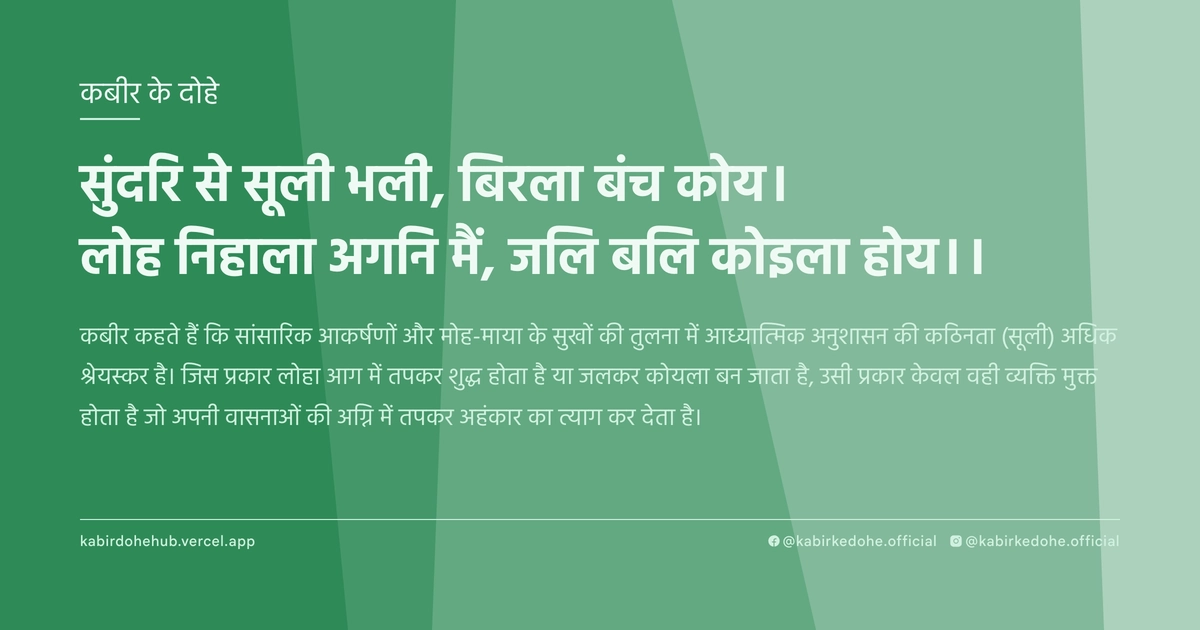
सुंदरि से सूली भली, बिरला बंच कोय।
लोह निहाला अगनि मैं, जलि बलि कोइला होय।।
Sundari se sooli bhali, birla banch koy. Loh nihala agni main, jali bali koila hoye.
इस पृष्ठ पर इस कबीर दोहे का अर्थ (meaning), हिंदी व्याख्या और अंग्रेज़ी अनुवाद, दार्शनिक विश्लेषण और व्यावहारिक जीवन सीख दी गई है। यह दोहा काम (Lust) विषय से जुड़ा है — Kabir doha meaning and explanation in Hindi and English.
अर्थ (Meaning):
कबीर कहते हैं कि सांसारिक आकर्षणों और मोह-माया के सुखों की तुलना में आध्यात्मिक अनुशासन की कठिनता (सूली) अधिक श्रेयस्कर है। जिस प्रकार लोहा आग में तपकर शुद्ध होता है या जलकर कोयला बन जाता है, उसी प्रकार केवल वही व्यक्ति मुक्त होता है जो अपनी वासनाओं की अग्नि में तपकर अहंकार का त्याग कर देता है।
Kabir asserts that the rigorous discipline of spiritual awakening, though as painful as a cross or a stake, is far superior to the deceptive allure of worldly pleasures. Just as iron is transformed in the furnace—either becoming a refined tool or burning into charcoal—only the rare few who endure the fire of self-purification and surrender their ego achieve true liberation.
व्याख्या (Interpretation):
इस दोहे में 'सुंदरि' माया और भौतिक आकर्षण का प्रतीक है, जबकि 'सूली' आध्यात्मिक साधना के कठिन मार्ग को दर्शाती है। कबीर का तर्क है कि माया का सुख क्षणिक है और अंततः बंधन का कारण बनता है, जबकि साधना का कष्ट स्थायी मुक्ति दिलाता है। यह निर्गुण भक्ति का सार है जहाँ साधक को बाहरी आडंबरों को त्यागकर अंतर्मुखी होना पड़ता है। यहाँ 'लोह' मानव आत्मा का प्रतीक है जो अज्ञानता की जंग से ढकी है। 'अगनि' वह विवेक और वैराग्य है जो अहंकार को जलाकर भस्म करता है। अद्वैत वेदांत के अनुसार, जब तक 'मैं' और 'मेरा' का भाव नहीं मिटता, तब तक ब्रह्म का साक्षात्कार असंभव है। अंततः, जो इस अग्नि परीक्षा से गुजरता है, वह कोयले की तरह अपनी पुरानी पहचान खोकर एक नई, शुद्ध चेतना में परिवर्तित हो जाता है।
In this couplet, 'Sundari' symbolizes the seductive nature of Maya and worldly attachments, while 'sooli' (the stake) represents the arduous path of spiritual discipline. Kabir argues that the pleasures of the world are ephemeral and lead to further bondage, whereas the pain of spiritual rigor leads to eternal liberation. This aligns with Nirgun Bhakti, where the seeker must discard external rituals to find the formless Divine within. The 'iron' represents the human soul encrusted with the rust of ignorance. The 'fire' is the transformative power of discernment (Viveka) and detachment (Vairagya) that incinerates the ego. According to Advaita Vedanta, the realization of the non-duality of Atman and Brahman is impossible until the illusion of the separate self is destroyed. Ultimately, the one who endures this fire is like iron turning into charcoal—completely losing its previous form to become something fundamentally different and pure.
दार्शनिक विश्लेषण (Philosophical Analysis):
कबीर का यह दर्शन उनके समय के सामाजिक और धार्मिक पाखंड के विरुद्ध एक कड़ा प्रहार था। उन्होंने देखा कि लोग तीर्थयात्राओं और बाहरी पूजा-पाठ में उलझे हुए थे, जिसे वे 'सुंदरि' या आकर्षक भ्रम मानते थे। उनके लिए वास्तविक धर्म कर्मकांड नहीं, बल्कि आंतरिक रूपांतरण था। वे सूफी मत के 'फना' (अहंकार का विनाश) और वेदांत के 'अद्वैत' के संगम पर खड़े थे, जहाँ आत्मा का परमात्मा में विलीनीकरण ही एकमात्र लक्ष्य है।
इस दोहे में 'सूली' का उल्लेख केवल शारीरिक कष्ट नहीं, बल्कि मनोवैज्ञानिक मृत्यु का संकेत है। जब एक व्यक्ति अपनी इच्छाओं और पहचान से मोह छोड़ता है, तो उसे ऐसा महसूस होता है जैसे वह सूली पर चढ़ रहा हो। यह 'अहंकार की मृत्यु' है। कबीर स्पष्ट करते हैं कि बिना तपे सोना शुद्ध नहीं होता, उसी प्रकार बिना कष्ट सहे आत्मा शुद्ध नहीं होती।
वे जाति और वर्ग के भेदों को निरर्थक मानते थे क्योंकि आग में तपते समय लोहा यह नहीं बताता कि वह किस खान से आया है। यह समानता का एक गहरा आध्यात्मिक संदेश है। उनके अनुसार, मोक्ष किसी विशेष जाति या धर्म के लिए नहीं, बल्कि उसके लिए है जो अपनी वासनाओं को जलाने का साहस रखता है।
मनोवैज्ञानिक स्तर पर, यह दोहे हमें सिखाता है कि हम अक्सर आसान रास्तों (माया) को चुनते हैं जो हमें अंततः दुख की ओर ले जाते हैं। कबीर हमें 'कठिन मार्ग' चुनने की चुनौती देते हैं क्योंकि वही मार्ग वास्तविक स्वतंत्रता की ओर जाता है। यह सुखवाद (Hedonism) के विरुद्ध एक आध्यात्मिक विद्रोह है।
अंततः, कबीर का संदेश यह है कि रूपांतरण की प्रक्रिया दर्दनाक होती है। लोहा जब आग में जाता है, तो वह अपनी पुरानी आकृति खो देता है। इसी तरह, जब मनुष्य अपनी पहचान (Identity) को मिटा देता है, तभी वह सार्वभौमिक सत्य का हिस्सा बन पाता है। यह विनाश नहीं, बल्कि एक उच्चतर सृजन की प्रक्रिया है।
Kabir's philosophy serves as a scathing critique of the social and religious hypocrisy of his era. He observed people entangled in pilgrimages and external rituals, which he viewed as the 'Sundari'—a seductive illusion. For Kabir, true religion was not found in ritualism but in internal transformation. He stood at the intersection of the Sufi concept of 'Fana' (annihilation of the self) and the Vedantic principle of 'Advaita' (non-duality), where the merging of the individual soul into the Universal Consciousness is the sole objective.
The mention of the 'sooli' (stake) is not merely a reference to physical pain, but a metaphor for psychological death. When a person relinquishes their desires and clings no longer to their identity, it feels as though they are being crucified. This is the 'death of the ego.' Kabir clarifies that just as gold cannot be purified without heat, the soul cannot be cleansed without the fire of discipline.
He viewed caste and class distinctions as irrelevant because when iron is cast into the fire, it does not declare its origin. This is a profound spiritual message of equality. According to him, liberation is not reserved for a specific caste or creed, but for anyone possessing the courage to burn away their cravings.
On a psychological level, this doha teaches us that humans instinctively gravitate toward the path of least resistance (Maya), which ultimately leads to suffering. Kabir challenges us to choose the 'difficult path' because only that path leads to genuine freedom. It is a spiritual rebellion against hedonism and the pursuit of superficial comfort.
Ultimately, Kabir emphasizes that the process of transformation is inherently painful. When iron enters the fire, it loses its original shape. Similarly, when a human erases their narrow sense of identity, they become a part of the universal truth. This is not destruction, but a process of higher creation through the incineration of the false self.
मूल संदेश (Core Message):
- माया का आकर्षण एक सुंदर जाल है जो आत्मा को कैद करता है।
- आध्यात्मिक अनुशासन का कष्ट, सांसारिक सुखों के बंधन से बेहतर है।
- अहंकार का दहन ही वास्तविक ज्ञान का एकमात्र द्वार है।
- तपस्या वह अग्नि है जो अज्ञानता के लोहे को शुद्ध करती है।
- जब 'मैं' मिटता है, तभी 'वह' (परमात्मा) प्रकट होता है।
- मुक्ति आसान नहीं है; यह स्वयं के विनाश की मांग करती है।
- The allure of Maya is a beautiful trap that imprisons the soul.
- The rigor of spiritual discipline is superior to the bondage of worldly pleasure.
- The incineration of the ego is the only gateway to true knowledge.
- Austerity is the fire that purifies the iron of ignorance.
- Only when the 'I' vanishes does the 'Divine' manifest.
- Liberation is not easy; it demands the annihilation of the false self.
व्यावहारिक उदाहरण (Practical Example):
एक समय की बात है, वाराणसी के घाटों पर माधव नाम का एक वृद्ध बुनकर रहता था। माधव अपनी कला में निपुण था और शहर के सबसे अमीर व्यापारियों के लिए रेशमी वस्त्र बुनता था। उसकी प्रसिद्धि और धन ने उसे अहंकारी बना दिया था। वह मानता था कि उसकी कुशलता ही उसकी असली पहचान है और वह अपने धन के मद में गरीब बुनकरों का तिरस्कार करता था।
एक दिन उसकी मुलाकात एक घुमक्कड़ फकीर से हुई, जिसने माधव के शानदार वस्त्रों को देखा और मुस्कुराते हुए कहा, "यह रेशम सुंदर तो है, लेकिन यह तुम्हें बांध रहा है। तुम इस चमक में इतने अंधे हो गए हो कि तुम्हें अपनी आत्मा की सूली नहीं दिख रही।"
माधव को यह बात चुभी। उसने तर्क दिया कि सुख और समृद्धि तो ईश्वर का आशीर्वाद हैं। फकीर ने उसे एक चुनौती दी: "यदि तुम वास्तव में कुशल हो, तो एक ऐसा वस्त्र बुनो जिसमें तुम्हारा 'मैं' न हो।"
माधव ने कोशिश की, लेकिन हर धागे में उसका अहंकार झलकता था। वह जितना अधिक प्रयास करता, उतना ही अधिक परेशान होता। वह रातों को सो नहीं पाता था, उसका मन अशांत रहने लगा। उसे महसूस हुआ कि उसकी समृद्धि वास्तव में एक सोने की जंजीर थी जिसने उसे संकीर्ण बना दिया था।
धीरे-धीरे माधव की आर्थिक स्थिति बिगड़ने लगी। एक समय ऐसा आया जब उसके पास कुछ नहीं बचा। वह पूरी तरह टूट गया। उसे लगा कि वह 'सूली' पर चढ़ गया है। उसकी सारी प्रतिष्ठा, उसका घमंड और उसकी पहचान जलकर राख हो गई।
लेकिन इस राख के बीच से एक नया माधव जन्मा। अब वह केवल अपने लिए नहीं, बल्कि उन लोगों के लिए बुनने लगा जिन्हें वास्तव में जरूरत थी। उसने महसूस किया कि जब तक वह 'महान बुनकर' होने के भ्रम में था, वह वास्तव में एक कैदी था।
अब वह बिना किसी अपेक्षा के काम करता था। उसकी कला में अब एक ऐसी शांति थी जो पहले कभी नहीं थी। उसने पाया कि जिस 'कष्ट' और 'हानि' से वह डरता था, उसी ने उसे वास्तव में मुक्त किया था।
माधव अब समझ गया था कि 'सुंदरि' (उसका अहंकार और धन) उसे अंधा बना रहा था, और 'सूली' (उसका सर्वनाश) ने उसे सत्य से मिलाया। वह अब लोहे से कोयला नहीं, बल्कि उस शुद्ध सोने में बदल गया था जिसे केवल अग्नि ही निखार सकती है।
उसने अपना शेष जीवन दूसरों की सेवा में लगा दिया, यह जानते हुए कि असली सुंदरता बाहरी चमक में नहीं, बल्कि आंतरिक शून्यता और करुणा में है।
Once in the ghats of Varanasi, there lived an elderly weaver named Madhav. Madhav was a master of his craft, weaving exquisite silk garments for the wealthiest merchants of the city. His fame and wealth had rendered him arrogant; he believed his skill was his sole identity and looked down upon poorer weavers with disdain.
One day, he encountered a wandering fakir. The fakir looked at Madhav's magnificent fabrics and smiled, saying, "This silk is beautiful, but it is binding you. You are so blinded by this glitter that you cannot see the stake (sooli) of your own soul."
Madhav was offended. He argued that wealth and prosperity were blessings from God. The fakir gave him a challenge: "If you are truly skilled, weave a garment in which there is no 'I'."
Madhav tried, but every thread reflected his ego. The more he struggled, the more distressed he became. He lost sleep, and his mind became a storm of anxiety. He began to realize that his prosperity was actually a golden chain that had made him narrow-minded.
Gradually, Madhav's financial situation deteriorated. A time came when he lost everything. He felt as though he were being crucified on a stake. All his prestige, his pride, and his identity were burned to ashes.
But from these ashes, a new Madhav was born. He no longer wove for profit, but for those who truly needed clothing. He realized that as long as he lived in the illusion of being the 'Great Weaver,' he was actually a prisoner.
He began to work without expectation. There was now a peace in his art that had never existed before. He discovered that the 'pain' and 'loss' he had feared were the very things that had set him free.
Madhav now understood that the 'Sundari' (his ego and wealth) had blinded him, and the 'sooli' (his downfall) had introduced him to the Truth. He had not merely turned into charcoal, but into the pure gold that only fire can refine.
He spent the rest of his life in service to others, knowing that true beauty lies not in external luster, but in internal emptiness and compassion.
अभ्यास मार्गदर्शन (Practice Guidance):
- प्रतिदिन 20 मिनट मौन अभ्यास करें, जहाँ आप अपने भीतर उठने वाली इच्छाओं को केवल एक साक्षी (Witness) की तरह देखें, उनमें शामिल न हों।
- एक 'अहंकार डायरी' लिखें: दिन भर में उन क्षणों को दर्ज करें जब आपको अपनी श्रेष्ठता का अनुभव हुआ या जब आपने किसी को छोटा महसूस कराया।
- सचेत असुविधा का अभ्यास करें: कभी-कभी जानबूझकर विलासिता का त्याग करें (जैसे जमीन पर सोना या सादा भोजन करना) ताकि आप भौतिक सुखों के प्रति अपनी निर्भरता को पहचान सकें।
- निदान चेकलिस्ट: क्या मैं अपनी प्रशंसा सुनकर खुश होता हूँ? क्या मैं आलोचना होने पर क्रोधित होता हूँ? क्या मैं अपनी उपलब्धियों को अपनी पहचान मानता हूँ? यदि हाँ, तो आप अभी भी 'सुंदरि' के मोह में हैं।
- Practice 20 minutes of daily silence, observing the desires arising within you as a detached witness without engaging with them.
- Maintain an 'Ego Journal': Record moments throughout the day when you felt a sense of superiority or when you made someone else feel inferior.
- Practice conscious discomfort: Occasionally intentionally renounce luxuries (such as sleeping on the floor or eating very simple food) to recognize your dependency on material comforts.
- Diagnostic Checklist: Do I feel a surge of joy upon being praised? Do I react with anger to criticism? Do I equate my achievements with my identity? If yes, you are still under the spell of the 'Sundari'.
चिंतन प्रश्न (Reflection Questions):
- मेरे जीवन में वह 'सुंदरि' (आकर्षण) क्या है, जिसके लिए मैं अपनी आंतरिक शांति का बलिदान दे रहा हूँ?
- यदि आज मेरी सारी सामाजिक प्रतिष्ठा और उपलब्धियाँ छीन ली जाएँ, तो मेरे पास क्या बचेगा?
- क्या मैं वास्तव में सत्य की खोज कर रहा हूँ, या मैं केवल एक 'आध्यात्मिक' दिखने वाली छवि का निर्माण कर रहा हूँ?
- मेरे भीतर का वह कौन सा हिस्सा है जो 'सूली' पर चढ़ने (बदलाव लाने) से सबसे ज्यादा डरता है?
- क्या मेरी करुणा वास्तविक है, या यह मेरे अहंकार को 'परोपकारी' दिखाने का एक तरीका है?
- मैं अपनी डिजिटल पहचान (Social Media Ego) को बनाए रखने के लिए कितनी मानसिक ऊर्जा व्यर्थ कर रहा हूँ?
- What is the 'Sundari' (attraction) in my life for which I am sacrificing my inner peace?
- If all my social prestige and achievements were stripped away today, what would remain of me?
- Am I truly seeking the Truth, or am I merely constructing an image of being 'spiritual'?
- Which part of my being is most terrified of the 'sooli' (the process of transformative change)?
- Is my compassion genuine, or is it a tool for my ego to feel 'philanthropic'?
- How much mental energy am I wasting to maintain my digital identity (Social Media Ego)?