
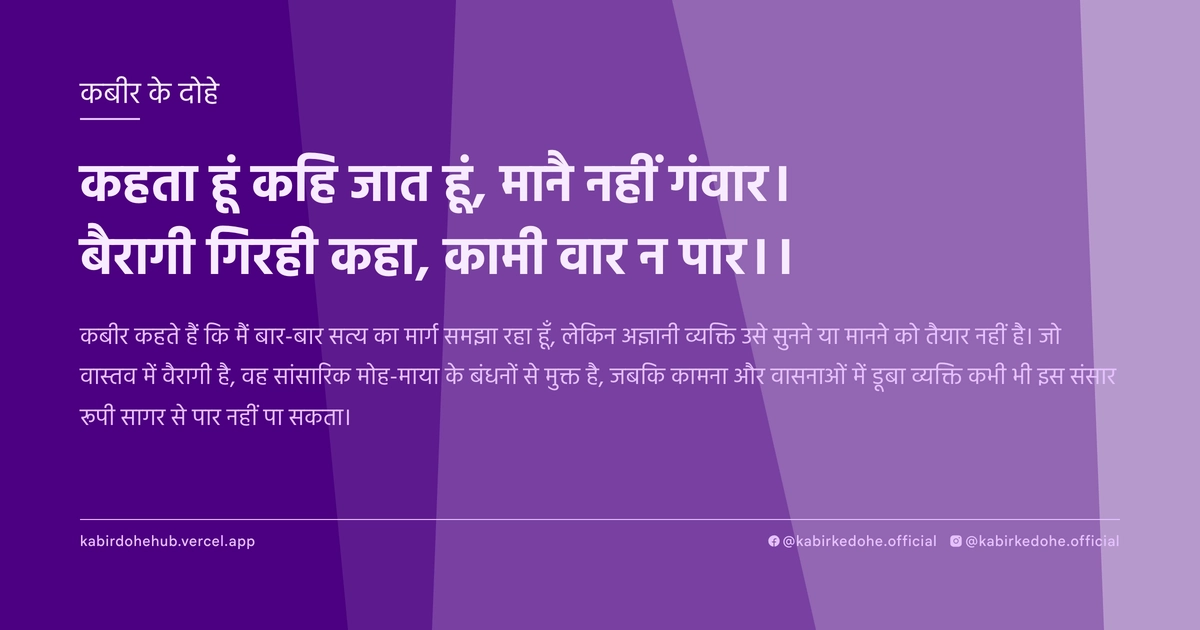
कहता हूं कहि जात हूं, मानै नहीं गंवार।
बैरागी गिरही कहा, कामी वार न पार।।
Kehta hun kahi jaat hun, manai nahin ganwar. Bairagi girhi kaha, kaami vaar na paar.
इस पृष्ठ पर इस कबीर दोहे का अर्थ (meaning), हिंदी व्याख्या और अंग्रेज़ी अनुवाद, दार्शनिक विश्लेषण और व्यावहारिक जीवन सीख दी गई है। यह दोहा काम (Lust) विषय से जुड़ा है — Kabir doha meaning and explanation in Hindi and English.
अर्थ (Meaning):
कबीर कहते हैं कि मैं बार-बार सत्य का मार्ग समझा रहा हूँ, लेकिन अज्ञानी व्यक्ति उसे सुनने या मानने को तैयार नहीं है। जो वास्तव में वैरागी है, वह सांसारिक मोह-माया के बंधनों से मुक्त है, जबकि कामना और वासनाओं में डूबा व्यक्ति कभी भी इस संसार रूपी सागर से पार नहीं पा सकता।
Kabir expresses his frustration that despite repeated attempts to convey the ultimate truth, the ignorant soul refuses to listen. He asserts that a true ascetic is one who has severed the knots of worldly attachment, whereas one enslaved by desire and lust can never cross the turbulent ocean of existence to reach liberation.
व्याख्या (Interpretation):
इस दोहे का शाब्दिक अर्थ है कि सत्य की पुकार अनसुनी की जा रही है। गहरा आध्यात्मिक विश्लेषण यह है कि 'गंवार' वह नहीं है जो पढ़ा-लिखा नहीं है, बल्कि वह है जो अपनी अहंकार-दृष्टि के कारण सत्य को नहीं देख पाता। यहाँ 'गिरही' (गाँठ) माया के उन सूक्ष्म बंधनों का प्रतीक है जो आत्मा को परमात्मा से अलग रखते हैं। निर्गुण भक्ति के अनुसार, जब तक वासना (कामी) जीवित है, तब तक द्वैत बना रहता है। अद्वैत वेदांत के परिप्रेक्ष्य में, यह वासना ही वह पर्दा है जो आत्मा को यह भुला देता है कि वह स्वयं ब्रह्म है। मुक्ति केवल बाहरी वस्त्र बदलने या वैराग्य का ढोंग करने से नहीं, बल्कि आंतरिक तृष्णाओं के पूर्ण विसर्जन से संभव है।
Literally, the verse speaks of a teacher's struggle with a stubborn student. Metaphorically, the 'ignorant' (ganvaar) refers to the ego-driven mind that blinds the seeker to the obvious truth of existence. The 'knots' (girhi) symbolize the karmic attachments and psychological conditioning that bind the Atman to the material world. In the context of Nirgun Bhakti, the 'kaami' or the lustful person represents the state of duality, where the individual perceives themselves as separate from the Divine. The paradox presented is that liberation is not found in the rejection of the world, but in the annihilation of the desire for the world. Only when the internal knots of attachment are untied can the soul transition from the illusion of Maya to the realization of non-duality (Advaita).
दार्शनिक विश्लेषण (Philosophical Analysis):
कबीर का यह दोहा उस सामाजिक और धार्मिक जड़ता पर प्रहार करता है जो उनके समय में व्याप्त थी। उन्होंने देखा कि लोग बाहरी कर्मकांडों, तीर्थयात्राओं और जातिगत श्रेष्ठता में उलझे थे, जबकि आंतरिक शुद्धि की ओर कोई ध्यान नहीं था। यह विश्लेषण सीधे तौर पर ritualism के विरोध को दर्शाता है, जहाँ धर्म केवल एक प्रदर्शन बन गया था।
दार्शनिक स्तर पर, कबीर यहाँ सूफी मत के 'फना' (अहंकार का विनाश) और वेदांत के 'माया' सिद्धांत का समन्वय करते हैं। वे समझाते हैं कि जब तक मनुष्य अपनी इंद्रियों का दास है, वह सत्य का अनुभव नहीं कर सकता। वासना केवल यौन इच्छा नहीं है, बल्कि किसी भी चीज़ को पाने की तीव्र लालसा है जो हमें वर्तमान क्षण से दूर ले जाती है।
अद्वैत वेदांत के अनुसार, आत्मा और ब्रह्म एक ही हैं। लेकिन 'कामी' व्यक्ति अपनी इच्छाओं के कारण स्वयं को एक सीमित शरीर और मन मान लेता है। यह सीमितता ही दुख का मूल कारण है। कबीर का 'वैरागी' वह है जिसने इस भ्रम को तोड़ दिया है और यह जान लिया है कि वह स्वयं पूर्ण है।
ऐतिहासिक रूप से, कबीर ने उस समय के पंडितों और मुल्लाओं को चुनौती दी जो केवल शास्त्रों के ज्ञान पर गर्व करते थे लेकिन व्यवहार में काम वासना और लोभ से ग्रस्त थे। उनके लिए ज्ञान वह नहीं जो किताबों में है, बल्कि वह है जो आचरण में उतरे।
अंततः, यह दोहा मनोवैज्ञानिक रूपांतरण की बात करता है। यह बताता है कि सत्य की प्राप्ति के लिए बौद्धिक क्षमता से अधिक 'हृदय की पात्रता' आवश्यक है। यदि मन अहंकार और वासना से भरा है, तो सबसे महान गुरु का उपदेश भी व्यर्थ है।
Kabir’s verse is a sharp critique of the spiritual stagnation and religious hypocrisy prevalent during his era. He observed a society obsessed with external rituals, caste hierarchies, and superficial piety, while the internal landscape remained desolate and unexplored. This rejection of ritualism is central to his philosophy, asserting that God is not found in temples or mosques but within the purity of the heart.
Philosophically, Kabir bridges the gap between the Sufi concept of 'Fana' (the annihilation of the self) and the Vedantic understanding of 'Maya' (the cosmic illusion). He posits that as long as a human is a slave to their senses, the realization of Truth remains an impossibility. 'Kama' or desire is not merely sexual lust but an all-encompassing craving for the finite, which distracts the soul from the infinite.
From the lens of Advaita Vedanta, the core problem is the perceived separation between the Atman (individual soul) and Brahman (universal consciousness). The 'kaami' person reinforces this separation by identifying with their desires and ego. This identification creates a veil of duality, preventing the soul from recognizing its inherent divinity.
Historically, Kabir challenged the religious orthodoxy of his time—the Brahmins and the Ulemas—who claimed spiritual authority through scripture while remaining enslaved by greed and lust. For Kabir, true knowledge is not an academic accumulation of facts but a lived experience of liberation.
Ultimately, this analysis highlights a psychological transformation. It suggests that intellectual brilliance is useless without spiritual receptivity. The 'ignorant' person is not the one lacking education, but the one whose ego acts as a barrier to the truth. Liberation requires the courage to dismantle the ego and the discipline to transcend desire.
मूल संदेश (Core Message):
- अहंकार सत्य के मार्ग में सबसे बड़ी बाधा है।
- बाहरी वैराग्य केवल ढोंग है, आंतरिक शुद्धि ही सत्य है।
- इच्छाएं आत्मा को संसार के चक्र में बांधे रखती हैं।
- सत्य को जानने के लिए पात्रता और विनम्रता आवश्यक है।
- मुक्ति का मार्ग वासनाओं के विसर्जन से होकर गुजरता है।
- आत्मा का मिलन तभी संभव है जब द्वैत समाप्त हो जाए।
- The ego is the primary obstacle on the path to Truth.
- External renunciation is a facade; internal purity is the only reality.
- Desires bind the soul to the endless cycle of worldly existence.
- Receptivity and humility are prerequisites for spiritual awakening.
- Liberation is achieved only through the dissolution of cravings.
- Union with the Divine occurs only when duality is extinguished.
व्यावहारिक उदाहरण (Practical Example):
एक समय की बात है, वाराणसी के घाटों पर रहने वाला एक वृद्ध बुनकर था, जिसका नाम माधव था। माधव अपनी कला में निपुण था, लेकिन उसका मन हमेशा इस बात की शिकायत में रहता था कि उसके पास पर्याप्त धन नहीं है। वह दिन-रात केवल अधिक मुनाफे और बेहतर कपड़ों की लालसा में डूबा रहता था।
वह अक्सर संतों की बातें सुनता था, लेकिन उसे लगता था कि यह सब केवल उन लोगों के लिए है जिनके पास करने को कोई काम नहीं है। उसके लिए 'सफलता' का अर्थ था—शहर के सबसे बड़े व्यापारी के साथ अनुबंध करना और अधिक संपत्ति जमा करना।
एक दिन, उसकी मुलाकात एक घुमक्कड़ फकीर से हुई। फकीर ने माधव के कपड़ों की प्रशंसा नहीं की, बल्कि उसकी आँखों में छिपी बेचैनी को देखा। फकीर ने उससे कहा, 'माधव, तुम धागों को तो बहुत सलीके से जोड़ रहे हो, लेकिन अपनी आत्मा की गाँठें नहीं खोल पा रहे हो।'
माधव को यह बात समझ नहीं आई। उसने तर्क दिया कि बिना धन के जीवन कठिन है। फकीर मुस्कुराया और बोला, 'धन कठिनता को कम कर सकता है, लेकिन तृष्णा को नहीं। तुम जितना अधिक कमाओगे, तुम्हारी प्यास उतनी ही बढ़ेगी। तुम उस प्यासे की तरह हो जो समुद्र का खारा पानी पीकर अपनी प्यास बुझाना चाहता है।'
अगले कुछ महीनों तक, माधव ने फकीर के साथ समय बिताया। उसने देखा कि फकीर के पास कुछ नहीं था, फिर भी उसके चेहरे पर एक ऐसी शांति थी जो माधव ने अपने जीवन के सबसे महंगे रेशमी कपड़ों में भी महसूस नहीं की थी।
एक रात, माधव ने महसूस किया कि उसकी सारी चिंताएं वास्तव में उसकी अपनी कल्पनाएं थीं। वह जिस 'भविष्य' को सुरक्षित करना चाहता था, वह वास्तव में एक अंतहीन दौड़ थी। उसने महसूस किया कि वह 'कामी' था—न केवल शारीरिक रूप से, बल्कि मानसिक रूप से भी वह सत्ता और सम्मान का भूखा था।
उसने अपनी जीवनशैली बदली। उसने अब भी बुनाई जारी रखी, लेकिन अब वह मुनाफे के लिए नहीं, बल्कि सृजन के आनंद के लिए काम करने लगा। उसने अपनी कमाई का एक हिस्सा उन लोगों की मदद में लगाना शुरू किया जो उससे भी अधिक गरीब थे।
जैसे ही उसने 'पाने' की इच्छा को 'देने' के आनंद में बदला, उसकी आंतरिक बेचैनी समाप्त हो गई। वह अब उस 'वैरागी' की श्रेणी में आने लगा था, जिसने संसार में रहते हुए भी संसार को अपने भीतर नहीं बसने दिया।
माधव की कहानी यह दर्शाती है कि वैराग्य घर छोड़ने में नहीं, बल्कि घर के भीतर रहते हुए मोह की गाँठों को खोलने में है। उसकी सफलता अब उसके बैंक बैलेंस से नहीं, बल्कि उसकी मानसिक शांति से मापी जाने लगी।
अंत में, माधव ने पाया कि जब उसने अपनी इच्छाओं का त्याग किया, तो उसे वह सब कुछ मिल गया जिसकी उसने कभी कामना की थी—परम संतोष और आंतरिक स्वतंत्रता।
Once, in the bustling ghats of Varanasi, lived an elderly weaver named Madhav. Madhav was a master of his craft, but his heart was perpetually plagued by a sense of lack. He spent his days and nights obsessed with the idea of earning more profit and acquiring finer materials.
He often listened to the discourses of wandering saints, but he dismissed them as idle talk for those without a profession. To Madhav, 'success' meant securing a contract with the city's wealthiest merchant and accumulating a vast hoard of gold.
One day, he encountered a wandering fakir. The fakir did not praise the intricacy of Madhav's fabrics; instead, he looked deep into Madhav's eyes and saw a profound restlessness. The fakir remarked, 'Madhav, you weave your threads with great precision, but you have failed to untie the knots within your own soul.'
Madhav was confused. He argued that without wealth, life was a struggle. The fakir smiled and replied, 'Wealth may ease the struggle of the body, but it cannot quench the thirst of the soul. You are like a man drinking salt water to satisfy his thirst; the more you drink, the thirstier you become.'
Over the next few months, Madhav spent time with the fakir. He noticed that although the fakir possessed nothing, his face radiated a peace that Madhav had never experienced, even while draped in the most expensive silks.
One night, in a moment of deep stillness, Madhav realized that his anxieties were merely constructs of his own ego. The 'future' he was so desperately trying to secure was an endless mirage. He recognized that he was 'kaami'—not just in a physical sense, but mentally enslaved by the hunger for power and status.
He began to shift his approach to life. He continued his weaving, but the motivation shifted from profit to the joy of creation. He started sharing a portion of his earnings with those even more destitute than himself.
As he replaced the desire to 'acquire' with the joy of 'giving,' his internal turbulence subsided. He began to embody the essence of a 'Bairagi'—one who lives in the world but does not allow the world to live within him.
Madhav's story illustrates that true renunciation is not about leaving one's home, but about untying the knots of attachment while remaining in the midst of worldly duties.
Ultimately, Madhav discovered that by letting go of his cravings, he attained everything he had ever sought: absolute contentment and inner liberation.
अभ्यास मार्गदर्शन (Practice Guidance):
- दैनिक आत्म-निरीक्षण: प्रतिदिन 20 मिनट मौन बैठें और उन इच्छाओं की सूची बनाएं जो आपको मानसिक तनाव दे रही हैं। पूछें, 'क्या यह इच्छा मेरी आवश्यकता है या मेरा अहंकार?'
- साक्षी भाव का अभ्यास: जब भी कोई तीव्र लालसा या क्रोध उत्पन्न हो, तो उसे 'मैं' के बजाय 'यह' के रूप में देखें। कहें, 'एक इच्छा उत्पन्न हुई है,' न कि 'मुझे यह चाहिए।'
- सेवा का संकल्प: सप्ताह में एक बार बिना किसी अपेक्षा के किसी की सहायता करें। यह अभ्यास 'पाने' की प्रवृत्ति को 'देने' की प्रवृत्ति में बदलने में मदद करेगा।
- डायग्नोस्टिक चेकलिस्ट: यदि आप छोटी सी असफलता पर अत्यधिक विचलित होते हैं या दूसरों की सफलता से ईर्ष्या करते हैं, तो समझें कि 'कामी' (इच्छाओं का बंधन) अभी भी प्रभावी है।
- Daily Self-Inquiry: Spend 20 minutes in silence daily, listing the desires causing you stress. Ask yourself, 'Is this a genuine need or a demand of my ego?'
- Practice of Witness Consciousness: Whenever a strong craving or anger arises, observe it as an external object. Say, 'A desire has arisen,' instead of 'I want this.'
- Vow of Selfless Service: Once a week, help someone without expecting anything in return. This helps shift the psychological drive from 'acquisition' to 'contribution.'
- Diagnostic Checklist: If you feel disproportionate distress over small failures or experience envy toward others' success, recognize that the 'knots' of desire are still binding you.
चिंतन प्रश्न (Reflection Questions):
- मेरे जीवन में वे कौन सी 'गाँठें' (attachments) हैं जिन्हें मैं छोड़ने से डरता हूँ?
- क्या मेरी आध्यात्मिक पहचान केवल एक सामाजिक मुखौटा है या वास्तव में मेरे व्यवहार में बदलाव आया है?
- मैं किन चीजों को पाने की तीव्र इच्छा रखता हूँ, और यदि वे मुझे कभी न मिलें, तो मेरी पहचान क्या रह जाएगी?
- क्या मैं सत्य को सुनने का दावा करता हूँ, लेकिन वास्तव में केवल अपनी मान्यताओं की पुष्टि चाहता हूँ?
- मेरे भीतर का 'गंवार' (अज्ञानी) मुझे किन सत्यों को देखने से रोक रहा है?
- क्या मेरी करुणा वास्तव में निस्वार्थ है, या यह मेरी अपनी छवि को बेहतर बनाने का एक तरीका है?
- What are the specific 'knots' of attachment in my life that I am terrified to let go of?
- Is my spiritual identity merely a social mask, or has it fundamentally altered my behavior?
- What are the intense cravings I harbor, and if they are never satisfied, who am I without them?
- Do I claim to seek the truth, or am I merely seeking confirmation of my existing biases?
- Which truths is the 'ignorant' part of my ego preventing me from seeing?
- Is my compassion truly selfless, or is it a tool to polish my own public image?