
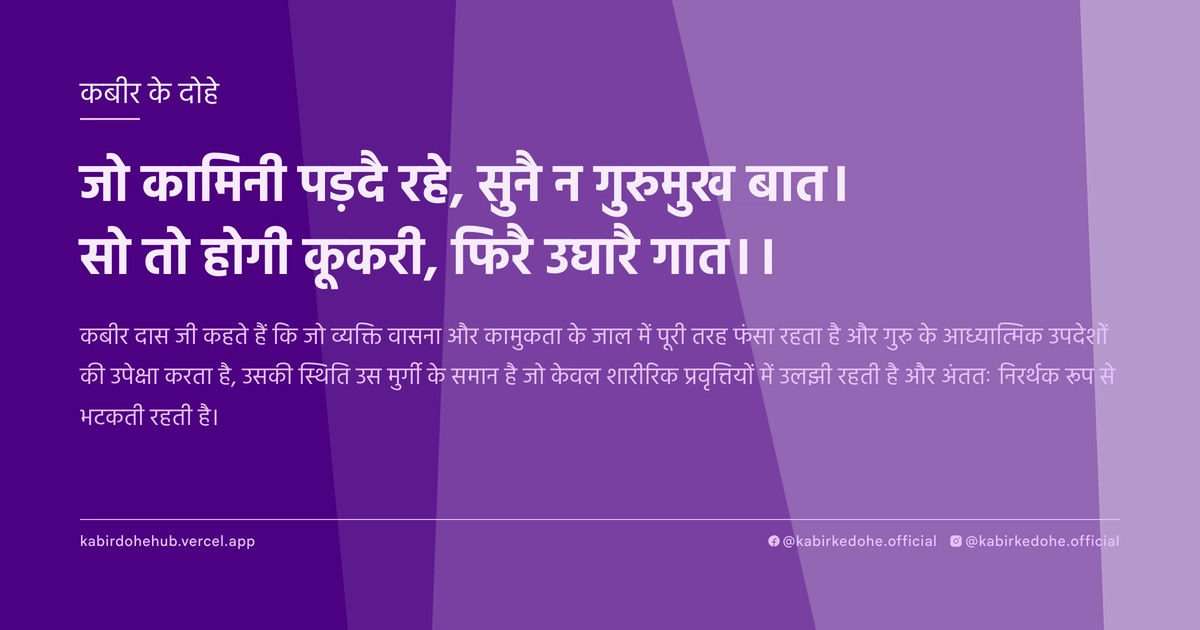
जो कामिनी पड़दै रहे, सुनै न गुरुमुख बात।
सो तो होगी कूकरी, फिरै उघारै गात।।
Jo kaamini paddai rahe, sunai na gurumukh baat. So to hogi kookri, phirai ugharai gaat.
इस पृष्ठ पर इस कबीर दोहे का अर्थ (meaning), हिंदी व्याख्या और अंग्रेज़ी अनुवाद, दार्शनिक विश्लेषण और व्यावहारिक जीवन सीख दी गई है। यह दोहा काम (Lust) विषय से जुड़ा है — Kabir doha meaning and explanation in Hindi and English.
अर्थ (Meaning):
कबीर दास जी कहते हैं कि जो व्यक्ति वासना और कामुकता के जाल में पूरी तरह फंसा रहता है और गुरु के आध्यात्मिक उपदेशों की उपेक्षा करता है, उसकी स्थिति उस मुर्गी के समान है जो केवल शारीरिक प्रवृत्तियों में उलझी रहती है और अंततः निरर्थक रूप से भटकती रहती है।
Kabir asserts that an individual who remains perpetually enslaved by sensual desires and lust, ignoring the spiritual guidance of a realized master, is akin to a hen. Such a person spends their existence driven by primal instincts, wandering aimlessly in a state of spiritual nakedness and ignorance.
व्याख्या (Interpretation):
इस दोहे का शाब्दिक अर्थ कामुकता के प्रति आसक्ति और गुरु के ज्ञान की अवहेलना है। रूपकात्मक रूप से, 'कामिनी' केवल स्त्री नहीं, बल्कि संसार की समस्त इंद्रिय-सुख देने वाली माया का प्रतीक है। 'कूकरी' (मुर्गी) का उदाहरण मानव की पतनशील अवस्था को दर्शाता है, जहाँ चेतना उच्च आध्यात्मिक स्तर से गिरकर केवल शारीरिक और जैविक स्तर पर सिमट जाती है। यह निर्गुण भक्ति के उस सिद्धांत को रेखांकित करता है जहाँ वासना को आत्मा और परमात्मा के बीच की सबसे बड़ी बाधा माना गया है। जब व्यक्ति माया के मोह में होता है, तो वह 'अद्वैत' की स्थिति को भूलकर द्वैत के भ्रम में फंस जाता है, जिससे उसका अस्तित्व केवल भौतिक तृप्ति तक सीमित रह जाता है।
Literally, the verse addresses the obsession with sensual pleasure and the disregard for a Guru's wisdom. Metaphorically, 'Kaamini' represents not just a woman, but the entirety of Maya—the illusory sensory attractions of the world. The analogy of the 'Kukri' (hen) symbolizes the regression of human consciousness; when a being ignores the spiritual call, they descend from a state of divine awareness to a purely biological, instinctive existence. In the context of Nirgun Bhakti, lust is the primary veil obscuring the Atman's realization of Brahman. The paradox here is that while the human body is a vehicle for liberation, the obsession with its sensory gratifications turns the seeker into a prisoner of the flesh, wandering in a spiritual void.
दार्शनिक विश्लेषण (Philosophical Analysis):
कबीर का यह प्रहार तत्कालीन समाज में व्याप्त पाखंड और इंद्रिय-भोग की अति पर है। वे यहाँ काम (Lust) को एक ऐसी मानसिक बेड़ी के रूप में देखते हैं जो विवेक को नष्ट कर देती है। यह दृष्टिकोण सूफी मत के 'नफ्स' (Nafs/Ego-desire) के नियंत्रण से मिलता-जुलता है, जहाँ वासनाओं का दमन नहीं बल्कि उनका रूपांतरण आवश्यक है।
अद्वैत वेदांत के अनुसार, जब तक मन बाहरी विषयों में रमा रहता है, वह अपनी वास्तविक प्रकृति (शुद्ध चेतना) को नहीं पहचान पाता। कबीर यहाँ चेतावनी दे रहे हैं कि गुरुमुख की बात (ज्ञान) ही वह एकमात्र शस्त्र है जो माया के इस जाल को काट सकता है। बिना मार्गदर्शन के, मनुष्य केवल अपनी वासनाओं का दास बनकर रह जाता है।
कबीर ने जाति और कर्मकांडों का विरोध किया, लेकिन उन्होंने आंतरिक अनुशासन पर अत्यधिक बल दिया। उनके लिए 'साधना' केवल माला फेरना नहीं, बल्कि अपनी कामुक प्रवृत्तियों पर विजय पाना है। जो व्यक्ति केवल शारीरिक सुखों के पीछे भागता है, वह आध्यात्मिक विकास की संभावनाओं को स्वयं समाप्त कर देता है।
मनोवैज्ञानिक स्तर पर, यह दोहा 'इच्छा' और 'तृष्णा' के बीच के अंतर को स्पष्ट करता है। इच्छा स्वाभाविक है, लेकिन जब वह तृष्णा बन जाती है और व्यक्ति को विवेकहीन कर देती है, तो वह उसकी चेतना को संकुचित कर देती है। मुर्गी का उदाहरण इसी संकुचित चेतना का प्रतीक है जो केवल तात्कालिक संतुष्टि खोजती है।
अंततः, कबीर यह समझाना चाहते हैं कि मुक्ति का मार्ग इंद्रियों के समर्पण से नहीं, बल्कि उनके अनुशासन और गुरु के ज्ञान के समन्वय से प्रशस्त होता है। वासना का त्याग ही वह द्वार है जिससे होकर साधक निर्गुण ब्रह्म की अनंतता में प्रवेश करता है।
Kabir’s critique targets the pervasive hypocrisy and sensory indulgence of his era. He views 'Kama' (lust) as a psychological shackle that obliterates 'Viveka' (discernment). This perspective aligns closely with the Sufi concept of 'Nafs' (the lower self/ego-desires), where the goal is not mere suppression but the transmutation of desire into divine love.
According to Advaita Vedanta, as long as the mind is anchored in external sensory objects, it remains oblivious to its true nature as pure consciousness. Kabir warns that the 'Gurumukh's word' (spiritual wisdom) is the only blade capable of severing the cords of Maya. Without this guidance, the human experience is reduced to a cycle of biological urges.
While Kabir famously rejected caste and ritualism, he emphasized rigorous internal discipline. For him, 'Sadhana' is not the mechanical repetition of mantras but the active conquest of lust. He argues that an obsession with physical pleasure effectively kills the potential for spiritual evolution, leaving the soul in a state of arrested development.
Psychologically, the verse distinguishes between natural need and obsessive craving. When craving dominates, consciousness shrinks. The analogy of the hen represents this 'shrunken consciousness'—a state where the individual is physically present but spiritually absent, driven only by the most basic instincts.
Ultimately, Kabir posits that liberation is achieved not through the blind denial of the body, but through the discipline of the senses guided by a realized master. The annihilation of the lustful ego is the prerequisite for merging with the Nirgun Brahman, transitioning from the finite to the infinite.
मूल संदेश (Core Message):
- वासना चेतना को संकुचित कर पशुवत बना देती है।
- इंद्रिय सुख क्षणभंगुर है, जबकि आत्मिक शांति शाश्वत है।
- गुरु का ज्ञान वासना के अंधकार को मिटाने वाला प्रकाश है।
- बाहरी आकर्षण एक मायाजाल है जो मुक्ति में बाधा है।
- अनुशासन और जागरूकता ही वास्तविक स्वतंत्रता का मार्ग हैं।
- Lust shrinks consciousness, reducing a human to a primal state.
- Sensual pleasure is ephemeral; spiritual peace is eternal.
- The Guru's wisdom is the light that dissolves the darkness of desire.
- External attraction is a veil of Maya obstructing liberation.
- Discipline and awareness are the only paths to true freedom.
व्यावहारिक उदाहरण (Practical Example):
एक समय की बात है, वाराणसी के घाटों पर रहने वाला एक वृद्ध बुनकर था, जिसका नाम माधव था। माधव अपने काम में निपुण था, लेकिन उसका मन हमेशा युवा स्त्रियों के आकर्षण और सांसारिक सुखों की कल्पनाओं में भटकता रहता था। वह घंटों तक घाटों पर बैठकर दूसरों की सुंदरता को निहारता और अपने मन में वासनाओं के महल बनाता।
उसी घाट पर एक शांत स्वभाव के संत रहते थे, जो अक्सर माधव को चेतावनी देते थे कि 'माधव, यह बाहरी चमक केवल एक छलावा है, असली आनंद भीतर है।' लेकिन माधव उन बातों को अनसुना कर देता। उसे लगता कि संत केवल अपनी तपस्या थोप रहे हैं और जीवन का असली मज़ा तो इंद्रियों के सुख में है।
धीरे-धीरे माधव की इस आदत ने उसके काम को प्रभावित करना शुरू किया। वह अपने करघे पर बैठता तो था, लेकिन उसका ध्यान कपड़ों के डिजाइन में नहीं, बल्कि गलियों में घूमने वाली स्त्रियों में होता। उसके कपड़ों की गुणवत्ता गिरने लगी और धीरे-धीरे उसके ग्राहक कम होने लगे।
एक दिन माधव ने देखा कि उसकी पत्नी, जो वर्षों से उसकी सेवा कर रही थी, वह भी बूढ़ी हो गई थी और बीमार रहने लगी थी। उसने महसूस किया कि जिस 'सुंदरता' के पीछे वह जीवन भर भागता रहा, वह तो समय की धूल में खो गई, लेकिन उसने उस शांति को खो दिया जो उसके अपने घर और मन में हो सकती थी।
वह गहरे अवसाद में चला गया। उसे लगा कि उसने अपना पूरा जीवन एक ऐसी मृगतृष्णा के पीछे बिता दिया जिसका कोई अंत नहीं था। वह अब उस 'मुर्गी' की तरह महसूस कर रहा था जिसे कबीर ने कहा था—सिर्फ शारीरिक इच्छाओं के पीछे भटकने वाला और अंत में खाली हाथ रहने वाला।
वह रोते हुए उन्हीं संत के पास गया और उनके चरणों में गिर पड़ा। उसने पूछा, 'महाराज, मैंने अपना जीवन व्यर्थ कर दिया, अब क्या रास्ता है?' संत ने मुस्कुराकर कहा, 'जिस वासना ने तुम्हें अंधा किया था, अब उसी को साक्षी मानकर यह देखो कि वह कितनी क्षणभंगुर है।'
संत ने उसे 'साक्षी भाव' (Witness Consciousness) का अभ्यास कराया। उन्होंने उसे सिखाया कि जब भी मन किसी बाहरी आकर्षण की ओर भागे, तो वह तुरंत अपने भीतर की सांसों पर ध्यान केंद्रित करे और यह सोचे कि यह आकर्षण केवल एक विचार है, सत्य नहीं।
माधव ने इस अभ्यास को पूरी निष्ठा से अपनाया। उसने पाया कि जैसे-जैसे उसकी बाहरी निर्भरता कम हुई, उसके भीतर एक असीम शांति का उदय हुआ। उसने फिर से बुनना शुरू किया, लेकिन अब उसके कपड़ों में एक दिव्य चमक थी क्योंकि वे वासना से नहीं, बल्कि प्रेम और एकाग्रता से बने थे।
उसका जीवन अब केवल 'प्राप्त करने' की दौड़ नहीं था, बल्कि 'होने' का उत्सव बन गया था। उसने समझ लिया कि गुरु की बात केवल उपदेश नहीं, बल्कि एक चाबी थी जिसने उसके मन के बंद दरवाजों को खोल दिया था।
अंत में, माधव ने अपनी शेष आयु अन्य लोगों को यह समझाने में बिताई कि इंद्रियों का सुख एक मीठा जहर है, और असली स्वतंत्रता उस बिंदु पर है जहाँ वासना समाप्त होती है और आत्म-बोध शुरू होता है।
Once in the ancient ghats of Varanasi, there lived an elderly weaver named Madhav. Madhav was skilled in his craft, but his mind was perpetually adrift in the attraction of young women and fantasies of sensual pleasure. He would spend hours watching people on the ghats, building elaborate palaces of lust within his mind.
On the same ghat lived a serene saint who often cautioned Madhav, saying, 'Madhav, this external glow is but a mirage; true bliss resides within.' However, Madhav ignored these words, believing the saint was merely imposing asceticism and that the real essence of life lay in sensory gratification.
Gradually, this habit began to erode Madhav's professional life. While he sat at his loom, his focus was not on the intricate patterns of the fabric, but on the women passing through the lanes. The quality of his work plummeted, and his clientele dwindled.
One day, Madhav noticed that his own wife, who had served him faithfully for decades, had grown frail and sickly with age. He suddenly realized that the 'beauty' he had chased his entire life was merely a fleeting shadow, and in the process, he had ignored the enduring peace and love that could have flourished within his own home.
He fell into a deep depression, realizing he had spent his existence chasing a mirage. He felt exactly like the 'hen' Kabir described—someone who wandered aimlessly driven by primal urges, only to end up spiritually bankrupt.
Broken, he fell at the feet of the saint and cried, 'Maharaj, I have wasted my life. Is there any way back?' The saint smiled and replied, 'The very lust that blinded you can now be your teacher. Observe it and see how ephemeral it truly is.'
The saint initiated him into the practice of 'Sakshi Bhav' (Witness Consciousness). He instructed Madhav that whenever the mind drifted toward external attraction, he must immediately shift his focus to his breath and recognize the attraction as a mere passing thought, not the ultimate truth.
Madhav embraced this practice with total devotion. He discovered that as his dependency on external stimulation decreased, an infinite inner peace began to emerge. He returned to his loom, but now his fabrics possessed a divine radiance, for they were woven with love and concentration rather than lust.
His life was no longer a race to 'acquire' but a celebration of 'being.' He understood that the Guru's words were not mere lectures, but a key that unlocked the prison of his own mind.
In his final years, Madhav dedicated himself to teaching others that sensory pleasure is a sweet poison, and true freedom begins where lust ends and self-realization awakens.
अभ्यास मार्गदर्शन (Practice Guidance):
- दैनिक अभ्यास: प्रतिदिन 20 मिनट 'साक्षी ध्यान' करें। जब भी कोई कामुक विचार या तीव्र इच्छा उत्पन्न हो, उसे दबाएँ नहीं, बल्कि एक तटस्थ दर्शक की तरह देखें और पूछें, 'यह इच्छा कहाँ से आ रही है?'
- आत्म-पूछताछ जर्नल: हर रात लिखें कि आज किन क्षणों में आपका मन बाहरी आकर्षणों के कारण विचलित हुआ और उस समय आपकी मानसिक स्थिति क्या थी।
- व्यवहार परिवर्तन: सचेत उपभोग (Conscious Consumption) का अभ्यास करें। ऐसी सामग्री (सोशल मीडिया, फिल्में) से दूरी बनाएं जो केवल वासना को उत्तेजित करती हैं और विवेक को सुलाती हैं।
- निदान चेकलिस्ट: यदि आप छोटी-छोटी भौतिक चीजों या शारीरिक आकर्षणों के बिना बेचैन महसूस करते हैं, तो यह संकेत है कि आप अभी भी 'कूकरी' (इंद्रिय-दास) की अवस्था में हैं। यदि आप बाहरी उत्तेजना के बिना भी शांत रह सकते हैं, तो आप गुरुमुख के मार्ग पर हैं।
- Daily Practice: Engage in 20 minutes of 'Witness Meditation' daily. When a sensual thought or intense craving arises, do not suppress it; instead, observe it as a neutral spectator and ask, 'Where is this desire originating from?'
- Self-Inquiry Journal: Every night, record the moments when your mind was distracted by external attractions and analyze your mental state during those episodes.
- Behavioral Shift: Practice Conscious Consumption. Distance yourself from media or environments that solely stimulate lust and lull the intellect into a state of unconsciousness.
- Diagnostic Checklist: If you feel restless without small material gratifications or physical attractions, you are still in the state of the 'Kukri' (slave to senses). If you can remain peaceful without external stimulation, you are aligning with the path of the Gurumukh.
चिंतन प्रश्न (Reflection Questions):
- मेरे जीवन में 'कामिनी' (आकर्षण) का आधुनिक रूप क्या है—क्या यह केवल शारीरिक है, या यह प्रसिद्धि, पद और डिजिटल मान्यता की भूख है?
- जब मैं किसी की सुंदरता या सफलता से आकर्षित होता हूँ, तो क्या मैं वास्तव में उस व्यक्ति को देख रहा हूँ, या अपनी अधूरी इच्छाओं का प्रतिबिंब?
- क्या मेरी 'आध्यात्मिक पहचान' केवल एक मुखौटा है, जबकि भीतर मैं अभी भी अपनी वासनाओं का गुलाम हूँ?
- गुरु या मार्गदर्शक की बातों को सुनने के बावजूद, मैं उन्हें लागू करने से क्यों डरता हूँ?
- यदि आज मेरे जीवन से सभी भौतिक और शारीरिक सुख छीन लिए जाएं, तो मेरे पास 'स्वयं' के रूप में क्या बचेगा?
- What is the modern form of 'Kaamini' (attraction) in my life—is it purely physical, or is it a hunger for fame, status, and digital validation?
- When I am attracted to someone's beauty or success, am I seeing the actual person, or merely a reflection of my own unfulfilled desires?
- Is my 'spiritual identity' just a mask, while internally I remain a slave to my impulses?
- Despite hearing the words of a guide or Guru, why do I resist implementing them in my actual life?
- If all material and physical pleasures were stripped away from my life today, what would remain of 'me'?