
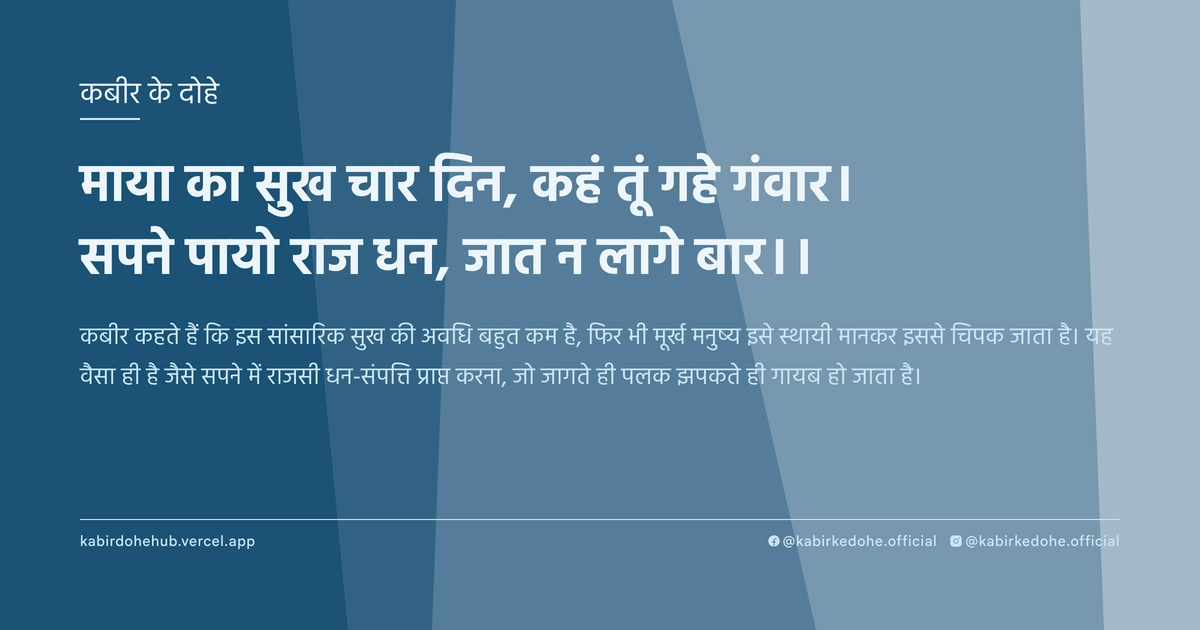
माया का सुख चार दिन, कहं तूं गहे गंवार।
सपने पायो राज धन, जात न लागे बार।।
Maya ka sukh char din, kahan tun gahe ganwar. Sapne payo raj dhan, jaat na lage baar.
इस पृष्ठ पर इस कबीर दोहे का अर्थ (meaning), हिंदी व्याख्या और अंग्रेज़ी अनुवाद, दार्शनिक विश्लेषण और व्यावहारिक जीवन सीख दी गई है। यह दोहा अनित्य (Impermanence) विषय से जुड़ा है — Kabir doha meaning and explanation in Hindi and English.
अर्थ (Meaning):
कबीर कहते हैं कि इस सांसारिक सुख की अवधि बहुत कम है, फिर भी मूर्ख मनुष्य इसे स्थायी मानकर इससे चिपक जाता है। यह वैसा ही है जैसे सपने में राजसी धन-संपत्ति प्राप्त करना, जो जागते ही पलक झपकते ही गायब हो जाता है।
Kabir asserts that worldly pleasures are fleeting, yet the ignorant cling to them as if they were permanent. He compares this attachment to dreaming of royal wealth and treasures, which vanish instantly the moment one awakens from the slumber of ignorance.
व्याख्या (Interpretation):
शाब्दिक अर्थ यह है कि भौतिक सुख क्षणभंगुर हैं। रूपक के स्तर पर, 'चार दिन' संपूर्ण मानव जीवन की अल्पता को दर्शाता है और 'गंवार' उस अज्ञानी को है जो माया के जाल में फंसा है। यह दोहा निर्गुण भक्ति के उस सिद्धांत पर आधारित है जहाँ संसार को एक मिथ्या स्वप्न माना गया है। यहाँ 'राज धन' अहंकार और सामाजिक प्रतिष्ठा का प्रतीक है। अद्वैत वेदांत के अनुसार, जब तक साधक स्वयं को शरीर और पद से जोड़ता है, वह माया के प्रभाव में रहता है। मुक्ति तब होती है जब व्यक्ति यह पहचान ले कि वह यह नश्वर शरीर नहीं, बल्कि अविनाशी आत्मा है। यह विरोधाभास है कि मनुष्य उस चीज़ के लिए रोता है जो वास्तव में कभी उसकी थी ही नहीं।
Literally, the verse warns of the transience of material joy. Metaphorically, 'four days' represents the brevity of human existence, and the 'ignorant' refers to the soul trapped in Maya. This aligns with Nirgun Bhakti, where the world is viewed as a cosmic illusion. 'Royal wealth' symbolizes the ego and social status. According to Advaita Vedanta, as long as the seeker identifies with the physical body or title, they remain under the spell of Maya. Liberation occurs when one realizes they are not the perishable body but the imperishable Atman. The central paradox lies in the human tendency to grieve for the loss of things that were never truly theirs to begin with.
दार्शनिक विश्लेषण (Philosophical Analysis):
कबीर का यह दोहा मध्यकालीन भारत के उस सामाजिक परिवेश में लिखा गया जहाँ धर्म और जाति के नाम पर बाहरी आडंबरों और भौतिक संचय को मोक्ष का मार्ग माना जाता था। कबीर ने स्पष्ट रूप से ritualism (कर्मकांड) का विरोध किया और यह बताया कि मंदिर, मस्जिद या राजसी ठाठ-बाट आत्मा की प्यास नहीं बुझा सकते। वे इस बात पर जोर देते हैं कि सच्चा ज्ञान आंतरिक है, न कि बाहरी संग्रह में।
दार्शनिक रूप से, यह सूफीवाद के 'फना' (अहंकार का विनाश) और वेदांत के 'माया' सिद्धांत का संगम है। सूफी मत की तरह, कबीर यहाँ दुनिया को एक सराय या सपने की तरह देखते हैं। जब व्यक्ति यह समझ जाता है कि संसार एक स्वप्न है, तो उसकी मोह-माया समाप्त हो जाती है। यह मनोवैज्ञानिक रूपांतरण है जहाँ व्यक्ति 'होने' (Being) की अवस्था से 'पाने' (Having) की अवस्था की ओर संक्रमण करता है।
कबीर यहाँ जाति और वर्ग के भेद को मिटाते हैं। चाहे वह राजा हो या रंक, मृत्यु के समय सबका 'राज धन' छिन जाता है। यह समानता का संदेश उस समय के सामंती ढांचे पर प्रहार था। वे सिखाते हैं कि अहंकार ही वह पर्दा है जो हमें सत्य देखने से रोकता है।
अक्सर लोग इस दोहे को केवल वैराग्य या दुनिया छोड़ने के संदेश के रूप में देखते हैं, जो एक गलत व्याख्या है। कबीर दुनिया छोड़ने को नहीं, बल्कि दुनिया के प्रति 'आसक्ति' (attachment) छोड़ने को कह रहे हैं। कर्म करते रहो, लेकिन फल और स्वामित्व के भ्रम से मुक्त रहो।
अंततः, यह विश्लेषण हमें इस निष्कर्ष पर ले जाता है कि आध्यात्मिक जागृति केवल तभी संभव है जब हम अपनी पहचान को बाहरी उपलब्धियों से हटाकर आंतरिक शून्य या पूर्णता में स्थापित करें। यही वह बिंदु है जहाँ व्यक्ति स्वयं को ब्रह्म या परमात्मा के साथ एकाकार महसूस करता है।
This couplet was composed during a medieval Indian era where external rituals and material accumulation were often mistaken for paths to salvation. Kabir explicitly rejected ritualism, arguing that temples, mosques, or royal luxuries cannot quench the soul's thirst. He emphasizes that true knowledge is internal, not found in external acquisitions.
Philosophically, this is a confluence of the Sufi concept of 'Fana' (annihilation of the ego) and the Vedantic theory of 'Maya'. Like the Sufis, Kabir views the world as a temporary inn or a dream. Once the seeker realizes the illusory nature of existence, the grip of attachment loosens. This represents a psychological shift from the state of 'Having' to the state of 'Being'.
Kabir dismantles caste and class hierarchies here. Whether a king or a pauper, all 'royal wealth' is stripped away at the moment of death. This message of equality was a direct critique of the feudal structures of his time. He teaches that the ego is the primary veil obscuring the Truth.
Common literalist misconceptions often frame this verse as a call to total asceticism or abandoning the world. However, Kabir is not advocating for the abandonment of action, but for the abandonment of 'attachment'. One should perform their duties while remaining detached from the illusion of ownership.
Ultimately, this analysis leads to the conclusion that spiritual awakening is only possible when identity is shifted from external achievements to the internal void or fullness. This is the point where the individual consciousness merges with the universal Brahman.
मूल संदेश (Core Message):
- बाहरी चमक केवल एक मायावी पर्दा है।
- अहंकार का त्याग ही वास्तविक जागृति है।
- स्थायी सुख केवल आत्मा के बोध में है।
- संसार एक स्वप्न है, सत्य केवल निर्गुण ब्रह्म है।
- स्वामित्व का मोह ही दुखों का मूल कारण है।
- External brilliance is merely a deceptive veil of Maya.
- The surrender of ego is the only true awakening.
- Permanent bliss resides only in the realization of the Soul.
- The world is a dream; only the Formless Absolute is Truth.
- The obsession with ownership is the root of all suffering.
व्यावहारिक उदाहरण (Practical Example):
वाराणसी के एक पुराने घाट पर रहने वाली एक वृद्ध विधवा, जानकी, का जीवन अत्यंत सादगीपूर्ण था। उसके पास केवल एक पुरानी साड़ी और कुछ बर्तन थे, फिर भी वह शांत रहती थी। उसी घाट के पास एक समृद्ध व्यापारी रहता था, जिसके पास सोने के आभूषण और विशाल हवेली थी, लेकिन वह हर समय अपनी संपत्ति की सुरक्षा और बढ़ते व्यापार की चिंता में तनावग्रस्त रहता था।
व्यापारी अक्सर जानकी को देखता और सोचता कि यह महिला इतनी संतुष्ट कैसे रह सकती है जबकि उसके पास कुछ नहीं है। एक दिन व्यापारी का व्यापार अचानक गिर गया और उसे भारी कर्ज के कारण अपनी हवेली बेचनी पड़ी। वह पूरी तरह टूट गया और अवसाद में डूब गया।
वह जानकी के पास गया और रोते हुए बोला, 'मैंने जीवन भर धन संचित किया, लेकिन एक झटके में सब चला गया। मेरा जीवन व्यर्थ गया।' जानकी ने मुस्कुराते हुए उसे एक छोटा सा पत्थर दिखाया और कहा, 'बेटा, तुमने इस पत्थर को हीरा मान लिया था, इसलिए इसके खोने का दुख है। यदि तुम जानते कि यह केवल पत्थर था, तो तुम कभी दुखी नहीं होते।'
व्यापारी को समझ नहीं आया। जानकी ने आगे समझाया, 'तुमने अपनी पहचान अपने धन से जोड़ ली थी। वह धन एक सपना था, और अब तुम जाग गए हो। दुख धन के जाने का नहीं, बल्कि उस भ्रम के टूटने का है जिसे तुम सत्य मान बैठे थे।'
इस क्षण व्यापारी को कबीर के शब्दों का अनुभव हुआ। उसे एहसास हुआ कि उसने अपनी पूरी ऊर्जा उस 'राज धन' को बचाने में लगा दी जो वास्तव में क्षणभंगुर था। उसने महसूस किया कि उसकी असली संपत्ति उसकी शांति और संतोष होना चाहिए था, न कि बैंक बैलेंस।
व्यापारी ने अपनी शेष संपत्ति का उपयोग गरीबों की सेवा में करना शुरू किया। उसने अब अपनी पहचान 'मालिक' के रूप में नहीं, बल्कि 'सेवक' के रूप में गढ़ी।
उसने देखा कि जब उसने स्वामित्व का मोह छोड़ा, तो उसकी मानसिक पीड़ा समाप्त हो गई। वह अब वास्तव में स्वतंत्र महसूस कर रहा था, क्योंकि अब उसके पास खोने के लिए कुछ नहीं था।
यह 'कबीर ट्विस्ट' उसके जीवन में एक क्रांतिकारी बदलाव लाया। वह अब सोने की हवेली में नहीं रहता था, लेकिन उसके भीतर एक ऐसा साम्राज्य था जिसे कोई छीन नहीं सकता था—शांति का साम्राज्य।
Janaki, an elderly widow living on an old ghat in Varanasi, led a life of extreme simplicity. She owned nothing more than a few old sarees and some utensils, yet she remained profoundly peaceful. Nearby lived a wealthy merchant who possessed gold ornaments and a massive mansion, but he lived in constant stress, worrying about the security of his assets and the expansion of his trade.
The merchant often observed Janaki, wondering how a woman with nothing could be so content. One day, the merchant's business collapsed abruptly, and he was forced to sell his mansion to pay off heavy debts. He was completely shattered and fell into a deep depression.
He approached Janaki, weeping, and said, 'I spent my entire life accumulating wealth, but in one stroke, it all vanished. My life has been a waste.' Janaki smiled, showed him a small common stone, and said, 'Son, you mistook this stone for a diamond; that is why you grieve its loss. Had you known it was just a stone, you would never have been sad.'
The merchant was confused. Janaki explained further, 'You tied your identity to your wealth. That wealth was a dream, and now you have awakened. Your pain is not from the loss of money, but from the shattering of the illusion you believed to be the truth.'
In that moment, the merchant experienced the essence of Kabir's words. He realized he had spent his entire energy protecting 'royal wealth' that was fundamentally transient. He understood that his true asset should have been peace and contentment, not a bank balance.
The merchant began using his remaining resources to serve the poor. He reshaped his identity not as a 'master' or 'owner,' but as a 'servant' of humanity.
He discovered that once he let go of the obsession with ownership, his mental agony ceased. He felt truly free for the first time because he no longer had anything to lose.
This 'Kabir Twist' brought a revolutionary change to his life. He no longer lived in a golden mansion, but he possessed an empire within that no one could steal—the empire of inner peace.
अभ्यास मार्गदर्शन (Practice Guidance):
- दैनिक चिंतन: प्रतिदिन 15 मिनट मौन बैठें और विचार करें कि आपके जीवन की कौन सी वस्तुएं या उपलब्धियां स्थायी हैं और कौन सी क्षणभंगुर।
- आत्म-पूछताछ जर्नल: लिखें कि 'यदि आज मेरी सारी सामाजिक प्रतिष्ठा और संपत्ति चली जाए, तो मैं कौन रहूँगा?' इस शून्य का सामना करें।
- व्यवहार परिवर्तन: सप्ताह में एक बार ऐसी वस्तु का दान करें जिससे आप भावनात्मक रूप से जुड़े हों, ताकि स्वामित्व के मोह को चुनौती दी जा सके।
- डायग्नोस्टिक चेकलिस्ट: क्या मैं किसी चीज़ के खोने के डर से तनाव में हूँ? क्या मेरी खुशी बाहरी प्रशंसा पर निर्भर है? यदि हाँ, तो मैं अभी भी 'स्वप्न' में हूँ।
- Daily Contemplation: Spend 15 minutes in silence daily, reflecting on which aspects of your life are permanent and which are transient.
- Self-Inquiry Journaling: Write a response to the prompt: 'If all my social status and possessions were gone today, who would I be?' Confront this void.
- Behavioral Change: Once a week, donate an item you are emotionally attached to, consciously challenging the illusion of ownership.
- Diagnostic Checklist: Am I stressed by the fear of losing something? Is my happiness dependent on external validation? If yes, I am still residing in the 'dream'.
चिंतन प्रश्न (Reflection Questions):
- मेरा 'डिजिटल अहंकार' (सोशल मीडिया इमेज) मेरे वास्तविक स्वरूप से कितना अलग है?
- मैं किन गुप्त पूर्वाग्रहों को अपनी पहचान का हिस्सा मानता हूँ, जबकि वे केवल सामाजिक कंडीशनिंग हैं?
- यदि मेरा पूरा जीवन एक सपना है, तो मैं इस समय जिसे 'सत्य' मानकर संघर्ष कर रहा हूँ, वह क्या है?
- क्या मेरी करुणा वास्तव में निस्वार्थ है, या यह मेरी अपनी छवि को 'अच्छा' बनाने का एक तरीका है?
- मैं मृत्यु के विचार से क्यों डरता हूँ, जबकि मैं जानता हूँ कि यह केवल एक वस्त्र बदलने जैसा है?
- How different is my 'digital ego' (social media image) from my authentic self?
- Which hidden biases do I consider part of my identity, when they are merely social conditioning?
- If my entire life is a dream, what is the 'truth' I am currently struggling for?
- Is my compassion truly selfless, or is it a tool to maintain a 'good' image of myself?
- Why do I fear the thought of death, knowing it is merely like changing a garment?