
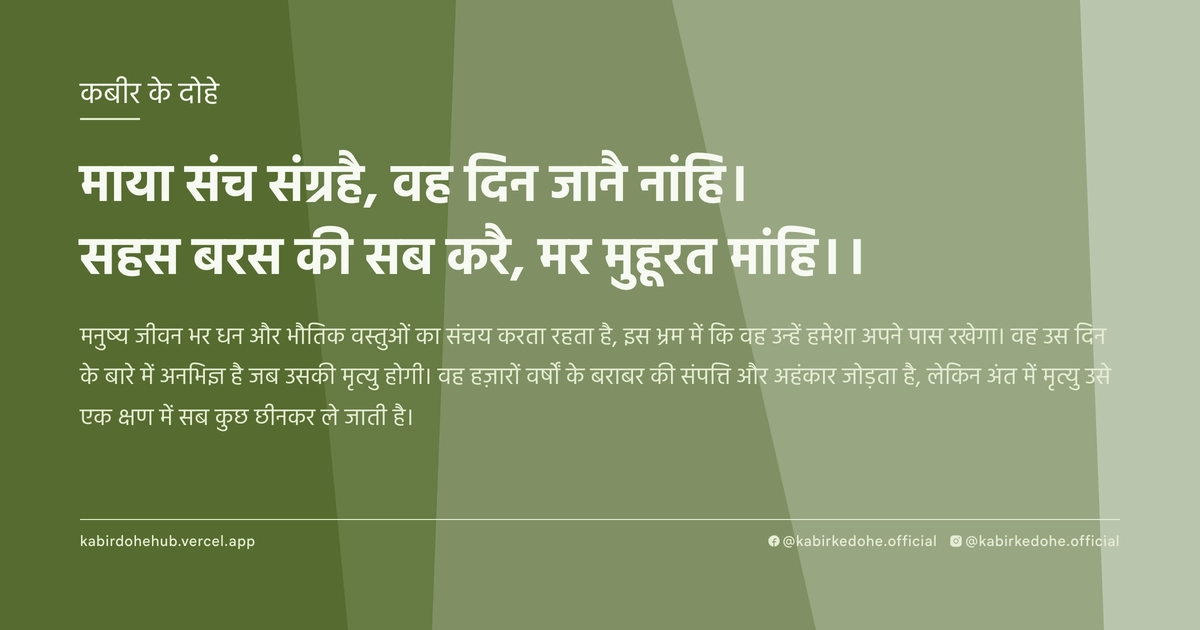
माया संच संग्रहै, वह दिन जानै नांहि।
सहस बरस की सब करै, मर मुहूरत मांहि।।
Maya sanch sangrahai, vah din jaane nahi. Sahas baras ki sab karai, mar muhurat mahin.
इस पृष्ठ पर इस कबीर दोहे का अर्थ (meaning), हिंदी व्याख्या और अंग्रेज़ी अनुवाद, दार्शनिक विश्लेषण और व्यावहारिक जीवन सीख दी गई है। यह दोहा मृतुक्यता (Mortality) विषय से जुड़ा है — Kabir doha meaning and explanation in Hindi and English.
अर्थ (Meaning):
मनुष्य जीवन भर धन और भौतिक वस्तुओं का संचय करता रहता है, इस भ्रम में कि वह उन्हें हमेशा अपने पास रखेगा। वह उस दिन के बारे में अनभिज्ञ है जब उसकी मृत्यु होगी। वह हज़ारों वर्षों के बराबर की संपत्ति और अहंकार जोड़ता है, लेकिन अंत में मृत्यु उसे एक क्षण में सब कुछ छीनकर ले जाती है।
Man spends his entire existence accumulating wealth and material possessions, blinded by the illusion of permanence. He remains oblivious to the exact moment of his departure. Though he may gather resources that seem sufficient for a thousand years, death arrives in a single heartbeat, rendering all worldly acquisitions instantly void.
व्याख्या (Interpretation):
यह दोहा भौतिकवाद और नश्वरता के बीच के गहरे विरोधाभास को दर्शाता है। शाब्दिक अर्थ में, यह धन के संचय की व्यर्थता है, लेकिन आध्यात्मिक स्तर पर, यह 'माया' के जाल का वर्णन है। संचय केवल धन का नहीं, बल्कि अहंकार और पहचान का भी है। निर्गुण भक्ति के अनुसार, आत्मा अजर-अमर है, परंतु जब वह शरीर और सांसारिक मोह से जुड़ती है, तो वह समय के चक्र में फंस जाती है। यहाँ 'मुहूरत' वह बिंदु है जहाँ द्वैत (दोहरापन) समाप्त होता है और सत्य का सामना होता है। यह हमें याद दिलाता है कि वास्तविक संपत्ति केवल वह है जो आत्मा के साथ जाती है—प्रेम और ज्ञान।
This couplet illuminates the profound paradox between materialism and impermanence. Literally, it addresses the futility of hoarding wealth, but metaphorically, it describes the snare of 'Maya' (illusion). Accumulation is not merely of gold, but of ego and false identities. In the framework of Nirgun Bhakti, the soul is timeless, yet when it identifies with the physical body and worldly attachments, it becomes trapped in the cycle of time. The 'muhurat' (moment) represents the singular point where duality collapses and the absolute truth emerges. It emphasizes that the only true wealth is that which transcends the physical—spiritual realization and unconditional love.
दार्शनिक विश्लेषण (Philosophical Analysis):
कबीर का यह दोहा उस सामाजिक और धार्मिक परिवेश की प्रतिक्रिया है जहाँ कर्मकांड और बाहरी आडंबरों को मोक्ष का साधन माना जाता था। कबीर ने स्पष्ट किया कि न तो तीर्थयात्रा और न ही धन का संचय आत्मा को मुक्त कर सकता है। यह विचार अद्वैत वेदांत के करीब है, जहाँ संसार को 'मिथ्या' या क्षणभंगुर माना गया है। कबीर यहाँ मनुष्य की मनोवैज्ञानिक स्थिति का विश्लेषण कर रहे हैं—एक ऐसी स्थिति जहाँ भय और लालच उसे वर्तमान क्षण से दूर ले जाते हैं।
सूफीवाद के 'फना' (अहंकार का विनाश) के सिद्धांत के समान, कबीर यहाँ भौतिक पहचान के विनाश की बात कर रहे हैं। जब मनुष्य यह समझ लेता है कि वह 'संग्रहकर्ता' नहीं बल्कि 'साक्षी' है, तब वह मृत्यु के भय से मुक्त हो जाता है। संचय की प्रवृत्ति वास्तव में असुरक्षा की भावना से उपजती है, जो यह मानती है कि बाहरी वस्तुएं आंतरिक रिक्तता को भर सकती हैं।
कबीर जाति और वर्ग के भेदभाव को नकारते हुए यह बताते हैं कि मृत्यु सबसे बड़ा लोकतांत्रिक सत्य है। चाहे वह राजा हो या रंक, समय का प्रहार सबके लिए समान है। यह बोध व्यक्ति को विनम्रता की ओर ले जाता है और उसे बाहरी दुनिया के बजाय आंतरिक जगत की खोज के लिए प्रेरित करता है।
यहाँ 'सहस बरस' (हजार वर्ष) उस मानसिक भ्रम का प्रतीक है जिसे हम 'भविष्य' कहते हैं। हम भविष्य की योजनाएं बनाते हैं जबकि वर्तमान ही एकमात्र सत्य है। यह मनोवैज्ञानिक विस्थापन ही दुख का मूल कारण है।
अंततः, यह विश्लेषण हमें यह समझने पर मजबूर करता है कि मुक्ति संचय में नहीं, बल्कि विसर्जन में है। जब हम अपनी पहचान को वस्तुओं से अलग करते हैं, तब हम उस निराकार ब्रह्म के साथ एकाकार हो जाते हैं जिसे कबीर ने अपनी कविताओं में बार-बार पुकारा है।
Kabir’s couplet is a visceral reaction to a socio-religious climate where ritualism and external displays of piety were mistaken for paths to liberation. He asserts that neither pilgrimage nor the hoarding of wealth can liberate the soul. This aligns closely with Advaita Vedanta, which posits the material world as 'Mithya'—transient and illusory. Kabir analyzes the human psychological state: a condition where fear and greed alienate the individual from the present moment.
Parallel to the Sufi concept of 'Fana' (the annihilation of the ego), Kabir speaks of the destruction of the material identity. When a person realizes they are not the 'accumulator' but the 'witness,' they transcend the fear of death. The impulse to hoard stems from a deep-seated insecurity, a mistaken belief that external acquisitions can fill an internal void.
By rejecting caste and class distinctions, Kabir highlights death as the ultimate democratic truth. Whether a king or a pauper, the strike of time is impartial. This realization fosters humility and redirects the seeker's gaze from the external world toward the internal landscape of the spirit.
The phrase 'thousand years' symbolizes the mental construct we call the 'future.' We meticulously plan for a distant tomorrow while ignoring the only existing reality: the Now. This psychological displacement is the root cause of human suffering.
Ultimately, this analysis compels us to understand that liberation lies not in accumulation, but in relinquishment. When we decouple our identity from possessions, we merge with the formless Brahman (the Absolute) that Kabir tirelessly sought throughout his poetic journey.
मूल संदेश (Core Message):
- भौतिक संचय एक मानसिक भ्रम है।
- मृत्यु ही एकमात्र अटल सत्य है।
- वर्तमान क्षण ही वास्तविक जीवन है।
- अहंकार का त्याग ही सच्ची समृद्धि है।
- आत्मा का संबंध निराकार ब्रह्म से है।
- Material accumulation is a psychological illusion.
- Death is the only absolute certainty.
- The present moment is the only real life.
- Relinquishing the ego is true prosperity.
- The soul's true bond is with the Formless Absolute.
व्यावहारिक उदाहरण (Practical Example):
वाराणसी के एक पुराने घाट पर रहने वाले रामदीन नाम के एक वृद्ध बुनकर थे। रामदीन ने अपना पूरा जीवन बेहतरीन रेशमी साड़ियाँ बनाने में बिताया। उन्होंने अपनी कला से बहुत धन कमाया और उसे एक भारी लोहे की तिजोरी में बंद कर दिया। उनका पूरा जीवन इसी बात पर केंद्रित था कि उनके बाद उनके बेटे को एक समृद्ध विरासत मिले। वे इतने व्यस्त थे कि उन्होंने कभी अपने पड़ोसियों की मदद नहीं की और न ही कभी शांति से बैठकर गंगा की लहरों को देखा।
रामदीन का बेटा शहर चला गया था और उनसे साल में एक बार बात करता था। रामदीन को लगता था कि उनकी तिजोरी की चाबियाँ ही उनकी असली ताकत हैं। वे हर दिन अपने सोने के सिक्कों को गिनते और सोचते कि वे अगले दस सालों तक बिना काम किए ऐश कर सकते हैं। उनके लिए जीवन का अर्थ था—अधिक से अधिक संचय करना।
एक दिन, रामदीन को अचानक सीने में तेज दर्द हुआ। वे बिस्तर से गिर पड़े। उनके हाथ तिजोरी की चाबियों की ओर बढ़े, लेकिन शरीर ने साथ देना बंद कर दिया। उस अंतिम क्षण में, उन्हें एहसास हुआ कि जिस धन को उन्होंने 'हजार साल' के लिए जमा किया था, वह उनके काम का एक पैसा भी नहीं था।
उनके पास कोई ऐसा व्यक्ति नहीं था जो उनका हाथ थाम सके, क्योंकि उन्होंने रिश्तों के बजाय सिक्कों को संचित किया था। उनकी आँखों के सामने वह तिजोरी एक बेजान लोहे के बक्से की तरह दिख रही थी, जिसमें उनकी पूरी जिंदगी की ऊर्जा कैद थी, लेकिन वह ऊर्जा अब उनके किसी काम की नहीं थी।
तभी उनकी नजर खिड़की से बाहर एक छोटे बच्चे पर पड़ी जो बारिश में भीगते हुए जोर-जोर से हंस रहा था। उस बच्चे के पास कुछ नहीं था, फिर भी वह उस क्षण में पूर्ण था। रामदीन को कबीर की वह बात याद आई कि सब कुछ एक 'मुहूरत' में चला जाता है।
मृत्यु के ठीक पहले, रामदीन ने अपनी अंतिम सांस के साथ एक गहरी आह भरी। उन्होंने महसूस किया कि उन्होंने जीवन भर 'चीजों' को इकट्ठा किया, लेकिन 'जीवन' को जीना भूल गए।
उनकी मृत्यु के बाद, उनके बेटे ने आकर तिजोरी खोली और पैसों को लेकर वापस शहर चला गया। रामदीन की पूरी जीवन भर की मेहनत केवल एक कागजी लेनदेन बनकर रह गई।
यह कहानी हमें सिखाती है कि संचय का मोह हमें वर्तमान की जीवंतता से काट देता है। असली विरासत वह नहीं जो बैंक खातों में हो, बल्कि वह है जो हम दूसरों के दिलों में छोड़कर जाते हैं।
In the ancient ghats of Varanasi lived an elderly weaver named Ramdeen. Ramdeen spent his entire life crafting the finest silk sarees. Through his mastery, he accumulated vast wealth, which he kept locked in a heavy iron chest. His entire existence revolved around the idea of leaving a prosperous legacy for his son. He was so consumed by this pursuit that he never helped his neighbors nor took a moment to simply watch the ripples of the Ganges.
His son had moved to the city and spoke to him only once a year. Ramdeen believed that the keys to his chest were his true source of power. Every day, he would count his gold coins, convinced that he could live in luxury for the next ten years without working a single day. To him, life meant maximum accumulation.
One day, Ramdeen was struck by a sudden, searing pain in his chest. He collapsed. His hand reached instinctively for the keys of the chest, but his body refused to obey. In that final moment, he realized that the wealth he had gathered for 'a thousand years' was utterly useless to him now.
There was no one to hold his hand, for he had accumulated coins instead of relationships. The chest appeared to him as a lifeless iron box, imprisoning the energy of his entire life, yet that energy could not grant him a single extra breath.
Just then, he saw a small child through the window, laughing loudly while drenched in the rain. The child possessed nothing, yet in that moment, he was complete. Ramdeen recalled Kabir’s words about how everything vanishes in a single 'muhurat.'
With his final breath, Ramdeen let out a deep sigh. He realized that he had spent his life collecting 'things' and had forgotten to actually 'live' his life.
After his passing, his son arrived, opened the chest, and took the money back to the city. Ramdeen’s lifelong labor was reduced to a mere financial transaction.
This story teaches us that the obsession with accumulation severs our connection to the vibrancy of the present. The true legacy is not what resides in bank accounts, but the love and kindness we leave in the hearts of others.
अभ्यास मार्गदर्शन (Practice Guidance):
- प्रतिदिन 15 मिनट मौन ध्यान करें, जहाँ आप स्वयं को एक 'संग्रहकर्ता' के बजाय एक 'साक्षी' के रूप में देखें।
- एक 'त्याग डायरी' बनाएँ: हर सप्ताह एक ऐसी भौतिक वस्तु या मानसिक विचार (जैसे क्रोध या ईर्ष्या) को छोड़ें जिसकी आपको अब आवश्यकता नहीं है।
- स्व-पूछताछ करें: 'यदि आज मेरा अंतिम दिन हो, तो मेरी कौन सी उपलब्धि या संबंध वास्तव में मायने रखेंगे?'
- निदान चेकलिस्ट: क्या आप भविष्य की चिंता में वर्तमान का आनंद खो रहे हैं? क्या आपकी खुशी बाहरी वस्तुओं के स्वामित्व पर निर्भर है? यदि हाँ, तो आप संचय के जाल में हैं।
- Practice 15 minutes of silent meditation daily, viewing yourself as a 'witness' rather than an 'accumulator.'
- Maintain a 'Relinquishment Journal': Each week, consciously let go of one physical object or mental construct (like anger or jealousy) that no longer serves your growth.
- Engage in self-inquiry: 'If today were my final day, which achievements or relationships would truly hold meaning?'
- Diagnostic Checklist: Are you sacrificing the joy of the present for the anxiety of the future? Is your happiness dependent on the ownership of external objects? If yes, you are trapped in the cycle of accumulation.
चिंतन प्रश्न (Reflection Questions):
- आपकी डिजिटल पहचान (सोशल मीडिया) पर आप क्या संचित कर रहे हैं, और क्या वह आपकी वास्तविक आत्मा को दर्शाता है?
- वह कौन सा डर है जो आपको अधिक से अधिक संचय करने के लिए मजबूर करता है?
- यदि आपसे आपकी सारी सामाजिक प्रतिष्ठा छीन ली जाए, तो आपके भीतर क्या बचेगा?
- क्या आप अपनी उपलब्धियों को 'मेरा' कहते हैं, जबकि वे समय के प्रवाह में अस्थायी हैं?
- आपकी कौन सी ऐसी आदत है जो आपको वर्तमान क्षण से दूर ले जाती है?
- क्या आप वास्तव में स्वतंत्र हैं, या आप अपनी वस्तुओं के गुलाम बन चुके हैं?
- What are you accumulating in your digital identity, and does it reflect your authentic soul?
- What is the underlying fear that compels you to hoard more and more?
- If all your social status were stripped away, what would remain within you?
- Do you refer to your achievements as 'mine,' despite them being transient in the flow of time?
- Which habit of yours consistently pulls you away from the present moment?
- Are you truly free, or have you become a slave to your possessions?