
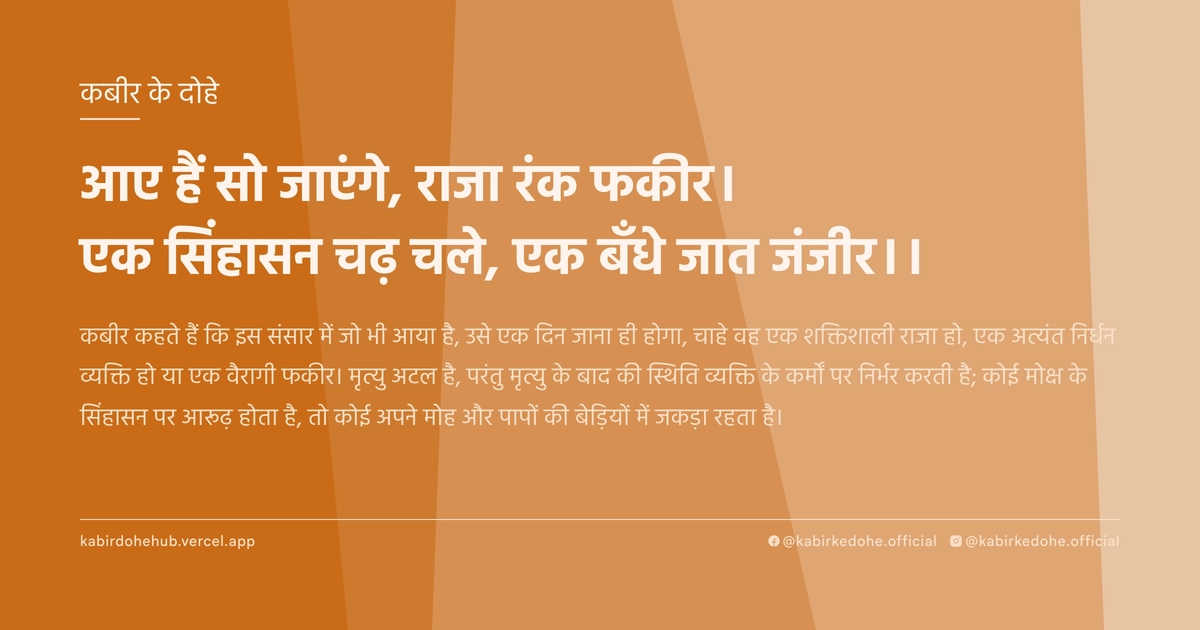
आए हैं सो जाएंगे, राजा रंक फकीर।
एक सिंहासन चढ़ चले, एक बँधे जात जंजीर।।
Aaye hain so jaayenge, raja rank fakeer. Ek sinhasan chadh chale, ek bandhe jaat zanjeer.
इस पृष्ठ पर इस कबीर दोहे का अर्थ (meaning), हिंदी व्याख्या और अंग्रेज़ी अनुवाद, दार्शनिक विश्लेषण और व्यावहारिक जीवन सीख दी गई है। यह दोहा अनित्य (Impermanence) विषय से जुड़ा है — Kabir doha meaning and explanation in Hindi and English.
अर्थ (Meaning):
कबीर कहते हैं कि इस संसार में जो भी आया है, उसे एक दिन जाना ही होगा, चाहे वह एक शक्तिशाली राजा हो, एक अत्यंत निर्धन व्यक्ति हो या एक वैरागी फकीर। मृत्यु अटल है, परंतु मृत्यु के बाद की स्थिति व्यक्ति के कर्मों पर निर्भर करती है; कोई मोक्ष के सिंहासन पर आरूढ़ होता है, तो कोई अपने मोह और पापों की बेड़ियों में जकड़ा रहता है।
Kabir asserts that every soul who has entered this world must inevitably depart, regardless of whether they were a powerful monarch, a destitute pauper, or a wandering ascetic. While death is the universal equalizer, the aftermath is determined by one's spiritual alignment; some ascend to the throne of liberation, while others remain shackled by the chains of their own attachments and karmic debts.
व्याख्या (Interpretation):
इस दोहे का शाब्दिक अर्थ मृत्यु की अनिवार्यता है, लेकिन इसका गहरा आध्यात्मिक अर्थ 'माया' और 'अहंकार' के विसर्जन से जुड़ा है। 'सिंहासन' यहाँ भौतिक सत्ता का नहीं, बल्कि आत्म-साक्षात्कार और मोक्ष (Mukti) का प्रतीक है, जहाँ आत्मा ब्रह्म में विलीन हो जाती है। इसके विपरीत, 'जंजीर' उन मानसिक और भावनात्मक बंधनों को दर्शाती है जिन्हें हम जीवन भर संचित करते हैं—जैसे क्रोध, लोभ और अहंकार। यह निरगुण भक्ति का सार है, जो बताता है कि ईश्वर किसी बाहरी पद या संपत्ति में नहीं, बल्कि आंतरिक पवित्रता में बसता है। अद्वैत वेदांत के अनुसार, जब तक व्यक्ति स्वयं को शरीर या सामाजिक पहचान (राजा या रंक) से जोड़ता है, वह जंजीरों में बंधा रहता है। केवल वही मुक्त होता है जो इस द्वैत को मिटाकर अपनी वास्तविक स्वरूप को पहचानता है। यह विरोधाभास है कि जिसे हम जीवन भर 'उपलब्धि' समझते हैं, वही मृत्यु के समय सबसे भारी जंजीर बन जाती है।
Literally, the couplet speaks of the inevitability of death, but its profound spiritual essence concerns the dissolution of 'Maya' (illusion) and the 'Ahamkara' (ego). The 'throne' here does not symbolize earthly power, but rather the state of self-realization and Moksha, where the individual soul merges into the formless Brahman. Conversely, the 'chains' represent the psychological and emotional attachments accumulated over a lifetime—greed, anger, and pride. This aligns with Nirgun Bhakti, emphasizing that the Divine resides not in external status or wealth, but in internal purity. According to Advaita Vedanta, as long as a person identifies with the body or a social role (king or pauper), they remain shackled. Liberation occurs only when one transcends this duality to recognize their true essence. The central paradox is that what we perceive as 'achievement' during life often becomes the heaviest chain at the moment of departure.
दार्शनिक विश्लेषण (Philosophical Analysis):
कबीर का यह दोहा उस सामाजिक और धार्मिक परिवेश में लिखा गया था जहाँ जाति और वर्ग का कठोर विभाजन था। कबीर ने इस सत्य को उजागर किया कि मृत्यु के समक्ष सामाजिक पदानुक्रम पूरी तरह निरर्थक है। उन्होंने कर्मकांडों और बाहरी आडंबरों का खंडन किया, यह तर्क देते हुए कि मोक्ष किसी विशेष पूजा पद्धति या उच्च कुल में जन्म लेने से नहीं, बल्कि आत्मा के शुद्धिकरण से मिलता है।
दार्शनिक रूप से, यह विचार सूफीवाद के 'फना' (अहंकार का विनाश) और अद्वैत वेदांत के 'अहम ब्रह्मास्मि' के करीब है। कबीर का मानना था कि मनुष्य की सबसे बड़ी त्रासदी यह है कि वह 'राजा' होने के भ्रम में या 'रंक' होने के दुख में इतना खो जाता है कि वह अपनी शाश्वत प्रकृति को भूल जाता है। यह मनोवैज्ञानिक रूपांतरण की मांग करता है जहाँ व्यक्ति अपनी पहचान को बाहरी उपाधियों से हटाकर आंतरिक चेतना पर केंद्रित करे।
यहाँ 'जंजीर' केवल पाप नहीं, बल्कि 'आसक्ति' (Attachment) है। जब हम किसी वस्तु या व्यक्ति को 'मेरा' कहते हैं, तो हम एक अदृश्य जंजीर बना लेते हैं। यह जंजीर हमें वर्तमान क्षण से दूर ले जाती है और पुनर्जन्म के चक्र में बांधे रखती है। कबीर का प्रहार उन लोगों पर है जो सोचते हैं कि धन या सत्ता उन्हें मृत्यु के भय से बचा सकती है।
निरगुण भक्ति के संदर्भ में, यह दोहा सिखाता है कि ईश्वर का कोई आकार या भौतिक पता नहीं है। वह केवल उस हृदय में मिलता है जो अहंकार से मुक्त है। जो व्यक्ति स्वयं को शून्य कर लेता है, वही उस अनंत सिंहासन का अधिकारी बनता है। यह एक क्रांतिकारी विचार था जिसने मध्यकालीन भारत में आम जनमानस को यह विश्वास दिलाया कि आध्यात्मिकता किसी पुरोहित के नियंत्रण में नहीं है।
अंततः, यह विश्लेषण हमें यह समझने पर मजबूर करता है कि जीवन का वास्तविक उद्देश्य संचय नहीं, बल्कि विसर्जन है। जब हम अपनी पहचान के बोझ को उतार फेंकते हैं, तभी हम वास्तव में स्वतंत्र होते हैं। यह भौतिक जगत एक सराय की तरह है जहाँ हम केवल कुछ समय के लिए आए हैं; यहाँ की वस्तुओं पर दावा करना वैसा ही है जैसे किसी होटल के फर्नीचर को अपना कहना।
Kabir composed this couplet within a socio-religious landscape defined by rigid caste hierarchies and class divisions. He exposes the truth that in the face of death, all social stratifications are utterly meaningless. He rejected ritualism and external pomposity, arguing that liberation is not achieved through specific liturgical practices or birth into a high caste, but through the purification of the soul.
Philosophically, this perspective converges with the Sufi concept of 'Fana' (annihilation of the ego) and the Advaita Vedanta realization of 'Aham Brahmasmi' (I am Brahman). Kabir posits that the greatest human tragedy is becoming so consumed by the illusion of being a 'king' or the misery of being a 'pauper' that one forgets their eternal nature. This necessitates a psychological transformation where identity is shifted from external titles to internal consciousness.
Here, the 'chains' are not merely sins, but 'Asakti' (attachment). Whenever we label something or someone as 'mine,' we forge an invisible link. This link detaches us from the present moment and binds us to the cycle of Samsara. Kabir targets the delusion that wealth or power can provide an escape from the inevitability of death.
In the context of Nirgun Bhakti, the couplet teaches that the Divine has no form or physical location. God is found only in the heart that has been emptied of ego. The one who renders themselves as 'zero' becomes eligible for the infinite throne. This was a revolutionary idea in medieval India, empowering the common masses by asserting that spirituality is not the monopoly of the priesthood.
Ultimately, this analysis compels us to understand that the true purpose of life is not accumulation, but dissolution. Only when we shed the burden of our constructed identities do we become truly free. The material world is like a transient inn; claiming ownership over its contents is as futile as claiming the furniture of a hotel as one's own.
मूल संदेश (Core Message):
- मृत्यु एकमात्र अटल सत्य है, बाकी सब माया है।
- अहंकार की जंजीरें मोक्ष के मार्ग में सबसे बड़ी बाधा हैं।
- असली सत्ता आंतरिक शांति में है, बाहरी पद में नहीं।
- आसक्ति ही दुख का मूल कारण और बंधन का आधार है।
- शून्य होने की क्षमता ही अनंत होने का एकमात्र मार्ग है।
- Death is the only absolute truth; all else is illusion.
- The chains of ego are the greatest obstacles to liberation.
- True sovereignty lies in inner peace, not external rank.
- Attachment is the root of suffering and the basis of bondage.
- The capacity to become zero is the only path to becoming infinite.
व्यावहारिक उदाहरण (Practical Example):
वाराणसी के घाटों पर रहने वाले एक वृद्ध विधवा, जानकी, का जीवन अत्यंत कठिन था। वह दूसरों के घरों में छोटे-मोटे काम करके अपना गुजारा करती थी। उसके पास न तो धन था और न ही कोई अपना, लेकिन वह हर शाम गंगा किनारे बैठकर मौन प्रार्थना करती थी।
उसी शहर में एक अत्यंत धनी व्यापारी, सेठ धर्मदास रहता था। धर्मदास का अहंकार इतना बड़ा था कि वह अपने दान को भी अपनी श्रेष्ठता सिद्ध करने का माध्यम मानता था। वह अक्सर जानकी जैसे लोगों को तुच्छ दृष्टि से देखता था और अपनी संपत्ति को ही अपनी असली शक्ति समझता था।
एक दिन शहर में एक महान संत आए। धर्मदास ने उनका भव्य स्वागत किया और अपनी धन-संपदा का प्रदर्शन किया, यह उम्मीद करते हुए कि संत उसकी प्रशंसा करेंगे। संत ने उसकी ओर देखा भी नहीं और चुपचाप जानकी के पास जाकर बैठ गए, जो अपनी फटी साड़ी में शांत मुद्रा में बैठी थी।
धर्मदास को यह देखकर क्रोध आया। उसने पूछा, 'महाराज, आप इस दीन-हीन स्त्री में क्या देख रहे हैं? मेरे पास वह सब कुछ है जो एक मनुष्य को महान बनाता है।' संत ने मुस्कुराते हुए कबीर का यह दोहा सुनाया और कहा, 'धर्मदास, तुम जिस सिंहासन को आज पकड़कर बैठे हो, वह मृत्यु के समय तुम्हारी सबसे बड़ी जंजीर बनेगा।'
धर्मदास को पहले तो यह बात समझ नहीं आई, लेकिन कुछ महीनों बाद एक गंभीर बीमारी ने उसे घेर लिया। उसकी सारी संपत्ति, उसके नौकर और उसका अहंकार उसके बिस्तर के पास खड़े थे, लेकिन वे उसकी पीड़ा कम नहीं कर पा रहे थे। वह जितना अधिक अपनी संपत्ति के बारे में सोचता, उसे उतना ही डर लगता कि वह यह सब पीछे छोड़ जाएगा।
दूसरी ओर, जानकी अपनी बीमारी और गरीबी के बावजूद शांत थी। उसे खोने का कोई डर नहीं था क्योंकि उसने कभी कुछ पकड़ा ही नहीं था। वह मृत्यु को एक पुराने वस्त्र को बदलने की तरह देख रही थी।
अपनी अंतिम घड़ियों में, धर्मदास ने महसूस किया कि उसकी 'सफलता' वास्तव में उसकी कैद थी। उसने अपनी पूरी जिंदगी उन चीजों को इकट्ठा करने में लगा दी जो उसे आत्मा से दूर ले गईं। उसने जानकी की शांति को देखा और महसूस किया कि असली 'राजा' वह है जिसका मन इच्छाओं से मुक्त है।
अंतिम क्षणों में, धर्मदास ने अपनी सारी संपत्ति दान कर दी और अपनी पहचान के अहंकार को त्याग दिया। उसने महसूस किया कि जब वह 'मैं' और 'मेरा' को छोड़कर शून्य हुआ, तभी उसे उस आंतरिक शांति का अनुभव हुआ जिसे जानकी ने जीवन भर जिया था।
यह 'कबीर ट्विस्ट' था—जहाँ एक भौतिक राजा अपनी जंजीरों को पहचानकर अंततः आध्यात्मिक स्वतंत्रता की ओर बढ़ा। धर्मदास ने सीखा कि मुक्ति सिंहासन पर बैठने में नहीं, बल्कि सिंहासन के मोह को छोड़ने में है।
जानकी की सादगी और धर्मदास का रूपांतरण यह सिद्ध करता है कि मृत्यु केवल शरीर का अंत नहीं, बल्कि एक दर्पण है जो हमें दिखाता है कि हमने वास्तव में क्या कमाया है—शांति या बोझ।
Janaki, an elderly widow living on the ghats of Varanasi, led a life of extreme hardship. She survived by doing odd jobs in other people's homes. She possessed neither wealth nor kin, yet every evening she sat by the Ganges in silent prayer.
In the same city lived a wealthy merchant, Seth Dharmdas. Dharmdas's ego was so immense that he viewed even his charity as a means to prove his superiority. He often looked down upon people like Janaki, believing his accumulated riches were his true power.
One day, a renowned saint visited the city. Dharmdas welcomed him with grandeur, showcasing his opulence in hopes of receiving praise. The saint ignored the display and quietly went to sit beside Janaki, who sat serene in her tattered saree.
Infuriated, Dharmdas asked, 'Maharaj, what do you see in this destitute woman? I possess everything that makes a man great.' The saint smiled and recited Kabir's couplet, saying, 'Dharmdas, the throne you cling to today will become your heaviest chain at the moment of death.'
Dharmdas did not understand at first, but months later, a severe illness struck him. All his wealth, servants, and ego stood by his bed, yet they could not alleviate his suffering. The more he thought of his possessions, the more he feared leaving them behind.
Conversely, Janaki remained peaceful despite her illness and poverty. She had no fear of loss because she had never clung to anything. She viewed death as simply changing an old garment.
In his final days, Dharmdas realized that his 'success' was actually his prison. He had spent his entire life gathering things that distanced him from his soul. He observed Janaki's peace and realized that the true 'king' is the one whose mind is free from desire.
In his last moments, Dharmdas donated all his wealth and surrendered the ego of his identity. He felt that only when he became 'zero' by letting go of 'I' and 'mine' did he experience the inner peace Janaki had lived by.
This was the 'Kabir Twist'—where a material king recognized his chains and finally moved toward spiritual freedom. Dharmdas learned that liberation is not in occupying the throne, but in relinquishing the attachment to it.
Janaki's simplicity and Dharmdas's transformation prove that death is not just the end of the body, but a mirror showing us what we have truly earned—peace or a burden.
अभ्यास मार्गदर्शन (Practice Guidance):
- दैनिक चिंतन: प्रतिदिन 15 मिनट यह विचार करें कि आपकी कौन सी भौतिक या मानसिक उपलब्धियां वास्तव में 'जंजीरें' हैं जो आपको वर्तमान से दूर रखती हैं।
- आत्म-पूछताछ जर्नल: एक सूची बनाएं उन पहचानों की (जैसे- पद, रिश्ता, प्रतिष्ठा) जिन्हें आप सबसे अधिक महत्व देते हैं। फिर लिखें कि यदि ये सब कल छिन जाएं, तो आपके भीतर क्या बचेगा।
- व्यवहारिक परिवर्तन: सप्ताह में एक बार अपनी किसी प्रिय वस्तु का त्याग करें या किसी ऐसे व्यक्ति की निस्वार्थ सेवा करें जिससे आपको कोई लाभ न मिले, ताकि 'मेरा' का भाव कम हो सके।
- निदान चेकलिस्ट: क्या आप किसी की आलोचना सुनकर विचलित होते हैं? क्या आप अपनी उपलब्धियों का बार-बार जिक्र करते हैं? यदि हाँ, तो आप अभी भी 'जंजीरों' में हैं। यदि आप विपरीत परिस्थितियों में भी तटस्थ रह पाते हैं, तो आप 'सिंहासन' की ओर बढ़ रहे हैं।
- Daily Contemplation: Spend 15 minutes daily reflecting on which of your material or mental achievements are actually 'chains' keeping you detached from the present.
- Self-Inquiry Journal: List the identities (e.g., rank, relationship, reputation) you value most. Then write what would remain within you if all these were stripped away tomorrow.
- Behavioral Change: Once a week, renounce a cherished object or serve someone selflessly from whom you gain nothing, to diminish the sense of 'mine'.
- Diagnostic Checklist: Do you get agitated by criticism? Do you frequently mention your achievements? If yes, you are still in 'chains'. If you remain neutral in adverse conditions, you are ascending toward the 'throne'.
चिंतन प्रश्न (Reflection Questions):
- यदि आपकी सारी सामाजिक पहचान (नाम, पद, प्रतिष्ठा) हटा दी जाए, तो आप वास्तव में कौन हैं?
- आपकी कौन सी ऐसी 'अदृश्य जंजीर' है जिसे आप दुनिया के सामने 'गर्व' के रूप में प्रदर्शित करते हैं?
- क्या आपकी डिजिटल पहचान (सोशल मीडिया इमेज) आपके वास्तविक अस्तित्व को निगल रही है?
- आप मृत्यु के विचार से डरते हैं या उस सत्य से जो मृत्यु आपके सामने उजागर करेगी?
- क्या आप दूसरों की मदद इसलिए करते हैं ताकि आप 'परोपकारी' दिखें, या वास्तव में उनके दुख को महसूस करते हैं?
- If all your social identities (name, rank, reputation) were removed, who are you actually?
- What is that 'invisible chain' which you display to the world as a point of 'pride'?
- Is your digital identity (social media image) consuming your actual existence?
- Do you fear the thought of death, or the truth that death will expose about you?
- Do you help others so that you appear 'charitable,' or do you truly feel their suffering?