
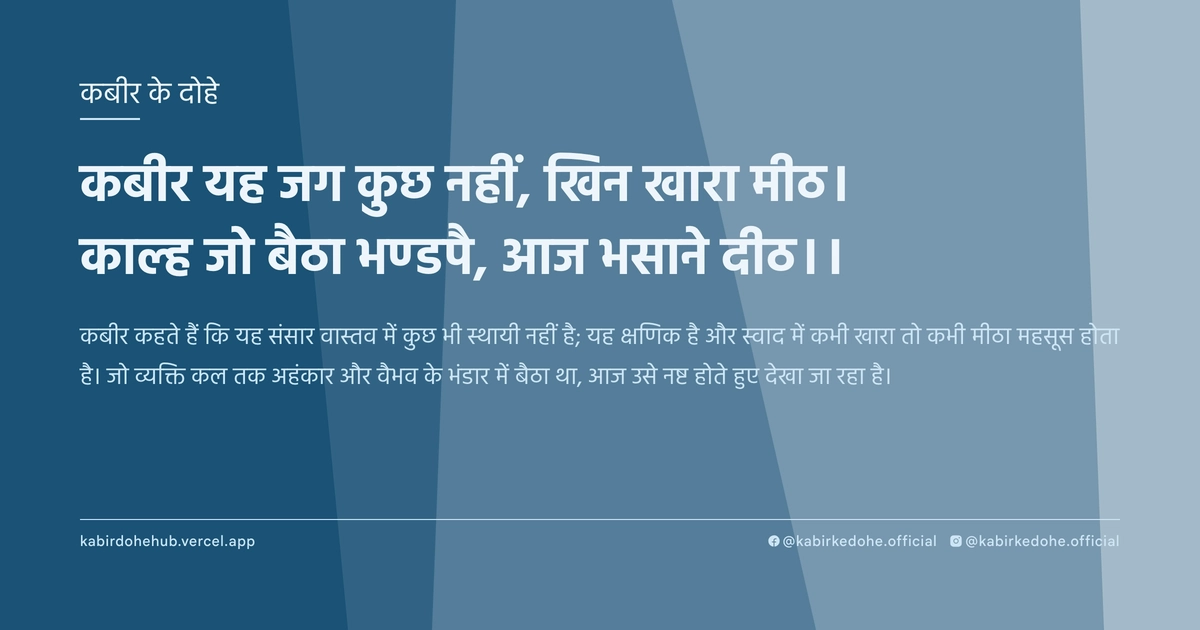
कबीर यह जग कुछ नहीं, खिन खारा मीठ।
काल्ह जो बैठा भण्डपै, आज भसाने दीठ।।
Kabir yah jag kuch nahi, khin khara meeth. Kal jo baitha bhandpai, aaj bhasane deeth.
इस पृष्ठ पर इस कबीर दोहे का अर्थ (meaning), हिंदी व्याख्या और अंग्रेज़ी अनुवाद, दार्शनिक विश्लेषण और व्यावहारिक जीवन सीख दी गई है। यह दोहा अनित्य (Impermanence) विषय से जुड़ा है — Kabir doha meaning and explanation in Hindi and English.
अर्थ (Meaning):
कबीर कहते हैं कि यह संसार वास्तव में कुछ भी स्थायी नहीं है; यह क्षणिक है और स्वाद में कभी खारा तो कभी मीठा महसूस होता है। जो व्यक्ति कल तक अहंकार और वैभव के भंडार में बैठा था, आज उसे नष्ट होते हुए देखा जा रहा है।
Kabir asserts that this world is an illusion with no permanent substance, fluctuating like taste between saltiness and sweetness. He observes that the one who sat proudly amidst vast treasures and ego yesterday is seen today reduced to ashes or oblivion.
व्याख्या (Interpretation):
शाब्दिक अर्थ यह है कि संसार की सुख-दुख की स्थितियाँ अस्थिर हैं। रूपक के तौर पर, 'खारा-मीठा' माया के द्वंद्व को दर्शाता है। निर्गुण भक्ति के अनुसार, यह जगत एक स्वप्न है जहाँ आत्मा स्वयं को शरीर और पद से जोड़ लेती है। जब व्यक्ति यह समझता है कि 'भण्डपै' (संग्रह और अहंकार) केवल एक भ्रम है, तब वह अद्वैत वेदांत के उस सत्य को पहचानता है जहाँ केवल ब्रह्म सत्य है और जगत मिथ्या है। यह दोहा मनुष्य को उसकी नश्वरता और अहंकार की निरर्थकता का बोध कराता है।
Literally, the verse speaks of the instability of worldly pleasure and pain. Metaphorically, 'salt and sweet' represent the duality of Maya—the cosmic illusion. In the light of Nirgun Bhakti, the world is a transient dream where the Atman mistakenly identifies with the physical body and social status. When one realizes that 'bhandpai' (accumulation and pride) is a mere mirage, they touch upon the Advaita Vedanta truth: Brahman alone is real, and the world is ephemeral. The central paradox is that man spends his life building a fortress of ego on shifting sands.
दार्शनिक विश्लेषण (Philosophical Analysis):
कबीर का यह दोहा उनके समय के सामाजिक और धार्मिक पाखंड पर एक गहरा प्रहार है। उन्होंने देखा कि कैसे लोग जाति, धर्म और धन के अहंकार में डूबे रहते हैं, जबकि मृत्यु सबको समान कर देती है। यह दृष्टिकोण सूफी मत के 'फना' (अहंकार का विनाश) और वेदांत के 'माया' सिद्धांत का संगम है। कबीर यहाँ यह समझा रहे हैं कि भौतिक संग्रह केवल मानसिक बंधन पैदा करता है।
ऐतिहासिक रूप से, कबीर ने कर्मकांडों का विरोध किया क्योंकि वे बाहरी दिखावे को सत्य मान लेते थे। उनके लिए, ईश्वर किसी मंदिर या मस्जिद में नहीं, बल्कि उस शून्य में है जो अहंकार के मिटने के बाद बचता है। यह 'शून्य' ही वह परम तत्व है जिसे वे निर्गुण कहते हैं।
मनोवैज्ञानिक स्तर पर, यह दोहा 'अटैचमेंट' (आसक्ति) के दुख को संबोधित करता है। जब हम किसी स्थिति को स्थायी मान लेते हैं, तो उसका परिवर्तन हमें तोड़ देता है। कबीर हमें 'साक्षी भाव' (witness consciousness) में आने के लिए प्रेरित करते हैं।
अद्वैत वेदांत के अनुसार, जब तक 'मैं' और 'मेरा' का भाव है, तब तक द्वैत है। 'भण्डपै' केवल भौतिक धन नहीं, बल्कि मानसिक संचय भी है—जैसे कि हमारी मान्यताएं और पूर्वाग्रह। इनका विनाश ही वास्तविक मुक्ति है।
अंततः, कबीर यह संदेश देते हैं कि जीवन का एकमात्र स्थायी सत्य वह निराकार तत्व है जो जन्म और मृत्यु से परे है। संसार की क्षणभंगुरता को स्वीकार करना ही शांति का एकमात्र मार्ग है, क्योंकि जो बदलता है वह सत्य नहीं हो सकता।
This Doha is a profound critique of the social and religious hypocrisy of Kabir's era. He observed how individuals clung to caste, creed, and wealth, oblivious to the fact that death is the great equalizer. This perspective merges the Sufi concept of 'Fana' (annihilation of the self) with the Vedantic doctrine of 'Maya'. Kabir argues that material accumulation serves only to strengthen the chains of the ego.
Historically, Kabir rejected ritualism because it prioritized external form over internal essence. For him, the Divine is not found in temples or mosques but in the 'Shunya' (Void) that remains once the ego is extinguished. This formless void is the essence of Nirgun Bhakti.
Psychologically, the verse addresses the suffering caused by attachment. We suffer not because things change, but because we believe they should remain permanent. Kabir urges the seeker to adopt the 'Sakshi' or witness consciousness, observing the ebb and flow of life without being swept away by it.
According to Advaita Vedanta, as long as the sense of 'I' and 'Mine' persists, duality remains. 'Bhandpai' refers not just to gold, but to the mental hoarding of identities and biases. The dissolution of this perceived identity is the only path to liberation.
Ultimately, Kabir posits that the only enduring truth is the formless element beyond birth and death. Accepting the transience of the world is the only way to achieve peace, for that which is subject to change cannot be the Absolute Truth.
मूल संदेश (Core Message):
- संसार एक अस्थिर रंगमंच है, यहाँ कुछ भी स्थायी नहीं है।
- अहंकार का महल रेत पर बना होता है, जो एक लहर में ढह जाता है।
- सुख और दुख एक ही सिक्के के दो पहलू हैं; दोनों को साक्षी भाव से देखें।
- सच्ची संपत्ति भौतिक संग्रह नहीं, बल्कि आंतरिक वैराग्य है।
- जब 'मैं' मिटता है, तभी अनंत सत्य का उदय होता है।
- The world is an unstable stage; nothing here is permanent.
- The palace of ego is built on sand, collapsing with a single wave.
- Joy and sorrow are two sides of the same coin; observe both as a witness.
- True wealth is not material accumulation, but internal detachment.
- Only when the 'I' vanishes does the Infinite Truth emerge.
व्यावहारिक उदाहरण (Practical Example):
वाराणसी के घाटों पर रहने वाला एक वृद्ध विधवा, जानकी, अपनी पूरी जिंदगी एक छोटे से कमरे और कुछ पुराने बर्तनों के मोह में बिताती थी। वह मानती थी कि उसकी पहचान उसी छोटे से स्थान और उन वस्तुओं से है। वह अक्सर दूसरों से अपनी 'संपत्ति' के बारे में बात करती, भले ही वह बहुत कम थी।
एक दिन उसने देखा कि घाट पर एक बहुत बड़े सेठ का अंतिम संस्कार हो रहा था। वह सेठ शहर का सबसे अमीर व्यक्ति था, जिसके पास विशाल महल और अनगिनत नौकर थे। लेकिन अब, वह केवल एक लकड़ियों के ढेर पर जल रहा था।
जानकी ने देखा कि सेठ के परिवार वाले उसकी संपत्ति के लिए वहीं रोते हुए लड़ रहे थे। वह वैभव, जो कल तक सबको डराता और प्रभावित करता था, आज राख बन रहा था।
उस क्षण जानकी को कबीर का यह दोहा याद आया। उसने महसूस किया कि वह जिन बर्तनों और उस कमरे को अपनी पहचान मानती थी, वे भी उसी राख की तरह क्षणभंगुर हैं।
उसने अपनी आँखों में एक अजीब सी शांति महसूस की। उसने महसूस किया कि उसका दुख इस बात में नहीं था कि उसके पास कम है, बल्कि इस बात में था कि वह उस 'कम' को पकड़ कर बैठी थी।
अगले दिन, जानकी ने अपने पास मौजूद कुछ पुराने कपड़े और बर्तन उन लोगों को दे दिए जो उससे भी अधिक गरीब थे। उसने पहली बार महसूस किया कि 'देने' का सुख 'पकड़ने' के सुख से कहीं बड़ा है।
उसका व्यवहार बदल गया। वह अब घाट पर आने वाले हर अजनबी से मुस्कराकर बात करती और उन्हें यह याद दिलाती कि यहाँ सब मेहमान हैं।
उसकी आंतरिक शांति देखकर लोग उससे सलाह लेने आने लगे। वह अब एक संपत्ति की मालकिन नहीं, बल्कि एक आध्यात्मिक मार्गदर्शक बन गई थी।
उसने जान लिया कि असली 'भण्डपै' हृदय की करुणा और संतोष है, न कि भौतिक वस्तुओं का ढेर।
जानकी का जीवन अब एक उत्सव बन गया था, क्योंकि उसने उस बोझ को उतार फेंका था जिसे वह अपनी पहचान समझती थी।
Janaki, an elderly widow living on the ghats of Varanasi, spent her entire life clinging to a tiny room and a few old brass utensils. She believed her identity was inextricably tied to these meager possessions and often spoke of them as her 'estate'.
One day, she witnessed the cremation of a powerful merchant. This man had been the wealthiest in the city, owning sprawling mansions and commanding countless servants. Yet, there he was, reduced to a heap of burning wood.
Janaki observed the merchant's heirs fighting over his gold and land right there beside the pyre. The grandeur that had once intimidated and fascinated the city was now turning into grey ash.
In that moment, Kabir's words resonated within her. She realized that the room and utensils she guarded so fiercely were just as ephemeral as the merchant's empire.
A strange sense of lightness washed over her. She understood that her suffering didn't stem from having little, but from the desperate act of clutching onto that 'little'.
The following morning, Janaki gave away her spare clothes and utensils to those even more destitute than herself. For the first time, she discovered that the joy of letting go far outweighed the joy of possessing.
Her demeanor shifted. She began greeting every stranger on the ghats with a genuine smile, reminding them softly that we are all merely guests here.
People began seeking her out for wisdom, drawn by the profound peace radiating from her. She was no longer a woman defined by a small room, but a guide defined by her vast heart.
She realized that the only true 'treasure' (Bhandpai) is compassion and contentment, not the accumulation of matter.
Janaki's life became a celebration, for she had finally dropped the heavy burden of a false identity.
अभ्यास मार्गदर्शन (Practice Guidance):
- प्रतिदिन 15 मिनट मौन बैठें और अपने जीवन की उन चीजों की सूची बनाएं जिनसे आप अत्यधिक जुड़ाव महसूस करते हैं। विचार करें कि यदि वे कल गायब हो जाएं, तो क्या आपका अस्तित्व समाप्त हो जाएगा?
- एक 'अस्थिरता जर्नल' लिखें: दिन भर में होने वाले बदलावों (जैसे मौसम, मूड, या लोगों का व्यवहार) को नोट करें और महसूस करें कि कैसे सब कुछ 'खारा-मीठा' है।
- व्यवहार परिवर्तन: सप्ताह में एक बार ऐसी वस्तु दान करें जो आपको प्रिय हो, ताकि आप 'पकड़ने' की आदत को तोड़ सकें।
- निदान चेकलिस्ट: क्या आप किसी की प्रशंसा पाकर बहुत खुश और आलोचना पाकर बहुत दुखी होते हैं? यदि हाँ, तो आप अभी भी माया के द्वंद्व में फंसे हैं।
- Spend 15 minutes in silence daily, listing the things you are most attached to. Ask yourself: If these vanished tomorrow, would my core existence cease to be?
- Maintain an 'Impermanence Journal': Note the shifts in weather, your mood, or people's behavior throughout the day, observing the 'salt and sweet' nature of existence.
- Behavioral Shift: Once a week, donate an item you genuinely love to break the psychological habit of hoarding and clinging.
- Diagnostic Checklist: Do you feel extreme euphoria from praise and deep despair from criticism? If so, you are still trapped in the duality of Maya.
चिंतन प्रश्न (Reflection Questions):
- आपकी वह कौन सी 'डिजिटल पहचान' या सामाजिक छवि है जिसे आप खोने से सबसे ज्यादा डरते हैं?
- क्या आपका आत्म-सम्मान आपकी उपलब्धियों पर टिका है, या आपकी अंतरात्मा की शांति पर?
- यदि आज आपकी सारी उपाधियाँ और संपत्ति छीन ली जाए, तो आप स्वयं को कैसे परिभाषित करेंगे?
- आप किन गुप्त पूर्वाग्रहों को 'सत्य' मानकर पकड़ कर बैठे हैं, जो वास्तव में केवल मानसिक बोझ हैं?
- क्या आप वास्तव में स्वतंत्र हैं, या आप अपनी इच्छाओं के गुलाम हैं जो आपको एक अंतहीन चक्र में घुमा रही हैं?
- What is that 'digital identity' or social image you are most terrified of losing?
- Is your self-worth anchored in your achievements or in the stillness of your soul?
- If all your titles and possessions were stripped away today, how would you define yourself?
- What hidden biases are you clinging to as 'truth', which are actually just mental burdens?
- Are you truly free, or are you a slave to desires that keep you spinning in an endless cycle?