
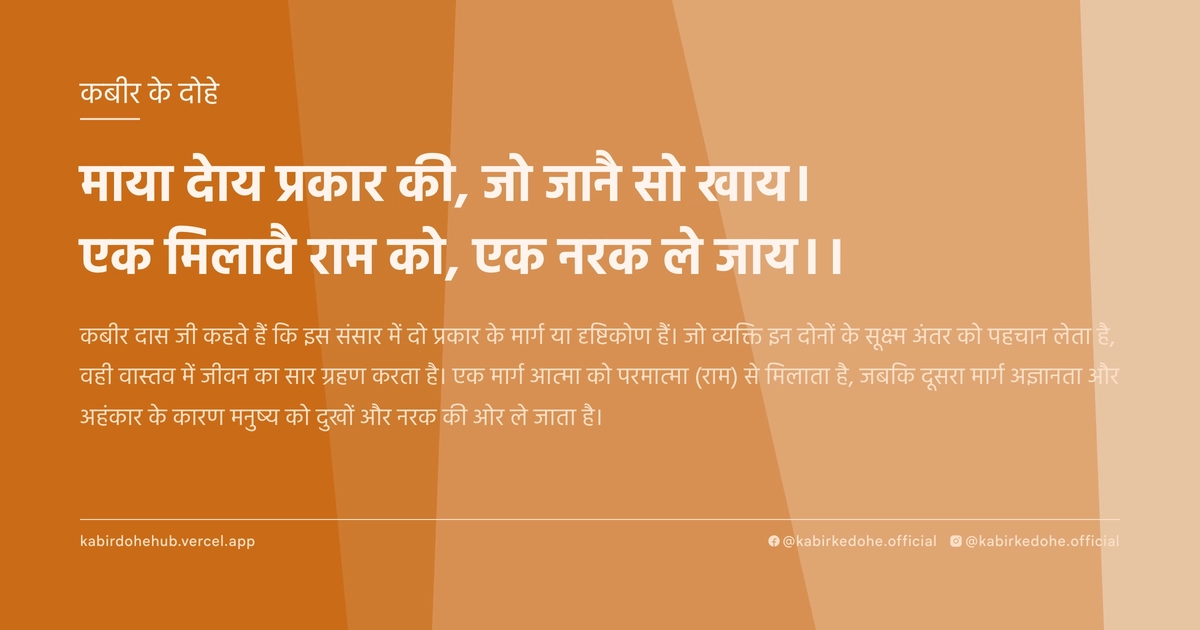
माया देाय प्रकार की, जो जानै सो खाय।
एक मिलावै राम को, एक नरक ले जाय।।
Maya doy prakar ki, jo jaane so khaaye. Ek milavai Ram ko, ek narak le jaaye.
इस पृष्ठ पर इस कबीर दोहे का अर्थ (meaning), हिंदी व्याख्या और अंग्रेज़ी अनुवाद, दार्शनिक विश्लेषण और व्यावहारिक जीवन सीख दी गई है। यह दोहा सहज योग (Sahaja Yoga) विषय से जुड़ा है — Kabir doha meaning and explanation in Hindi and English.
अर्थ (Meaning):
कबीर दास जी कहते हैं कि इस संसार में दो प्रकार के मार्ग या दृष्टिकोण हैं। जो व्यक्ति इन दोनों के सूक्ष्म अंतर को पहचान लेता है, वही वास्तव में जीवन का सार ग्रहण करता है। एक मार्ग आत्मा को परमात्मा (राम) से मिलाता है, जबकि दूसरा मार्ग अज्ञानता और अहंकार के कारण मनुष्य को दुखों और नरक की ओर ले जाता है।
Kabir explains that there are two distinct paths or modes of existence in this world. Only the one who possesses the discernment to distinguish between them can truly 'consume' or internalize the truth. One path leads the seeker toward union with the Divine (Ram), while the other, driven by ignorance and ego, leads the soul toward suffering and spiritual degradation.
व्याख्या (Interpretation):
यहाँ 'दो प्रकार' का अर्थ केवल बाहरी रास्तों से नहीं, बल्कि आंतरिक प्रवृत्तियों—सत्व और तम—से है। शाब्दिक अर्थ में यह सही और गलत के चुनाव की बात करता है, लेकिन आध्यात्मिक स्तर पर यह 'माया' और 'सत्य' के बीच के भेद को दर्शाता है। निर्गुण भक्ति के अनुसार, जब तक मनुष्य बाहरी आडंबरों और देह-अभिमान में लिप्त रहता है, वह नरक रूपी मानसिक द्वंद्व में रहता है। जैसे ही वह आत्म-साक्षात्कार करता है, वह उस निराकार राम का अनुभव करता है जो उसके भीतर ही स्थित है। यह द्वैत से अद्वैत की ओर संक्रमण है। यह विरोधाभास है कि एक ही जीवन में दो विपरीत गंतव्य संभव हैं, और चुनाव केवल जागरूकता (Awareness) पर निर्भर करता है।
The 'two types' mentioned here do not merely refer to external paths, but to internal tendencies—Sattva (purity) and Tamas (darkness). While the literal meaning suggests a choice between right and wrong, the metaphorical layer addresses the distinction between Maya (illusion) and Satya (Truth). In the context of Nirgun Bhakti, as long as a person is entangled in external rituals and bodily ego, they reside in a psychological 'hell' of fragmentation. The moment they achieve self-realization, they encounter the formless Ram dwelling within. This represents the transition from duality to non-duality (Advaita). The central paradox is that within a single human life, two diametrically opposite destinations are possible, and the deciding factor is solely conscious awareness.
दार्शनिक विश्लेषण (Philosophical Analysis):
कबीर का यह दोहा उस युग की उपज है जहाँ धर्म केवल कर्मकांडों और जातिगत श्रेष्ठता तक सीमित था। कबीर ने इस व्यवस्था को चुनौती देते हुए यह स्पष्ट किया कि मोक्ष किसी मंदिर, मस्जिद या विशेष जाति के जन्म से नहीं, बल्कि आंतरिक विवेक से मिलता है। यह विचार अद्वैत वेदांत के करीब है, जहाँ आत्मा और ब्रह्म की एकता पर बल दिया गया है। कबीर यहाँ 'राम' शब्द का प्रयोग किसी पौराणिक राजा के लिए नहीं, बल्कि उस सर्वव्यापी चेतना के लिए कर रहे हैं जो कण-कण में व्याप्त है।
सूफी मत के 'फना' (अहंकार का विनाश) के सिद्धांत की तरह, कबीर भी मानते हैं कि जब तक 'मैं' (अहंकार) जीवित है, तब तक मनुष्य नरक के मार्ग पर है। नरक यहाँ किसी भौगोलिक स्थान का नाम नहीं, बल्कि वह मानसिक अवस्था है जहाँ व्यक्ति सत्य से कटा हुआ महसूस करता है। यह अलगाव ही वास्तविक दुख है।
कबीर की दृष्टि में, ritualism (कर्मकांड) अक्सर एक ढाल बन जाता है जिसके पीछे मनुष्य अपने अहंकार को छिपाता है। वे तर्क देते हैं कि यदि पूजा करते समय मन में घृणा या श्रेष्ठता का भाव है, तो वह पूजा वास्तव में नरक का मार्ग प्रशस्त कर रही है। वास्तविक भक्ति वह है जो मनुष्य को विनम्र बनाए और उसे समस्त सृष्टि में एक ही नूर देखने के लिए प्रेरित करे।
मनोवैज्ञानिक स्तर पर, यह दोहा संज्ञानात्मक विसंगति (cognitive dissonance) की बात करता है। हम अक्सर वह करते हैं जो हमें विनाश की ओर ले जाता है, जबकि हम शांति की खोज करते हैं। कबीर इस अंतराल को पाटने के लिए 'जानने' (Knowledge/Gnosis) पर जोर देते हैं। यह ज्ञान किताबी नहीं, बल्कि अनुभवात्मक (Experiential) है।
अंततः, यह विश्लेषण हमें सिखाता है कि आध्यात्मिक प्रगति का अर्थ बाहरी दुनिया को बदलना नहीं, बल्कि अपनी दृष्टि को बदलना है। जब दृष्टि बदलती है, तो वही संसार जो पहले नरक जैसा प्रतीत होता था, परमात्मा के साक्षात्कार का माध्यम बन जाता है। यह पूर्णतः एक आंतरिक क्रांति है।
This Doha emerges from an era where religion was largely reduced to ritualism and caste-based hierarchies. Kabir challenged this structure, asserting that liberation is not granted by temples, mosques, or birthright, but through internal discernment. This aligns closely with Advaita Vedanta, which emphasizes the essential unity of Atman and Brahman. Kabir uses the term 'Ram' not as a mythological deity, but as the pervasive, formless consciousness that permeates every atom of existence.
Similar to the Sufi concept of 'Fana' (the annihilation of the ego), Kabir posits that as long as the 'I' (the ego) survives, the individual remains on the path to hell. In this context, 'hell' is not a geographical location of fire and brimstone, but a psychological state of profound alienation from the Truth. This separation is the root of all human suffering.
In Kabir's view, ritualism often serves as a veil behind which the ego hides. He argues that if a prayer is performed with feelings of hatred or superiority, that very act of worship is paving the way to spiritual degradation. True devotion is that which fosters humility and enables the seeker to perceive a single Divine Light in all beings.
Psychologically, this verse addresses the gap between our desired state of peace and our habitual patterns of destruction. Kabir emphasizes 'knowing' (Gnosis)—not as academic learning, but as direct, experiential realization. This awareness is the only tool capable of bridging the gap between the mundane and the divine.
Ultimately, this analysis reveals that spiritual progress is not about altering the external world, but about shifting one's perception. When the lens of perception changes, the very world that seemed like a hell becomes the medium for encountering the Divine. It is a call for a total internal revolution of consciousness.
मूल संदेश (Core Message):
- बाहरी कर्मकांडों के बजाय आंतरिक जागरूकता को प्राथमिकता दें।
- अहंकार का त्याग ही परमात्मा से मिलन का एकमात्र द्वार है।
- नरक कोई स्थान नहीं, बल्कि सत्य से विमुख होने की मानसिक अवस्था है।
- सच्ची भक्ति वह है जो मनुष्य को विनम्र और करुणामयी बनाए।
- जीवन के दो मार्गों का चुनाव हमारी चेतना और विवेक पर निर्भर करता है।
- Prioritize internal awareness over external ritualistic displays.
- The annihilation of ego is the only gateway to union with the Divine.
- Hell is not a place, but a psychological state of alienation from Truth.
- True devotion is that which renders a human humble and compassionate.
- The choice between the two paths of life depends entirely on our consciousness.
व्यावहारिक उदाहरण (Practical Example):
एक समय की बात है, वाराणसी के घाटों पर माधव नाम का एक वृद्ध बुनकर रहता था। माधव अपने काम में निपुण था, लेकिन उसका मन हमेशा अशांत रहता था। वह दिन भर कठोर परिश्रम करता और फिर मंदिर जाकर घंटों प्रार्थना करता, लेकिन उसके मन में अपने पड़ोसियों के प्रति ईर्ष्या और समाज के प्रति क्रोध भरा रहता था। वह मानता था कि उसकी पूजा उसे स्वर्ग ले जाएगी, जबकि उसका व्यवहार उसके आसपास के लोगों के लिए नरक जैसा था।
एक दिन उसकी मुलाकात एक घुमक्कड़ फकीर से हुई। फकीर ने माधव को देखा और मुस्कुराते हुए पूछा, "तुम जिस राम को मंदिर में खोज रहे हो, क्या वह तुम्हारे उन धागों में नहीं है जिन्हें तुम इतनी नफरत से बुन रहे हो?"
माधव हैरान रह गया। उसने कहा, "राम तो पवित्र हैं, और मेरा काम तो केवल जीविका है।"
फकीर ने उत्तर दिया, "यही वह 'दो प्रकार' का भेद है। एक राम वह है जिसे तुम शब्दों में पुकारते हो और जिसे तुम अपनी श्रेष्ठता का साधन बनाते हो—वह तुम्हें अहंकार के नरक में ले जाएगा। दूसरा राम वह है जो तुम्हारे कर्म में, तुम्हारी करुणा में और तुम्हारी ईमानदारी में बसता है—वही तुम्हें परमात्मा से मिलाएगा।"
माधव को अपनी गलती का एहसास हुआ। उसने महसूस किया कि उसकी पूजा केवल एक दिखावा थी, जबकि उसका वास्तविक जीवन क्रोध और द्वेष से भरा था। उसने तय किया कि वह अब केवल मंदिर में नहीं, बल्कि अपने हर धागे की बुनाई में प्रेम और शांति को शामिल करेगा।
अगले कुछ महीनों में, माधव का व्यवहार पूरी तरह बदल गया। उसने अपने उन पड़ोसियों की मदद करना शुरू किया जिनसे वह नफरत करता था। उसने पाया कि जब वह दूसरों के दुख को अपना समझने लगा, तो उसके मन की बेचैनी गायब हो गई।
अब वह जब मंदिर जाता, तो वह कुछ माँगने नहीं, बल्कि उस कृतज्ञता को व्यक्त करने जाता जो उसने अपने दैनिक जीवन में अनुभव की थी। उसकी बुनाई अब और भी सुंदर हो गई थी क्योंकि उसमें अब शांति का वास था।
गाँव के लोग हैरान थे कि जो माधव कभी कड़वा बोलता था, वह अब शांति का प्रतीक बन गया है। माधव ने जान लिया था कि 'जानना' केवल सुनने में नहीं, बल्कि जीने में है।
उसने अनुभव किया कि जिस दिन उसने अपने अहंकार को त्याग कर सेवा का मार्ग चुना, उसी दिन वह उस 'राम' से मिल गया जिसे वह सालों से पत्थरों में खोज रहा था। यह उसके जीवन का वास्तविक रूपांतरण था।
Once, on the ghats of Varanasi, lived an elderly weaver named Madhav. Madhav was skilled in his craft, but his mind was perpetually turbulent. He worked hard all day and spent hours in the temple praying, yet his heart was filled with jealousy toward his neighbors and anger toward society. He believed his rituals would secure him a place in heaven, while his behavior made life a living hell for those around him.
One day, he encountered a wandering fakir. The fakir looked at Madhav and asked with a smile, "The Ram you seek in the temple, does He not also reside in the very threads you weave with such hatred?"
Madhav was stunned. He replied, "Ram is holy, and my work is merely for survival."
The fakir answered, "This is the distinction between the 'two types.' One Ram is the one you call with words and use as a tool for your own superiority—that path leads to the hell of ego. The other Ram is the one who dwells in your actions, your compassion, and your honesty—that is the path to union with the Divine."
Madhav realized his error. He saw that his prayers were a mere facade, while his actual life was steeped in malice. He decided that from then on, he would weave love and peace into every thread of his cloth, not just seek it in a temple.
Over the following months, Madhav's behavior transformed completely. He began helping the neighbors he once despised. He discovered that as he started empathizing with the suffering of others, the restlessness in his own mind vanished.
Now, when he visited the temple, he went not to ask for favors, but to express the gratitude he had experienced in his daily life. His weaving became even more exquisite because it was now infused with inner peace.
The villagers were amazed that the man who once spoke with bitterness had become a beacon of tranquility. Madhav had learned that 'knowing' is not about hearing the truth, but about living it.
He realized that the moment he abandoned his ego and chose the path of selfless service, he finally met the 'Ram' he had spent years searching for in stone idols. This was his true transformation.
अभ्यास मार्गदर्शन (Practice Guidance):
- दैनिक आत्म-निरीक्षण: प्रतिदिन 15 मिनट मौन बैठें और विश्लेषण करें कि आपके आज के कार्यों में 'अहंकार' (नरक मार्ग) हावी था या 'करुणा' (राम मार्ग)।
- कर्म-योग का अभ्यास: किसी भी एक ऐसे कार्य को चुनें जिसे आप नापसंद करते हैं, और उसे पूरी ईमानदारी और प्रेम के साथ करें, यह देखते हुए कि आप उस कार्य के माध्यम से परमात्मा की सेवा कर रहे हैं।
- जर्नलिंग प्रॉम्प्ट: 'मेरे जीवन के वे कौन से व्यवहार हैं जो मुझे दूसरों से अलग करते हैं (द्वैत)? मैं उन्हें एकता (अद्वैत) में कैसे बदल सकता हूँ?'
- डायग्नोस्टिक चेकलिस्ट: यदि आप दूसरों की सफलता पर जलन महसूस करते हैं या अपनी धार्मिकता का उपयोग दूसरों को नीचा दिखाने के लिए करते हैं, तो आप 'नरक मार्ग' पर हैं। यदि आप विपरीत परिस्थितियों में भी आंतरिक शांति और सबके प्रति प्रेम महसूस करते हैं, तो आप 'राम मार्ग' पर हैं।
- Daily Self-Inquiry: Sit in silence for 15 minutes daily and analyze whether your actions today were driven by 'Ego' (the path to hell) or 'Compassion' (the path to Ram).
- Practice of Karma Yoga: Choose one task you dislike and perform it with absolute integrity and love, perceiving it as a service to the Divine residing within the task itself.
- Journaling Prompt: 'Which behaviors in my life create a sense of separation (duality) from others? How can I transform these into a sense of oneness (non-duality)?'
- Diagnostic Checklist: If you feel jealousy at others' success or use your spirituality to feel superior to others, you are on the 'path to hell.' If you maintain inner peace and love for all even in adversity, you are on the 'path to Ram.'
चिंतन प्रश्न (Reflection Questions):
- क्या मेरी धार्मिक पहचान वास्तव में मुझे विनम्र बना रही है, या यह मेरे अहंकार को संतुष्ट करने का एक नया तरीका बन गई है?
- मैं किन लोगों को 'नरक' जैसा महसूस कराता हूँ, और क्या वह मेरी अपनी आंतरिक अशांति का प्रतिबिंब है?
- यदि मेरे पास कोई सामाजिक पद या धार्मिक पहचान न हो, तो क्या मेरा व्यवहार अभी भी प्रेमपूर्ण रहेगा?
- मेरे जीवन का वह कौन सा 'छिपा हुआ' हिस्सा है जो मुझे सत्य को स्वीकार करने से रोकता है?
- क्या मैं परमात्मा को बाहर खोज रहा हूँ क्योंकि मैं अपने भीतर के शून्य का सामना करने से डरता हूँ?
- Is my religious identity truly making me humble, or has it become a new way to satisfy my ego?
- Who in my life do I make feel like they are in 'hell,' and is that a reflection of my own internal turmoil?
- If I had no social status or religious identity, would my behavior still be rooted in love?
- What is that 'hidden' part of my life that prevents me from accepting the absolute Truth?
- Am I searching for the Divine externally because I am afraid to face the void within myself?