
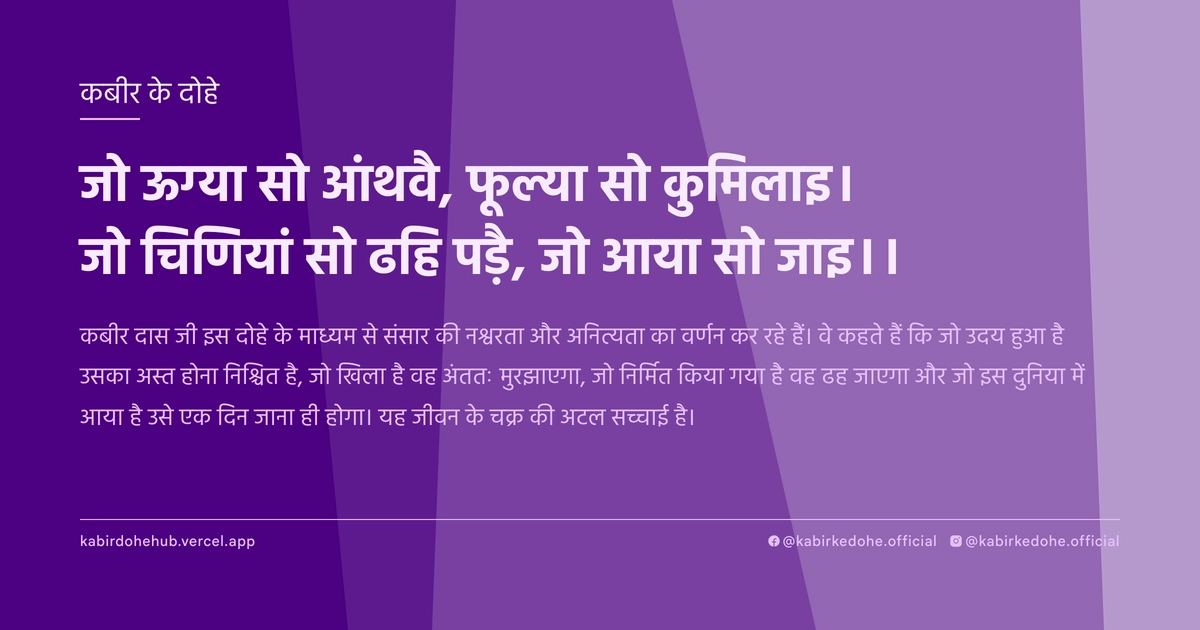
जो ऊग्या सो आंथवै, फूल्या सो कुमिलाइ।
जो चिणियां सो ढहि पड़ै, जो आया सो जाइ।।
Jo ugya so aanthvai, phulya so kumilai. Jo chiniyan so dahi padai, jo aaya so jaai.
इस पृष्ठ पर इस कबीर दोहे का अर्थ (meaning), हिंदी व्याख्या और अंग्रेज़ी अनुवाद, दार्शनिक विश्लेषण और व्यावहारिक जीवन सीख दी गई है। यह दोहा अनित्य (Impermanence) विषय से जुड़ा है — Kabir doha meaning and explanation in Hindi and English.
अर्थ (Meaning):
कबीर दास जी इस दोहे के माध्यम से संसार की नश्वरता और अनित्यता का वर्णन कर रहे हैं। वे कहते हैं कि जो उदय हुआ है उसका अस्त होना निश्चित है, जो खिला है वह अंततः मुरझाएगा, जो निर्मित किया गया है वह ढह जाएगा और जो इस दुनिया में आया है उसे एक दिन जाना ही होगा। यह जीवन के चक्र की अटल सच्चाई है।
Kabir describes the absolute transience and impermanence of the material world. He asserts that whatever has risen must eventually set, whatever has bloomed is destined to wither, whatever has been constructed will inevitably crumble, and whoever has entered this world must eventually depart. It is a stark reminder of the cyclical and fleeting nature of existence.
व्याख्या (Interpretation):
शाब्दिक रूप से यह दोहा प्रकृति के चक्र की बात करता है, लेकिन आध्यात्मिक स्तर पर यह 'माया' के भ्रम पर प्रहार है। 'ऊग्या' और 'फूल्या' केवल भौतिक वस्तुओं के लिए नहीं, बल्कि मानवीय अहंकार, पद, प्रतिष्ठा और शारीरिक यौवन के लिए प्रयुक्त हुए हैं। कबीर यहाँ अद्वैत वेदांत के उस सत्य को रेखांकित कर रहे हैं जहाँ केवल 'ब्रह्म' या 'निर्गुण' ही शाश्वत है। जब हम नश्वर वस्तुओं से जुड़ाव रखते हैं, तो हम दुख के जाल में फंस जाते हैं। यह विरोधाभास है कि मनुष्य उस चीज़ को संजोने की कोशिश करता है जो स्वभाव से ही नष्ट होने वाली है। अंततः, यह दोहा हमें शरीर की पहचान छोड़कर उस अविनाशी आत्मा की ओर मुड़ने का संकेत देता है जो जन्म और मृत्यु के चक्र से परे है।
Literally, the couplet speaks of natural cycles, but spiritually, it is a critique of the illusion of 'Maya'. The terms 'risen' and 'bloomed' refer not just to plants, but to human ego, status, prestige, and physical youth. Kabir highlights the truth of Advaita Vedanta, where only the 'Nirgun' (formless) is eternal. When we attach ourselves to transient objects, we become trapped in suffering. The central paradox is the human tendency to cling to that which is inherently designed to perish. Ultimately, the verse signals a shift from identifying with the perishable body to the imperishable Atman, which exists beyond the cycle of birth and death.
दार्शनिक विश्लेषण (Philosophical Analysis):
कबीर का यह दर्शन उनके समय के कर्मकांडीय और बाहरी आडंबरों के विरुद्ध एक सशक्त प्रतिक्रिया था। जहाँ लोग मंदिरों और मस्जिदों के निर्माण में लगे थे, कबीर ने याद दिलाया कि पत्थर की इमारतें भी ढह जाएंगी। यह विचार सूफीवाद के 'फना' (अहंकार का विनाश) के करीब है, जहाँ साधक को यह समझना होता है कि उसकी व्यक्तिगत पहचान एक बुलबुले की तरह है।
अद्वैत वेदांत के परिप्रेक्ष्य में, यह दोहा 'विवेक' जागृत करने का प्रयास है—नित्य (eternal) और अनित्य (transient) के बीच अंतर करने की क्षमता। कबीर तर्क देते हैं कि यदि सब कुछ नष्ट होने वाला है, तो उस पर गर्व करना या उसके लिए लड़ना मूर्खता है। यह जाति और वर्ग के भेदभाव को भी समाप्त करता है, क्योंकि मृत्यु सबको समान स्तर पर ले आती है।
मनोवैज्ञानिक स्तर पर, यह 'अटैचमेंट' (आसक्ति) के मनोविज्ञान को संबोधित करता है। जब मनुष्य यह स्वीकार कर लेता है कि हानि अपरिहार्य है, तो वह वर्तमान क्षण में अधिक शांति से जी पाता है। यह वैराग्य का मार्ग नहीं, बल्कि सत्य की स्वीकृति का मार्ग है।
कबीर यहाँ किसी डराने वाले मृत्यु-बोध की बात नहीं कर रहे, बल्कि एक मुक्तिदायी बोध की बात कर रहे हैं। जब हम यह जान लेते हैं कि 'जो आया है सो जाइ', तब हम बाहरी दुनिया की भागदौड़ से हटकर आंतरिक यात्रा शुरू करते हैं।
अंततः, यह विश्लेषण हमें बताता है कि कबीर का उद्देश्य निराशा पैदा करना नहीं, बल्कि हमें उस सत्य से परिचित कराना है जो समय और स्थान से परे है। यह भौतिकता के मोह को तोड़कर शुद्ध चेतना में विलीन होने का आह्वान है।
Kabir's philosophy here is a powerful reaction against the ritualism and external pomposity of his era. While people were obsessed with building grand temples and mosques, Kabir reminded them that even stone structures eventually crumble. This thought aligns closely with the Sufi concept of 'Fana' (annihilation of the ego), where the seeker must realize that their individual identity is as fleeting as a bubble.
From the perspective of Advaita Vedanta, this doha is an attempt to awaken 'Viveka'—the discernment between the eternal (Nitya) and the transient (Anitya). Kabir argues that if everything is destined to perish, it is futile to take pride in it or fight over it. This realization effectively erases caste and class distinctions, as death is the ultimate equalizer.
Psychologically, this addresses the mechanics of attachment. When a human accepts that loss is inevitable, they can live in the present moment with greater equanimity. This is not a path of morbid escapism, but a path of accepting reality to transcend suffering.
Kabir is not promoting a frightening obsession with death, but a liberating awareness. By acknowledging that 'whoever came must go', one shifts focus from the external rat race to the internal spiritual journey.
Ultimately, this analysis reveals that Kabir's intent is not to create despair, but to introduce the seeker to the truth that exists beyond time and space. It is a call to break the shackles of materialism and merge with pure consciousness.
मूल संदेश (Core Message):
- नश्वरता को स्वीकार करना ही वास्तविक स्वतंत्रता का पहला कदम है।
- अहंकार उस रेत के महल की तरह है जिसे समय की लहरें मिटा देती हैं।
- सच्चा प्रेम और भक्ति केवल उस तत्व से हो सकती है जो अविनाशी है।
- बाहरी उपलब्धियां केवलtemporary आवरण हैं, आंतरिक शांति ही स्थायी लक्ष्य है।
- मृत्यु अंत नहीं, बल्कि एक पुराने वस्त्र को त्यागकर सत्य में विलीन होना है।
- Accepting impermanence is the first step toward true spiritual liberation.
- The ego is like a sandcastle, destined to be washed away by the tides of time.
- Genuine love and devotion can only be directed toward that which is eternal.
- External achievements are temporary veils; inner peace is the only permanent goal.
- Death is not an end, but the shedding of an old garment to merge with Truth.
व्यावहारिक उदाहरण (Practical Example):
वाराणसी के घाटों पर रहने वाले एक वृद्ध बुनकर, माधव, अपनी पूरी जिंदगी बेहतरीन रेशमी साड़ियाँ बुनने में बिता चुके थे। उन्हें अपनी कला पर बहुत गर्व था और वे मानते थे कि उनकी बनाई साड़ियाँ उनकी अमरता का प्रमाण हैं। वे अक्सर नए बुनकरों को नीचा दिखाते थे, यह दावा करते हुए कि उनकी तकनीक अद्वितीय है और कभी पुरानी नहीं होगी।
एक दिन माधव ने देखा कि उनके द्वारा दशकों पहले बनाई गई एक अत्यंत महंगी साड़ी, जिसे एक अमीर परिवार ने सहेज कर रखा था, समय की मार और नमी के कारण गलकर फटने लगी थी। वह साड़ी, जिसे उन्होंने अपनी 'मास्टरपीस' माना था, अब केवल धागों का एक ढेर थी।
उसी शाम माधव ने कबीर का यह दोहा सुना। उन्हें अचानक महसूस हुआ कि जिस 'अमरता' की तलाश में वे अहंकार से भरे रहे, वह केवल एक भ्रम था। साड़ी का फटना उनके लिए केवल एक कपड़े का नुकसान नहीं, बल्कि उनके अहंकार का टूटना था।
उन्होंने महसूस किया कि वे अपनी पहचान अपनी कला और उसकी प्रशंसा से जोड़ चुके थे, जबकि वह कला स्वयं नश्वर थी। इस बोध ने उन्हें भीतर से शांत कर दिया।
माधव ने अब अपनी कला को 'अहंकार' के बजाय 'सेवा' के रूप में देखना शुरू किया। उन्होंने बिना किसी लालच के गरीब बच्चों को बुनाई सिखाना शुरू कर दिया।
अब वे साड़ियाँ बनाते तो थे, लेकिन इस भावना के साथ कि यह एक दिन नष्ट हो जाएगी, इसलिए वे अब परिणाम से ज्यादा प्रक्रिया का आनंद लेने लगे।
उनके व्यवहार में एक अद्भुत विनम्रता आ गई। वे अब दूसरों की प्रशंसा करते थे क्योंकि उन्हें पता था कि प्रशंसा भी उतनी ही क्षणभंगुर है जितनी कि उनकी साड़ियाँ।
जब माधव का अंतिम समय आया, तो वे डरे हुए नहीं थे। उन्होंने मुस्कुराते हुए कहा, 'जो आया था, वह जा रहा है, और जो शेष रहेगा, वह वह है जो कभी आया ही नहीं था।'
Madhav, an elderly weaver living on the ghats of Varanasi, had spent his entire life weaving the finest silk sarees. He took immense pride in his craft, believing that his creations were a testament to his immortality. He often belittled novice weavers, claiming his technique was peerless and timeless.
One day, Madhav witnessed a masterpiece saree he had woven decades ago—preserved by a wealthy family—disintegrating due to age and moisture. The fabric, which he considered his crowning achievement, was now merely a heap of decaying threads.
That evening, Madhav heard this specific doha of Kabir. Suddenly, he realized that the 'immortality' he sought through his ego was a mere illusion. The tearing of the saree was not just a loss of fabric, but the shattering of his pride.
He recognized that he had tethered his identity to his art and the praise it garnered, while the art itself was inherently transient.
This realization brought a profound inner stillness. Madhav began to view his craft not as a source of ego, but as a form of service.
He started teaching weaving to underprivileged children without expecting anything in return. He continued to weave, but with the conscious understanding that the product would perish, allowing him to enjoy the process more than the result.
A remarkable humility entered his demeanor. He began praising others, knowing that praise is as fleeting as the silk he wove.
When Madhav's final moments arrived, he was not afraid. He smiled and said, 'That which came is now leaving, and what remains is that which never arrived.'
अभ्यास मार्गदर्शन (Practice Guidance):
- दैनिक चिंतन: प्रतिदिन 10 मिनट मौन बैठें और अपने जीवन की उन चीजों की सूची बनाएं जिनसे आप बहुत अधिक जुड़ाव महसूस करते हैं। फिर विचार करें कि यदि वे कल चले जाएं, तो आपकी आत्मा पर क्या प्रभाव पड़ेगा।
- आत्म-पूछताछ जर्नल: लिखें—'मैं कौन हूँ यदि मेरी उपलब्धियां, मेरा शरीर और मेरा नाम मुझसे छीन लिया जाए?' इस शून्य में जो बचता है, उसे पहचानने का प्रयास करें।
- व्यवहार परिवर्तन: जब भी आप किसी भौतिक वस्तु या पद के लिए अत्यधिक उत्तेजित या क्रोधित हों, तो मन में दोहराएं: 'यह भी ढह जाएगा'। इसे अपनी प्रतिक्रिया को संतुलित करने के उपकरण के रूप में उपयोग करें।
- डायग्नोस्टिक चेकलिस्ट: क्या मैं किसी की प्रशंसा से अत्यधिक खुश होता हूँ? क्या मैं नुकसान होने पर गहरे अवसाद में जाता हूँ? क्या मैं अपनी पहचान केवल अपने काम या रिश्तों से जोड़ता हूँ? यदि हाँ, तो आप अभी भी 'माया' के प्रभाव में हैं।
- Daily Contemplation: Sit in silence for 10 minutes daily and list the things in your life you are most attached to. Then contemplate: if these were gone tomorrow, what would remain of your essence?
- Self-Inquiry Journaling: Write and reflect on the prompt: 'Who am I if my achievements, my body, and my name are stripped away?' Try to identify the presence that exists in that void.
- Behavioral Shift: Whenever you feel intense excitement or anger regarding a material object or status, mentally repeat: 'This too shall crumble.' Use this as a tool to balance your emotional reactions.
- Diagnostic Checklist: Do I feel excessive euphoria from praise? Do I fall into deep despair upon loss? Do I define my identity solely through my work or relationships? If yes, you are still operating under the influence of 'Maya'.
चिंतन प्रश्न (Reflection Questions):
- आपकी डिजिटल पहचान (सोशल मीडिया प्रोफाइल) आपके वास्तविक अस्तित्व का कितना हिस्सा है, और यदि वह कल गायब हो जाए, तो आप क्या महसूस करेंगे?
- आप किन गुप्त पूर्वाग्रहों को पकड़े हुए हैं जो आपको यह विश्वास दिलाते हैं कि आप दूसरों से श्रेष्ठ हैं, जबकि अंततः सब समान हैं?
- क्या आपका 'सफल' होने का प्रयास वास्तव में विकास है, या केवल मृत्यु के भय से बचने की एक कोशिश?
- यदि आप आज अपनी पूरी जीवन कहानी एक अजनबी को सुनाएं, तो उसमें से कौन से हिस्से केवल आपके अहंकार को संतुष्ट करने के लिए हैं?
- आप अपनी आंतरिक शांति के लिए बाहरी परिस्थितियों पर कितने निर्भर हैं?
- How much of your digital identity (social media profiles) constitutes your actual existence, and what would you feel if it vanished tomorrow?
- What hidden biases do you hold that convince you of your superiority over others, despite the ultimate equality of all in death?
- Is your pursuit of 'success' truly growth, or is it merely an attempt to escape the fear of mortality?
- If you told your life story to a stranger today, which parts are designed solely to satisfy your ego?
- To what extent is your inner peace dependent on external circumstances?