
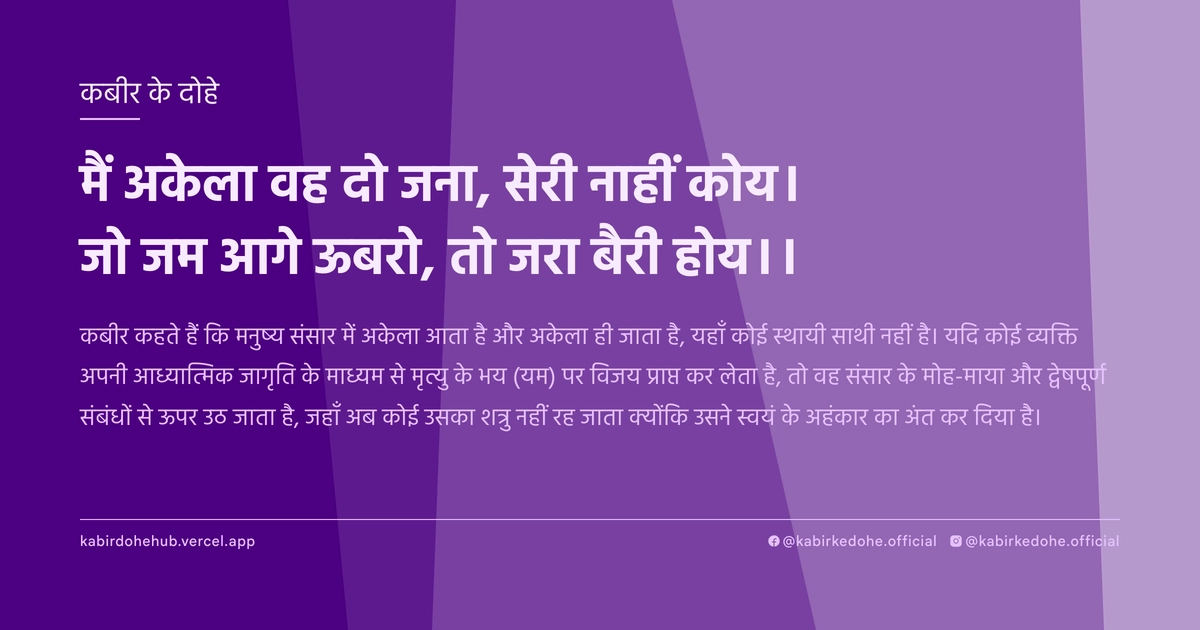
मैं अकेला वह दो जना, सेरी नाहीं कोय।
जो जम आगे ऊबरो, तो जरा बैरी होय।।
Main akela vah do jana, seri naahin koy. Jo jam aage oobaro, to jara bairi hoye.
इस पृष्ठ पर इस कबीर दोहे का अर्थ (meaning), हिंदी व्याख्या और अंग्रेज़ी अनुवाद, दार्शनिक विश्लेषण और व्यावहारिक जीवन सीख दी गई है। यह दोहा मृतुक्यता (Mortality) विषय से जुड़ा है — Kabir doha meaning and explanation in Hindi and English.
अर्थ (Meaning):
कबीर कहते हैं कि मनुष्य संसार में अकेला आता है और अकेला ही जाता है, यहाँ कोई स्थायी साथी नहीं है। यदि कोई व्यक्ति अपनी आध्यात्मिक जागृति के माध्यम से मृत्यु के भय (यम) पर विजय प्राप्त कर लेता है, तो वह संसार के मोह-माया और द्वेषपूर्ण संबंधों से ऊपर उठ जाता है, जहाँ अब कोई उसका शत्रु नहीं रह जाता क्योंकि उसने स्वयं के अहंकार का अंत कर दिया है।
Kabir asserts that a human being enters and exits this world in absolute solitude; no companion is permanent. He suggests that if one can transcend the fear of death (Yama) through spiritual awakening, they rise above the cycle of worldly attachments and animosities. Once the ego is annihilated, the concept of an 'enemy' ceases to exist, as the seeker realizes the unity of all existence.
व्याख्या (Interpretation):
इस दोहे का शाब्दिक अर्थ है कि जन्म और मृत्यु के समय मनुष्य अकेला होता है। यहाँ 'दो जना' का संकेत उस द्वैत (Duality) की ओर है जिसे मनुष्य अपनी पहचान मान लेता है—शरीर और आत्मा। जब तक हम इस द्वैत में फंसे हैं, हम अकेलेपन और भय का अनुभव करते हैं। 'जम' या यम केवल मृत्यु के देवता नहीं हैं, बल्कि उस अज्ञानता के प्रतीक हैं जो हमें बांधे रखती है। निर्गुण भक्ति के अनुसार, जब साधक अपनी आत्मा को ब्रह्म (Brahman) के साथ एकाकार कर लेता है, तो वह माया के पर्दे को हटा देता है। इस अवस्था में, 'बैरी' या शत्रु का अस्तित्व समाप्त हो जाता है क्योंकि द्वैत का अंत हो चुका है। यह अद्वैत वेदांत की उस स्थिति को दर्शाता है जहाँ 'मैं' और 'तू' का भेद मिट जाता है और केवल एक अनंत चेतना शेष रहती है।
Literally, the verse speaks of the solitude of birth and death. However, 'two people' (do jana) metaphorically refers to the duality the human mind creates—the separation between the observer and the observed, or the body and the soul. As long as we reside in this duality, we experience loneliness and the terror of extinction. 'Yama' (the god of death) symbolizes the ultimate ignorance and the grip of Maya (illusion) that binds the soul to the cycle of Samsara. In the context of Nirgun Bhakti, when the seeker merges their individual consciousness with the formless Absolute, the veil of illusion is lifted. At this peak of non-duality (Advaita), the notion of an 'enemy' vanishes because the 'self' that could be opposed has been dissolved. The paradox is that by accepting absolute solitude, one finds the universal kinship of all beings.
दार्शनिक विश्लेषण (Philosophical Analysis):
कबीर का यह दृष्टिकोण उनके समय के सामाजिक और धार्मिक पाखंडों के विरुद्ध एक सशक्त प्रहार है। उन्होंने देखा कि लोग बाहरी कर्मकांडों और जातिगत श्रेष्ठता के माध्यम से मोक्ष पाने की कोशिश कर रहे थे, जबकि वास्तविक मुक्ति आंतरिक रूपांतरण में थी। यह दोहा सूफीवाद के 'फना' (अहंकार का विनाश) और अद्वैत वेदांत के 'अहं ब्रह्मास्मि' के सिद्धांतों का संगम है। कबीर यह समझाते हैं कि जब तक मनुष्य स्वयं को एक अलग इकाई मानता है, वह भय और शत्रुता के चक्र में फंसा रहता है।
यहाँ 'यम' का उल्लेख केवल शारीरिक मृत्यु के लिए नहीं, बल्कि मानसिक मृत्यु के लिए है—अर्थात उस अहंकार की मृत्यु जो हमें दूसरों से अलग करता है। कबीर के अनुसार, ritualism (कर्मकांड) केवल एक बाहरी आवरण है जो आत्मा की वास्तविक पुकार को दबा देता है। वे तर्क देते हैं कि ईश्वर किसी मंदिर या मस्जिद में नहीं, बल्कि उस शून्य में है जहाँ 'मैं' समाप्त हो जाता है।
मनोवैज्ञानिक स्तर पर, यह दोहा अलगाव की भावना (alienation) को संबोधित करता है। मनुष्य समाज में रहकर भी अकेला महसूस करता है क्योंकि उसके संबंध 'अहंकार' पर आधारित होते हैं। जब यह अहंकार टूटता है, तो वह अकेलापन 'एकांत' (Solitude) में बदल जाता है, जो कि एक आनंदमय स्थिति है।
यह शिक्षण हमें सिखाता है कि शत्रुता वास्तव में हमारे अपने भीतर के प्रतिबिंब हैं। यदि हम अपने भीतर के अंधकार को जीत लेते हैं, तो बाहरी दुनिया में कोई शत्रु नहीं बचता। यह एक क्रांतिकारी विचार था जिसने तत्कालीन समाज में व्याप्त ऊंच-नीच और घृणा को चुनौती दी।
अंततः, कबीर यह स्पष्ट करते हैं कि मुक्ति का मार्ग बाहरी सहायता से नहीं, बल्कि स्वयं के भीतर की यात्रा से संभव है। जब साधक यह जान लेता है कि वह स्वयं ही वह अनंत सत्य है, तो वह मृत्यु के भय से मुक्त होकर जीवन के वास्तविक उत्सव में शामिल हो जाता है।
Kabir’s perspective serves as a potent critique of the socio-religious hypocrisy of his era. He observed people seeking liberation through external rituals and caste hierarchies, whereas true liberation lay in internal transmutation. This verse is a synthesis of the Sufi concept of 'Fana' (annihilation of the self) and the Advaita Vedanta realization of 'Aham Brahmasmi' (I am Brahman). Kabir argues that as long as a human perceives themselves as a separate entity, they remain trapped in a cycle of fear and hostility.
The reference to 'Yama' is not merely about physical demise but refers to the 'death of the ego'—the psychological expiration of the false identity that separates us from others. Kabir posits that ritualism is an external shell that muffles the soul's authentic cry. He contends that the Divine is not found in temples or mosques, but in the 'Shunya' (Void) where the 'I' ceases to exist.
Psychologically, this verse addresses the profound sense of alienation. Humans often feel lonely even in crowds because their connections are built on the fragile foundation of ego. When the ego shatters, this loneliness transforms into 'Solitude'—a state of blissful completeness and self-sufficiency.
This teaching reveals that enmity is actually a projection of our own internal shadows. If we conquer the darkness within, no enemy remains in the external world. This was a revolutionary idea that challenged the systemic hatred and caste-based divisions of the 15th century.
Ultimately, Kabir clarifies that the path to liberation is not through external mediation but through an inward journey. Once the seeker realizes they are the Infinite Truth itself, they are liberated from the fear of death and enter the true celebration of existence.
मूल संदेश (Core Message):
- अकेलापन वास्तव में परमात्मा से मिलने का द्वार है।
- अहंकार का अंत ही वास्तविक शत्रुता का अंत है।
- मृत्यु का भय केवल अज्ञानता की एक परत है।
- द्वैत से अद्वैत की ओर बढ़ना ही वास्तविक विकास है।
- संसार के रिश्तों को समझें, पर उनमें खोएं नहीं।
- Loneliness is actually the gateway to Divine union.
- The annihilation of ego is the only end to enmity.
- Fear of death is merely a layer of spiritual ignorance.
- Moving from duality to non-duality is the ultimate evolution.
- Understand worldly bonds, but do not be imprisoned by them.
व्यावहारिक उदाहरण (Practical Example):
वाराणसी के एक पुराने घाट पर रहने वाले एक वृद्ध विधवा, जानकी, का जीवन अत्यंत एकाकी था। उनके परिवार ने उन्हें वर्षों पहले त्याग दिया था और वे केवल मंदिर की सेवा और भिक्षा पर निर्भर थीं। उनके मन में उन लोगों के प्रति गहरी कड़वाहट थी जिन्होंने उन्हें छोड़ा था; वे उन्हें अपना सबसे बड़ा 'बैरी' मानती थीं।
एक दिन उन्होंने एक फकीर को सुना जो कबीर के इसी दोहे का वर्णन कर रहा था। फकीर ने कहा, 'तुम अकेले नहीं हो, तुम उस अनंत के साथ हो, बस तुमने खुद को इन रिश्तों की बेड़ियों में बांध रखा है।' जानकी को पहले यह बात समझ नहीं आई, लेकिन उन्होंने विचार करना शुरू किया कि उनका दुख उनके अपनों की वजह से नहीं, बल्कि इस उम्मीद की वजह से था कि उन्हें प्यार मिलना चाहिए।
धीरे-धीरे उन्होंने महसूस किया कि जिस 'अकेलेपन' से वे डरती थीं, वही उनका सबसे बड़ा अवसर था। उन्होंने अपनी पूरी ऊर्जा स्वयं को जानने में लगा दी। उन्होंने यह स्वीकार किया कि शरीर तो अकेला ही आया था और अंत में अकेला ही जाएगा, फिर इस बीच की अवधि में किसी और से अपेक्षा करना व्यर्थ है।
जैसे-जैसे उनका अहंकार और अपेक्षाएं कम हुईं, उनके भीतर एक असीम शांति छा गई। एक दिन वही बेटा, जिसने उन्हें छोड़ा था, अपनी पत्नी और बच्चों के साथ क्षमा मांगने आया। पुराने समय में जानकी शायद क्रोधित होतीं या रोतीं, लेकिन अब उनके मन में कोई द्वेष नहीं था।
उन्होंने अपने बेटे को देखा और उन्हें महसूस हुआ कि वह व्यक्ति भी उसी माया के जाल में फंसा है जिसमें वे कभी थीं। उन्होंने उसे बिना किसी शर्त के माफ कर दिया, न कि इसलिए कि वह उनका बेटा था, बल्कि इसलिए क्योंकि अब उनके लिए कोई 'शत्रु' बचा ही नहीं था।
जानकी ने महसूस किया कि जब उन्होंने अपनी आंतरिक शून्यता को स्वीकार कर लिया, तो बाहरी दुनिया की रिक्तता उन्हें परेशान करना बंद कर दी। वे अब भीड़ में भी अकेली नहीं थीं, बल्कि सबके साथ एक सूत्र में जुड़ी हुई थीं।
उनकी यह मानसिक स्थिति एक 'कबीर ट्विस्ट' थी—जहाँ उन्होंने अपनी सबसे बड़ी कमजोरी (अकेलापन) को अपनी सबसे बड़ी शक्ति (एकांत) में बदल दिया। अब वे घाट पर आने वाले हर दुखी व्यक्ति के लिए एक मार्गदर्शक बन गईं।
उनकी कहानी यह सिखाती है कि जब हम अपनी मृत्यु और अकेलेपन के सत्य को स्वीकार कर लेते हैं, तो हम वास्तव में जीवन में पहली बार स्वतंत्र होते हैं।
In the ancient ghats of Varanasi lived an elderly widow named Janaki, whose life was defined by profound isolation. Her family had abandoned her years ago, leaving her to survive on temple service and alms. For decades, she harbored a deep, simmering bitterness toward those who had cast her aside, viewing them as her greatest 'enemies.'
One afternoon, she overheard a wandering Sufi reciting this specific Doha of Kabir. The Sufi remarked, 'You are not alone; you are with the Infinite. You have simply shackled yourself to the memory of broken relationships.' Initially, Janaki found this dismissive, but she began to contemplate the nature of her suffering. She realized her pain stemmed not from the abandonment itself, but from the clinging expectation of love.
Slowly, she began to perceive that the 'loneliness' she feared was actually her greatest opportunity. She redirected her energy toward self-inquiry, accepting the stark truth that the body enters and exits the world in solitude. She understood that expecting validation from others was a futile struggle against the nature of existence.
As her ego and expectations dissolved, an immense peace descended upon her. One day, the very son who had abandoned her returned with his family to seek forgiveness. In the past, Janaki would have reacted with rage or theatrical sorrow, but now, there was no residue of hatred in her heart.
Looking at her son, she realized he was merely another prisoner of the same Maya that had once imprisoned her. She forgave him unconditionally—not because of a familial bond, but because the concept of an 'enemy' had ceased to exist within her.
Janaki discovered that by embracing her internal void, the external emptiness of her life stopped haunting her. She was no longer 'alone' in the crowd; she was interconnected with all beings through a single thread of consciousness.
This was her 'Kabir Twist'—the transformation of her greatest vulnerability (loneliness) into her greatest strength (solitude). She became a beacon of solace for every grieving soul who visited the ghats.
Her story illustrates that when we confront the truth of our solitude and the inevitability of death, we are, for the first time, truly liberated to live.
अभ्यास मार्गदर्शन (Practice Guidance):
- दैनिक ध्यान: प्रतिदिन 20 मिनट मौन बैठें और यह अनुभव करें कि आप केवल एक शरीर नहीं, बल्कि एक साक्षी चेतना हैं।
- आत्म-पूछताछ जर्नल: प्रतिदिन लिखें—'आज मैंने किस व्यक्ति को अपना शत्रु माना और उस शत्रुता के पीछे मेरा कौन सा अहंकार (Ego) छिपा था?'
- व्यवहार परिवर्तन: जब भी किसी के प्रति क्रोध आए, स्वयं से कहें, 'हम दोनों अंततः अकेले हैं और एक ही सत्य का हिस्सा हैं।'
- निदान चेकलिस्ट: क्या आप अभी भी दूसरों की स्वीकृति पर निर्भर हैं? क्या मृत्यु का विचार आपको भयभीत करता है? यदि हाँ, तो आप अभी भी द्वैत (Duality) में हैं।
- Daily Meditation: Spend 20 minutes in absolute silence, observing yourself not as a body or a name, but as a witnessing consciousness.
- Self-Inquiry Journaling: Write daily—'Whom did I perceive as an enemy today, and which part of my ego was threatened to create that enmity?'
- Behavioral Shift: Whenever anger arises toward another, remind yourself: 'We are both ultimately solitary travelers and fragments of the same Truth.'
- Diagnostic Checklist: Are you still dependent on external validation? Does the thought of death evoke terror? If yes, you are still operating within the illusion of duality.
चिंतन प्रश्न (Reflection Questions):
- यदि आज आपकी सारी सामाजिक पहचान (नाम, पद, रिश्ता) छीन ली जाए, तो आपके भीतर क्या बचेगा?
- आप जिन लोगों को अपना शत्रु मानते हैं, क्या वे वास्तव में आपके उन गुणों का प्रतिबिंब हैं जिन्हें आप स्वयं में नापसंद करते हैं?
- क्या आपका 'अकेलापन' वास्तव में बाहरी है, या आप भीड़ में रहकर भी अपने अहंकार के कारण अलग-थलग हैं?
- मृत्यु का भय आपको जीवन जीने से रोकता है या आपको अधिक जागरूक बनाता है?
- आपकी डिजिटल पहचान (Social Media Ego) आपके वास्तविक स्वरूप को कितना ढक रही है?
- If all your social identities—name, title, relationships—were stripped away today, what would remain of you?
- Are the people you perceive as enemies actually reflections of the traits you dislike within yourself?
- Is your 'loneliness' truly external, or are you isolated even in crowds due to the walls of your own ego?
- Does the fear of death hinder your living, or does it make you more consciously present?
- To what extent does your digital persona (social media ego) obscure your authentic spiritual essence?