
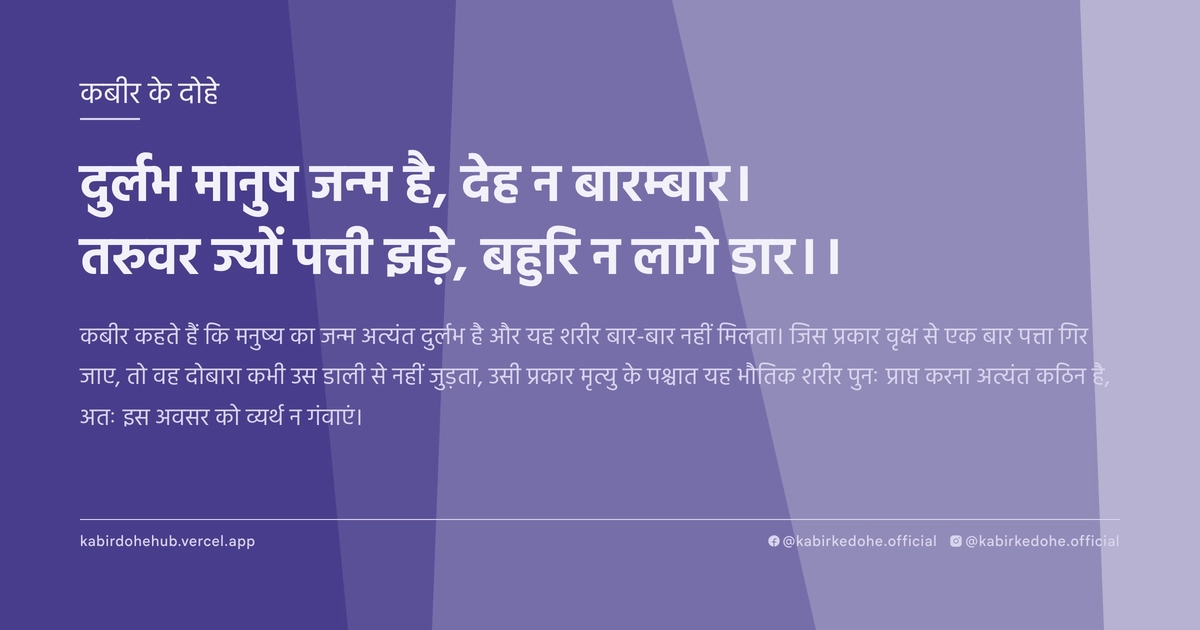
दुर्लभ मानुष जन्म है, देह न बारम्बार।
तरुवर ज्यों पत्ती झड़े, बहुरि न लागे डार।।
Durlabh manush janm hai, deh na baarambaar. Taruvar jyon patti jhare, bahuri na laage daar.
इस पृष्ठ पर इस कबीर दोहे का अर्थ (meaning), हिंदी व्याख्या और अंग्रेज़ी अनुवाद, दार्शनिक विश्लेषण और व्यावहारिक जीवन सीख दी गई है। यह दोहा मृतुक्यता (Mortality) विषय से जुड़ा है — Kabir doha meaning and explanation in Hindi and English.
अर्थ (Meaning):
कबीर कहते हैं कि मनुष्य का जन्म अत्यंत दुर्लभ है और यह शरीर बार-बार नहीं मिलता। जिस प्रकार वृक्ष से एक बार पत्ता गिर जाए, तो वह दोबारा कभी उस डाली से नहीं जुड़ता, उसी प्रकार मृत्यु के पश्चात यह भौतिक शरीर पुनः प्राप्त करना अत्यंत कठिन है, अतः इस अवसर को व्यर्थ न गंवाएं।
Kabir asserts that human birth is an exceedingly rare opportunity and this physical form is not granted repeatedly. Just as a leaf, once fallen from a tree, can never reattach itself to the branch, the human body, once lost to death, is not easily regained; therefore, one must not squander this precious moment of existence.
व्याख्या (Interpretation):
शाब्दिक अर्थ में यह दोहा जीवन की नश्वरता और समय की अपरिवर्तनीयता को दर्शाता है। प्रतीकात्मक रूप से, 'पत्ती' का गिरना आत्मा के भौतिक शरीर से अलग होने और समय के चक्र में विलीन होने का संकेत है। निर्गुण भक्ति के परिप्रेक्ष्य में, यह चेतावनी है कि माया के मोह में पड़कर हम उस 'परम तत्व' को भूल जाते हैं जिसके लिए यह मानव जन्म एक सेतु है। अद्वैत वेदांत के अनुसार, यह शरीर केवल एक माध्यम है जिससे जीव अपनी सीमित पहचान को मिटाकर ब्रह्म में विलीन हो सके। यदि हम इस जन्म में आत्म-साक्षात्कार नहीं करते, तो हम उस अनंत चक्र में फंस जाते हैं जहाँ चेतना जागृत होने का अवसर दुर्लभ हो जाता है। यह विरोधाभास है कि हम अमर होने की इच्छा रखते हैं, परंतु क्षणभंगुर शरीर के सुखों में जीवन व्यतीत करते हैं।
Literally, this couplet highlights the fragility of life and the irreversibility of time. Symbolically, the 'falling leaf' signifies the separation of the soul from the physical vessel and its dissolution into the cosmic cycle. Within the framework of Nirgun Bhakti, this serves as a warning that by succumbing to the illusions of Maya, we forget the 'Ultimate Reality' for which human birth is the essential bridge. According to Advaita Vedanta, the body is merely a vehicle through which the Jiva (individual soul) can transcend its limited identity to merge with Brahman. If self-realization is not achieved in this lifetime, one remains trapped in a cycle where the opportunity for awakening becomes exceedingly rare. It is a profound paradox that while we crave immortality, we spend our fleeting existence chasing transient physical pleasures.
दार्शनिक विश्लेषण (Philosophical Analysis):
कबीर का यह विचार उनके युग के सामाजिक और धार्मिक परिवेश की प्रतिक्रिया है, जहाँ कर्मकांडों और बाहरी आडंबरों ने वास्तविक आध्यात्मिकता को ढक लिया था। वे इस बात पर जोर देते हैं कि मोक्ष किसी मंदिर, मस्जिद या जाति विशेष के अधिकार में नहीं है, बल्कि यह व्यक्तिगत चेतना के जागरण का विषय है। उनका दृष्टिकोण सूफी मत के 'फना' (अहंकार का विनाश) और वेदांत के 'अहं ब्रह्मास्मि' का संगम है। वे तर्क देते हैं कि शरीर केवल एक वस्त्र है, लेकिन इस वस्त्र का उपयोग करके आत्मा को शुद्ध करना अनिवार्य है।
यहाँ 'दुर्लभ' शब्द केवल सांख्यिकीय दुर्लभता नहीं, बल्कि आध्यात्मिक पात्रता की बात करता है। कबीर के अनुसार, मनुष्य वह अवस्था है जहाँ विवेक (Discernment) संभव है। पशु या वनस्पति जगत में चेतना सीमित है, परंतु मनुष्य अपनी इच्छाशक्ति से माया के पर्दे को हटा सकता है। यह विश्लेषण हमें सिखाता है कि समय की कीमत भौतिक धन से नहीं, बल्कि आध्यात्मिक प्रगति से मापी जानी चाहिए।
कबीर ritualism (कर्मकांड) का विरोध करते हुए कहते हैं कि माला जपना या तीर्थ यात्रा करना व्यर्थ है यदि आंतरिक अहंकार जीवित है। यदि शरीर एक अवसर है, तो उस अवसर का उपयोग 'स्व' को जानने में होना चाहिए, न कि सामाजिक प्रतिष्ठा अर्जित करने में। यह मनोवैज्ञानिक रूपांतरण की मांग करता है जहाँ व्यक्ति 'मैं' (Ego) से 'वह' (Universal Consciousness) की ओर बढ़ता है।
सूफीवाद के प्रभाव में, कबीर इस जीवन को एक 'अमानत' या धरोहर मानते हैं जिसे अंततः ईश्वर को लौटाना है। यदि इस धरोहर का सही उपयोग नहीं किया गया, तो आत्मा केवल पश्चाताप के साथ विलीन होगी। यह विचार मृत्यु के भय को एक सकारात्मक प्रेरणा में बदल देता है, जिससे व्यक्ति वर्तमान क्षण में जागरूक हो जाता है।
अंततः, यह दोहा हमें याद दिलाता है कि अस्तित्व का उद्देश्य केवल जीवित रहना नहीं, बल्कि जागृत होना है। जब हम यह समझते हैं कि यह शरीर एक बार का अवसर है, तो हमारी प्राथमिकताएं बदल जाती हैं। हम बाहरी संघर्षों को छोड़कर आंतरिक शांति और सत्य की खोज की ओर अग्रसर होते हैं, जो कि अद्वैत की चरम अवस्था है।
Kabir's insight is a reaction to the socio-religious climate of his era, where ritualism and outward displays of piety had obscured true spirituality. He emphasizes that liberation is not the prerogative of any specific temple, mosque, or caste, but is a matter of individual consciousness awakening. His perspective is a confluence of the Sufi concept of 'Fana' (annihilation of the ego) and the Vedantic realization of 'Aham Brahmasmi' (I am Brahman).
Here, the term 'rare' (durlabh) does not refer to mere statistical scarcity, but to spiritual eligibility. According to Kabir, the human state is the only plane where 'Viveka' (discernment) is possible. While consciousness is limited in the animal or vegetable kingdoms, a human can lift the veil of Maya through sheer willpower. This analysis teaches us that the value of time should be measured not by material wealth, but by spiritual evolution.
Opposing ritualism, Kabir suggests that chanting beads or visiting pilgrimages is futile if the internal ego remains intact. If the body is an opportunity, that opportunity must be used to know the 'Self,' rather than to accumulate social prestige. This demands a psychological transformation where the individual shifts from the 'I' (Ego) toward the 'That' (Universal Consciousness).
Influenced by Sufism, Kabir views this life as an 'Amanat' or a trust that must eventually be returned to the Divine. If this trust is mismanaged, the soul departs with nothing but regret. This perspective transforms the fear of death into a positive catalyst, making the individual acutely aware of the present moment.
Ultimately, this couplet reminds us that the purpose of existence is not merely to survive, but to awaken. When we realize that this body is a one-time opportunity, our priorities shift. We cease our external conflicts and move toward inner peace and the pursuit of Truth, which is the pinnacle of Advaita non-duality.
मूल संदेश (Core Message):
- समय की क्षणभंगुरता को पहचानें, यह एकमात्र सत्य है।
- बाहरी आडंबरों को त्यागकर आंतरिक सत्य की खोज करें।
- अहंकार का विसर्जन ही वास्तविक जीवन की शुरुआत है।
- मानव जन्म एक अवसर है, इसे आदत न बनने दें।
- चेतना का जागरण ही इस दुर्लभ देह का एकमात्र उद्देश्य है।
- Recognize the transience of time; it is the only absolute truth.
- Abandon external rituals to seek the internal truth.
- The dissolution of ego is the true beginning of life.
- Human birth is a rare opportunity; do not let it become a habit.
- The awakening of consciousness is the sole purpose of this rare body.
व्यावहारिक उदाहरण (Practical Example):
वाराणसी के घाटों पर रहने वाले एक वृद्ध विधवा, जानकी, का जीवन केवल दूसरों के लिए भोजन बनाने और मंदिर की सीढ़ियों पर बैठने में बीत रहा था। वह अपने बीते हुए कल के दुखों और खोए हुए रिश्तों के शोक में डूबी रहती थी। वह मानती थी कि उसका जीवन अब केवल मृत्यु की प्रतीक्षा है।
एक दिन उसने कबीर के इस दोहे को सुना। पहले तो उसे लगा कि यह केवल एक और उपदेश है, लेकिन 'पत्ती के गिरने' वाले उदाहरण ने उसे झकझोर दिया। उसने महसूस किया कि वह अपने वर्तमान को भी उसी शोक में जला रही है, जैसे कोई सूखी पत्ती हवा में उड़ रही हो, बिना यह जाने कि वह अभी भी वृक्ष से जुड़ी है।
जानकी ने अपनी दिनचर्या बदली। उसने तय किया कि वह अपने शेष समय का उपयोग उन अनाथ बच्चों को पढ़ाने में करेगी जो घाटों पर भीख मांगते थे। उसने अपनी छोटी सी कुटिया को एक अनौपचारिक पाठशाला बना लिया।
शुरुआत में उसे कठिनाइयाँ हुईं, क्योंकि समाज ने उसे 'अशुभ' मानकर अनदेखा किया था। लेकिन उसने यह सोचना छोड़ दिया कि लोग क्या कहेंगे, क्योंकि उसे अब अपनी 'दुर्लभ' देह की कीमत समझ आ गई थी।
वह अब केवल भोजन नहीं बनाती थी, बल्कि भोजन के साथ-साथ उन बच्चों को जीवन के मूल्यों की कहानियाँ सुनाती थी। उसका दुख अब करुणा में बदल गया था।
एक समय ऐसा आया जब वही लोग जो उसे अनदेखा करते थे, उसके पास अपने बच्चों के संस्कार सीखने आने लगे। जानकी ने पाया कि जब उसने स्वयं को 'मृत' मानना छोड़कर 'जीवित' होने का निर्णय लिया, तो उसका जीवन सार्थक हो गया।
उसकी आँखों में अब शोक नहीं, बल्कि एक गहरी शांति थी। उसने महसूस किया कि शरीर पुराना हो सकता है, लेकिन आत्मा का उद्देश्य हर पल नया हो सकता है।
यह 'कबीर ट्विस्ट' था—मृत्यु के भय से निकलकर जीवन के उत्सव की ओर बढ़ना। जानकी ने यह सिद्ध किया कि दुर्लभ जन्म का मूल्य केवल लंबी आयु में नहीं, बल्कि इस बात में है कि हमने अपने समय को दूसरों के जीवन में प्रकाश लाने के लिए कैसे उपयोग किया।
Janaki, an elderly widow living on the ghats of Varanasi, spent her days cooking for others and sitting on temple steps. She was immersed in the grief of her past and the sorrow of lost relationships, believing her life was now merely a waiting room for death.
One day, she heard this couplet of Kabir. Initially, she dismissed it as another sermon, but the metaphor of the 'falling leaf' shook her. She realized she was burning her present in the fire of grief, like a dry leaf drifting in the wind, forgetting that she was still attached to the tree of life.
Janaki changed her routine. She decided to spend her remaining time teaching orphaned children who begged on the ghats. She turned her small hut into an informal classroom.
Initially, she faced hardships, as society had marginalized her as 'inauspicious.' However, she stopped caring about public perception because she now understood the value of her 'rare' physical existence.
She no longer just cooked food; she shared stories of life values while feeding the children. Her personal sorrow evolved into universal compassion.
Eventually, the very people who had ignored her began visiting her to learn how to instill values in their own children. Janaki discovered that when she stopped viewing herself as 'dead' and decided to be 'alive,' her existence became meaningful.
There was no longer grief in her eyes, only a profound peace. She realized that while the body may age, the soul's purpose can be renewed every single moment.
This was the 'Kabir Twist'—moving from the fear of death to the celebration of life. Janaki proved that the value of a rare birth lies not in longevity, but in how we use our time to bring light into the lives of others.
अभ्यास मार्गदर्शन (Practice Guidance):
- प्रतिदिन 15 मिनट मौन ध्यान करें, जहाँ आप केवल अपनी श्वास पर ध्यान केंद्रित करें और यह अनुभव करें कि यह श्वास ही आपके जीवन का एकमात्र सहारा है।
- एक 'चेतना पत्रिका' (Journal) बनाएँ जिसमें प्रतिदिन लिखें: 'यदि आज मेरा अंतिम दिन होता, तो क्या मैं अपने वर्तमान कार्यों से संतुष्ट होता?'
- व्यवहार परिवर्तन: किसी भी विवाद या क्रोध के क्षण में स्वयं से पूछें, 'क्या यह छोटा सा झगड़ा मेरे इस दुर्लभ जीवन के बहुमूल्य समय के योग्य है?'
- निदान चेकलिस्ट: (1) क्या मैं समय को 'काट' रहा हूँ या 'जी' रहा हूँ? (2) क्या मेरी प्राथमिकताएं बाहरी दिखावे पर हैं या आंतरिक विकास पर? (3) क्या मैं मृत्यु के विचार से डरता हूँ या वह मुझे जागरूक करता है?
- Practice 15 minutes of silent meditation daily, focusing solely on your breath and realizing that this breath is the only support of your existence.
- Maintain a 'Consciousness Journal' with a daily prompt: 'If today were my final day, would I be satisfied with my current actions and state of mind?'
- Behavioral Shift: In moments of conflict or anger, ask yourself, 'Is this trivial argument worth the precious time of my rare human life?'
- Diagnostic Checklist: (1) Am I merely 'passing' time or actively 'living' it? (2) Are my priorities centered on external validation or internal growth? (3) Does the thought of death evoke fear or a sense of urgency to awaken?
चिंतन प्रश्न (Reflection Questions):
- यदि आपका सामाजिक पद और पहचान छीन ली जाए, तो आपके पास ऐसा क्या बचेगा जिसे आप 'शाश्वत' कह सकें?
- आप अपने समय का कितना हिस्सा 'दिखावे की दुनिया' (Digital Ego) को संतुष्ट करने में बिताते हैं, और कितना स्वयं को जानने में?
- क्या आप वास्तव में स्वतंत्र हैं, या आप अपनी पुरानी आदतों और पूर्वाग्रहों के कैदी हैं?
- मृत्यु का विचार आपको डराता है या आपको वर्तमान क्षण में अधिक सचेत बनाता है?
- आपकी कौन सी ऐसी इच्छाएं हैं जो आपके आध्यात्मिक विकास में बाधा बन रही हैं?
- If your social status and identity were stripped away, what would remain that you could call 'eternal'?
- How much of your time is spent satisfying the 'digital ego' of the world, and how much is spent knowing yourself?
- Are you truly free, or are you a prisoner of your own old habits and unconscious biases?
- Does the thought of death frighten you, or does it make you more conscious of the present moment?
- Which of your desires are acting as obstacles to your spiritual evolution?