
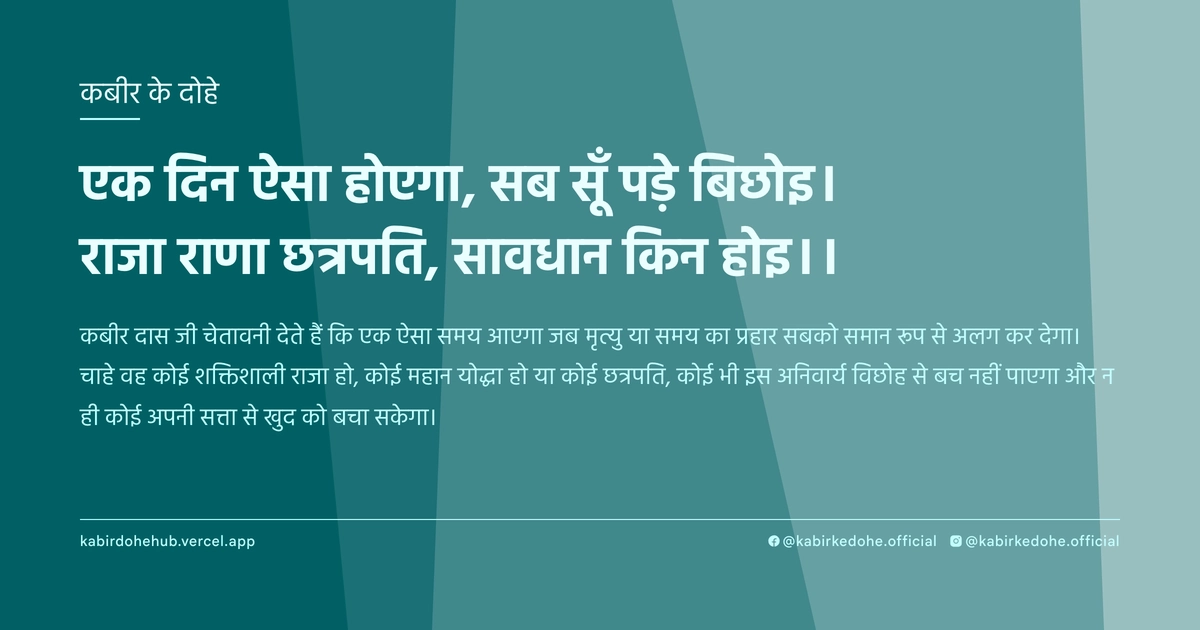
एक दिन ऐसा होएगा, सब सूँ पड़े बिछोइ।
राजा राणा छत्रपति, सावधान किन होइ।।
Ek din aisa hoega, sab soon pade bichhoi. Raja rana chhatrapati, savdhan kin hoi.
इस पृष्ठ पर इस कबीर दोहे का अर्थ (meaning), हिंदी व्याख्या और अंग्रेज़ी अनुवाद, दार्शनिक विश्लेषण और व्यावहारिक जीवन सीख दी गई है। यह दोहा मृतुक्यता (Mortality) विषय से जुड़ा है — Kabir doha meaning and explanation in Hindi and English.
अर्थ (Meaning):
कबीर दास जी चेतावनी देते हैं कि एक ऐसा समय आएगा जब मृत्यु या समय का प्रहार सबको समान रूप से अलग कर देगा। चाहे वह कोई शक्तिशाली राजा हो, कोई महान योद्धा हो या कोई छत्रपति, कोई भी इस अनिवार्य विछोह से बच नहीं पाएगा और न ही कोई अपनी सत्ता से खुद को बचा सकेगा।
Kabir warns of an inevitable day of reckoning—death—that will sever all earthly ties for everyone. Regardless of one's status as a king, a noble, or a sovereign ruler, no amount of power or prestige can provide sanctuary or caution against the absolute certainty of separation from the material world.
व्याख्या (Interpretation):
शाब्दिक अर्थ में यह दोहा मृत्यु की अनिवार्यता की बात करता है, लेकिन आध्यात्मिक स्तर पर यह 'माया' के मोह का विश्लेषण है। 'बिछोइ' केवल शारीरिक मृत्यु नहीं, बल्कि अहंकार के विसर्जन का संकेत है। निर्गुण भक्ति के अनुसार, जब तक मनुष्य स्वयं को पद और प्रतिष्ठा (राजा, राणा) से जोड़ता है, वह सत्य से दूर रहता है। यह दोहा अद्वैत वेदांत के उस सिद्धांत को दर्शाता है जहाँ आत्मा और ब्रह्म एक हैं, और सांसारिक पहचान केवल एक अस्थायी मुखौटा है। यहाँ विरोधाभास यह है कि जिसे हम 'शक्ति' समझते हैं, वही वास्तव में हमारी सबसे बड़ी बाधा है क्योंकि वह हमें नश्वरता के बोध से दूर रखती है। अंततः, यह विछोह ही वह द्वार है जो जीव को उसकी वास्तविक प्रकृति से मिलाता है।
Literally, the couplet speaks of the inevitability of death, but metaphorically, it analyzes the grip of 'Maya' (illusion). 'Bichhoi' (separation) refers not just to physical demise, but to the necessary dissolution of the ego. In the context of Nirgun Bhakti, as long as a human identifies with titles like 'King' or 'Sovereign,' they remain alienated from the Ultimate Truth. This aligns with Advaita Vedanta, where the Atman and Brahman are non-dual, and worldly identities are merely transient masks. The central paradox lies in the fact that the very power we strive to accumulate becomes the primary obstacle to spiritual awakening by blinding us to our own impermanence. Ultimately, this separation from the material is the only gateway to realizing one's eternal nature.
दार्शनिक विश्लेषण (Philosophical Analysis):
कबीर का यह दोहा उस सामाजिक और धार्मिक परिवेश में लिखा गया था जहाँ जाति, वर्ग और सत्ता का अत्यधिक प्रभाव था। कबीर ने जानबूझकर 'राजा' और 'छत्रपति' जैसे शब्दों का प्रयोग किया ताकि वे सत्ता के अहंकार पर प्रहार कर सकें। उनका दर्शन केवल मृत्यु का भय नहीं है, बल्कि 'मृत्यु-बोध' के माध्यम से जीवन को जीने की कला है। वे ritualism (कर्मकांड) का विरोध करते हैं क्योंकि मंदिर, मस्जिद या राजमहल किसी को भी समय के चक्र से नहीं बचा सकते।
दार्शनिक रूप से, यह सूफी मत के 'फना' (अहंकार का विनाश) और वेदांत के 'माया' विलोपन के करीब है। कबीर कहते हैं कि जब तक 'मैं' (अहंकार) जीवित है, तब तक सत्य अदृश्य है। राजा का मुकुट और फकीर की झोली अंत में एक ही मिट्टी में मिल जाते हैं। यह समानता ही वास्तविक न्याय है।
मनोवैज्ञानिक स्तर पर, यह दोहा 'अस्तित्वगत चिंता' (Existential Anxiety) को एक उपकरण के रूप में उपयोग करता है। जब मनुष्य को यह अहसास होता है कि उसकी उपलब्धियाँ शून्य हैं, तब वह बाहरी दुनिया से हटकर आंतरिक खोज की ओर मुड़ता है। यह अहंकार का विखंडन ही आध्यात्मिक रूपांतरण की पहली शर्त है।
कबीर यहाँ यह स्पष्ट करते हैं कि सावधानी (सावधान) केवल बाहरी सुरक्षा उपायों से नहीं आती, बल्कि आंतरिक जागरूकता से आती है। जो व्यक्ति स्वयं को इस नश्वर जगत का स्वामी मानता है, वह सबसे अधिक असुरक्षित है। वास्तविक सुरक्षा केवल उस 'निर्गुण' तत्व में है जो समय और स्थान से परे है।
अंततः, यह दोहा हमें यह सिखाता है कि विछोह केवल दुखद नहीं होता; यह एक आवश्यक शुद्धि है। जब हम सब कुछ खो देते हैं, तभी हम वह पाते हैं जिसे कभी खोया नहीं जा सकता। यह भौतिक रिक्तता ही आध्यात्मिक पूर्णता का आधार बनती है।
This couplet was composed in a socio-religious climate dominated by rigid hierarchies of caste, class, and imperial power. Kabir deliberately invokes titles like 'Raja' and 'Chhatrapati' to dismantle the illusion of superiority. His philosophy is not about the fear of death, but about using 'memento mori' (the remembrance of death) as a tool for authentic living. He rejects ritualism because neither temples, mosques, nor palaces can offer sanctuary from the wheel of time.
Philosophically, this resonates with the Sufi concept of 'Fana' (annihilation of the self) and the Vedantic dissolution of 'Maya.' Kabir posits that as long as the 'I' (the ego) persists, the Truth remains hidden. The crown of a king and the bowl of a beggar eventually merge into the same earth; this absolute equality is the only true justice in the universe.
Psychologically, the poem utilizes existential anxiety as a catalyst for growth. When a human realizes that their worldly achievements are void, they are forced to pivot from external validation to internal inquiry. The fragmentation of the ego is the prerequisite for spiritual metamorphosis.
Kabir clarifies that 'caution' (savdhan) does not come from external security measures but from internal consciousness. The person who believes they own the world is the most vulnerable. True security exists only in the 'Nirgun' (formless) element that transcends time and space.
Ultimately, this teaching suggests that separation is not merely tragic; it is a necessary purification. Only when we lose everything do we find that which can never be lost. This material void becomes the foundation for spiritual plenitude.
मूल संदेश (Core Message):
- अहंकार एक ऐसा पर्दा है जो हमें सत्य से दूर रखता है।
- मृत्यु केवल शरीर का अंत है, आत्मा का नहीं।
- सच्ची सुरक्षा बाहरी सत्ता में नहीं, आंतरिक शांति में है।
- समय सबसे बड़ा न्यायधीश है, जो सबको समान कर देता है।
- नश्वरता का बोध ही वास्तविक जागृति का मार्ग है।
- Ego is the veil that separates the seeker from the Truth.
- Death is the end of the form, not the essence of the soul.
- True security lies in inner stillness, not in external power.
- Time is the ultimate equalizer, reducing all hierarchies to zero.
- The realization of impermanence is the only path to awakening.
व्यावहारिक उदाहरण (Practical Example):
एक समय की बात है, वाराणसी के घाटों पर एक वृद्ध विधवा रहती थी, जिसका नाम जानकी था। जानकी का जीवन अत्यंत कठिन था, लेकिन वह शहर के सबसे धनी व्यापारियों और पंडितों के बीच अपनी सादगी के लिए जानी जाती थी। वह अक्सर देखती थी कि कैसे लोग अपने धन और प्रभाव का प्रदर्शन करते थे, यह मानकर कि उनकी संपत्ति उन्हें जीवन के दुखों और मृत्यु के भय से बचा लेगी।
उसी शहर में एक अत्यंत अहंकारी सेठ था, जिसने अपने लिए एक विशाल हवेली बनाई थी और वह खुद को शहर का अनौपचारिक राजा मानता था। वह जानकी को तुच्छ समझता था और अक्सर उसका उपहास करता था कि उसके पास न तो कोई आश्रय है और न ही कोई उत्तराधिकारी।
एक दिन शहर में एक भीषण महामारी फैली। देखते ही देखते, वह हवेली जो कभी शक्ति का प्रतीक थी, एक अस्पताल और फिर एक श्मशान जैसी बन गई। सेठ का धन, उसके सेवक और उसकी प्रतिष्ठा उसे उस बीमारी से बचाने में असमर्थ रहे। वह अपनी रेशमी चादरों में लिपटा हुआ भी कांप रहा था, यह महसूस करते हुए कि उसकी सारी सत्ता अब व्यर्थ है।
दूसरी ओर, जानकी, जिसके पास खोने के लिए कुछ नहीं था, शांति से दूसरों की सेवा कर रही थी। उसने देखा कि कैसे वह 'राजा' जैसा सेठ अब एक लाचार मनुष्य बन गया था। जब सेठ ने अंतिम सांसें ले रही स्थिति में जानकी को देखा, तो उसने महसूस किया कि जिस 'विछोह' से वह डर रहा था, वह तो उसके अहंकार के साथ पहले ही शुरू हो चुका था।
जानकी ने उसके पास जाकर धीरे से कहा, 'सेठ जी, जिस मुकुट को आप पहनकर गर्व करते थे, वह तो मिट्टी का था। अब केवल वह बचेगा जो आपने दूसरों को दिया है।'
यह सुनकर सेठ के भीतर एक गहरा परिवर्तन आया। उसने अपने जीवन के अंतिम क्षणों में अपनी सारी संपत्ति उन गरीबों के नाम कर दी जिन्हें उसने कभी अनदेखा किया था।
उसका अहंकार पूरी तरह टूट चुका था। उसने महसूस किया कि वह अब तक एक भ्रम में जी रहा था कि वह अपनी सत्ता से समय को नियंत्रित कर सकता है।
यह 'कबीर ट्विस्ट' था—जब मृत्यु का सामना हुआ, तब उसे समझ आया कि वास्तविक 'सावधानी' धन संचय में नहीं, बल्कि प्रेम और करुणा में थी।
सेठ की मृत्यु के बाद, शहर के लोग उसे उसके धन के लिए नहीं, बल्कि उसके अंतिम समय के उदारतापूर्ण बदलाव के लिए याद करने लगे।
जानकी की शांति और सेठ का पतन इस सत्य को प्रमाणित करता था कि समय के सामने सब समान हैं, और केवल निस्वार्थता ही स्थायी है।
Once, on the ghats of Varanasi, lived an elderly widow named Janaki. Her life was fraught with hardship, yet she was respected among the city's wealthiest merchants and priests for her profound simplicity. She often observed how people flaunted their wealth and influence, believing their assets could shield them from the sorrows of life and the terror of death.
In the same city lived an arrogant merchant who had built a colossal mansion and considered himself the unofficial king of the town. He viewed Janaki with contempt, often mocking her for having neither a permanent shelter nor an heir.
One day, a devastating plague swept through the city. In a short time, the mansion that was once a symbol of power became a makeshift hospital and then resembled a graveyard. The merchant's wealth, his servants, and his prestige were powerless to protect him from the contagion. Even wrapped in silk sheets, he trembled, realizing his entire empire was now useless.
Meanwhile, Janaki, who had nothing to lose, spent her days calmly serving others. She witnessed how the 'king-like' merchant had been reduced to a helpless man. When the merchant saw Janaki while taking his final breaths, he realized that the 'separation' he feared had already begun with the collapse of his ego.
Janaki leaned in and whispered, 'Seth ji, the crown you wore with such pride was made of clay. Now, only that which you gave to others will remain.'
Upon hearing this, a profound transformation occurred within the merchant. In his final moments, he bequeathed all his remaining assets to the poor he had once ignored.
His ego was completely shattered. He realized he had lived in the delusion that he could control time with his authority.
This was the 'Kabir Twist'—confronted by death, he understood that true 'caution' lay not in accumulating wealth, but in practicing love and compassion.
After his passing, the townspeople remembered him not for his riches, but for the selfless transformation of his final hours.
Janaki's peace and the merchant's fall proved the truth that all are equal before time, and only selflessness is permanent.
अभ्यास मार्गदर्शन (Practice Guidance):
- दैनिक चिंतन: प्रतिदिन 15 मिनट मौन रहकर यह विचार करें कि आपकी वर्तमान पहचान (पद, नाम, संपत्ति) अस्थायी है।
- आत्म-पूछताछ जर्नल: लिखें कि यदि आज आपकी सारी बाहरी उपलब्धियाँ छीन ली जाएँ, तो आपके भीतर क्या बचेगा?
- व्यवहार परिवर्तन: किसी ऐसे व्यक्ति की सेवा करें जिसे आप सामाजिक स्तर पर अपने से 'नीचे' समझते हैं, ताकि आपके भीतर का 'राजा' मर सके।
- डायग्नोस्टिक चेकलिस्ट: क्या आप अपनी उपलब्धियों पर गर्व महसूस करते हैं? क्या आप मृत्यु के विचार से घबराते हैं? यदि हाँ, तो आप अभी भी माया के प्रभाव में हैं।
- Daily Contemplation: Spend 15 minutes in silence reflecting on the transience of your current identity (status, name, possessions).
- Self-Inquiry Journaling: Write about what would remain of your essence if all your external achievements were stripped away today.
- Behavioral Shift: Serve someone whom you socially perceive as 'below' you, specifically to dismantle the internal 'sovereign' ego.
- Diagnostic Checklist: Do you feel a surge of pride in your achievements? Do you feel acute anxiety at the thought of death? If yes, you are still under the influence of Maya.
चिंतन प्रश्न (Reflection Questions):
- आपका 'डिजिटल अहंकार' (सोशल मीडिया प्रोफाइल) आपकी वास्तविक पहचान को कैसे ढक रहा है?
- आप अपनी सत्ता या प्रभाव का उपयोग दूसरों को नियंत्रित करने के लिए करते हैं या उन्हें मुक्त करने के लिए?
- यदि आपकी मृत्यु की तिथि निश्चित हो जाए, तो आप आज अपने रिश्तों को कैसे बदलेंगे?
- वह कौन सा 'मुकुट' है जिसे आपने मानसिक रूप से पहन रखा है और जिसे उतारने में आपको डर लगता है?
- क्या आपकी करुणा केवल उन लोगों के लिए है जो आपकी मदद कर सकते हैं, या वह वास्तव में सार्वभौमिक है?
- How does your 'digital ego' (social media persona) obscure your authentic self?
- Do you use your influence to control others or to liberate them?
- If your date of death were fixed, how would you transform your relationships today?
- What is the 'crown' you are mentally wearing that you are too afraid to take off?
- Is your compassion reserved for those who can benefit you, or is it truly universal?