
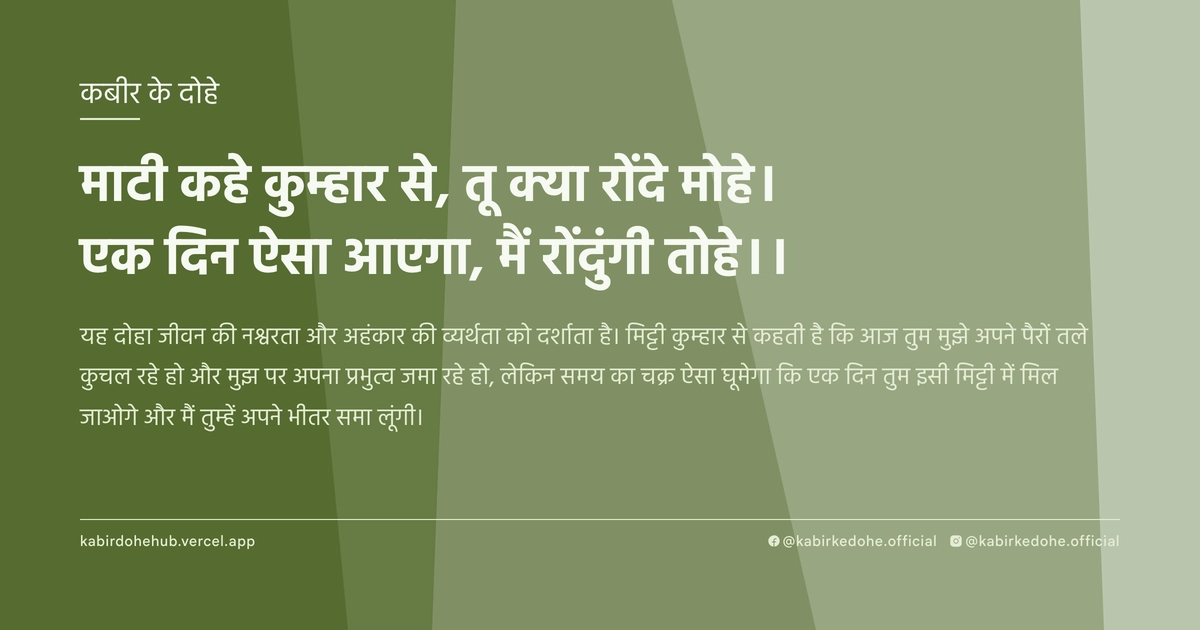
माटी कहे कुम्हार से, तू क्या रोंदे मोहे।
एक दिन ऐसा आएगा, मैं रोंदुंगी तोहे।।
Maati kahe kumhaar se, tu kya ronde mohe. Ek din aisa aayega, main ronduungi tohe.
इस पृष्ठ पर इस कबीर दोहे का अर्थ (meaning), हिंदी व्याख्या और अंग्रेज़ी अनुवाद, दार्शनिक विश्लेषण और व्यावहारिक जीवन सीख दी गई है। यह दोहा मृतुक्यता (Mortality) विषय से जुड़ा है — Kabir doha meaning and explanation in Hindi and English.
अर्थ (Meaning):
यह दोहा जीवन की नश्वरता और अहंकार की व्यर्थता को दर्शाता है। मिट्टी कुम्हार से कहती है कि आज तुम मुझे अपने पैरों तले कुचल रहे हो और मुझ पर अपना प्रभुत्व जमा रहे हो, लेकिन समय का चक्र ऐसा घूमेगा कि एक दिन तुम इसी मिट्टी में मिल जाओगे और मैं तुम्हें अपने भीतर समा लूंगी।
This couplet illuminates the transience of human existence and the futility of ego. The earth speaks to the potter, questioning his arrogance in trampling the soil, reminding him that the wheel of time inevitably turns; a day shall come when the potter himself will return to the earth, and the soil will envelop him in an eternal embrace.
व्याख्या (Interpretation):
शाब्दिक अर्थ में यह एक कुम्हार और मिट्टी के बीच का संवाद है, परंतु आध्यात्मिक स्तर पर यह 'माया' और 'अहंकार' पर प्रहार है। यहाँ मिट्टी प्रकृति और अंतिम सत्य (मृत्यु) का प्रतीक है, जबकि कुम्हार उस मानव अहंकार का प्रतिनिधित्व करता है जो स्वयं को कर्ता और स्वामी मानता है। यह दोहा निर्गुण भक्ति के उस सिद्धांत को पुष्ट करता है जहाँ शरीर को केवल पंचतत्वों का एक अस्थायी मेल माना गया है। अद्वैत वेदांत के अनुसार, जब व्यक्ति यह समझ लेता है कि वह केवल हाड़-मांस का पुतला नहीं बल्कि उस अनंत ब्रह्म का अंश है, तब उसका अहंकार नष्ट होता है। यह विरोधाभास है कि जिस मिट्टी को हम तुच्छ समझकर पैरों तले रौंदते हैं, वही अंततः हमारा एकमात्र आश्रय बनती है। यह आत्मा और परमात्मा के मिलन की पूर्वपीठिका है, जहाँ भौतिक पहचान पूरी तरह मिट जाती है।
Literally, this is a dialogue between the clay and the potter, yet on a spiritual plane, it is a searing critique of 'Maya' (illusion) and the ego. The soil symbolizes Nature and the ultimate truth of mortality, while the potter represents the human ego that perceives itself as the sole doer and master. This verse reinforces the Nirgun Bhakti principle that the physical body is merely a transient assembly of five elements. According to Advaita Vedanta, when an individual realizes they are not merely a vessel of flesh and bone but a spark of the infinite Brahman, the ego dissolves. There is a profound paradox here: the very earth we deem insignificant and trample underfoot eventually becomes our only sanctuary. It serves as a prelude to the union of Atman and Paramatman, where all material identities are utterly erased.
दार्शनिक विश्लेषण (Philosophical Analysis):
कबीर का यह दोहा उस सामाजिक और धार्मिक परिवेश में रचा गया था जहाँ कर्मकांड और जातिगत श्रेष्ठता का बोलबाला था। कबीर ने इस सरल रूपक के माध्यम से यह संदेश दिया कि जन्म और जाति का अहंकार निरर्थक है क्योंकि मृत्यु सबको एक ही स्तर पर ले आती है। यह विचार सूफीवाद के 'फना' (अहंकार का विनाश) के सिद्धांत से मेल खाता है, जहाँ साधक को अपनी व्यक्तिगत पहचान मिटाकर ईश्वर में विलीन होना होता है।
दार्शनिक रूप से, यह दोहा 'प्रकृति' की सर्वोच्चता को स्थापित करता है। मनुष्य अक्सर प्रकृति को जीतने या उसे नियंत्रित करने का प्रयास करता है, लेकिन कबीर याद दिलाते हैं कि मनुष्य प्रकृति का स्वामी नहीं, बल्कि उसका एक छोटा सा हिस्सा है। यह प्रकृति के साथ सामंजस्य बिठाने की पुकार है, न कि उस पर विजय पाने की।
अद्वैत वेदांत के परिप्रेक्ष्य में, कुम्हार का अहंकार 'अविद्या' (अज्ञानता) है। वह भूल गया है कि वह और मिट्टी अलग नहीं हैं। जब तक वह स्वयं को अलग मानता है, वह संघर्ष करता है; जिस क्षण वह अपनी नश्वरता को स्वीकार करता है, वह उस परम सत्य के करीब पहुँच जाता है जो जन्म और मृत्यु से परे है।
कबीर यहाँ ritualism या बाहरी आडंबरों का विरोध करते हैं। वे कहते हैं कि मंदिर, मस्जिद या ऊँचे पदों की खोज व्यर्थ है यदि व्यक्ति अपनी आंतरिक नश्वरता को नहीं पहचानता। असली ज्ञान वह है जो मनुष्य को विनम्र बनाए और उसे यह अहसास कराए कि वह शून्य से आया है और शून्य में ही मिल जाएगा।
मनोवैज्ञानिक स्तर पर, यह दोहा मृत्यु-चेतना (Memento Mori) को जागृत करता है। जब हम अपनी मृत्यु को स्वीकार करते हैं, तो हमारे जीवन के छोटे-छोटे संघर्ष, ईर्ष्या और क्रोध समाप्त हो जाते हैं। यह अहंकार के विसर्जन की प्रक्रिया है, जो आध्यात्मिक जागृति के लिए अनिवार्य है।
Kabir composed this verse within a socio-religious milieu dominated by rigid rituals and caste-based superiority. Through this simple metaphor, he asserts that the arrogance of birth and caste is futile, as death is the great equalizer that brings all to the same level. This aligns with the Sufi concept of 'Fana' (annihilation of the self), where the seeker must dissolve their individual identity to merge with the Divine.
Philosophically, the couplet establishes the supremacy of Nature. Humans often strive to conquer or control the natural world, but Kabir reminds us that man is not the master of nature, but a minuscule part of it. It is a call for harmony with the cosmos rather than a quest for dominance over it.
From the perspective of Advaita Vedanta, the potter's arrogance is 'Avidya' (ignorance). He has forgotten that he and the clay are not distinct. As long as he perceives separation, he exists in conflict; the moment he accepts his transience, he edges closer to the ultimate truth that transcends birth and death.
Kabir here rejects ritualism and outward ostentation. He suggests that the pursuit of temples, mosques, or high social status is meaningless if one does not recognize their internal mortality. True knowledge is that which renders a person humble and makes them realize they emerged from the void and shall return to it.
Psychologically, this verse awakens 'Memento Mori'—the consciousness of death. When we truly accept our mortality, the petty conflicts, jealousies, and anger of daily life evaporate. This is the process of ego-dissolution, which is an indispensable prerequisite for spiritual awakening.
मूल संदेश (Core Message):
- अहंकार एक भ्रम है जो समय की धूल में मिट जाता है।
- मृत्यु ही अंतिम सत्य है, जो सभी भेदों को समाप्त करती है।
- विनम्रता ही वह सेतु है जो मनुष्य को परमात्मा से जोड़ता है।
- प्रकृति का सम्मान करें, क्योंकि हम उसी का एक अंश हैं।
- बाहरी उपलब्धियों से अधिक आंतरिक विसर्जन महत्वपूर्ण है।
- Ego is a mirage that vanishes in the dust of time.
- Death is the ultimate truth that erases all distinctions.
- Humility is the bridge that connects the human to the Divine.
- Revere Nature, for we are but a fragment of its whole.
- Internal dissolution is far more vital than external achievement.
व्यावहारिक उदाहरण (Practical Example):
वाराणसी के एक पुराने घाट पर रामदीन नाम का एक वृद्ध कुम्हार रहता था। रामदीन अपने काम में निपुण था, लेकिन उसे अपनी कला और अपनी जाति पर बहुत अहंकार था। वह अक्सर अपने सहायकों और आसपास के गरीब मजदूरों को तुच्छ समझता था और उन्हें नीची नजर से देखता था। वह मानता था कि उसके हाथों में वह जादू है जो मिट्टी को सोना बना सकता है, और इस कारण वह स्वयं को दूसरों से श्रेष्ठ समझने लगा था।
एक दिन, रामदीन ने एक बहुत ही सुंदर और विशाल मिट्टी का कलश बनाया। उसने उस कलश को अपनी श्रेष्ठता का प्रतीक माना और उसे शहर के सबसे बड़े मेले में प्रदर्शित करने का निर्णय लिया। वह गर्व से चलता था और रास्ते में आने वाले हर व्यक्ति को यह महसूस कराता था कि वह एक महान कलाकार है और बाकी सब साधारण हैं।
मेले के दौरान, अचानक एक भीषण तूफान आया और भारी बारिश शुरू हो गई। रामदीन का वह विशाल कलश, जिस पर उसे इतना गर्व था, बारिश की बूंदों के संपर्क में आते ही धीरे-धीरे गलने लगा। देखते ही देखते, वह सुंदर आकृति वापस बेजान मिट्टी के ढेर में बदल गई। रामदीन उसे बचाने की कोशिश करता रहा, लेकिन वह मिट्टी फिर से मिट्टी बन चुकी थी।
रामदीन स्तब्ध रह गया। उसने देखा कि जिस मिट्टी को वह अपने पैरों से रौंदकर आकार देता था, उसी मिट्टी ने उसके अहंकार के प्रतीक को एक पल में मिटा दिया। उसे अचानक कबीर का वह दोहा याद आया जिसमें मिट्टी कुम्हार को चेतावनी देती है। उसे अहसास हुआ कि उसकी कला, उसकी जाति और उसका अहंकार सब उस मिट्टी के सामने तुच्छ हैं।
उस रात रामदीन सो नहीं सका। उसने महसूस किया कि वह जिस मिट्टी को नियंत्रित करने का दावा करता था, वास्तव में वह मिट्टी ही उसका अंतिम सत्य है। उसने अपनी पूरी जिंदगी दूसरों को छोटा दिखाकर बिताई थी, जबकि वह स्वयं भी उसी मिट्टी का एक पुतला था जिसे एक दिन वापस मिट्टी में मिलना था।
अगली सुबह, रामदीन का व्यवहार पूरी तरह बदल गया। उसने अपने सहायकों को बुलाया और उनसे क्षमा मांगी। उसने अब मिट्टी को केवल एक वस्तु नहीं, बल्कि एक गुरु के रूप में देखना शुरू किया जो उसे विनम्रता सिखा रही थी।
उसने अपने घर के बाहर एक छोटा सा साझा केंद्र बनाया जहाँ वह बिना किसी भेदभाव के गरीब बच्चों को मिट्टी की कला सिखाने लगा। अब वह खुद को 'स्वामी' नहीं, बल्कि मिट्टी का एक 'सेवक' मानने लगा था।
रामदीन के जीवन में अब शांति थी। उसने जान लिया था कि असली सृजन वह नहीं है जो मिट्टी से बर्तन बनाए, बल्कि वह है जो मिट्टी की तरह विनम्र होकर अहंकार को गला दे।
On an ancient ghat in Varanasi lived an elderly potter named Ramdin. Ramdin was masterful in his craft, but he possessed a towering arrogance regarding his skill and his caste. He often looked down upon his assistants and the poor laborers around him, treating them as insignificant. He believed that his hands possessed a magic that could turn clay into gold, and this conviction fueled a sense of superiority over others.
One day, Ramdin crafted a magnificent and massive clay urn. He viewed this urn as a symbol of his supremacy and decided to exhibit it at the city's largest fair. He walked with a haughty stride, ensuring everyone he encountered felt that he was a grand artist while they were merely ordinary.
During the fair, a sudden, violent storm erupted, and torrential rain began to fall. The massive urn, the very object of his pride, began to dissolve upon contact with the raindrops. In a matter of moments, the beautiful form reverted into a shapeless heap of mud. Ramdin struggled to save it, but the clay had returned to its primal state.
Ramdin stood stunned. He realized that the very soil he had trampled and manipulated to create his masterpiece had erased the symbol of his ego in an instant. Suddenly, Kabir's couplet, where the earth warns the potter, echoed in his mind. He understood that his art, his caste, and his pride were all trivial before the earth.
Ramdin could not sleep that night. He realized that the clay he claimed to control was, in fact, his own ultimate truth. He had spent his entire life belittling others, forgetting that he himself was but a puppet of clay destined to return to the earth.
The following morning, Ramdin's demeanor had completely transformed. He summoned his assistants and sincerely asked for their forgiveness. He ceased to view the clay as a mere object and began to see it as a teacher imparting the lesson of humility.
He established a small communal center outside his home where he taught the art of pottery to underprivileged children without any discrimination. He no longer identified as a 'master' but as a 'servant' of the earth.
Peace finally descended upon Ramdin's life. He had learned that true creation is not about shaping clay into vessels, but about becoming as humble as clay to dissolve the ego.
अभ्यास मार्गदर्शन (Practice Guidance):
- प्रतिदिन 15 मिनट के लिए 'शवासन' में लेटें और कल्पना करें कि आपका शरीर धीरे-धीरे मिट्टी में विलीन हो रहा है, जिससे आपका अहंकार समाप्त हो रहा है।
- एक डायरी लिखें जिसमें आप उन तीन स्थितियों का वर्णन करें जहाँ आपने हाल ही में अपनी श्रेष्ठता का प्रदर्शन किया और विचार करें कि वह भावना कितनी अस्थायी थी।
- सप्ताह में एक बार ऐसी सेवा करें जिसमें आपको शारीरिक रूप से मिट्टी या जमीन के संपर्क में आना पड़े (जैसे बागवानी या सफाई), ताकि आप अपनी नश्वरता का अनुभव कर सकें।
- निदान चेकलिस्ट: क्या मैं दूसरों की गलतियों पर उपहास करता हूँ? क्या मैं अपनी उपलब्धियों का श्रेय केवल स्वयं को देता हूँ? यदि हाँ, तो आप अभी भी 'कुम्हार' के अहंकार में हैं।
- Practice 'Shavasana' for 15 minutes daily, visualizing your body slowly merging back into the earth, symbolizing the dissolution of the ego.
- Maintain a journal describing three instances where you recently exhibited a sense of superiority, reflecting on the transience of those feelings.
- Engage in a weekly act of service that brings you into physical contact with the earth (such as gardening or cleaning), grounding yourself in your own mortality.
- Diagnostic Checklist: Do I mock the mistakes of others? Do I attribute all my achievements solely to myself? If yes, you are still trapped in the 'Potter's' ego.
चिंतन प्रश्न (Reflection Questions):
- यदि आज मेरी सारी सामाजिक पहचान और पद छीन लिए जाएं, तो मेरे भीतर क्या बचेगा?
- मैं किन लोगों को अनजाने में 'मिट्टी' की तरह तुच्छ समझता हूँ, और क्यों?
- मेरी डिजिटल पहचान (सोशल मीडिया) मेरे वास्तविक और नश्वर स्वरूप को कितना ढक रही है?
- क्या मेरा धर्म या मेरी जाति मुझे वास्तव में श्रेष्ठ बनाती है, या यह केवल एक मानसिक सुरक्षा कवच है?
- मृत्यु का विचार मुझे डराता है या मुझे वर्तमान क्षण में अधिक प्रेमपूर्वक जीने के लिए प्रेरित करता है?
- If all my social identities and titles were stripped away today, what would remain within me?
- Whom do I unconsciously treat as 'insignificant clay,' and what is the root of that bias?
- To what extent does my digital persona mask my actual, mortal self?
- Does my religion or caste truly make me superior, or is it merely a psychological security blanket?
- Does the thought of death terrify me, or does it inspire me to live more lovingly in the present moment?