
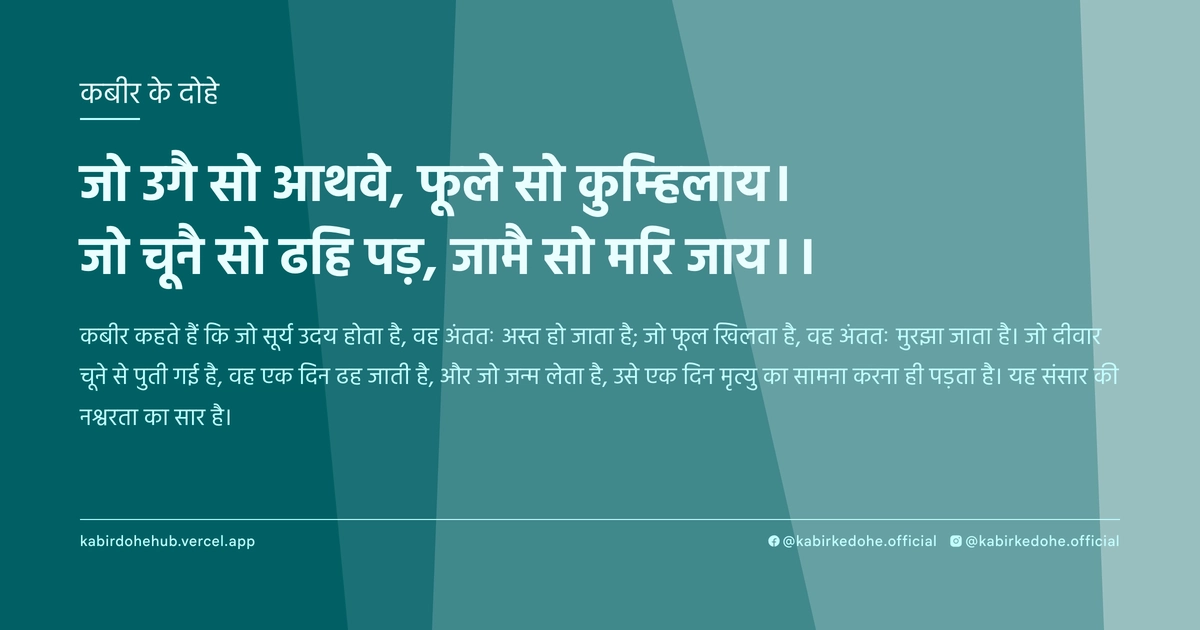
जो उगै सो आथवे, फूले सो कुम्हिलाय।
जो चूनै सो ढहि पड़, जामै सो मरि जाय।।
Jo ugai so aathve, phoole so kumhilay. Jo choonai so dahi pad, jamai so mari jaaye.
इस पृष्ठ पर इस कबीर दोहे का अर्थ (meaning), हिंदी व्याख्या और अंग्रेज़ी अनुवाद, दार्शनिक विश्लेषण और व्यावहारिक जीवन सीख दी गई है। यह दोहा अनित्य (Impermanence) विषय से जुड़ा है — Kabir doha meaning and explanation in Hindi and English.
अर्थ (Meaning):
कबीर कहते हैं कि जो सूर्य उदय होता है, वह अंततः अस्त हो जाता है; जो फूल खिलता है, वह अंततः मुरझा जाता है। जो दीवार चूने से पुती गई है, वह एक दिन ढह जाती है, और जो जन्म लेता है, उसे एक दिन मृत्यु का सामना करना ही पड़ता है। यह संसार की नश्वरता का सार है।
Kabir proclaims that the sun which rises must inevitably set, and the flower that blooms is destined to wither. The wall coated in lime will eventually crumble, and every being born into this world must eventually face death. It is a stark distillation of the transient nature of all material existence.
व्याख्या (Interpretation):
यह दोहा संसार की अनित्यता का एक शक्तिशाली चित्रण है। कबीर यहाँ भौतिक जगत के चक्र—उत्पत्ति, विकास और विनाश—को रेखांकित करते हैं। 'उगना', 'फूलना' और 'चुनना' मानवीय महत्वाकांक्षा और भौतिक सौंदर्य के प्रतीक हैं, जबकि 'अस्त होना', 'मुरझाना' और 'ढहना' वास्तविकता की अंतिम परिणति हैं। यह निरगुण भक्ति का मूल है, जहाँ साधक को यह समझाया जाता है कि माया का यह खेल केवल एक भ्रम है। जब व्यक्ति यह समझ लेता है कि शरीर और संसार नश्वर हैं, तब वह उस अविनाशी 'अविनाशी' (ब्रह्म) की खोज की ओर बढ़ता है। यह द्वैत से अद्वैत की ओर ले जाने वाली यात्रा है, जहाँ आत्मा को यह बोध होता है कि वह इस परिवर्तनशील शरीर से भिन्न और शाश्वत है।
This couplet serves as a potent illustration of cosmic impermanence. Kabir highlights the cycle of manifestation, growth, and decay inherent in the physical realm. 'Rising,' 'blooming,' and 'plastering' symbolize human ambition and material beauty, while 'setting,' 'withering,' and 'collapsing' represent the ultimate reality. This is the core of Nirgun Bhakti, where the seeker is taught that the play of Maya is a mere illusion. Once an individual realizes that the body and the world are ephemeral, they begin the quest for the 'Avinashi' (the Imperishable Brahman). It is a journey from duality to non-duality, where the Atman realizes it is distinct from the fluctuating body and is, in essence, eternal.
दार्शनिक विश्लेषण (Philosophical Analysis):
कबीर का यह दृष्टिकोण उनके समय के कर्मकांडीय धर्मों के विरुद्ध एक विद्रोह था। जहाँ लोग मोक्ष के लिए बाहरी अनुष्ठानों और तीर्थों पर निर्भर थे, कबीर ने आंतरिक बोध और सत्य की स्वीकारोक्ति पर बल दिया। यह दर्शन अद्वैत वेदांत के करीब है, जो कहता है कि केवल ब्रह्म ही सत्य है और जगत मिथ्या है। कबीर यहाँ 'मृत्यु' को डराने वाले तत्व के रूप में नहीं, बल्कि एक शिक्षक के रूप में प्रस्तुत करते हैं जो हमें अहंकार से मुक्त करता है।
सूफीवाद के प्रभाव में, यह दोहा 'फना' (अहंकार का विनाश) की अवधारणा को दर्शाता है। जब तक मनुष्य यह मानता है कि वह इस नश्वर शरीर का स्वामी है, वह माया के जाल में फंसा रहता है। कबीर का तर्क है कि यदि हम विनाश की अनिवार्यता को स्वीकार कर लें, तो हम वर्तमान क्षण में शांति पा सकते हैं।
ऐतिहासिक रूप से, कबीर ने जाति और वर्ग के भेदों को इस सत्य के माध्यम से चुनौती दी। राजा हो या रंक, ब्राह्मण हो या चर्मकार, मृत्यु सबको समान रूप से निगल लेती है। यह सामाजिक समानता का सबसे गहरा दार्शनिक आधार है।
मनोवैज्ञानिक स्तर पर, यह दोहा 'अटैचमेंट' या आसक्ति के मनोविज्ञान को तोड़ता है। दुख का कारण वस्तु का नष्ट होना नहीं, बल्कि उसे स्थायी मानने का भ्रम है। जब हम यह स्वीकार करते हैं कि 'सब कुछ ढह जाएगा', तो हम मोह से मुक्त होकर साक्षी भाव में स्थित हो जाते हैं।
अंततः, कबीर हमें उस बिंदु पर ले जाते हैं जहाँ 'मैं' और 'मेरा' समाप्त हो जाता है। जब बाहरी दुनिया की नश्वरता स्पष्ट हो जाती है, तब केवल वह आंतरिक प्रकाश शेष रहता है जो कभी नहीं बुझता। यही वह बिंदु है जहाँ जीव का मिलन शिव से होता है।
Kabir's perspective was a rebellion against the ritualistic religions of his era. While people relied on external rituals and pilgrimages for salvation, Kabir emphasized internal realization and the acceptance of truth. This philosophy aligns closely with Advaita Vedanta, which posits that only Brahman is real and the world is an illusion (Maya).
Influenced by Sufism, this doha reflects the concept of 'Fana' (the annihilation of the ego). As long as a human believes they are the master of this perishable body, they remain trapped in the web of Maya. Kabir argues that by accepting the inevitability of decay, one can find peace in the present moment.
Historically, Kabir challenged caste and class distinctions through this universal truth. Whether a king or a pauper, a priest or a laborer, death consumes all equally. This provides the deepest philosophical foundation for social equality.
Psychologically, the couplet dismantles the mechanism of attachment. Suffering is caused not by the destruction of the object, but by the illusion that it is permanent. When we accept that 'everything will collapse,' we move from attachment to the state of a witness (Sakshi).
Ultimately, Kabir leads us to the point where 'I' and 'Mine' vanish. When the transience of the external world becomes clear, only the internal light remains, which never fades. This is the juncture where the individual soul merges with the Universal Consciousness.
मूल संदेश (Core Message):
- परिवर्तन ही एकमात्र स्थायी सत्य है।
- अहंकार का अंत ही वास्तविक मुक्ति का प्रारंभ है।
- नश्वरता को स्वीकार करना भय को शांति में बदल देता है।
- बाहरी सौंदर्य एक क्षणभंगुर पर्दा है।
- शाश्वत सत्य केवल आत्मा के भीतर खोजा जा सकता है।
- Change is the only permanent truth.
- The end of ego is the beginning of true liberation.
- Accepting impermanence transforms fear into peace.
- External beauty is but a fleeting veil.
- Eternal truth can only be found within the soul.
व्यावहारिक उदाहरण (Practical Example):
वाराणसी के घाटों पर रहने वाली एक वृद्ध विधवा, जानकी, का जीवन केवल एक पुरानी हवेली की यादों और अपने मृत पति के प्रति गहरे मोह में बीता था। वह उस हवेली के हर पत्थर, हर दरार को अपनी पहचान मानती थी, भले ही वह हवेली अब खंडहर बन चुकी थी। वह दिन भर उस ढहती दीवार को सहारा देने की कोशिश करती और रोती कि उसका संसार उजड़ रहा है।
एक दिन उसने एक फकीर को देखा जो गंगा किनारे बैठकर मुस्कुरा रहा था, जबकि उसके पास रहने का कोई ठिकाना नहीं था। जानकी ने उससे पूछा, 'तुम्हें दुख नहीं कि तुम्हारे पास कुछ नहीं है?' फकीर ने मुस्कुराकर एक खिलते हुए फूल की ओर इशारा किया और कहा, 'देखो, यह अभी सुंदर है, लेकिन शाम तक यह मिट्टी में होगा। क्या तुम इस फूल के मुरझाने पर रोओगी?'
जानकी को लगा कि वह फूल की बात कर रहा है, लेकिन फकीर ने आगे कहा, 'जिस तरह यह फूल मुरझाएगा, वैसे ही तुम्हारी हवेली भी ढहेगी और तुम्हारा यह शरीर भी। दुख हवेली के गिरने में नहीं है, दुख इस भ्रम में है कि वह कभी नहीं गिरेगी।'
यह शब्द जानकी के हृदय में बिजली की तरह कौंधे। उसने महसूस किया कि वह वर्षों से एक ऐसी चीज को पकड़े हुए थी जो पहले ही मर चुकी थी। उसने अपनी पहचान उस ईंट और गारे से जोड़ ली थी, जबकि वह स्वयं एक चेतन आत्मा थी।
उस रात, जानकी ने पहली बार अपनी हवेली की ढहती छतों को डर से नहीं, बल्कि करुणा से देखा। उसने महसूस किया कि विनाश वास्तव में एक नई शुरुआत का द्वार है।
अगले कुछ हफ्तों में, जानकी का व्यवहार पूरी तरह बदल गया। उसने अपनी शेष जमापूंजी उन अनाथ बच्चों की शिक्षा पर खर्च करना शुरू किया जो घाटों पर भीख मांगते थे।
अब वह हवेली के गिरने की चिंता नहीं करती थी। जब एक दिन हवेली का एक बड़ा हिस्सा वास्तव में गिर गया, तो वह रोई नहीं, बल्कि हँस पड़ी।
उसने पाया कि जब उसने खोने का डर छोड़ दिया, तो वह वास्तव में स्वतंत्र हो गई। उसकी आंतरिक शांति अब किसी भौतिक दीवार की मोहताज नहीं थी।
उसका जीवन अब 'पकड़ने' के बजाय 'छोड़ने' की कला बन गया था। वह जान गई थी कि असली घर वह नहीं है जो ईंटों से बना है, बल्कि वह है जो आत्मा के भीतर स्थित है।
जानकी अब वाराणसी की गलियों में एक ऐसी स्त्री के रूप में जानी जाने लगी, जिसकी आँखों में एक ऐसी चमक थी जो केवल उन लोगों में होती है जिन्होंने मृत्यु का रहस्य जान लिया हो।
Janaki, an elderly widow living on the ghats of Varanasi, spent her life clinging to the memories of an old haveli and a deep attachment to her deceased husband. She viewed every stone and crack of that mansion as her identity, even though the building had become a ruin. She spent her days trying to support the crumbling walls, weeping that her world was falling apart.
One day, she noticed a fakir sitting by the Ganges, smiling despite having no home of his own. Janaki asked him, 'Do you not feel the pain of having nothing?' The fakir pointed to a blooming flower and said, 'Look, it is beautiful now, but by evening it will be in the dust. Will you weep when this flower withers?'
Janaki thought he was merely talking about the flower, but the fakir continued, 'Just as this flower withers, so will your mansion collapse, and so will this body. The pain is not in the falling of the mansion, but in the illusion that it would never fall.'
These words struck Janaki like a bolt of lightning. She realized she had spent years clinging to something that had already perished. She had tied her identity to brick and mortar, forgetting she was a conscious soul.
That night, for the first time, Janaki looked at the collapsing ceilings of her home not with fear, but with compassion. She realized that destruction is actually the gateway to a new beginning.
Over the next few weeks, Janaki's behavior transformed completely. She began spending her remaining savings on the education of orphaned children who begged on the ghats.
She no longer worried about the mansion's decay. When a large section of the house finally collapsed one day, she did not cry; instead, she laughed.
She discovered that once she let go of the fear of loss, she became truly free. Her inner peace was no longer dependent on any physical wall.
Her life became an art of 'letting go' rather than 'holding on.' She understood that the real home is not built of bricks, but resides within the soul.
Janaki became known in the alleys of Varanasi as a woman whose eyes held a radiance found only in those who have unlocked the secret of death.
अभ्यास मार्गदर्शन (Practice Guidance):
- दैनिक चिंतन: हर सुबह दर्पण में देखते समय स्वयं को याद दिलाएं कि यह शरीर एक अस्थायी वस्त्र है, जिसे एक दिन उतारना होगा।
- आत्म-पूछताछ जर्नल: लिखें कि वर्तमान में आप किन भौतिक वस्तुओं या रिश्तों से इतने जुड़े हैं कि उनके खोने का विचार आपको भयभीत करता है।
- व्यवहार परिवर्तन: दिन में एक बार जानबूझकर किसी ऐसी छोटी चीज का त्याग करें जिससे आप जुड़े हों, ताकि 'छोड़ने' की आदत विकसित हो।
- नैदानिक चेकलिस्ट: क्या आप किसी की आलोचना करते समय यह भूल जाते हैं कि आप दोनों का अंत एक ही है? क्या आप अपनी उपलब्धियों पर अहंकार करते हैं? यदि हाँ, तो आप अभी भी माया के प्रभाव में हैं।
- Daily Contemplation: Every morning while looking in the mirror, remind yourself that this body is a temporary garment that must be shed one day.
- Self-Inquiry Journal: Write down which material possessions or relationships you are so attached to that the thought of losing them terrifies you.
- Behavioral Change: Once a day, consciously let go of a small thing you are attached to, cultivating the habit of detachment.
- Diagnostic Checklist: Do you forget that you and the person you criticize share the same end? Do you feel ego over your achievements? If yes, you are still under the influence of Maya.
चिंतन प्रश्न (Reflection Questions):
- यदि आज आपकी सारी सामाजिक पहचान (पद, नाम, संपत्ति) छीन ली जाए, तो आपके भीतर क्या बचेगा?
- आप अपने जीवन के किन हिस्सों को 'स्थायी' मानकर झूठ जी रहे हैं?
- क्या आपका डिजिटल व्यक्तित्व (सोशल मीडिया) आपकी नश्वरता के डर को छिपाने का एक प्रयास है?
- जब आप किसी की मृत्यु पर शोक करते हैं, तो क्या आप वास्तव में उस व्यक्ति के लिए रोते हैं या अपनी स्वयं की नश्वरता के डर से डरते हैं?
- क्या आप उस सत्य को स्वीकार करने का साहस रखते हैं कि आप इस ब्रह्मांड में केवल एक क्षणभंगुर बुलबुले के समान हैं?
- If all your social identities (rank, name, wealth) were stripped away today, what would remain within you?
- Which parts of your life are you pretending are 'permanent' while living a lie?
- Is your digital persona (social media) an attempt to mask your fear of impermanence?
- When you mourn someone's death, are you truly weeping for them, or are you terrified of your own mortality?
- Do you have the courage to accept that you are but a fleeting bubble in this vast cosmos?