
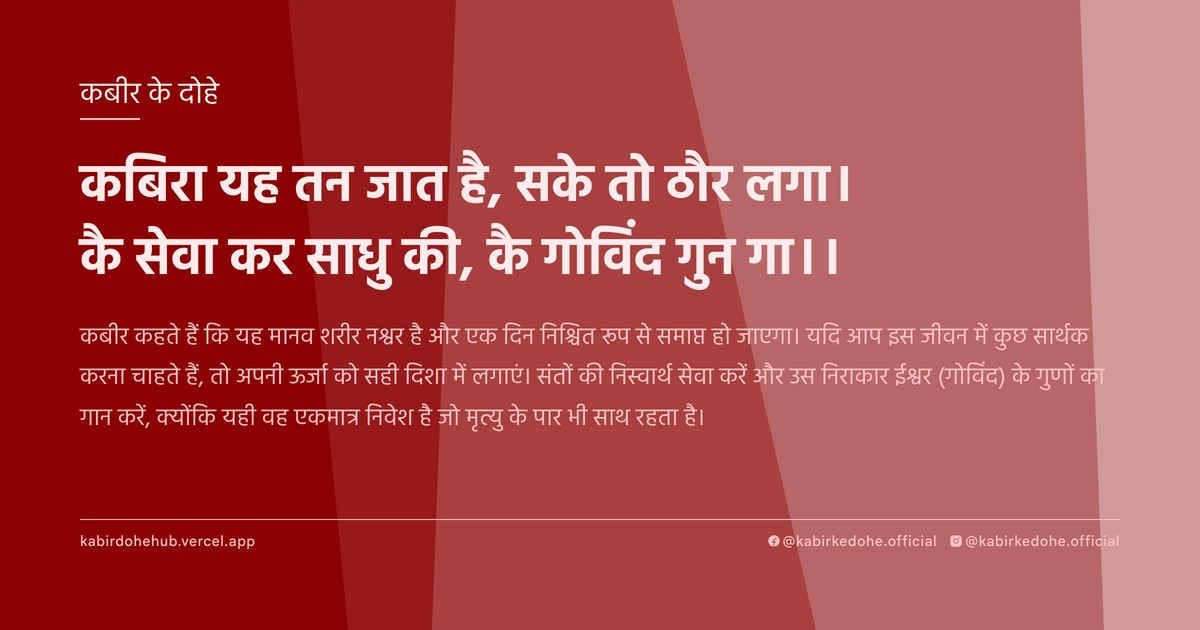
कबिरा यह तन जात है, सके तो ठौर लगा।
कै सेवा कर साधु की, कै गोविंद गुन गा।।
Kabira yeh tan jaat hai, sake to thaur laga. Kai seva kar sadhu ki, kai Govind gun ga.
इस पृष्ठ पर इस कबीर दोहे का अर्थ (meaning), हिंदी व्याख्या और अंग्रेज़ी अनुवाद, दार्शनिक विश्लेषण और व्यावहारिक जीवन सीख दी गई है। यह दोहा मृतुक्यता (Mortality) विषय से जुड़ा है — Kabir doha meaning and explanation in Hindi and English.
अर्थ (Meaning):
कबीर कहते हैं कि यह मानव शरीर नश्वर है और एक दिन निश्चित रूप से समाप्त हो जाएगा। यदि आप इस जीवन में कुछ सार्थक करना चाहते हैं, तो अपनी ऊर्जा को सही दिशा में लगाएं। संतों की निस्वार्थ सेवा करें और उस निराकार ईश्वर (गोविंद) के गुणों का गान करें, क्योंकि यही वह एकमात्र निवेश है जो मृत्यु के पार भी साथ रहता है।
Kabir reminds us that the human body is transient and destined to perish. If you wish to achieve something lasting, anchor your existence in a meaningful purpose. He suggests that the only enduring path is the selfless service of the enlightened (Sadhus) and the contemplation of the divine attributes of the Formless Lord, as these spiritual merits are the only treasures that transcend the physical death.
व्याख्या (Interpretation):
इस दोहे का शाब्दिक अर्थ शरीर की नश्वरता की चेतावनी है, लेकिन इसका गहरा आध्यात्मिक अर्थ 'स्थिरता' की खोज है। 'ठौर लगा' का अर्थ केवल किसी स्थान पर रुकना नहीं, बल्कि चेतना को माया के भटकाव से हटाकर परमात्मा में स्थिर करना है। यहाँ 'साधु' केवल बाहरी व्यक्ति नहीं, बल्कि उस जागृत चेतना का प्रतीक है जो हमें अहंकार से मुक्त करती है। यह निरगुण भक्ति का मार्ग है जहाँ बाहरी कर्मकांडों के बजाय आंतरिक शुद्धि और सेवा को प्राथमिकता दी गई है। अद्वैत वेदांत के अनुसार, जब हम स्वयं को शरीर (नश्वर) के बजाय आत्मा (अविनाशी) के रूप में देखते हैं, तब हम वास्तव में 'ठौर' या परम आश्रय प्राप्त करते हैं। यह विरोधाभास है कि शरीर को खोकर ही हम उस शाश्वत सत्य को पाते हैं जिसे हम जीवन भर पकड़ कर रखने की कोशिश करते हैं।
Literally, the couplet warns of the body's transience, but metaphorically, it is a quest for 'Sthirta' or spiritual stability. 'Thaur laga' does not merely mean finding a place, but anchoring the consciousness in the Divine, away from the fluctuations of Maya. The 'Sadhu' represents not just a person, but the awakened consciousness that guides the seeker toward the annihilation of the ego. This aligns with Nirgun Bhakti, where internal purification and selfless service supersede ritualistic piety. According to Advaita Vedanta, the paradox lies in the fact that only by relinquishing the identification with the perishable body can one realize the imperishable Atman-Brahman identity. The 'anchor' is the realization that the individual soul is not a separate entity but a wave in the infinite ocean of consciousness.
दार्शनिक विश्लेषण (Philosophical Analysis):
कबीर का यह संदेश उस युग की प्रतिक्रिया है जहाँ लोग बाहरी आडंबरों और मोक्ष के लिए कठिन अनुष्ठानों में फंसे थे। कबीर ने स्पष्ट किया कि मोक्ष किसी तीर्थयात्रा या कठिन तपस्या से नहीं, बल्कि 'सेवा' और 'सुमिरन' से मिलता है। यह सूफी मत के 'फना' (अहंकार का विलीनीकरण) और वेदांत के 'अद्वैत' का एक सुंदर संगम है। उनके लिए, संतों की सेवा करना वास्तव में अपने भीतर के अहंकार को मिटाना है, क्योंकि एक सच्चा साधु दर्पण की तरह होता है जो हमें हमारी वास्तविक स्थिति दिखाता है।
ऐतिहासिक रूप से, कबीर ने जाति और धर्म की दीवारों को तोड़कर एक ऐसे मार्ग का प्रस्ताव दिया जो सार्वभौमिक था। उन्होंने तर्क दिया कि यदि शरीर नश्वर है, तो जातिगत श्रेष्ठता का अहंकार पूरी तरह व्यर्थ है। यह मनोवैज्ञानिक रूपांतरण की प्रक्रिया है जहाँ व्यक्ति 'मैं' (अहंकार) से 'हम' (ब्रह्मांडीय चेतना) की ओर बढ़ता है।
यहाँ 'गोविंद' शब्द का प्रयोग केवल एक नाम के रूप में नहीं, बल्कि उस सर्वव्यापी ऊर्जा के लिए किया गया है जो कण-कण में व्याप्त है। कबीर का दर्शन यह है कि ईश्वर मंदिर या मस्जिद में नहीं, बल्कि सेवा और प्रेम के माध्यम से अनुभव किया जाता है।
अक्सर लोग इस दोहे को केवल 'पुण्य कमाने' के रूप में देखते हैं, लेकिन कबीर का उद्देश्य संचय नहीं, बल्कि विसर्जन है। सेवा का अर्थ यहाँ किसी की मदद करना मात्र नहीं, बल्कि सेवा के माध्यम से स्वयं के 'कर्ता' भाव को समाप्त करना है।
अंततः, यह दोहा समय की सीमितता और अनंत की संभावना के बीच के संघर्ष को दर्शाता है। यह हमें याद दिलाता है कि भौतिक जगत एक सराय की तरह है, और बुद्धिमानी इसी में है कि हम यहाँ से उस पूंजी के साथ विदा हों जो आत्मा की शुद्धि से अर्जित की गई हो।
Kabir’s message is a direct critique of the era's obsession with external rituals and complex austerities for salvation. He asserts that liberation is not found in pilgrimages or rigid penance, but through 'Seva' (service) and 'Sumiran' (remembrance). This reflects a synthesis of the Sufi concept of 'Fana' (annihilation of the self) and the Advaita Vedantic realization of non-duality. For Kabir, serving a realized soul (Sadhu) is a method of dissolving the ego, as the Guru acts as a mirror reflecting the seeker's true nature.
Historically, Kabir dismantled the hierarchies of caste and creed, proposing a universal path. He argued that if the body is transient, the pride of caste superiority is an absolute absurdity. This is a psychological shift from the 'I' (egoic identity) to the 'All' (universal consciousness).
The term 'Govind' here is not used as a sectarian deity but as a placeholder for the Omnipresent Energy that permeates every atom. Kabir’s philosophy posits that the Divine is experienced not in temples or mosques, but through the alchemy of love and service.
Common literalist interpretations often mistake this for 'earning merit' (punya), but Kabir’s intent is not accumulation, but dissolution. Service is not merely an act of charity; it is a tool to erase the 'doer' (Karta) within the practitioner.
Ultimately, the couplet highlights the tension between the finite nature of time and the infinite nature of the soul. It reminds us that the material world is a temporary inn, and wisdom lies in departing with the spiritual wealth acquired through the purification of the heart.
मूल संदेश (Core Message):
- शरीर एक अस्थायी वस्त्र है, इसे स्थायी घर न समझें।
- सच्ची स्थिरता बाहरी उपलब्धियों में नहीं, आंतरिक समर्पण में है।
- सेवा केवल परोपकार नहीं, बल्कि स्वयं के अहंकार का विसर्जन है।
- ईश्वर का गान केवल शब्दों में नहीं, आचरण की पवित्रता में है।
- मृत्यु का भय केवल उन्हीं को है जिन्होंने जीवन को संचय में बिताया।
- निराकार की खोज के लिए साकार के मोह का त्याग आवश्यक है।
- The body is a temporary garment; do not mistake it for a permanent home.
- True stability lies not in external achievements, but in internal surrender.
- Service is not mere charity, but the dissolution of the individual ego.
- Praising the Divine is found not in chants, but in the purity of conduct.
- The fear of death haunts only those who spent life in accumulation.
- To find the Formless, one must first release the attachment to the Form.
व्यावहारिक उदाहरण (Practical Example):
वाराणसी के एक पुराने मोहल्ले में माधव नाम का एक वृद्ध बुनकर रहता था। वह अपनी कला में निपुण था, लेकिन उसका मन हमेशा इस चिंता में रहता था कि उसके बाद उसकी संपत्ति और नाम का क्या होगा। वह अपनी श्रेष्ठता के अहंकार में डूबा रहता और खुद को शहर का सबसे कुशल बुनकर मानता था।
एक दिन उसने देखा कि एक फकीर सड़क किनारे बैठा था, जिसके पास न घर था, न धन, लेकिन उसके चेहरे पर एक असीम शांति थी। माधव ने पहले तो उसे अनदेखा किया, लेकिन फकीर की आँखों की गहराई ने उसे खींच लिया।
माधव ने फकीर से पूछा, 'आप इतने शांत कैसे हैं जबकि आपके पास कुछ नहीं है?' फकीर ने मुस्कुराकर कहा, 'मैं वह बोझ ढोना छोड़ चुका हूँ जिसे तुम संपत्ति कहते हो। जब शरीर जाएगा, तो क्या तुम अपनी साड़ियों को साथ ले जाओगे?'
यह बात माधव के दिल पर लगी। उसे एहसास हुआ कि उसने जीवन भर केवल धागों को बुना, लेकिन अपनी आत्मा के साथ कोई संबंध नहीं जोड़ा। उसने तय किया कि वह अब केवल लाभ के लिए नहीं, बल्कि सेवा के लिए काम करेगा।
उसने अपने घर के एक हिस्से को उन गरीब बच्चों के लिए खोल दिया जो पढ़ना चाहते थे। वह उन्हें मुफ्त में बुनाई सिखाने लगा। शुरू में उसे लगा कि वह उन पर उपकार कर रहा है, लेकिन धीरे-धीरे उसे समझ आया कि वह सेवा वास्तव में उसके अपने अहंकार को काट रही थी।
वह अब सुबह उठकर केवल अपने मुनाफे की गणना नहीं करता था, बल्कि उन बच्चों की मुस्कान में उस 'गोविंद' को खोजने लगा। उसने पाया कि जब वह दूसरों के जीवन में रंग भरता है, तो उसका अपना आंतरिक अंधकार मिटने लगता है।
एक समय ऐसा आया जब माधव की बीमारी ने उसे बिस्तर पर डाल दिया। अब उसके पास न तो वह पुराना अहंकार था और न ही संपत्ति का मोह। उसके पास केवल उन लोगों का प्रेम था जिनकी उसने निस्वार्थ सेवा की थी।
जब उसकी अंतिम घड़ी आई, तो वह डरा हुआ नहीं था। उसने महसूस किया कि उसने वास्तव में 'ठौर' पा लिया है—एक ऐसा स्थान जो भौतिक नहीं, बल्कि प्रेम और करुणा से बना था। उसकी मृत्यु एक अंत नहीं, बल्कि एक पूर्णता थी।
In an ancient lane of Varanasi lived an elderly weaver named Madhav. He was a master of his craft, yet his mind was perpetually clouded by anxiety over his legacy and the preservation of his wealth. He lived in the cocoon of his own superiority, believing himself to be the finest weaver in the city.
One day, he noticed a wandering dervish sitting by the roadside. The man possessed neither home nor coin, yet his face radiated an incomprehensible peace. Madhav initially dismissed him, but the profound stillness in the dervish's eyes drew him in.
Madhav asked, 'How can you be so tranquil while possessing nothing?' The dervish smiled and replied, 'I have simply stopped carrying the burden that you call wealth. When the body departs, will you take your exquisite silks with you?'
These words struck a chord in Madhav’s heart. He realized he had spent his entire life weaving threads, but had failed to weave a connection with his own soul. He decided that from that day forward, he would work not for profit, but for service.
He opened a portion of his home for underprivileged children who wished to learn. He began teaching them the art of weaving for free. Initially, he felt he was doing them a favor, but gradually he realized that this service was actually pruning his own ego.
He stopped waking up to calculate profits and instead began seeking the 'Govind' within the smiles of those children. He discovered that as he added color to the lives of others, the grey shadows of his own internal void began to vanish.
Eventually, a prolonged illness confined Madhav to his bed. By then, he no longer possessed the old arrogance nor the attachment to material hoardings. He possessed only the love of those he had served selflessly.
As his final hour approached, he felt no fear. He realized he had finally found his 'Thaur'—an anchor not made of brick and mortar, but of compassion and love. His passing was not an end, but a completion.
अभ्यास मार्गदर्शन (Practice Guidance):
- दैनिक चिंतन: प्रतिदिन 15 मिनट मौन बैठें और विचार करें कि आपकी कौन सी आदतें अहंकार से प्रेरित हैं और कौन सी निस्वार्थता से।
- सेवा का अभ्यास: सप्ताह में एक बार ऐसा कार्य करें जिससे किसी अन्य को लाभ हो, लेकिन इस शर्त पर कि आप इसका श्रेय किसी को न दें और इसे गुप्त रखें।
- आत्म-पूछताछ जर्नल: लिखें कि 'यदि आज मेरा शरीर समाप्त हो जाए, तो मेरे पीछे कौन सा ऐसा गुण बचेगा जो भौतिक नहीं है?'
- निदान चेकलिस्ट: क्या मैं दूसरों की मदद करते समय श्रेष्ठता महसूस करता हूँ? क्या मैं केवल फल की इच्छा से सेवा करता हूँ? यदि हाँ, तो आप अभी भी अहंकार के प्रभाव में हैं।
- Daily Contemplation: Spend 15 minutes in silence daily, observing which of your actions are driven by ego and which are born of genuine selflessness.
- Practice of Seva: Perform one act of service weekly that benefits another, with the strict condition that you seek no recognition and keep the act secret.
- Self-Inquiry Journaling: Reflect and write on the prompt: 'If my physical body were to vanish today, what non-material quality of mine would remain?'
- Diagnostic Checklist: Do I feel a sense of superiority while helping others? Am I serving only to receive a reward? If yes, you are still operating within the egoic framework.
चिंतन प्रश्न (Reflection Questions):
- मेरी सार्वजनिक छवि (Public Image) और मेरे आंतरिक सत्य के बीच कितना अंतर है?
- मैं जिन लोगों की सेवा करता हूँ, क्या मैं वास्तव में उन्हें देख पा रहा हूँ या केवल अपनी 'मदद करने की छवि' को देख रहा हूँ?
- मेरे जीवन का वह कौन सा हिस्सा है जिसे मैं मृत्यु के बाद भी साथ ले जाना चाहता हूँ, और क्या वह वास्तव में अविनाशी है?
- क्या मेरी धार्मिक आस्था मुझे दूसरों से जोड़ती है या मुझे एक श्रेष्ठता का भ्रम देती है?
- यदि मेरा सामाजिक पद और पहचान छीन ली जाए, तो मेरे पास 'मैं' के रूप में क्या बचेगा?
- मैं अपनी ऊर्जा को 'ठौर' लगाने में क्यों डरता हूँ? वह कौन सा मोह है जो मुझे भटका रहा है?
- What is the gap between my curated public identity and my raw internal truth?
- When I serve others, am I truly seeing the person, or am I merely seeing my own image as a 'helper'?
- Which part of my existence do I wish to carry beyond death, and is that part truly imperishable?
- Does my spiritual practice connect me to others, or does it fuel a delusion of superiority?
- If my social status and professional identity were stripped away, what would remain of 'I'?
- Why do I fear anchoring myself in the Divine? What specific attachment keeps me drifting?