
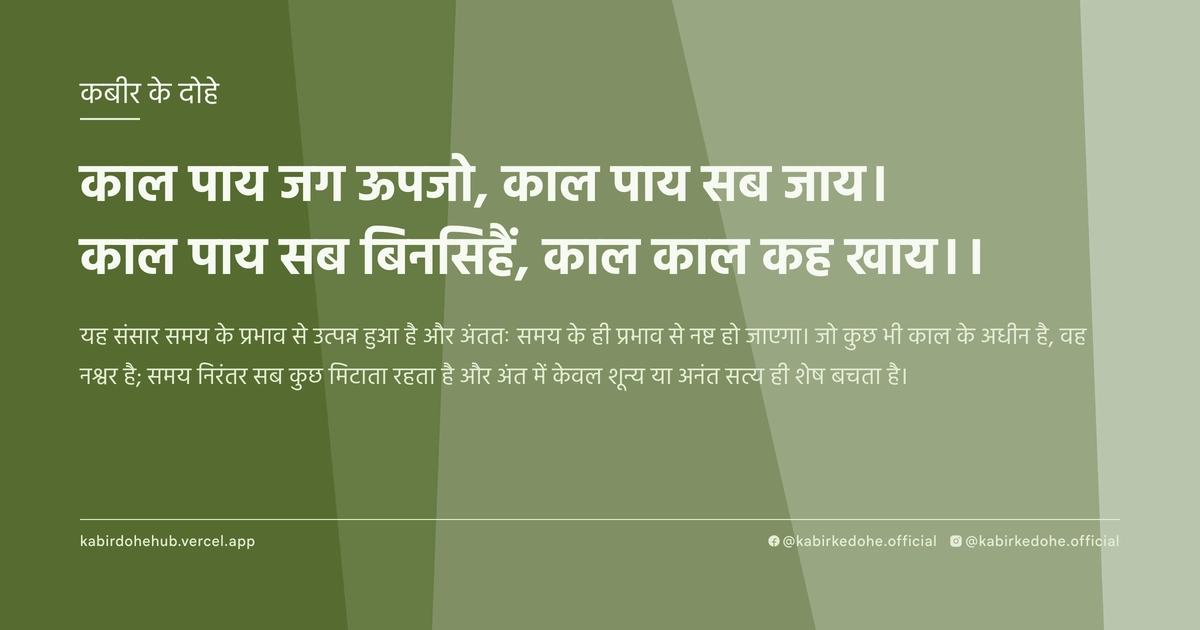
काल पाय जग ऊपजो, काल पाय सब जाय।
काल पाय सब बिनसिहैं, काल काल कह खाय।।
Kaal paay jag oopjo, kaal paay sab jaaye. Kaal paay sab binsihain, kaal kaal kah khaaye.
इस पृष्ठ पर इस कबीर दोहे का अर्थ (meaning), हिंदी व्याख्या और अंग्रेज़ी अनुवाद, दार्शनिक विश्लेषण और व्यावहारिक जीवन सीख दी गई है। यह दोहा मृतुक्यता (Mortality) विषय से जुड़ा है — Kabir doha meaning and explanation in Hindi and English.
अर्थ (Meaning):
यह संसार समय के प्रभाव से उत्पन्न हुआ है और अंततः समय के ही प्रभाव से नष्ट हो जाएगा। जो कुछ भी काल के अधीन है, वह नश्वर है; समय निरंतर सब कुछ मिटाता रहता है और अंत में केवल शून्य या अनंत सत्य ही शेष बचता है।
The entire universe emerged through the influence of time and shall inevitably dissolve back into it. Everything subject to time is transient; time relentlessly erases all existence, consuming every form until only the timeless truth remains.
व्याख्या (Interpretation):
इस दोहे का शाब्दिक अर्थ है कि समय ही सृष्टि का सृजन करता है और समय ही उसका विनाश। रूपक के स्तर पर, 'काल' केवल घड़ी का समय नहीं, बल्कि वह ब्रह्मांडीय चक्र है जो माया के खेल को संचालित करता है। कबीर यहाँ निर्गुण भक्ति के माध्यम से यह समझा रहे हैं कि शरीर और संसार 'साकार' हैं, इसलिए वे परिवर्तनशील हैं। जब हम स्वयं को इस नश्वर शरीर से जोड़ते हैं, तो हम काल के ग्रास बन जाते हैं। लेकिन जो आत्मा (अद्वैत वेदांत के अनुसार ब्रह्म) है, वह 'कालातीत' है। विरोधाभास यह है कि मनुष्य समय से डरता है, जबकि वह स्वयं उस अनंत तत्व का हिस्सा है जो समय से परे है।
Literally, the verse states that time creates and time destroys. Metaphorically, 'Kaal' is not merely chronological time but the cosmic cycle driving the play of Maya. Through the lens of Nirgun Bhakti, Kabir explains that because the body and world are 'formed' (Sakar), they are inherently subject to change. By identifying with the perishable physical shell, one becomes prey to time. However, the Atman—as per Advaita Vedanta—is 'Kalatita' or timeless. The central paradox lies in the human fear of time, despite being an embodiment of the eternal element that exists beyond the reach of temporal decay.
दार्शनिक विश्लेषण (Philosophical Analysis):
कबीर का यह दृष्टिकोण उनके युग के कट्टरपंथी कर्मकांडों और बाहरी आडंबरों के विरुद्ध एक सशक्त प्रहार है। जहाँ लोग मोक्ष के लिए कठिन अनुष्ठानों का सहारा ले रहे थे, कबीर ने समय की नश्वरता को याद दिलाकर व्यक्ति को आंतरिक जागरण की ओर मोड़ा। यह दर्शन सूफी मत के 'फना' (अहंकार का विनाश) और अद्वैत वेदांत के 'माया' सिद्धांत का संगम है।
ऐतिहासिक रूप से, कबीर ने जाति और धर्म की दीवारों को तोड़कर यह बताया कि मृत्यु और समय किसी के साथ भेदभाव नहीं करते। चाहे वह राजा हो या रंक, काल सबको समान रूप से निगलता है। यह बोध मनुष्य के भीतर के अहंकार (Ego) को नष्ट करने का सबसे प्रभावी साधन है। जब व्यक्ति यह स्वीकार करता है कि उसका अस्तित्व क्षणभंगुर है, तब वह बाहरी दुनिया की व्यर्थ प्रतिस्पर्धा को छोड़कर सत्य की खोज में लग जाता है।
मनोवैज्ञानिक स्तर पर, यह दोहा 'मृत्यु बोध' के माध्यम से जीवन को सार्थकता देने का प्रयास है। कबीर यह नहीं कह रहे कि जीवन व्यर्थ है, बल्कि यह कि जो व्यर्थ (नश्वर) है उससे मोह छोड़ो। यह एक प्रकार का आध्यात्मिक विरक्ति मार्ग है जो व्यक्ति को भय से मुक्त कर उसे उस 'अविनाशी' तत्व से जोड़ता है जो समय के चक्र से ऊपर है।
यहाँ 'काल' को एक भक्षक के रूप में चित्रित करना वास्तव में एक चेतावनी है। यह चेतावनी है उस मोह के प्रति जो हमें यह विश्वास दिलाता है कि हम यहाँ स्थायी हैं। जब हम इस भ्रम को तोड़ते हैं, तब हम वास्तव में स्वतंत्र होते हैं। यह मुक्ति किसी स्वर्ग या नरक की प्राप्ति नहीं, बल्कि वर्तमान क्षण में पूर्णता का अनुभव है।
अंततः, यह शिक्षण हमें यह समझने पर मजबूर करता है कि केवल वही कार्य या भाव स्थायी हैं जो निस्वार्थ भाव से किए गए हों। जो कुछ भी 'मैं' और 'मेरा' के अहंकार से जुड़ा है, वह काल द्वारा खा लिया जाएगा। केवल वह शेष रहेगा जो अहंकार शून्य है और परमात्मा में विलीन हो चुका है।
Kabir's perspective serves as a powerful critique of the rigid rituals and external pomposity of his era. While contemporaries sought salvation through complex rites, Kabir redirected the seeker toward inner awakening by highlighting the transience of time. This philosophy represents a convergence of the Sufi concept of 'Fana' (annihilation of the ego) and the Advaita Vedanta doctrine of 'Maya' (illusion).
Historically, Kabir dismantled caste and religious barriers by asserting that time and death are the ultimate equalizers. Whether a king or a pauper, 'Kaal' consumes all without discrimination. This realization is the most potent tool for dismantling the human ego. Once an individual accepts the fragility of their existence, they cease the futile competition of the material world and turn toward the pursuit of Truth.
Psychologically, this verse employs the 'awareness of death' to imbue life with meaning. Kabir is not suggesting that life is meaningless, but rather that attachment to the perishable is futile. This is a path of spiritual detachment that liberates the individual from fear, connecting them to the 'Indestructible' element that transcends the temporal cycle.
Depicting 'Kaal' as a devourer is a strategic warning against the delusion of permanence. When we shatter the illusion that we are permanent residents of this world, we achieve true liberation. This liberation is not about attaining a distant heaven or avoiding hell, but about experiencing wholeness in the present moment.
Ultimately, this teaching compels us to realize that only those actions and emotions rooted in selflessness endure. Everything tied to the ego of 'I' and 'Mine' will be consumed by time. Only that which is ego-less and merged with the Divine remains eternal.
मूल संदेश (Core Message):
- समय का चक्र अटल है, इससे भागना व्यर्थ है।
- अहंकार वह भ्रम है जो हमें नश्वरता भुला देता है।
- सच्ची शांति केवल 'मोह' के त्याग में निहित है।
- जो समय से परे है, वही वास्तविक सत्य है।
- सेवा और प्रेम ही समय की मार से बचते हैं।
- स्वयं को शरीर नहीं, बल्कि कालातीत आत्मा मानें।
- The cycle of time is inevitable; fleeing from it is futile.
- Ego is the illusion that blinds us to our own transience.
- True peace resides only in the relinquishment of attachment.
- That which is beyond time is the only absolute truth.
- Only selfless service and love survive the erosion of time.
- Identify not as the perishable body, but as the timeless soul.
व्यावहारिक उदाहरण (Practical Example):
वाराणसी के एक पुराने घाट पर रामदीन नाम का एक वृद्ध नाविक रहता था। उसका पूरा जीवन नाव चलाने और पर्यटकों को गंगा की लहरों पर घुमाने में बीता। रामदीन को अपनी नाव और अपनी कुशलता पर बहुत गर्व था; वह मानता था कि उसकी नाव इस घाट की सबसे श्रेष्ठ नाव है और वह कभी असफल नहीं होगा।
वह अक्सर युवा नाविकों का उपहास करता था और अपनी संपत्ति को संचित करने में लगा रहता था, यह सोचकर कि वह हमेशा इसी तरह राज करेगा। उसका अहंकार उसकी पहचान बन गया था। वह अपनी नाव को केवल लकड़ी का ढांचा नहीं, बल्कि अपनी सत्ता का प्रतीक मानता था।
एक रात, भीषण बाढ़ आई। गंगा का जलस्तर इतनी तेजी से बढ़ा कि घाट के किनारे बंधी कई नावें बह गईं। रामदीन की वह 'श्रेष्ठ' नाव, जिसे उसने सालों तक संवारा था, पानी के प्रचंड वेग में टूटकर बिखर गई। उसकी जीवन भर की जमा पूँजी और उसका गर्व, दोनों एक ही पल में लहरों में समा गए।
अगली सुबह, जब वह तट पर अपनी टूटी हुई नाव के टुकड़ों को देख रहा था, उसे कबीर का यह दोहा याद आया। उसे अहसास हुआ कि वह जिस नाव और प्रतिष्ठा को स्थायी मान रहा था, वह वास्तव में 'काल' के एक छोटे से झटके के सामने तिनके जैसी थी।
उसने देखा कि उसके पास अब कुछ नहीं बचा था, लेकिन पहली बार उसे एक अजीब सी शांति महसूस हुई। वह बोझ, जिसे वह 'मेरा' कहकर ढो रहा था, वह अब उतर चुका था। उसका अहंकार उस नाव के साथ ही टूट गया था।
रामदीन ने अब नाव चलाने का काम जारी रखा, लेकिन अब उसका उद्देश्य धन या प्रतिष्ठा नहीं था। वह अब नाव में बैठने वाले हर व्यक्ति की सेवा निस्वार्थ भाव से करने लगा। वह अब नाव को अपनी संपत्ति नहीं, बल्कि एक माध्यम मानता था।
उसने अपनी बची हुई छोटी सी पूंजी से गरीब बच्चों के लिए एक छोटी सी पाठशाला शुरू की। उसने महसूस किया कि भौतिक वस्तुएं तो नष्ट हो जाएंगी, लेकिन दूसरों के जीवन में लाया गया सकारात्मक बदलाव समय की मार से बचा रहता है।
उसका व्यवहार पूरी तरह बदल गया। जो रामदीन पहले क्रोधित और अभिमानी था, वह अब शांत और करुणामयी बन गया था। वह अब समय से डरता नहीं था, क्योंकि उसने जान लिया था कि समय केवल उसे छीनता है जो पकड़ कर रखता है।
जब वह अंततः इस दुनिया से विदा हुआ, तो वह अपनी टूटी नाव के लिए नहीं, बल्कि उन अनगिनत मुस्कुराहटों के लिए याद किया गया जो उसने दूसरों के चेहरों पर बिखेरी थीं।
यह 'कबीर ट्विस्ट' था—विनाश के माध्यम से सृजन। रामदीन ने अपनी भौतिक हानि को आध्यात्मिक लाभ में बदल दिया, क्योंकि उसने समय की नश्वरता को स्वीकार कर लिया था।
On an ancient ghat in Varanasi lived an elderly boatman named Ramdin. His entire life was spent rowing and guiding tourists across the currents of the Ganges. Ramdin took immense pride in his boat and his skill; he believed his vessel was the finest on the ghat and that his dominance was absolute.
He often mocked younger boatmen and spent his days hoarding wealth, convinced that he would rule these waters forever. His ego became his identity. He viewed his boat not as a wooden structure, but as a symbol of his own power and status.
One night, a devastating flood struck. The water levels of the Ganges rose so violently that many boats moored at the ghat were swept away. Ramdin's 'superior' boat, which he had meticulously maintained for years, was splintered and shattered by the ferocious current.
In a single moment, his lifelong savings and his pride were swallowed by the waves. The next morning, as he stood on the shore staring at the wreckage of his boat, Kabir's words echoed in his mind. He realized that the boat and the prestige he deemed permanent were as fragile as straws before the strike of 'Kaal'.
He saw that he had nothing left, yet for the first time, he felt a strange, profound peace. The burden he had been carrying, labeled as 'Mine', had finally been lifted. His ego had broken along with the wood of his boat.
Ramdin continued to row, but his purpose had shifted. He no longer sought wealth or status; instead, he began serving every passenger with selfless devotion. He no longer viewed the boat as his property, but as a medium of service.
With the small amount of money he had left, he started a tiny school for the village children. He understood that while material objects perish, the positive change brought into others' lives survives the erosion of time.
His temperament transformed completely. The Ramdin who was once angry and arrogant became serene and compassionate. He no longer feared time, for he had learned that time only takes away from those who cling.
When he eventually departed from this world, he was remembered not for his broken boat, but for the countless smiles he had etched onto the faces of others.
This was the 'Kabir Twist'—creation through destruction. Ramdin converted his material loss into spiritual gain by embracing the transience of time.
अभ्यास मार्गदर्शन (Practice Guidance):
- दैनिक चिंतन: प्रतिदिन 10 मिनट मौन बैठें और विचार करें कि आपके जीवन की कौन सी वस्तुएं या रिश्ते 'स्थायी' हैं और कौन सी 'नश्वर'।
- आत्म-पूछताछ जर्नल: एक डायरी लिखें जिसमें आप उन चीजों की सूची बनाएं जिनसे आप अत्यधिक मोह रखते हैं, और फिर लिखें कि यदि वे कल गायब हो जाएं, तो आपके भीतर क्या शेष रहेगा।
- व्यवहारिक परिवर्तन: दिन में कम से कम एक कार्य ऐसा करें जिसमें आपका कोई व्यक्तिगत लाभ न हो, ताकि 'मैं' और 'मेरा' का भाव कम हो सके।
- निदान चेकलिस्ट: यदि आप छोटी सी हानि पर अत्यधिक क्रोधित होते हैं या भविष्य की चिंता में वर्तमान को खो रहे हैं, तो समझें कि आप अभी भी 'काल' के भ्रम में हैं।
- Daily Contemplation: Spend 10 minutes in silence daily, reflecting on which aspects of your life are truly 'permanent' and which are 'transient'.
- Self-Inquiry Journal: Maintain a diary listing things you are deeply attached to, then write what would remain of your essence if those things vanished tomorrow.
- Behavioral Shift: Perform at least one act of service daily with zero personal gain to consciously diminish the sense of 'I' and 'Mine'.
- Diagnostic Checklist: If you react with extreme anger to minor losses or lose the present moment to anxiety about the future, recognize that you are still trapped in the illusion of time.
चिंतन प्रश्न (Reflection Questions):
- आपकी वह कौन सी 'डिजिटल पहचान' है जिसे आप स्थायी मान रहे हैं, जबकि वह एक क्लिक में मिट सकती है?
- यदि आज आपकी मृत्यु हो जाए, तो क्या आपका 'अहंकार' आपके पीछे कोई सार्थक छाप छोड़ेगा?
- आप समय को नियंत्रित करने की कोशिश करते हैं या समय के प्रवाह के साथ बहना सीखते हैं?
- आपके भीतर का वह कौन सा हिस्सा है जो कभी नहीं बदलता, चाहे परिस्थितियां कितनी भी बदल जाएं?
- क्या आपका डर समय के खोने का है, या उस पहचान के खोने का जिसे आपने समय के साथ बनाया है?
- Which part of your 'digital identity' do you perceive as permanent, despite it being erasable in a single click?
- If you were to pass away today, would your 'ego' leave behind any meaningful imprint?
- Do you spend your life trying to control time, or learning to flow with its current?
- What part of your inner being remains unchanged, regardless of how your external circumstances shift?
- Is your fear rooted in the loss of time, or in the loss of the identity you have constructed over time?