
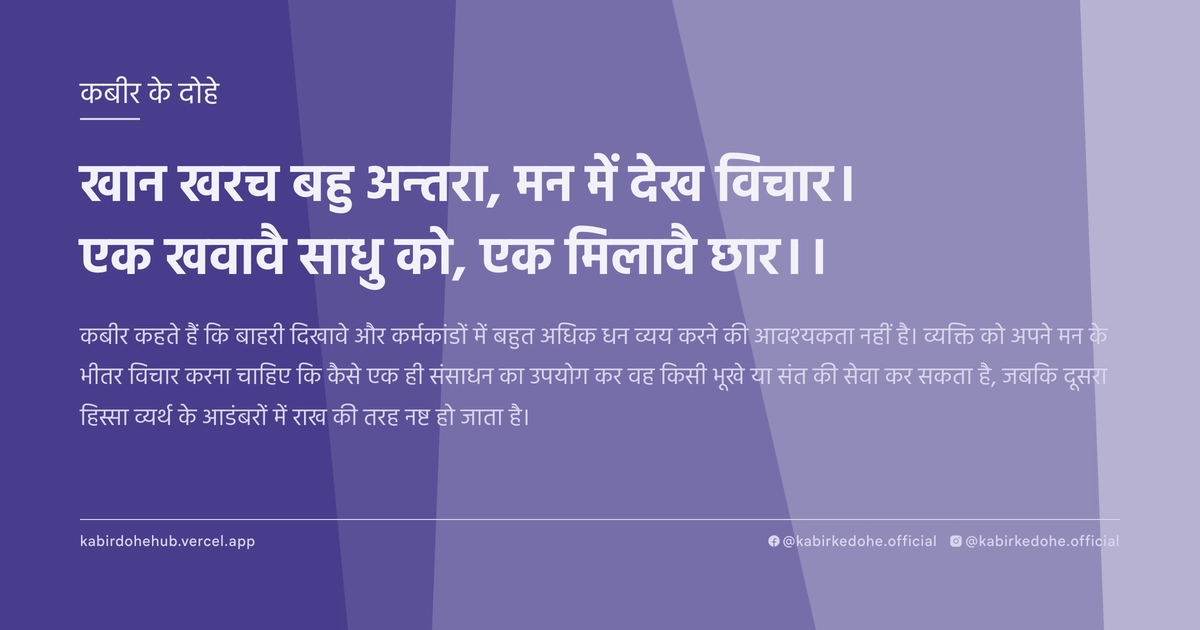
खान खरच बहु अन्तरा, मन में देख विचार।
एक खवावै साधु को, एक मिलावै छार।।
Khan kharach bahu antara, man mein dekh vichaar. Ek khavaye sadhu ko, ek milavaye chhaar.
इस पृष्ठ पर इस कबीर दोहे का अर्थ (meaning), हिंदी व्याख्या और अंग्रेज़ी अनुवाद, दार्शनिक विश्लेषण और व्यावहारिक जीवन सीख दी गई है। यह दोहा संतोष (Contentment) विषय से जुड़ा है — Kabir doha meaning and explanation in Hindi and English.
अर्थ (Meaning):
कबीर कहते हैं कि बाहरी दिखावे और कर्मकांडों में बहुत अधिक धन व्यय करने की आवश्यकता नहीं है। व्यक्ति को अपने मन के भीतर विचार करना चाहिए कि कैसे एक ही संसाधन का उपयोग कर वह किसी भूखे या संत की सेवा कर सकता है, जबकि दूसरा हिस्सा व्यर्थ के आडंबरों में राख की तरह नष्ट हो जाता है।
Kabir asserts that there is no need for extravagant spending on external rituals or superficial displays of piety. One must introspect and realize that while a small portion of one's resources can satisfy a seeker or the needy, the rest is often wasted on hollow ceremonies, effectively turning precious effort into useless ash.
व्याख्या (Interpretation):
इस दोहे का शाब्दिक अर्थ है कि आध्यात्मिक प्राप्ति के लिए भारी खर्च की आवश्यकता नहीं है। रूपक के स्तर पर, 'साधु' केवल एक व्यक्ति नहीं, बल्कि मानवता और करुणा का प्रतीक है, जबकि 'छार' (राख) उन मृत अनुष्ठानों का प्रतीक है जो आत्मा को पोषण नहीं देते। यह निर्गुण भक्ति का सार है, जहाँ ईश्वर मंदिर या मस्जिद में नहीं, बल्कि सेवा और आंतरिक शुद्धि में बसता है। माया हमें विश्वास दिलाती है कि महंगे अनुष्ठान मोक्ष का मार्ग हैं, परंतु कबीर इस भ्रम को तोड़ते हैं। यहाँ द्वैत का अंत होता है जब साधक यह समझता है कि परोपकार ही वास्तविक पूजा है। अंततः, यह दोहा अहंकार के विसर्जन और सरल, निस्वार्थ प्रेम की ओर संकेत करता है।
Literally, the verse argues against the financial burden of religious piety. Metaphorically, the 'Saadhu' represents the living embodiment of divine consciousness and human suffering, while 'Chhaar' (ash) symbolizes the sterile remains of ritualistic obsession. This aligns with Nirgun Bhakti, where the formless Divine is accessed not through gold or incense, but through the alchemy of compassion. Maya creates the illusion that spiritual merit is proportional to material expenditure; Kabir shatters this by contrasting the nourishing act of feeding with the destructive act of burning resources. The paradox presented is that the path to the Infinite is found in the simplest finite act of kindness. It is a call to shift from the 'religion of performance' to the 'spirituality of presence,' emphasizing the non-duality of the server and the served.
दार्शनिक विश्लेषण (Philosophical Analysis):
कबीर का यह दृष्टिकोण उनके समय के सामाजिक और धार्मिक परिवेश की एक तीखी प्रतिक्रिया है, जहाँ पंडित और मुल्ला धर्म के नाम पर आम जनता का शोषण करते थे। वे कर्मकांडीय धर्म (Ritualism) का पुरजोर विरोध करते हैं क्योंकि उनका मानना था कि बाहरी क्रियाएं केवल अहंकार को पुष्ट करती हैं, आत्मा को मुक्त नहीं।
अद्वैत वेदांत के परिप्रेक्ष्य में, यदि सब कुछ ब्रह्म है, तो किसी बाहरी मूर्ति या अनुष्ठान की आवश्यकता नहीं है; स्वयं के भीतर और दूसरों की सेवा में ही ब्रह्म का साक्षात्कार होता है। कबीर यहाँ 'सेवा' को 'साधना' से ऊपर रखते हैं।
सूफी मत के 'इश्क-ए-हकीकी' (ईश्वरीय प्रेम) के समान, कबीर का दर्शन यह सिखाता है कि ईश्वर प्रेम का भूखा है, धन का नहीं। वे तर्क देते हैं कि जो व्यक्ति भूखे को खिलाता है, वह वास्तव में ईश्वर को ही खिला रहा है, क्योंकि आत्मा सर्वव्यापी है।
मनोवैज्ञानिक स्तर पर, यह दोहा 'दिखावे की संस्कृति' पर प्रहार करता है। जब हम बड़े अनुष्ठान करते हैं, तो हम अक्सर अपनी सामाजिक प्रतिष्ठा (Ego) को संतुष्ट कर रहे होते हैं, न कि अपनी आध्यात्मिक प्यास को।
अतः, कबीर का संदेश स्पष्ट है: आध्यात्मिक प्रगति का मापदंड आपके द्वारा खर्च किया गया धन नहीं, बल्कि आपके हृदय में उत्पन्न हुई करुणा है। यह भौतिकता से आध्यात्मिकता की ओर एक क्रांतिकारी संक्रमण है।
Kabir’s perspective is a visceral reaction to the socio-religious climate of his era, characterized by the exploitation of the masses by the priestly classes through complex rituals. He rejects ritualism because it reinforces the 'ego of the pious' rather than liberating the soul from its bondage.
From the lens of Advaita Vedanta, if the entire universe is a manifestation of Brahman, then external intermediaries and expensive ceremonies are redundant. The realization of the Self is found in the recognition of the Self in others. Kabir elevates 'Seva' (selfless service) above 'Sadhana' (formal spiritual practice).
Parallel to the Sufi concept of 'Ishq-e-Haqiqi' (Divine Love), Kabir suggests that the Divine craves love and sincerity, not gold or incense. To feed a hungry soul is to feed the Divine, as the Atman is omnipresent and transcends the boundaries of caste and creed.
Psychologically, this verse attacks the 'culture of performance.' Rituals often serve as a mask for the ego, allowing the practitioner to feel spiritually superior while remaining internally stagnant. The 'ash' mentioned is the residue of a burnt-out ego that failed to transform into love.
Ultimately, Kabir redefines spiritual success. It is not measured by the grandeur of one's offerings but by the depth of one's empathy. He advocates for a spiritual economy where the currency is compassion, not coin.
मूल संदेश (Core Message):
- आडंबर आध्यात्मिक प्रगति का अवरोध है।
- करुणा ही वास्तविक पूजा है।
- अहंकार को सेवा की अग्नि में जलाएं।
- ईश्वर मंदिर में नहीं, मानवता में है।
- सादगी ही सर्वोच्च सत्य की कुंजी है।
- Ostentation is a barrier to spiritual growth.
- Compassion is the only authentic form of worship.
- Burn the ego in the fire of selfless service.
- The Divine resides in humanity, not in monuments.
- Simplicity is the master key to ultimate truth.
व्यावहारिक उदाहरण (Practical Example):
एक समय की बात है, बनारस के घाटों पर रहने वाली एक वृद्ध विधवा, जानकी, थी। उसके पास बहुत कम संसाधन थे, लेकिन वह अपनी छोटी सी बचत का एक बड़ा हिस्सा हर महीने मंदिर के बड़े उत्सवों और पुजारियों को दान में देती थी, यह सोचकर कि इससे उसे मोक्ष मिलेगा। वह अक्सर भूखी रहती थी ताकि वह 'पवित्र' कार्यों में अधिक खर्च कर सके।
एक दिन उसने देखा कि एक छोटा बच्चा, जो घाटों पर कचरा चुनता था, भूख से बेहाल होकर एक कोने में बैठा था। जानकी ने अपनी आदत के अनुसार उसे अनदेखा कर मंदिर की ओर बढ़ने की कोशिश की, लेकिन उसके मन में एक अजीब सी बेचैनी हुई।
उसी समय उसकी मुलाकात एक फकीर से हुई जिसने उसे कबीर का यह दोहा सुनाया। फकीर ने कहा, 'माँ, तुम पत्थर की मूर्तियों को सोने से सजा रही हो, जबकि जीवित ईश्वर तुम्हारे सामने भूख से तड़प रहा है। क्या तुम्हारी पूजा उस बच्चे की भूख मिटाने से बड़ी है?'
जानकी को एक गहरा झटका लगा। उसने महसूस किया कि वह अब तक केवल अपने 'पुण्य' के अहंकार को पाल रही थी, न कि वास्तविक भक्ति को।
उसने तुरंत अपने पास मौजूद कुछ सिक्के निकाले और उस बच्चे के लिए भोजन खरीदा। जब उसने बच्चे के चेहरे पर वह संतोष देखा, तो उसे वह शांति महसूस हुई जो उसे वर्षों के महंगे अनुष्ठानों से नहीं मिली थी।
उस दिन के बाद, जानकी ने भव्य दान देना बंद कर दिया। उसने अपनी छोटी सी बचत का उपयोग उन लोगों की मदद के लिए करना शुरू किया जिन्हें वास्तव में उसकी आवश्यकता थी।
उसने पाया कि उसका मन अब अधिक शांत था और उसकी प्रार्थनाएं अधिक सच्ची हो गई थीं। वह अब मंदिर के बाहर नहीं, बल्कि मानवता की सेवा में ईश्वर को खोजने लगी।
उसका जीवन बदल गया; वह अब एक 'दानवीर' नहीं, बल्कि एक 'करुणामयी' स्त्री बन गई थी।
यह 'कबीर ट्विस्ट' था—जब उसने बाहरी आडंबर की 'राख' को त्याग कर सेवा के 'अमृत' को अपनाया, तब उसे वास्तविक मोक्ष का अनुभव हुआ।
उसकी मृत्यु के समय, उसके पास कोई सोने का पदक नहीं था, लेकिन पूरा मोहल्ला उसे एक संत की तरह याद करता था।
In the ancient lanes of Varanasi lived an elderly widow named Janaki. Despite her meager means, she spent a significant portion of her small savings on elaborate temple festivals and offerings to priests, believing that these expensive rituals were the only gateway to salvation. She often skipped meals to ensure her 'religious contributions' were substantial.
One day, she noticed a small child, a scavenger on the ghats, shivering and weeping from intense hunger in a dark corner. Habitually, Janaki tried to ignore him and move toward the temple, but for the first time, a strange restlessness stirred in her heart.
At that moment, she encountered a wandering mystic who recited Kabir's verse to her. The mystic asked, 'Mother, you adorn stone idols with gold while the living God trembles in hunger before you. Is your ritual more sacred than this child's survival?'
Janaki felt a profound shock. She realized that her generosity was not an act of love, but an act of ego—she was buying a sense of spiritual superiority through expensive donations.
Immediately, she used her remaining coins to buy food for the child. As she watched the boy eat with pure gratitude, she experienced a surge of peace that years of costly rituals had never provided.
From that day forward, Janaki ceased her extravagant donations to the temple. She redirected her modest resources toward those in genuine need within her community.
She discovered that her mind became quieter and her prayers more authentic. She stopped searching for God inside the temple walls and began finding Him in the eyes of the suffering.
Her identity shifted; she was no longer a 'pious donor' but a 'compassionate soul.'
This was the 'Kabir Twist'—by discarding the 'ash' of outward performance and embracing the 'nectar' of service, she found the liberation she had been paying for.
When she finally passed away, she left no gold behind, but the entire neighborhood remembered her as a living saint.
अभ्यास मार्गदर्शन (Practice Guidance):
- दैनिक चिंतन: प्रतिदिन 10 मिनट यह विचार करें कि क्या आपके धार्मिक या सामाजिक कार्य वास्तव में दूसरों की मदद कर रहे हैं या केवल आपकी छवि सुधार रहे हैं।
- आत्म-पूछताछ जर्नल: लिखें कि 'आज मैंने अपनी किस इच्छा का त्याग किया ताकि किसी और की बुनियादी जरूरत पूरी हो सके?'
- व्यवहार परिवर्तन: महीने में एक बार किसी ऐसे व्यक्ति की गुप्त रूप से मदद करें जिसे समाज अनदेखा करता है, बिना किसी प्रशंसा की उम्मीद के।
- डायग्नोस्टिक चेकलिस्ट: यदि आप दान देने के बाद गर्व महसूस करते हैं, तो आप 'राख' (अहंकार) बना रहे हैं। यदि आप केवल कृतज्ञता महसूस करते हैं कि आपको मदद करने का मौका मिला, तो आप 'साधु' (सेवा) के मार्ग पर हैं।
- Daily Contemplation: Spend 10 minutes reflecting on whether your religious or social acts are genuinely helping others or merely polishing your public image.
- Self-Inquiry Journal: Record daily entries answering: 'What personal desire did I sacrifice today to fulfill someone else's basic necessity?'
- Behavioral Shift: Once a month, perform an anonymous act of kindness for someone marginalized by society, ensuring no one knows of your contribution.
- Diagnostic Checklist: If you feel a sense of pride or superiority after giving, you are creating 'ash' (ego). If you feel only gratitude for the opportunity to serve, you are on the path of the 'Saadhu' (service).
चिंतन प्रश्न (Reflection Questions):
- क्या मेरी धार्मिकता दूसरों को नीचा दिखाने का एक सूक्ष्म तरीका है?
- मैं अपनी आध्यात्मिक पहचान को बनाए रखने के लिए कितना 'दिखावा' करता हूँ?
- यदि मेरे सभी धार्मिक प्रतीकों को छीन लिया जाए, तो क्या मेरे भीतर की करुणा जीवित रहेगी?
- क्या मैं केवल उन्हीं की मदद करता हूँ जिनसे मुझे सामाजिक लाभ मिलने की संभावना है?
- मेरे जीवन का कौन सा हिस्सा 'राख' (व्यर्थ) है और कौन सा 'साधु' (सार्थक)?
- Is my piety a subtle tool used to feel superior to others?
- How much 'performance' do I engage in to maintain my spiritual identity?
- If all my religious symbols were stripped away, would my compassion still exist?
- Do I only help those from whom I might receive social validation or benefit?
- Which parts of my daily routine are 'ash' (waste) and which are 'Saadhu' (meaningful)?