
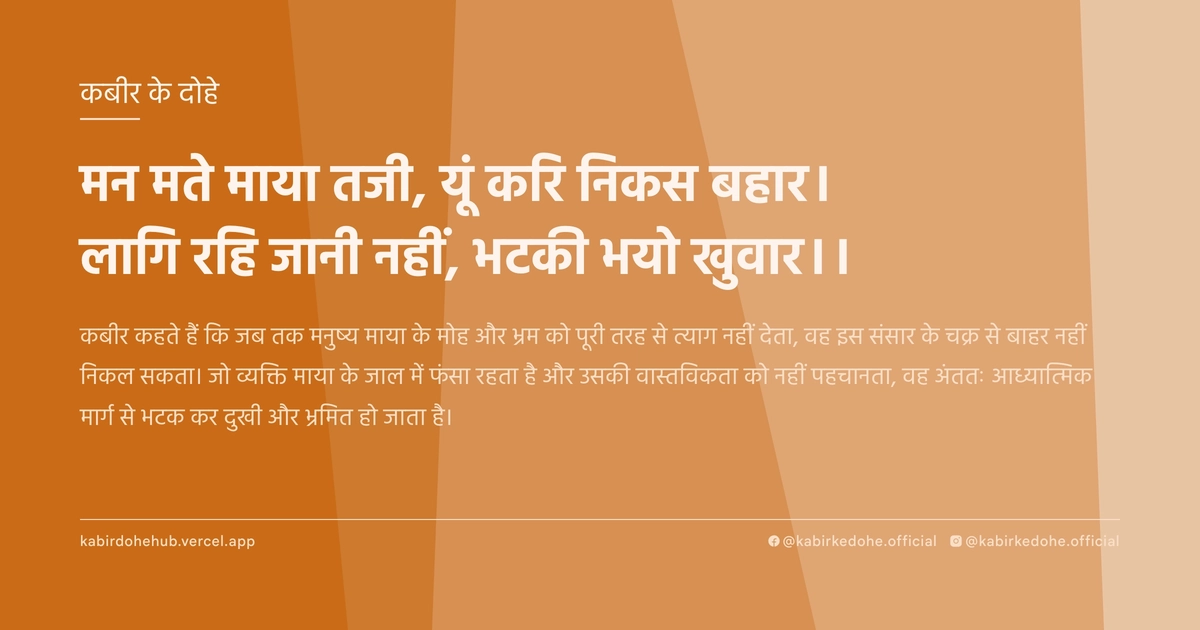
मन मते माया तजी, यूं करि निकस बहार।
लागि रहि जानी नहीं, भटकी भयो खुवार।।
Man mate maya taji, yun kari nikas bahaar. Laagi rahi jaani nahi, bhatki bhayo khuwar.
इस पृष्ठ पर इस कबीर दोहे का अर्थ (meaning), हिंदी व्याख्या और अंग्रेज़ी अनुवाद, दार्शनिक विश्लेषण और व्यावहारिक जीवन सीख दी गई है। यह दोहा माया (Maya) विषय से जुड़ा है — Kabir doha meaning and explanation in Hindi and English.
अर्थ (Meaning):
कबीर कहते हैं कि जब तक मनुष्य माया के मोह और भ्रम को पूरी तरह से त्याग नहीं देता, वह इस संसार के चक्र से बाहर नहीं निकल सकता। जो व्यक्ति माया के जाल में फंसा रहता है और उसकी वास्तविकता को नहीं पहचानता, वह अंततः आध्यात्मिक मार्ग से भटक कर दुखी और भ्रमित हो जाता है।
Kabir asserts that until one completely renounces the delusions and attachments of Maya, liberation from the worldly cycle remains impossible. He warns that those who remain entangled in these illusions, failing to perceive their transient nature, inevitably wander aimlessly in spiritual ignorance, ending in profound distress and confusion.
व्याख्या (Interpretation):
इस दोहे का शाब्दिक अर्थ है कि माया को छोड़े बिना मुक्ति संभव नहीं है। यहाँ 'माया' केवल धन-दौलत नहीं, बल्कि वह मानसिक पर्दा है जो आत्मा को परमात्मा से अलग दिखाता है। कबीर निर्गुण भक्ति के माध्यम से समझाते हैं कि यह द्वैत का भाव ही सबसे बड़ा अवरोध है। जब साधक यह मान लेता है कि वह शरीर है, तो वह माया के प्रभाव में आ जाता है। अद्वैत वेदांत के अनुसार, माया वह शक्ति है जो ब्रह्म को जगत के रूप में प्रस्तुत करती है। जब तक यह अज्ञान (Avidya) बना रहता है, आत्मा स्वयं को सीमित मानती है और संसार की नश्वर वस्तुओं में सुख खोजती है। यह विरोधाभास है कि हम जिसे सत्य मानकर पकड़ते हैं, वही हमें सत्य से दूर ले जाता है। अंततः, माया की पहचान ही उसके विनाश का पहला कदम है।
Literally, the verse states that liberation is unattainable without the abandonment of Maya. Here, 'Maya' transcends mere material wealth; it is the psychic veil that creates a perceived separation between the Atman and the Brahman. Through the lens of Nirgun Bhakti, Kabir explains that the sense of duality is the primary obstacle to enlightenment. When a seeker identifies solely with the physical body, they fall prey to the illusions of the ego. In Advaita Vedanta, Maya is the cosmic power that projects the singular Absolute as a fragmented universe. As long as this Avidya (ignorance) persists, the soul perceives itself as limited and seeks permanence in transient objects. The central paradox lies in the fact that the very things we cling to as 'real' are the chains that bind us. Ultimately, the conscious recognition of Maya's deceptive nature is the first step toward its dissolution.
दार्शनिक विश्लेषण (Philosophical Analysis):
कबीर का यह दोहा उस समय के सामाजिक और धार्मिक परिवेश पर एक गहरा प्रहार है जहाँ कर्मकांडों और बाहरी दिखावे को मोक्ष का मार्ग माना जाता था। कबीर ने स्पष्ट किया कि मंदिर, मस्जिद या तीर्थयात्राएं माया के जाल को नहीं काट सकतीं, क्योंकि ये स्वयं माया के सूक्ष्म रूप हैं। उनका दृष्टिकोण सूफी मत के 'फना' (अहंकार का विनाश) और अद्वैत वेदांत के 'अहं ब्रह्मास्मि' का एक अनूठा संगम है।
माया का अर्थ यहाँ केवल भौतिकता नहीं, बल्कि वह मानसिक स्थिति है जहाँ व्यक्ति 'मैं' और 'मेरा' के भ्रम में जीता है। कबीर तर्क देते हैं कि जब तक अहंकार (Ego) जीवित है, तब तक सत्य का अनुभव असंभव है। यह मनोवैज्ञानिक रूपांतरण की प्रक्रिया है जहाँ साधक को यह समझना होता है कि बाहरी दुनिया एक प्रतिबिंब मात्र है।
ऐतिहासिक रूप से, कबीर ने जाति व्यवस्था और धार्मिक कट्टरता को माया का हिस्सा माना, क्योंकि ये मनुष्य को मनुष्य से अलग करती हैं और उसे एक झूठी पहचान (Identity) प्रदान करती हैं। उन्होंने सिखाया कि वास्तविक भक्ति बाहरी आडंबरों में नहीं, बल्कि आंतरिक शुद्धता और शून्य की अवस्था में है।
अद्वैत दर्शन के अनुसार, माया वह शक्ति है जो सत्य को ढक देती है। कबीर इस 'ढकाव' को हटाने के लिए 'विवेक' और 'वैराग्य' की आवश्यकता पर बल देते हैं। वे चेतावनी देते हैं कि जो केवल किताबी ज्ञान या शास्त्रार्थ में उलझे रहते हैं, वे माया के और गहरे जाल में फंस जाते हैं क्योंकि वे बौद्धिक अहंकार को ही ज्ञान समझ लेते हैं।
अंततः, यह दोहा हमें सिखाता है कि मुक्ति किसी बाहरी स्थान पर जाने से नहीं, बल्कि आंतरिक भ्रमों के विसर्जन से मिलती है। जब 'मैं' मिटता है, तब केवल वह 'एक' बचता है जो सर्वव्यापी है। यही निर्गुण भक्ति का सार है—बिना किसी रूप, रंग या नाम के उस निराकार सत्य में विलीन हो जाना।
This couplet serves as a profound critique of the socio-religious climate of Kabir's era, where ritualism and external displays of piety were mistaken for the path to salvation. Kabir clarifies that temples, mosques, or pilgrimages cannot sever the ties of Maya, as these structures themselves often become subtle extensions of the illusion.
In this context, Maya is not merely materialism but a psychological state where the individual exists within the delusion of 'I' and 'Mine.' Kabir argues that as long as the ego persists, the experience of the Absolute is impossible. This is a process of psychological transmutation where the seeker must realize that the external world is but a reflection, a shimmering mirage.
Historically, Kabir identified the caste system and religious bigotry as manifestations of Maya, as they fragment humanity and impose false identities. He taught that true devotion resides not in outward pomp, but in inner purity and the attainment of the state of 'Shunya' (void/emptiness).
Drawing from Advaita Vedanta, Maya is the power that veils the Truth. Kabir emphasizes the necessity of 'Viveka' (discernment) and 'Vairagya' (detachment) to lift this veil. He warns that those entangled in scholastic debates or scriptural pedantry often sink deeper into Maya, mistaking intellectual arrogance for spiritual realization.
Ultimately, the verse teaches that liberation is not a journey to a distant place but a dissolution of internal delusions. When the 'I' vanishes, only the 'One' remains—the omnipresent Truth. This is the essence of Nirgun Bhakti: merging into the formless Absolute without the mediation of image, name, or ritual.
मूल संदेश (Core Message):
- बाहरी पहचान एक भ्रम है, आंतरिक शून्य ही सत्य है।
- माया को पहचानना ही उससे मुक्त होने का एकमात्र मार्ग है।
- अहंकार का अंत ही वास्तविक ज्ञान की शुरुआत है।
- कर्मकांड आत्मा की प्यास नहीं बुझा सकते, केवल प्रेम और वैराग्य सकते हैं।
- सत्य वह नहीं जो दिखता है, बल्कि वह है जो पर्दे के पीछे है।
- External identity is a mirage; the inner void is the only truth.
- Recognizing the illusion of Maya is the only path to liberation from it.
- The annihilation of the ego is the true dawn of knowledge.
- Rituals cannot quench the soul's thirst; only love and detachment can.
- Truth is not what is visible, but that which exists behind the veil.
व्यावहारिक उदाहरण (Practical Example):
वाराणसी के घाटों पर रहने वाले एक वृद्ध विधवा, जानकी, की कहानी है। जानकी ने अपना पूरा जीवन धर्म के कठोर नियमों, उपवासों और घंटों की पूजा-अर्चना में बिता दिया था। उनका मानना था कि जितना अधिक वे बाहरी नियमों का पालन करेंगी, उतना ही वे ईश्वर के करीब पहुँचेंगी।
वे हर दिन गंगा स्नान करतीं और अन्य महिलाओं को भी यही उपदेश देतीं कि मोक्ष केवल इन अनुष्ठानों से ही संभव है। उनके मन में एक सूक्ष्म अहंकार था कि वे दूसरों से अधिक 'पवित्र' हैं।
एक दिन उनकी मुलाकात एक घुमंतू साधु से हुई, जिसने उन्हें देखा और मुस्कुराकर कहा, 'माँ, आप गंगा में शरीर तो धो रही हैं, लेकिन मन के मैल को धोने के लिए जिस साबुन की जरूरत है, वह तो आपके अहंकार में छिपा है।'
जानकी को पहले तो यह बात बुरी लगी। उन्होंने तर्क दिया कि वे शास्त्रों के अनुसार जीवन जी रही हैं। साधु ने शांति से पूछा, 'यदि आप इतनी पवित्र हैं, तो क्या आपके मन में अभी भी उन लोगों के प्रति तिरस्कार है जो आपकी तरह पूजा नहीं करते?'
जानकी चुप हो गईं। उन्हें एहसास हुआ कि उनकी सारी पूजा वास्तव में उनकी 'धार्मिक पहचान' की माया थी। वे ईश्वर को नहीं, बल्कि अपनी 'पवित्र छवि' को पूज रही थीं।
इस बोध ने उन्हें हिला कर रख दिया। उन्होंने महसूस किया कि जिस मोक्ष को वे बाहरी नियमों में खोज रही थीं, वह वास्तव में उनके भीतर के अहंकार को मिटाने में था।
अगले कुछ महीनों में, जानकी ने दिखावे की पूजा कम कर दी और अपना समय उन लोगों की सेवा में लगाने लगी जिन्हें समाज 'अपवित्र' मानता था।
उन्होंने पाया कि जब उन्होंने 'पवित्र होने' की जिद छोड़ी, तब उन्हें वास्तव में उस शांति का अनुभव हुआ जिसे वे वर्षों से खोज रही थीं।
यह 'कबीर ट्विस्ट' था—जब उन्होंने अपनी धार्मिक माया को त्यागा, तब वे वास्तव में आध्यात्मिक रूप से स्वतंत्र हुईं।
अब वे घाट पर बैठकर केवल मौन रहती थीं, और उनकी आँखों में एक ऐसी करुणा थी जो किसी भी मंत्र या अनुष्ठान से अधिक शक्तिशाली थी।
Consider the story of Janaki, an elderly widow living on the ghats of Varanasi. Janaki had spent her entire life adhering to the strictest religious codes, fasting, and spending hours in ritualistic prayer. She believed that the more rigorously she followed these external rules, the closer she would get to the Divine.
Every day, she bathed in the Ganges and advised other women that salvation was only possible through these specific rituals. Within her grew a subtle ego, a belief that she was 'holier' than those around her.
One day, she encountered a wandering ascetic who looked at her and smiled, saying, 'Mother, you are washing your body in the Ganges, but the soap needed to cleanse the grime of the mind is hidden within your own pride.'
Initially, Janaki was offended. She argued that she was living strictly according to the scriptures. The ascetic calmly asked, 'If you are so pure, why does your heart still harbor contempt for those who do not pray as you do?'
Janaki fell silent. She realized that her entire spiritual practice had become a veil of Maya—the illusion of a 'religious identity.' She wasn't worshipping God; she was worshipping her own image of piety.
This realization shook her foundation. She understood that the liberation she sought through external rules was actually found in the annihilation of her internal ego.
Over the following months, Janaki reduced her performative rituals and began spending her time serving those whom society deemed 'impure.'
She discovered that once she let go of the insistence on 'being holy,' she finally experienced the peace she had spent decades searching for.
This was the 'Kabir Twist'—by abandoning the Maya of her religious superiority, she attained genuine spiritual freedom.
Now, she would sit on the ghats in silence, her eyes radiating a compassion that was far more powerful than any mantra or ritual she had ever performed.
अभ्यास मार्गदर्शन (Practice Guidance):
- दैनिक आत्म-निरीक्षण: प्रतिदिन 20 मिनट मौन बैठें और विचार करें कि आज आपने कितनी बार 'मैं' या 'मेरा' शब्द का प्रयोग किया और उसके पीछे कौन सा अहंकार था।
- माया का विसर्जन अभ्यास: किसी ऐसी वस्तु या विचार को पहचानें जिससे आप अत्यधिक जुड़े हुए हैं, और मानसिक रूप से उसे 'नश्वर' मानकर उससे अपनी पहचान अलग करें।
- सेवा बिना अपेक्षा: सप्ताह में एक बार किसी ऐसे व्यक्ति की मदद करें जिससे आपको कोई लाभ न हो और न ही समाज में आपकी प्रतिष्ठा बढ़े।
- निदान चेकलिस्ट: क्या आप अपनी उपलब्धियों पर गर्व महसूस करते हैं? क्या आप दूसरों को अपने से कमतर आंकते हैं? क्या आप बाहरी प्रशंसा के लिए आध्यात्मिक कार्य करते हैं? यदि हाँ, तो आप अभी भी माया के प्रभाव में हैं।
- Daily Self-Inquiry: Spend 20 minutes in silence daily, observing how many times you used the words 'I' or 'Mine' and identifying the specific ego-drive behind those thoughts.
- Maya Dissolution Practice: Identify an object or a belief you are deeply attached to, and consciously label it as 'transient,' decoupling your identity from its possession.
- Selfless Service: Once a week, perform an act of kindness for someone from whom you can gain neither material benefit nor social prestige.
- Diagnostic Checklist: Do you feel a surge of pride in your achievements? Do you subconsciously judge others as inferior? Do you perform spiritual acts for external validation? If yes, you are still operating under the influence of Maya.
चिंतन प्रश्न (Reflection Questions):
- यदि आपकी सारी सामाजिक प्रतिष्ठा और उपलब्धियां आज छीन ली जाएं, तो आपके पास 'मैं' के रूप में क्या बचेगा?
- आपकी वह कौन सी 'धार्मिक' या 'नैतिक' मान्यता है जिसका उपयोग आप दूसरों को छोटा महसूस कराने के लिए करते हैं?
- क्या आपका आध्यात्मिक अभ्यास आपको विनम्र बना रहा है, या यह आपके अहंकार को एक नया 'आध्यात्मिक' रूप दे रहा है?
- आप किन चीजों को 'स्थायी' मानते हैं, और क्या वास्तव में उनमें से कुछ भी समय की कसौटी पर खरी उतरती है?
- डिजिटल युग में, आपकी ऑनलाइन छवि (Digital Ego) किस प्रकार आपको आपके वास्तविक स्वरूप से दूर ले जा रही है?
- If all your social prestige and achievements were stripped away today, what would remain of the 'I'?
- Which of your 'religious' or 'moral' beliefs do you secretly use to make others feel inferior?
- Is your spiritual practice making you humble, or is it simply giving your ego a new 'spiritual' mask?
- What things do you perceive as 'permanent,' and do any of them truly withstand the test of time?
- In the digital age, how is your online persona (Digital Ego) distancing you from your authentic self?