
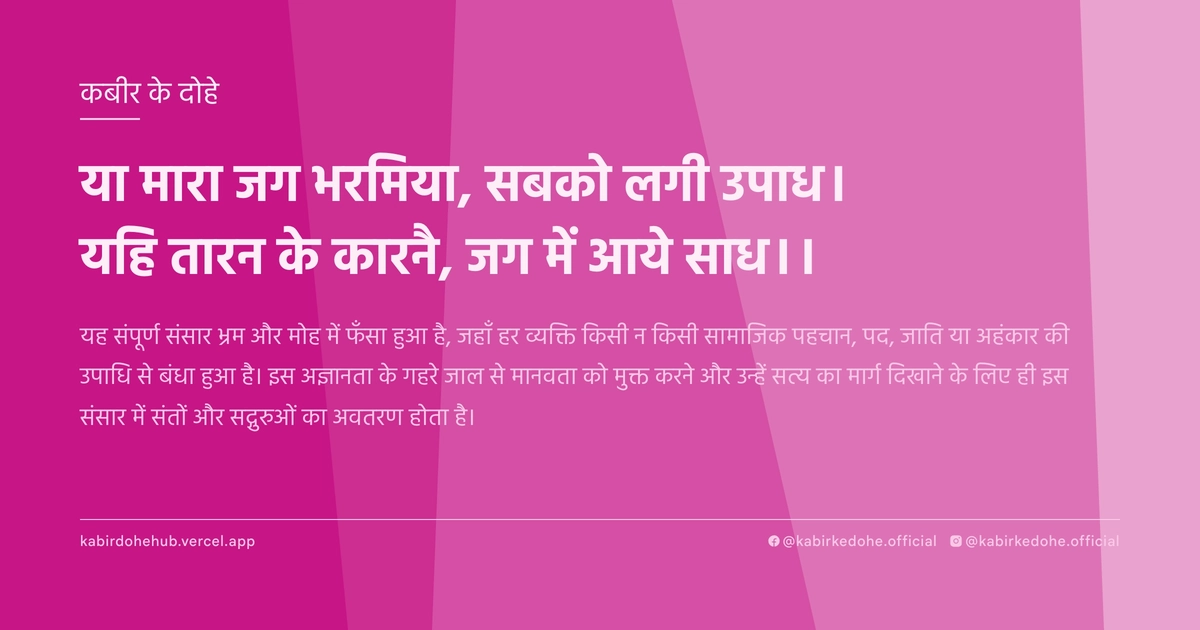
या मारा जग भरमिया, सबको लगी उपाध।
यहि तारन के कारनै, जग में आये साध।।
Ya maara jag bharmiya, sabko lagi upadh. Yahi taaran ke kaaranai, jag mein aaye sadh.
इस पृष्ठ पर इस कबीर दोहे का अर्थ (meaning), हिंदी व्याख्या और अंग्रेज़ी अनुवाद, दार्शनिक विश्लेषण और व्यावहारिक जीवन सीख दी गई है। यह दोहा विश्व-दर्शन (Universalism) विषय से जुड़ा है — Kabir doha meaning and explanation in Hindi and English.
अर्थ (Meaning):
यह संपूर्ण संसार भ्रम और मोह में फँसा हुआ है, जहाँ हर व्यक्ति किसी न किसी सामाजिक पहचान, पद, जाति या अहंकार की उपाधि से बंधा हुआ है। इस अज्ञानता के गहरे जाल से मानवता को मुक्त करने और उन्हें सत्य का मार्ग दिखाने के लिए ही इस संसार में संतों और सद्गुरुओं का अवतरण होता है।
The entire world is wandering in a state of profound delusion, where every individual is shackled by 'upadh'—the superficial labels of caste, creed, status, and ego. To rescue humanity from this intricate web of ignorance and to guide them toward the ultimate truth, enlightened saints and spiritual masters manifest in this world.
व्याख्या (Interpretation):
कबीर यहाँ 'भरमिया' शब्द का प्रयोग अज्ञान की उस स्थिति के लिए करते हैं जहाँ आत्मा स्वयं को शरीर और सामाजिक पहचान समझ बैठती है। 'उपाधि' केवल नाम नहीं, बल्कि वह मानसिक बोझ है जो मनुष्य को उसकी मूल प्रकृति से अलग करता है। यह स्थिति अद्वैत वेदांत के 'माया' सिद्धांत के अनुरूप है, जहाँ द्वैत का भ्रम सत्य को ढक लेता है। साधक का लक्ष्य इस बाहरी आवरण को हटाकर उस निर्गुण ब्रह्म को पहचानना है जो उपाधियों से परे है। यहाँ 'तारन' का अर्थ केवल भौतिक पारगमन नहीं, बल्कि अहंकार का विसर्जन है। जब व्यक्ति यह समझ जाता है कि वह न तो अपनी जाति है, न अपना पेशा और न ही अपना पद, तब वह वास्तविक स्वतंत्रता का अनुभव करता है। यह विरोधाभास है कि मुक्ति के लिए पहले उस बंधन को पहचानना आवश्यक है जिसे हम अपनी पहचान मान बैठे हैं।
Kabir uses the term 'bharmiya' to describe the state of spiritual disorientation where the soul mistakenly identifies itself with the physical body and social constructs. 'Upadh' refers not merely to titles, but to the psychological burdens of identity that alienate a human from their primordial nature. This aligns with the Advaita Vedanta concept of 'Maya,' where the illusion of duality veils the singular Truth. The seeker's goal is to strip away these external layers to realize the Nirgun Brahman, which exists beyond all labels. 'Taran' (crossing over) here signifies not a physical journey, but the dissolution of the ego. The central paradox is that liberation requires the conscious recognition of the very shackles we have mistaken for our identity. Only when one realizes they are neither their caste, nor their profession, nor their status, does true freedom emerge.
दार्शनिक विश्लेषण (Philosophical Analysis):
कबीर का यह दोहा मध्यकालीन भारत के उस सामाजिक परिवेश पर प्रहार करता है जहाँ धर्म और समाज पूरी तरह से बाहरी कर्मकांडों और जातिगत श्रेष्ठता पर आधारित थे। उन्होंने 'उपाधि' को एक मानसिक बीमारी के रूप में देखा, जो मनुष्य को उसकी आंतरिक दिव्यता से दूर करती है। कबीर का दर्शन यहाँ सूफीवाद के 'फना' (अहंकार का विनाश) और अद्वैत के 'अहं ब्रह्मास्मि' का संगम है। वे तर्क देते हैं कि जब तक मनुष्य स्वयं को एक विशिष्ट समूह या श्रेणी का हिस्सा मानता है, वह सार्वभौमिक सत्य तक नहीं पहुँच सकता।
उनका विरोध केवल ब्राह्मणवाद या कट्टरपंथ से नहीं था, बल्कि उस हर मानसिक संरचना से था जो मनुष्य को विभाजित करती है। उनके लिए 'साध' (संत) वह नहीं है जिसने शास्त्र पढ़े हों, बल्कि वह है जिसने अपनी उपाधियों को जला दिया हो। यह मनोवैज्ञानिक रूपांतरण की प्रक्रिया है जहाँ व्यक्ति 'मैं' (अहंकार) से 'वह' (परमात्मा) की ओर बढ़ता है।
ऐतिहासिक रूप से, कबीर ने एक ऐसे समय में यह बात कही जब समाज ऊंच-नीच की गहरी खाइयों में बंटा था। उन्होंने यह स्पष्ट किया कि ईश्वर किसी मंदिर, मस्जिद या विशेष जाति के एकाधिकार में नहीं है, बल्कि वह उस शून्य में है जहाँ कोई नाम या पहचान नहीं बचती।
दार्शनिक स्तर पर, यह दोहा यह समझाता है कि संसार एक भूलभुलैया है क्योंकि हम सत्य को खोजने के बजाय अपनी पहचान को संवारने में समय व्यतीत करते हैं। वास्तविक ज्ञान वह है जो हमें यह बताए कि हम वह नहीं हैं जो दुनिया हमें बताती है।
अंततः, कबीर यह संदेश देते हैं कि गुरु या साधक का कार्य केवल उपदेश देना नहीं, बल्कि शिष्य के भीतर के उस भ्रम को तोड़ना है जो उसे उसकी अपनी अनंतता से अलग करता है। यह एक आध्यात्मिक शल्य चिकित्सा है जो अहंकार के ट्यूमर को हटाती है।
Kabir’s couplet strikes at the heart of the medieval Indian social fabric, where religion and society were rigidly structured around external rituals and caste hierarchies. He perceives 'upadh' (labels) as a psychological pathology that alienates the human soul from its inherent divinity. His philosophy here represents a convergence of the Sufi concept of 'Fana' (annihilation of the self) and the Advaita realization of 'Aham Brahmasmi' (I am Brahman). He argues that as long as a person identifies with a specific group or category, they remain barred from the universal truth.
His rebellion was not merely against Brahmanism or orthodoxy, but against every mental construct that fosters division. For Kabir, a 'Sadh' (saint) is not one who has mastered scriptures, but one who has incinerated their own labels. This is a process of psychological transmutation where the individual shifts from the narrow 'I' (ego) toward the expansive 'That' (the Absolute).
Historically, Kabir spoke during an era of deep societal fragmentation. He clarified that the Divine is not the monopoly of any temple, mosque, or specific caste, but resides in the 'Shunya' (void) where all names and identities cease to exist.
On a philosophical level, this doha explains that the world is a labyrinth because we spend our lives polishing our identities rather than seeking the Truth. True knowledge is the realization that we are not who the world tells us we are.
Ultimately, Kabir suggests that the role of the Guru or the Saint is not merely to preach, but to shatter the illusion within the disciple that separates them from their own infinity. It is a spiritual surgery designed to excise the tumor of the ego.
मूल संदेश (Core Message):
- सामाजिक पहचान एक मानसिक कारागार है जिसे हम स्वयं निर्मित करते हैं।
- सत्य की खोज तब शुरू होती है जब हम 'मैं' की परिभाषा बदलना शुरू करते हैं।
- अहंकार का विसर्जन ही वास्तविक आध्यात्मिक उत्थान का एकमात्र मार्ग है।
- बाहरी उपाधियाँ केवल माया हैं; आंतरिक चेतना ही एकमात्र शाश्वत सत्य है।
- गुरु का कार्य हमें हमारी झूठी पहचान से मुक्त कराकर सत्य से मिलाना है।
- Social identity is a mental prison we construct for ourselves.
- The search for Truth begins when we redefine the meaning of 'I'.
- The dissolution of ego is the only path to genuine spiritual ascension.
- External labels are mere Maya; internal consciousness is the only eternal Truth.
- The Guru's role is to liberate us from false identities and unite us with the Truth.
व्यावहारिक उदाहरण (Practical Example):
वाराणसी के एक पुराने घाट पर माधव नाम का एक वृद्ध बुनकर रहता था। माधव अपनी बुनाई की कला में इतना निपुण था कि पूरे शहर में उसकी धागों की बारीकी की चर्चा थी। लेकिन इस निपुणता ने उसके भीतर एक गहरा अहंकार पैदा कर दिया था। वह खुद को 'सर्वश्रेष्ठ बुनकर' की उपाधि से जोड़ चुका था और अपने से छोटे बुनकरों को तुच्छ समझने लगा था।
एक दिन, एक फकीर उसके पास आया जिसने साधारण से फटे कपड़े पहने थे। फकीर ने माधव से एक छोटा सा टुकड़ा बुनने को कहा, लेकिन शर्त यह थी कि वह अपनी पहचान और अपनी श्रेष्ठता का गर्व छोड़कर केवल एक साधारण सेवक की तरह काम करे। माधव को यह बात चुभी, लेकिन जिज्ञासावश वह मान गया।
जैसे-जैसे वह बुनने लगा, फकीर उससे प्रश्न करता रहा—'यह धागा कौन है? यह रंग किसका है? और वह बुनने वाला कौन है जिसे तुम श्रेष्ठ कहते हो?' माधव ने उत्तर दिया, 'मैं हूँ, मैं माधव हूँ, सबसे बड़ा कलाकार!'
फकीर ने जोर से हंसते हुए कहा, 'माधव तो केवल एक नाम है, एक उपाधि है। यदि आज तुम्हारी आँखें चली जाएं या हाथ कांपने लगें, तो क्या यह 'श्रेष्ठ बुनकर' जीवित रहेगा? तुम उस उपाधि से चिपके हो जो कल मिट जाएगी, जबकि वह जो इस शरीर को चला रहा है, वह कभी नहीं मिटता।'
माधव को गहरा धक्का लगा। उसने महसूस किया कि उसने अपना पूरा जीवन एक 'लेबल' को सजाने में बिता दिया था, जबकि उसके भीतर का मनुष्य मर चुका था। उसे समझ आया कि उसकी श्रेष्ठता का गर्व वास्तव में उसकी सबसे बड़ी बेड़ी थी।
उस रात माधव सो नहीं सका। उसने अपनी सारी उपलब्धियों की सूची को मानसिक रूप से जला दिया। उसने महसूस किया कि वह न तो श्रेष्ठ बुनकर है, न ही केवल एक ब्राह्मण या एक निवासी; वह केवल एक चेतना है जो ब्रह्मांड के महान बुनकर का एक छोटा सा हिस्सा है।
अगले दिन से माधव का व्यवहार बदल गया। वह अब छोटे बुनकरों को नीचा नहीं दिखाता था, बल्कि उन्हें सिखाने लगा। उसने अपनी कला को अपनी पहचान नहीं, बल्कि अपनी सेवा का माध्यम बना लिया।
उसकी आँखों में अब एक नई चमक थी। वह अब 'श्रेष्ठ' होने की दौड़ से मुक्त हो चुका था। उसने पाया कि जब उसने 'सर्वश्रेष्ठ बुनकर' की उपाधि को त्याग दिया, तब उसे वह शांति मिली जो उसे जीवन भर की प्रसिद्धि से नहीं मिली थी।
माधव अब केवल कपड़े नहीं बुनता था, वह लोगों के बीच प्रेम और समानता के धागे बुनने लगा। उसकी कला अब अहंकार से नहीं, बल्कि करुणा से प्रेरित थी।
यह माधव का 'तारण' था—उपाधियों के सागर से पार होकर स्वयं की वास्तविक पहचान तक पहुँचना।
On an ancient ghat in Varanasi lived an elderly weaver named Madhav. Madhav was so skilled in his craft that the intricacy of his threads was discussed throughout the city. However, this mastery had birthed a profound ego within him. He had identified himself with the title of 'The Greatest Weaver' and began to view lesser weavers with contempt.
One day, a wandering dervish arrived, dressed in simple, tattered clothes. The dervish asked Madhav to weave a small piece of cloth, but on one condition: he must set aside his identity and his pride of superiority and work simply as a humble servant.
Madhav felt insulted, but out of curiosity, he agreed. As he began to weave, the dervish kept questioning him—'Who is this thread? Whose color is this? And who is this weaver you call the greatest?' Madhav replied, 'It is I, Madhav, the master artist!'
The dervish laughed loudly and said, 'Madhav is merely a name, a label. If your eyes fail today or your hands tremble, will this "Greatest Weaver" survive? You are clinging to a title that will vanish tomorrow, while the one who animates this body never vanishes.'
Madhav was shaken. He realized he had spent his entire life decorating a 'label,' while the human within him had withered. He understood that his pride in superiority was, in fact, his heaviest chain.
That night, Madhav could not sleep. He mentally burned the list of all his achievements. He realized he was neither the great weaver, nor merely a caste member or a resident; he was simply a consciousness, a small part of the Universe's Great Weaver.
From the next day, Madhav's behavior transformed. He no longer looked down upon other weavers; instead, he began to mentor them. He stopped treating his art as his identity and started treating it as a medium of service.
There was now a new light in his eyes. He had escaped the race to be 'the best.' He discovered that once he discarded the title of 'The Greatest Weaver,' he found a peace that lifelong fame had never provided.
Madhav no longer just wove cloth; he began weaving threads of love and equality among people. His art was now driven by compassion rather than ego.
This was Madhav's 'Taran'—crossing the ocean of labels to reach his authentic self.
अभ्यास मार्गदर्शन (Practice Guidance):
- दैनिक आत्म-निरीक्षण: प्रतिदिन 15 मिनट मौन बैठें और विचार करें कि आज आपने किन-किन 'उपाधियों' (जैसे- मैं बॉस हूँ, मैं पीड़ित हूँ, मैं ज्ञानी हूँ) के आधार पर प्रतिक्रिया दी।
- पहचान का विसर्जन अभ्यास: जब भी क्रोध या अहंकार महसूस हो, स्वयं से पूछें—'यदि मेरा यह पद, यह नाम और यह रिश्ता छीन लिया जाए, तो मैं वास्तव में कौन हूँ?'
- सेवा का संकल्प: सप्ताह में एक बार ऐसा कार्य करें जिसमें आपकी सामाजिक पहचान पूरी तरह गौण हो और आप केवल एक निस्वार्थ सहायक के रूप में कार्य करें।
- डायग्नोस्टिक चेकलिस्ट: क्या आप अपनी प्रशंसा सुनकर उत्साहित होते हैं? क्या आप दूसरों को उनकी जाति या पद से आंकते हैं? क्या आप अपनी पहचान खोने के डर से तनाव में रहते हैं? यदि हाँ, तो आप अभी भी 'उपाधि' के बंधन में हैं।
- Daily Self-Observation: Spend 15 minutes in silence daily, reflecting on which 'labels' (e.g., 'I am the boss,' 'I am the victim,' 'I am the expert') drove your reactions today.
- Identity Dissolution Practice: Whenever anger or pride arises, ask yourself—'If this position, this name, and this relationship were stripped away, who would I actually be?'
- Vow of Service: Once a week, perform a task where your social identity is completely irrelevant and you act solely as a selfless helper.
- Diagnostic Checklist: Do you feel an emotional surge upon being praised? Do you judge others based on their caste or status? Do you feel anxiety at the thought of losing your identity? If yes, you are still shackled by 'upadh'.
चिंतन प्रश्न (Reflection Questions):
- यदि आपसे आपकी सभी डिग्रियाँ, पद और पारिवारिक संबंध छीन लिए जाएँ, तो आपके पास बचने के लिए क्या बचेगा?
- आपकी वह कौन सी 'उपाधि' है जिसे आप सबसे अधिक सहेज कर रखते हैं, और वह आपको किस तरह सीमित कर रही है?
- क्या आप अपनी डिजिटल पहचान (सोशल मीडिया प्रोफाइल) को ही अपना वास्तविक अस्तित्व मानने की भूल कर रहे हैं?
- जब आप किसी को 'नीचा' देखते हैं, तो वास्तव में आप किस उपाधि का सहारा ले रहे होते हैं?
- क्या आपकी भक्ति ईश्वर के प्रति है, या उस छवि के प्रति जो आप दुनिया को दिखाना चाहते हैं कि आप एक 'भक्त' हैं?
- If all your degrees, positions, and family ties were stripped away, what would remain of you?
- Which 'label' do you cherish the most, and in what way is it limiting your growth?
- Are you mistaking your digital identity (social media profiles) for your actual existence?
- When you look down upon someone, which specific label are you leaning on to justify that superiority?
- Is your devotion directed toward the Divine, or toward the image of being a 'devotee' that you wish to project to the world?