
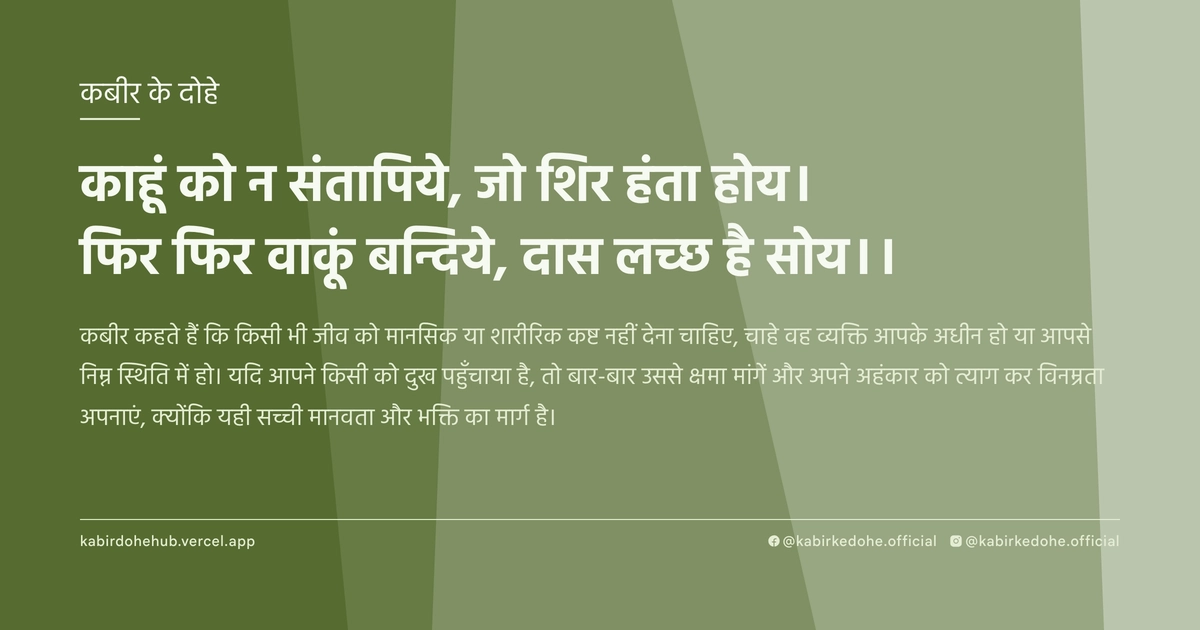
काहूं को न संतापिये, जो शिर हंता होय।
फिर फिर वाकूं बन्दिये, दास लच्छ है सोय।।
Kahun ko na santapiye, jo shir hanta hoye. Phir phir vakun bandiye, das lachh hai soy.
इस पृष्ठ पर इस कबीर दोहे का अर्थ (meaning), हिंदी व्याख्या और अंग्रेज़ी अनुवाद, दार्शनिक विश्लेषण और व्यावहारिक जीवन सीख दी गई है। यह दोहा क्षमा (Forgiveness) विषय से जुड़ा है — Kabir doha meaning and explanation in Hindi and English.
अर्थ (Meaning):
कबीर कहते हैं कि किसी भी जीव को मानसिक या शारीरिक कष्ट नहीं देना चाहिए, चाहे वह व्यक्ति आपके अधीन हो या आपसे निम्न स्थिति में हो। यदि आपने किसी को दुख पहुँचाया है, तो बार-बार उससे क्षमा मांगें और अपने अहंकार को त्याग कर विनम्रता अपनाएं, क्योंकि यही सच्ची मानवता और भक्ति का मार्ग है।
Kabir advises against causing distress or suffering to any living being, regardless of their social standing or your power over them. If one has caused pain to another, they must repeatedly seek forgiveness and bind themselves in humility, for the annihilation of the ego through apology is the only path to true spiritual liberation.
व्याख्या (Interpretation):
इस दोहे का शाब्दिक अर्थ है कि किसी को संताप (दुख) न दें। आध्यात्मिक स्तर पर, 'संताप' केवल बाहरी कष्ट नहीं, बल्कि अहंकार का प्रहार है। जब हम किसी को नीचा दिखाते हैं, तो हम वास्तव में अपने भीतर के 'अहं' को पुष्ट कर रहे होते हैं, जो हमें ब्रह्म से अलग करता है। निर्गुण भक्ति में, ईश्वर हर कण में व्याप्त है; अतः किसी भी मनुष्य को कष्ट देना साक्षात परमात्मा को कष्ट देने के समान है। 'बन्दिये' शब्द यहाँ केवल क्षमा मांगने के लिए नहीं, बल्कि अहंकार की बेड़ियों को तोड़ने और प्रेम के बंधन में बंधने का संकेत है। यह अद्वैत वेदांत के उस सिद्धांत को पुष्ट करता है जहाँ 'स्व' और 'पर' का भेद समाप्त हो जाता है।
Literally, the verse warns against causing suffering. Metaphorically, 'suffering' represents the friction caused by the ego. When we oppress another, we reinforce the illusion of separation (Maya), believing ourselves superior. In Nirgun Bhakti, the Divine is formless and omnipresent; thus, harming any creature is an assault on the Divine itself. The term 'bandiye' (to bind/request) suggests a paradoxical liberation: by humbling oneself and seeking forgiveness, the seeker breaks the chains of pride. This aligns with Advaita Vedanta, where the realization that the Atman in me is the same as the Atman in you renders all cruelty impossible, transforming the relationship from master-servant to soul-soul.
दार्शनिक विश्लेषण (Philosophical Analysis):
कबीर का यह संदेश उस युग की प्रतिक्रिया है जहाँ जातिगत श्रेष्ठता और धार्मिक कट्टरता चरम पर थी। उन्होंने कर्मकांडों के बजाय 'मानवता' को सर्वोच्च धर्म माना। यह दर्शन सूफीवाद के 'इश्क' (प्रेम) और अद्वैत वेदांत के 'अहं ब्रह्मास्मि' का संगम है। कबीर तर्क देते हैं कि यदि आप ईश्वर को खोज रहे हैं, तो वह किसी मंदिर या मस्जिद में नहीं, बल्कि पीड़ित मानवता की सेवा और करुणा में मिलेगा।
यहाँ 'शिर हंता' (सिर काटने वाला या दमनकारी) का प्रतीक वह व्यक्ति है जो सत्ता या ज्ञान के मद में चूर है। कबीर इस मनोवैज्ञानिक जाल को तोड़ते हैं कि क्षमा मांगना कमजोरी है। इसके विपरीत, वे इसे आध्यात्मिक शुद्धि की प्रक्रिया मानते हैं। जब एक शक्तिशाली व्यक्ति एक कमजोर से क्षमा मांगता है, तो वह वास्तव में अपने भीतर के 'अहंकार' की हत्या करता है।
यह दृष्टिकोण सामाजिक पदानुक्रम (Caste Hierarchy) पर सीधा प्रहार है। कबीर के अनुसार, आध्यात्मिक उन्नति के लिए सबसे पहली शर्त है—दूसरे के प्रति संवेदनशीलता। बिना करुणा के ज्ञान केवल एक बोझ है।
सूफी मत के 'फना' (अहंकार का विनाश) की तरह, यहाँ भी स्वयं को मिटाने की बात है। जब तक 'मैं' जीवित है, तब तक 'वह' (परमात्मा) प्रकट नहीं हो सकता। क्षमा मांगना उस 'मैं' को मिटाने का एक व्यावहारिक उपकरण है।
अंततः, यह दोहा हमें सिखाता है कि मोक्ष केवल ध्यान या जप से नहीं, बल्कि व्यवहारिक नैतिकता और दूसरों के प्रति निस्वार्थ प्रेम से प्राप्त होता है। यह धर्म को कर्मकांड से हटाकर आचरण में लाता है।
Kabir’s message is a visceral reaction to the rigid caste hierarchies and religious dogmatism of his era. He elevates 'humanity' above ritualism, blending the Sufi concept of 'Ishq' (divine love) with the Advaita Vedanta realization of non-duality. He posits that the Divine is not found in shrines but in the heart of the suffering.
The phrase 'shir hanta' symbolizes the oppressor—one blinded by power or intellectual pride. Kabir dismantles the psychological fallacy that seeking forgiveness is a sign of weakness. Instead, he frames it as a rigorous process of spiritual purification. When a superior seeks pardon from an inferior, the act is not a social defeat but a spiritual victory over the ego.
This philosophy directly challenges the social stratification of the time. For Kabir, empathy is the prerequisite for enlightenment. Knowledge without compassion is merely an intellectual ornament, devoid of spiritual potency.
Similar to the Sufi concept of 'Fana' (annihilation of the self), the act of apologizing is a tool for the dissolution of the 'I'. As long as the ego persists, the realization of the formless Brahman remains obscured. The 'binding' mentioned in the text is the binding of the self to the truth of universal kinship.
Ultimately, this Doha shifts the locus of salvation from external rituals to internal ethical conduct. It suggests that liberation is achieved not through the repetition of mantras, but through the active practice of kindness and the courageous dismantling of one's own pride.
मूल संदेश (Core Message):
- अहंकार ही आत्मा और परमात्मा के बीच की सबसे बड़ी दीवार है।
- किसी को नीचा दिखाना वास्तव में अपनी आध्यात्मिक गिरावट को निमंत्रण देना है।
- क्षमा मांगना कमजोरी नहीं, बल्कि उच्चतम स्तर की मानसिक शक्ति है।
- करुणा के बिना ज्ञान केवल एक बौद्धिक भ्रम है।
- सच्ची भक्ति का मार्ग दूसरों के प्रति संवेदनशीलता से होकर गुजरता है।
- The ego is the primary wall separating the individual soul from the Universal Truth.
- Belittling another is an invitation to one's own spiritual decline.
- Seeking forgiveness is not a sign of weakness, but of supreme psychological strength.
- Knowledge devoid of compassion is merely an intellectual illusion.
- The path to true devotion is paved with sensitivity toward all living beings.
व्यावहारिक उदाहरण (Practical Example):
वाराणसी के एक पुराने मोहल्ले में रामदीन नाम का एक वृद्ध बुनकर रहता था, जो अपने काम में अत्यंत निपुण था। उसका एक युवा सहायक था, माधव, जो अक्सर गलतियाँ करता था। रामदीन का स्वभाव कठोर था और वह छोटी-छोटी गलतियों पर माधव को सबके सामने अपमानित करता और उसे डांटता था। वह मानता था कि अनुशासन ही श्रेष्ठता की कुंजी है।
एक दिन, रामदीन ने एक बहुत बड़े ऑर्डर के दौरान माधव पर चिल्लाते हुए उसे 'मूर्ख' और 'अक्षम' कहा, जिससे माधव की आँखों में आँसू आ गए और वह चुपचाप काम छोड़कर चला गया। उस रात रामदीन को नींद नहीं आई। उसे कबीर का यह दोहा याद आया कि किसी को संताप नहीं देना चाहिए।
उसे अहसास हुआ कि उसकी निपुणता उसके अहंकार का कवच बन गई थी। उसने महसूस किया कि माधव की गलतियाँ उसकी अपनी अधीरता का प्रतिबिंब थीं। अगले दिन, रामदीन ने माधव को बुलाया।
पूरे मोहल्ले के सामने, जो अब तक रामदीन के डर से चुप रहते थे, उसने माधव का हाथ पकड़ा और उससे अपनी कठोरता के लिए क्षमा मांगी। उसने स्वीकार किया कि उसका ज्ञान उसके अहंकार के कारण जहर बन गया था।
माधव स्तब्ध था, लेकिन उसकी आँखों में अब डर नहीं, बल्कि सम्मान था। इस एक कृत्य ने रामदीन के भीतर के भारीपन को खत्म कर दिया।
रामदीन ने अब माधव को केवल एक सहायक नहीं, बल्कि एक शिष्य और मित्र की तरह देखना शुरू किया। उसने सीखा कि सुधार डांट से नहीं, बल्कि प्रेम और धैर्य से आता है।
धीरे-धीरे, रामदीन का व्यवहार पूरे मोहल्ले के लिए मिसाल बन गया। लोग अब उससे केवल उसकी बुनाई के लिए नहीं, बल्कि उसकी विनम्रता के लिए जुड़ने लगे।
रामदीन ने पाया कि जब उसने माधव को 'बन्दिया' (विनम्रता से स्वीकार) किया, तो वास्तव में वह स्वयं अपनी मानसिक प्रताड़ना से मुक्त हो गया। उसका जीवन अब शांति और संतोष से भर गया था।
In an ancient lane of Varanasi lived Ramdeen, an elderly weaver of unmatched skill. He had a young assistant, Madhav, who was eager but prone to mistakes. Ramdeen, driven by a rigid sense of perfection, often belittled Madhav, shouting at him in front of others to assert his dominance and discipline.
One afternoon, during a high-stakes commission, Ramdeen unleashed a torrent of insults upon Madhav, calling him 'worthless' and 'clumsy.' Madhav, overwhelmed by shame, left the loom in silence and walked away with tears in his eyes. That night, Ramdeen found no peace; sleep evaded him as Kabir’s words echoed in his mind: 'Do not cause distress to any soul.'
He realized that his mastery of the craft had become a fortress for his ego. He saw that his anger was not about Madhav’s errors, but about his own inability to be patient. The 'shir hanta' (oppressor) was not a king or a soldier, but himself in his small workshop.
The next morning, Ramdeen summoned Madhav. In the presence of the other weavers—who had long feared Ramdeen’s temper—the old man took Madhav’s hand and sincerely apologized for his cruelty. He admitted that his knowledge had become a poison because it lacked love.
Madhav was stunned. The power dynamic shifted instantly; the fear in his eyes was replaced by a profound sense of respect. By humbling himself, Ramdeen felt a physical weight lift from his chest.
From that day on, Ramdeen stopped treating Madhav as a mere tool of production and began treating him as a fellow seeker. He discovered that growth is nurtured by patience, not by the whip of criticism.
This transformation rippled through the neighborhood. People began to seek Ramdeen not just for his exquisite fabrics, but for his newfound serenity and wisdom.
Ramdeen discovered the 'Kabir Twist': by binding himself to the act of apology, he had finally broken the chains of his own arrogance. He found that the highest art was not the weaving of silk, but the weaving of human hearts.
अभ्यास मार्गदर्शन (Practice Guidance):
- दैनिक आत्म-निरीक्षण: प्रतिदिन सोने से पहले विचार करें कि क्या आज आपने अनजाने में भी किसी को मानसिक या भावनात्मक ठेस पहुँचाई है।
- सक्रिय क्षमा याचना: यदि आपको अपनी गलती का अहसास हो, तो बिना किसी तर्क या 'लेकिन' के, उस व्यक्ति से सीधे क्षमा मांगें।
- मौन अभ्यास: जब भी क्रोध आए, 10 गहरी सांसें लें और विचार करें कि सामने वाला व्यक्ति भी उसी ब्रह्म का अंश है जिसे आप खोज रहे हैं।
- डायग्नोस्टिक चेकलिस्ट: क्या आप दूसरों की गलतियों पर तुरंत प्रतिक्रिया देते हैं? क्या आप क्षमा मांगने को अपनी हार मानते हैं? यदि हाँ, तो आपका अहंकार अभी भी सक्रिय है।
- Daily Self-Audit: Before sleep, reflect on whether you caused any mental or emotional distress to another, even unintentionally.
- Active Atonement: Upon realizing a mistake, seek forgiveness directly and sincerely, without adding justifications or 'buts' to your apology.
- The Breath of Unity: When anger arises, take ten deep breaths and consciously remind yourself that the person before you is a manifestation of the same Divine essence you seek.
- Diagnostic Checklist: Do you react instantly to others' flaws? Do you perceive apologizing as a loss of status? If yes, your ego is still operating the steering wheel of your life.
चिंतन प्रश्न (Reflection Questions):
- आपकी सामाजिक स्थिति या पद आपको दूसरों के प्रति कठोर होने का अधिकार कैसे देता है, और क्या यह अधिकार वास्तव में वास्तविक है?
- जब आप किसी से क्षमा मांगते हैं, तो क्या आप वास्तव में अपनी गलती स्वीकार करते हैं, या केवल स्थिति को शांत करने का नाटक करते हैं?
- आपके जीवन में वह कौन सा व्यक्ति है जिसे आपने सबसे अधिक संताप दिया है, और आप उसे मुक्त करने के लिए क्या कर सकते हैं?
- क्या आपकी 'डिजिटल पहचान' (सोशल मीडिया) आपको दूसरों को जज करने और नीचा दिखाने के लिए प्रोत्साहित करती है?
- यदि आप अपनी पूरी पहचान (नाम, पद, जाति) खो दें, तो आपके पास दूसरों को देने के लिए क्या बचेगा?
- How does your social status or professional rank grant you a perceived 'right' to be harsh with others, and is this right grounded in any ultimate truth?
- When you apologize, are you truly acknowledging the pain caused, or are you simply performing a social ritual to restore peace?
- Who is the person in your life you have caused the most distress to, and what concrete step can you take to liberate them and yourself from that pain?
- Does your digital persona encourage you to judge and diminish others from a distance of perceived superiority?
- If you were stripped of your name, title, and caste, what would remain of you to offer to another human being?