
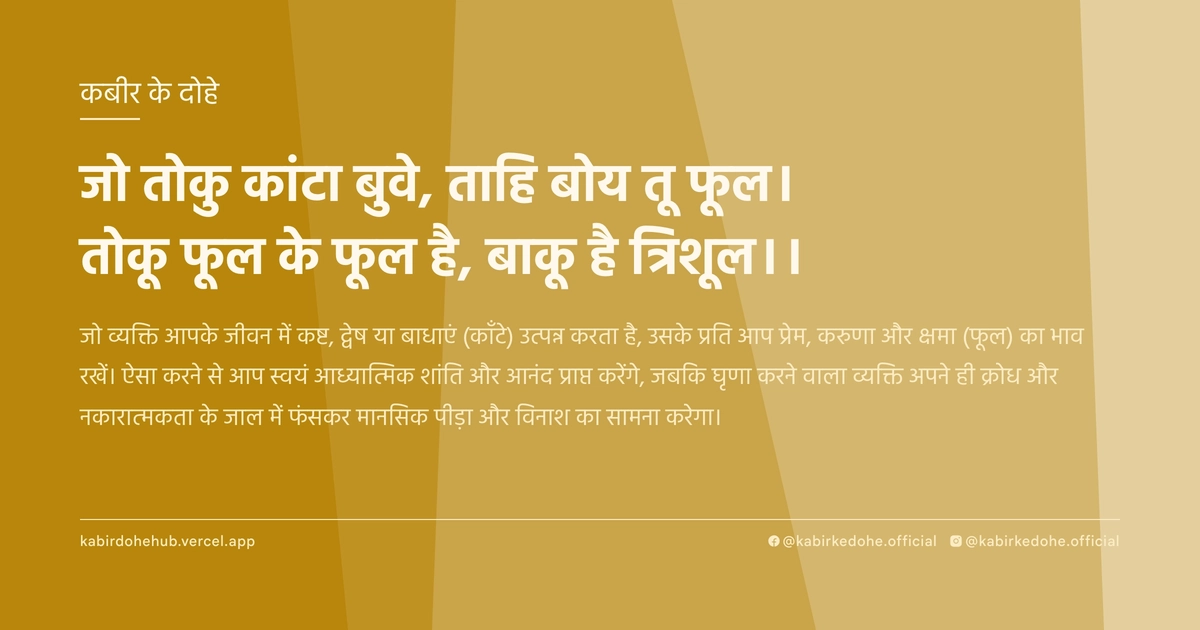
जो तोकु कांटा बुवे, ताहि बोय तू फूल।
तोकू फूल के फूल है, बाकू है त्रिशूल।।
Jo toku kanta buve, tahi boy tu phool. Toku phool ke phool hai, baaku hai trishul.
इस पृष्ठ पर इस कबीर दोहे का अर्थ (meaning), हिंदी व्याख्या और अंग्रेज़ी अनुवाद, दार्शनिक विश्लेषण और व्यावहारिक जीवन सीख दी गई है। यह दोहा क्षमा (Forgiveness) विषय से जुड़ा है — Kabir doha meaning and explanation in Hindi and English.
अर्थ (Meaning):
जो व्यक्ति आपके जीवन में कष्ट, द्वेष या बाधाएं (काँटे) उत्पन्न करता है, उसके प्रति आप प्रेम, करुणा और क्षमा (फूल) का भाव रखें। ऐसा करने से आप स्वयं आध्यात्मिक शांति और आनंद प्राप्त करेंगे, जबकि घृणा करने वाला व्यक्ति अपने ही क्रोध और नकारात्मकता के जाल में फंसकर मानसिक पीड़ा और विनाश का सामना करेगा।
Whoever sows thorns of hatred or hardship in your path, respond to them by planting flowers of love and compassion. By choosing kindness over retaliation, you cultivate a garden of inner peace and spiritual growth, while the one who harbors malice remains trapped in their own toxicity, effectively creating a trident of suffering for themselves.
व्याख्या (Interpretation):
यह दोहा बाहरी संघर्ष के बजाय आंतरिक रूपांतरण की बात करता है। 'काँटा' यहाँ केवल भौतिक चोट नहीं, बल्कि अहंकार, ईर्ष्या और द्वेष का प्रतीक है। जब हम प्रतिशोध लेते हैं, तो हम उसी निम्न चेतना के स्तर पर उतर जाते हैं जहाँ हमारा शत्रु है। 'फूल' बोने का अर्थ है निर्गुण भक्ति के उस मार्ग पर चलना जहाँ द्वैत समाप्त हो जाता है और केवल प्रेम शेष रहता है। यह अद्वैत वेदांत के उस सत्य को दर्शाता है कि शत्रु और मित्र वास्तव में एक ही चेतना के भिन्न रूप हैं। यदि हम घृणा का उत्तर घृणा से देते हैं, तो हम माया के भ्रम में फंसे रहते हैं। लेकिन जब हम करुणा चुनते हैं, तो हम अपनी आत्मा (Atman) को उस परमात्मा (Brahman) से जोड़ लेते हैं जो सर्वव्यापी है। 'त्रिशूल' यहाँ ईश्वरीय न्याय या कर्म के सिद्धांत का प्रतीक है, जो यह बताता है कि नकारात्मकता अंततः स्वयं कर्ता को ही नष्ट करती है।
This couplet transcends the superficial notion of forgiveness, focusing instead on the alchemy of internal transformation. The 'thorn' symbolizes not just a physical injury, but the psychic projections of ego, jealousy, and malice. To respond with a 'flower' is to consciously shift one's vibration from the frequency of conflict to the frequency of unconditional love, a cornerstone of Nirgun Bhakti. In the lens of Advaita Vedanta, the perceived 'enemy' is merely a reflection of the self in a distorted mirror; thus, hating the other is hating a part of the universal consciousness. By refusing to retaliate, the seeker breaks the cycle of Maya (illusion) and realizes the non-duality of existence. The 'trident' (Trishul) serves as a potent metaphor for the law of Karma—the inevitable psychic collapse of one who lives in hatred. While the practitioner of love blooms, the practitioner of hate constructs their own instrument of destruction.
दार्शनिक विश्लेषण (Philosophical Analysis):
कबीर का यह दर्शन उस समय के कट्टरपंथी सामाजिक और धार्मिक वातावरण के विरुद्ध एक क्रांतिकारी प्रहार था। उन्होंने देखा कि धर्म के नाम पर लोग एक-दूसरे के प्रति घृणा फैला रहे थे। कबीर ने कर्मकांडों और बाहरी आडंबरों को नकारते हुए 'सहज' मार्ग पर जोर दिया। उनका यह विचार कि शत्रु को भी प्रेम दिया जाए, सूफीवाद के 'इश्क-ए-हकीकी' (ईश्वरीय प्रेम) से गहराई से मेल खाता है, जहाँ प्रेमी अपने अस्तित्व को मिटाकर केवल प्रेम में विलीन हो जाता है।
दार्शनिक स्तर पर, यह दोहा अहंकार (Ego) के विसर्जन की प्रक्रिया है। जब कोई हमें चोट पहुँचाता है, तो हमारा अहंकार घायल होता है और प्रतिशोध की मांग करता है। कबीर कहते हैं कि इस प्रतिक्रिया को रोकना ही वास्तविक साधना है। यह मनोवैज्ञानिक रूपांतरण है जहाँ व्यक्ति 'प्रतिक्रिया' (Reaction) से 'प्रतिसाद' (Response) की ओर बढ़ता है।
अद्वैत वेदांत के अनुसार, जब तक हम स्वयं को दूसरे से अलग मानते हैं, तब तक द्वेष संभव है। जैसे ही यह बोध होता है कि 'सोहम' (वह मैं हूँ), शत्रुता समाप्त हो जाती है। कबीर यहाँ यह स्पष्ट कर रहे हैं कि करुणा कोई कमजोरी नहीं, बल्कि उच्चतम आध्यात्मिक शक्ति है।
ऐतिहासिक रूप से, कबीर ने जाति और धर्म की दीवारों को ढहाने के लिए प्रेम को ही एकमात्र औजार बनाया। उन्होंने सिखाया कि मंदिर या मस्जिद जाने से अधिक महत्वपूर्ण यह है कि आप अपने भीतर के मनुष्य को कैसे जागृत करते हैं।
अंततः, यह दोहा हमें सिखाता है कि हम अपने भाग्य के निर्माता स्वयं हैं। यदि हम घृणा चुनते हैं, तो हम नरक का निर्माण करते हैं; यदि हम प्रेम चुनते हैं, तो हम मोक्ष का मार्ग प्रशस्त करते हैं। यह एक ऐसी मानसिक अवस्था है जहाँ व्यक्ति बाहरी परिस्थितियों से अप्रभावित रहकर अपनी आंतरिक शांति को सुरक्षित रखता है।
Kabir’s philosophy emerged as a radical critique of the rigid socio-religious structures of his era, where communal hatred was often sanctioned by ritualistic purity and caste hierarchies. By advocating for the planting of 'flowers' in response to 'thorns,' Kabir dismantles the logic of retaliation, proposing instead a path of 'Sahaja' (spontaneous naturality). This approach aligns profoundly with the Sufi concept of 'Ishq-e-Haqiqi' (Divine Love), where the annihilation of the lower self (Fana) allows the practitioner to see the Divine in every being, regardless of their conduct.
From a metaphysical perspective, this Doha addresses the dissolution of the Ego. When we are hurt, the ego perceives a threat and demands vengeance to restore its perceived power. Kabir suggests that the only way to truly defeat an enemy is to dissolve the very concept of the 'enemy' within oneself. This is a psychological shift from reactive behavior to conscious response, moving the practitioner from a state of bondage to a state of liberation.
Integrating Advaita Vedanta, the teaching emphasizes the non-duality of the observer and the observed. If the Atman is universal, then the one who sows thorns is merely a confused soul acting out of ignorance (Avidya). To hate them is to remain trapped in the illusion of separation. By responding with love, the seeker acknowledges the shared divinity and transcends the duality of friend and foe.
Historically, Kabir used such paradoxes to challenge the hypocrisy of the religious elite. He argued that no amount of ritual bathing or prayer could cleanse a heart filled with malice. True purity is found in the capacity to love those who are unlovable, thereby turning a conflict into a catalyst for spiritual awakening.
Ultimately, the 'Trishul' represents the self-correcting nature of the universe. The energy of hatred is a boomerang; it must return to the sender. By refusing to participate in the cycle of violence, the seeker ensures that their own path remains floral and fragrant, while the aggressor is left to grapple with the psychic debris of their own making.
मूल संदेश (Core Message):
- घृणा का उत्तर घृणा से देना केवल अंधकार को बढ़ाना है।
- करुणा वह अग्नि है जो शत्रुता के लोहे को प्रेम के सोने में बदल देती है।
- आपका आंतरिक साम्राज्य आपकी प्रतिक्रियाओं से निर्धारित होता है, परिस्थितियों से नहीं।
- अहंकार का विसर्जन ही वास्तविक आध्यात्मिक विजय है।
- प्रेम वह एकमात्र सेतु है जो द्वैत को अद्वैत में बदल देता है।
- Responding to hatred with hatred only deepens the darkness of the soul.
- Compassion is the alchemy that transforms the iron of enmity into the gold of love.
- Your internal empire is defined by your responses, not by your circumstances.
- The dissolution of the ego is the only true spiritual victory.
- Love is the sole bridge that converts the illusion of duality into the truth of oneness.
व्यावहारिक उदाहरण (Practical Example):
एक समय की बात है, बनारस के घाटों के पास एक वृद्ध विधवा रहती थी, जिनका नाम जानकी था। जानकी का जीवन अत्यंत कठिन था और उनके पड़ोस में रहने वाली एक महिला, सुमित्रा, उनसे बहुत ईर्ष्या करती थी। सुमित्रा अक्सर जानकी के बारे में गाँव में झूठ फैलाती, उनके रास्ते में कचरा डाल देती और उन्हें नीचा दिखाने का कोई मौका नहीं छोड़ती थी।
जानकी ने यह सब देखा, लेकिन उन्होंने कभी पलटकर जवाब नहीं दिया। जब सुमित्रा ने जानकी के छोटे से बगीचे में रात के अंधेरे में कांटेदार झाड़ियाँ लगा दीं, तो जानकी ने सुबह उठकर उन्हें देखा। उन्होंने क्रोध करने के बजाय, उन कांटों के बीच में ही सुंदर गेंदे और गुलाब के बीज बो दिए।
सुमित्रा यह देखकर हैरान थी कि जानकी उसकी बुराई का जवाब और अधिक सुंदरता से दे रही थीं। वह जानकी को और अधिक परेशान करने की कोशिश करती, लेकिन जानकी हर बार सुमित्रा की मदद करती—कभी उसके बीमार बच्चे के लिए दवा लाकर, तो कभी उसके घर के काम में हाथ बँटाकर।
धीरे-धीरे, जानकी की इस अटूट करुणा ने सुमित्रा के भीतर के कठोर पत्थर को पिघलाना शुरू कर दिया। सुमित्रा को अपनी ही नज़रों में ग्लानि होने लगी। वह सोचने लगी कि जिस महिला को वह नष्ट करना चाहती थी, वही उसकी सबसे बड़ी शुभचिंतक निकली।
एक दिन सुमित्रा गहरे मानसिक तनाव में थी और उसके घर में भारी कलह चल रही थी। वह टूटकर रो रही थी। तभी जानकी उसके पास आई और बिना कुछ पूछे उसे गले लगा लिया। उस एक स्पर्श ने सुमित्रा के भीतर के सारे अहंकार और क्रोध को जलाकर राख कर दिया।
सुमित्रा को अहसास हुआ कि वह अब तक जिस 'युद्ध' को जीतना चाहती थी, वह वास्तव में खुद को ही चोट पहुँचा रही थी। उसका क्रोध उसके लिए 'त्रिशूल' बन गया था जिसने उसकी मानसिक शांति छीन ली थी।
उस दिन के बाद सुमित्रा पूरी तरह बदल गई। उसने जानकी से क्षमा मांगी और दोनों मिलकर उस बगीचे की देखभाल करने लगीं, जहाँ अब केवल फूल ही फूल थे।
यह 'कबीर ट्विस्ट' था—जहाँ प्रतिशोध की जगह करुणा ने ली, और एक शत्रु एक गहरे मित्र में बदल गया। जानकी ने यह सिद्ध कर दिया कि प्रेम ही वह एकमात्र शस्त्र है जो बिना किसी को चोट पहुँचाए सबसे बड़ी जीत दिलाता है।
In the narrow lanes near the ghats of Varanasi lived an elderly widow named Janaki. Her life was a testament to austerity and patience. However, her neighbor, Sumitra, harbored a deep-seated resentment toward Janaki's quiet dignity. Sumitra spent her days spreading malicious rumors and creating obstacles in Janaki's simple life.
One night, driven by a surge of spite, Sumitra entered Janaki's small courtyard and planted aggressive, thorny weeds to ruin the few vegetables Janaki grew for her sustenance. When Janaki discovered the thorns the next morning, she did not scream or complain to the village elders.
Instead, Janaki quietly began to plant fragrant marigolds and roses around and amidst the thorns. She treated the soil with care, transforming the site of sabotage into a sanctuary of fragrance. Sumitra was baffled; she expected anger, but she encountered an unexpected bloom of grace.
As months passed, Sumitra intensified her attacks, but Janaki responded with consistent kindness. When Sumitra's child fell ill, it was Janaki who stayed up all night preparing herbal decoctions. When Sumitra faced financial hardship, Janaki shared her meager rations without a word of judgment.
Sumitra's internal world began to fracture. The hatred she felt for Janaki was now colliding with the undeniable evidence of Janaki's purity. She realized that while she was spending her energy sowing thorns, Janaki was effortlessly cultivating a garden of peace.
One evening, overwhelmed by the chaos of her own dysfunctional home and the weight of her guilt, Sumitra collapsed in tears on her porch. Janaki approached her, not with a lecture, but with a silent, warm embrace. In that moment, the wall of ego that Sumitra had built for years crumbled instantly.
Sumitra realized that her malice had been a 'Trishul'—a weapon that had not harmed Janaki, but had instead pierced her own heart with loneliness and anxiety. The thorns she planted had only served to isolate her from the warmth of human connection.
This was the 'Kabir Twist': the total surrender of the aggressor not through force, but through the overwhelming power of non-resistance. Sumitra sought forgiveness, and the two women spent their remaining years tending to the garden together, proving that love is the only force capable of turning an enemy into a soul-companion.
अभ्यास मार्गदर्शन (Practice Guidance):
- प्रतिदिन 15 मिनट मौन ध्यान करें, जिसमें आप उन लोगों का स्मरण करें जिन्होंने आपको चोट पहुँचाई है और मानसिक रूप से उन्हें क्षमा करते हुए प्रेम भेजें।
- एक 'करुणा जर्नल' लिखें: जब भी कोई आपके साथ बुरा व्यवहार करे, तो लिखें कि उस व्यक्ति के भीतर कौन सा दर्द या डर है जो उसे ऐसा करने पर मजबूर कर रहा है।
- व्यवहार परिवर्तन: अगले 30 दिनों तक, किसी भी नकारात्मक टिप्पणी का उत्तर मुस्कुराहट या मौन से दें, बिना किसी आंतरिक प्रतिरोध के।
- डायग्नोस्टिक चेकलिस्ट: क्या मैं अभी भी उस व्यक्ति के बारे में सोचकर क्रोधित होता हूँ? क्या मैं अपनी शांति को दूसरों के व्यवहार पर निर्भर कर रहा हूँ? यदि हाँ, तो आप अभी भी 'काँटों' के प्रभाव में हैं।
- Practice 15 minutes of daily silent meditation, visualizing those who have caused you pain and consciously sending them waves of compassion and forgiveness.
- Maintain a 'Compassion Journal': Whenever someone treats you poorly, write down the potential pain or fear that is driving their behavior, shifting your perspective from victim to observer.
- Behavioral Shift: For the next 30 days, respond to every negative comment with a smile or mindful silence, consciously refusing to engage in the energy of conflict.
- Diagnostic Checklist: Do I still feel a surge of anger when remembering that person? Is my inner peace dependent on how others treat me? If yes, you are still entangled in the 'thorns' of the ego.
चिंतन प्रश्न (Reflection Questions):
- मेरे जीवन में वह कौन सा 'काँटा' है जिसे मैं अभी भी हटाने की कोशिश कर रहा हूँ, बजाय इसके कि मैं उसे फूल बना दूँ?
- क्या मेरी करुणा वास्तव में निस्वार्थ है, या मैं केवल इसलिए अच्छा व्यवहार कर रहा हूँ ताकि दूसरे मेरी प्रशंसा करें?
- जब मैं किसी से घृणा करता हूँ, तो मैं वास्तव में उस व्यक्ति के किस गुण से नफरत कर रहा हूँ जो मेरे अपने भीतर भी छिपा है?
- क्या मेरा डिजिटल व्यक्तित्व (Social Media) मेरी वास्तविक आंतरिक शांति को प्रतिबिंबित करता है, या यह केवल एक और मुखौटा है?
- यदि आज मेरा सबसे बड़ा शत्रु मेरे सामने खड़ा हो, तो क्या मैं बिना किसी आंतरिक संघर्ष के उसे गले लगा पाऊँगा?
- What is the 'thorn' in my life that I am still trying to remove, rather than transforming it into a flower?
- Is my compassion truly selfless, or am I behaving kindly only to cultivate a positive image of myself in the eyes of others?
- When I hate someone, which quality in them am I actually rejecting that exists as a hidden shadow within myself?
- Does my digital identity reflect my actual inner peace, or is it merely another layer of the ego's mask?
- If my greatest enemy stood before me today, could I embrace them without a single flicker of internal resistance?