
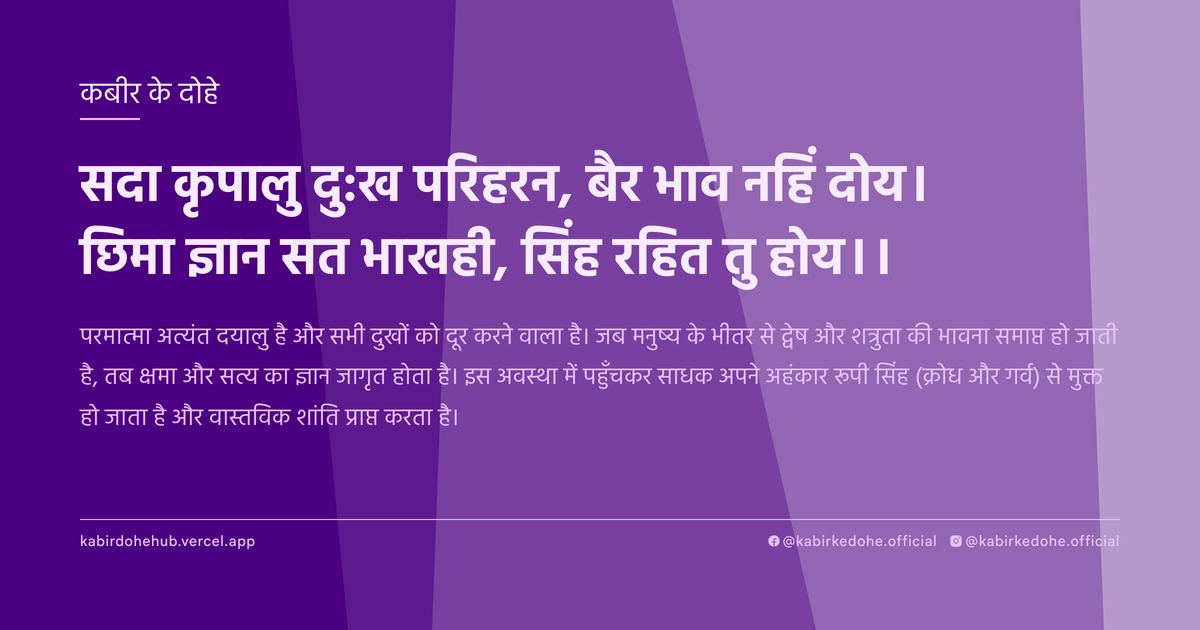
सदा कृपालु दु:ख परिहरन, बैर भाव नहिं दोय।
छिमा ज्ञान सत भाखही, सिंह रहित तु होय।।
Sada kripalu dukh pariharan, bair bhaav nahin doy. Chhima gyan sat bhakhahee, singh rahit tu hoye.
इस पृष्ठ पर इस कबीर दोहे का अर्थ (meaning), हिंदी व्याख्या और अंग्रेज़ी अनुवाद, दार्शनिक विश्लेषण और व्यावहारिक जीवन सीख दी गई है। यह दोहा क्षमा (Forgiveness) विषय से जुड़ा है — Kabir doha meaning and explanation in Hindi and English.
अर्थ (Meaning):
परमात्मा अत्यंत दयालु है और सभी दुखों को दूर करने वाला है। जब मनुष्य के भीतर से द्वेष और शत्रुता की भावना समाप्त हो जाती है, तब क्षमा और सत्य का ज्ञान जागृत होता है। इस अवस्था में पहुँचकर साधक अपने अहंकार रूपी सिंह (क्रोध और गर्व) से मुक्त हो जाता है और वास्तविक शांति प्राप्त करता है।
The Divine is the embodiment of compassion, the ultimate remover of all suffering. When a seeker eradicates the duality of enmity and hatred from their heart, the true knowledge of forgiveness and truth manifests. By shedding the 'lion' of ego and aggression, the individual transcends worldly conflict to find eternal peace.
व्याख्या (Interpretation):
यह दोहा द्वैत से अद्वैत की यात्रा का वर्णन करता है। 'बैर भाव' वह माया है जो आत्मा को दूसरे से अलग मानकर संघर्ष पैदा करती है। जब साधक यह अनुभव करता है कि सामने वाला भी उसी एक परमात्मा का अंश है, तो शत्रुता स्वतः समाप्त हो जाती है। यहाँ 'सिंह' अहंकार और क्रोध का प्रतीक है, जो मनुष्य की चेतना पर हावी रहता है। क्षमा केवल एक नैतिक गुण नहीं, बल्कि एक उच्च आध्यात्मिक ज्ञान है जो यह जानता है कि कोई वास्तव में शत्रु नहीं है। निर्गुण भक्ति के अनुसार, जब तक 'मैं' और 'तू' का भेद है, तब तक दुख है; जैसे ही यह भेद मिटता है, केवल करुणा शेष रहती है। यह स्थिति आत्मा और ब्रह्म के एकत्व की पहचान है।
This couplet describes the transition from duality to non-duality. 'Bair bhav' (the feeling of enmity) is the veil of Maya that creates a perceived separation between souls, leading to conflict. When the seeker realizes that the 'other' is merely another reflection of the same Divine Essence, hatred vanishes. The 'lion' symbolizes the fierce ego and uncontrolled anger that dominates human consciousness. Forgiveness here is not merely a moral virtue but a profound spiritual realization that no true enemy exists in a unified universe. In the path of Nirgun Bhakti, suffering persists as long as the distinction between 'I' and 'Thou' remains. Once this boundary dissolves, only compassion remains, marking the union of Atman and Brahman.
दार्शनिक विश्लेषण (Philosophical Analysis):
कबीर का यह दर्शन तत्कालीन समाज में व्याप्त धार्मिक कट्टरता और जातिगत संघर्षों पर एक सीधा प्रहार है। उन्होंने देखा कि कैसे मनुष्य बाहरी कर्मकांडों में उलझकर आंतरिक घृणा को पालता रहता है। उनका दृष्टिकोण सूफी मत के 'इश्क' (प्रेम) और वेदांत के 'अद्वैत' (non-duality) का एक अनूठा संगम है। कबीर तर्क देते हैं कि ईश्वर को मंदिर या मस्जिद में खोजने के बजाय, अपने भीतर के क्रोध और अहंकार को मिटाने में खोजना चाहिए।
यहाँ 'सिंह' का उल्लेख मनोवैज्ञानिक रूपांतरण की ओर संकेत करता है। क्रोध एक हिंसक ऊर्जा है जो व्यक्ति को अंधा कर देती है। जब यह ऊर्जा ज्ञान और क्षमा में परिवर्तित होती है, तो वह व्यक्ति को आध्यात्मिक रूप से मुक्त करती है। यह प्रक्रिया 'अहं ब्रह्मास्मि' के बोध की ओर ले जाती है, जहाँ व्यक्ति स्वयं को संपूर्ण ब्रह्मांड के साथ एकीकृत महसूस करता है।
कबीर ritualism (कर्मकांड) का विरोध करते हुए कहते हैं कि बिना हृदय परिवर्तन के कोई भी पूजा व्यर्थ है। यदि मन में बैर है, तो तीर्थयात्राएं केवल अहंकार को बढ़ाती हैं। वास्तविक शुद्धि केवल क्षमा के माध्यम से संभव है, क्योंकि क्षमा ही वह द्वार है जो अहंकार के विनाश और परमात्मा के मिलन का मार्ग प्रशस्त करता है।
सूफीवाद के प्रभाव में, कबीर 'फना' (अहंकार का विनाश) की बात करते हैं। जब साधक अपने 'स्व' को मिटा देता है, तब वह उस परमात्मा की दया का पात्र बनता है। यह दर्शन सिखाता है कि करुणा कोई बाहरी क्रिया नहीं, बल्कि आत्मा की स्वाभाविक स्थिति है जिसे केवल अज्ञानता और माया ने ढक रखा है।
अंततः, यह दोहा मनोवैज्ञानिक मुक्ति का मार्ग है। यह बताता है कि मानसिक शांति बाहरी परिस्थितियों पर नहीं, बल्कि आंतरिक प्रतिक्रियाओं पर निर्भर करती है। जब हम दूसरों को क्षमा करते हैं, तो हम वास्तव में स्वयं को उस बोझ से मुक्त करते हैं जो हमें परमात्मा से दूर रखता है।
Kabir’s philosophy serves as a direct critique of the religious bigotry and caste-based conflicts prevalent during his era. He observed how individuals remained entangled in external rituals while nurturing internal hatred. His approach is a unique synthesis of the Sufi concept of 'Ishq' (Divine Love) and the Vedantic principle of 'Advaita' (Non-duality). Kabir argues that instead of seeking God in temples or mosques, one must seek the Divine by eradicating inner anger and ego.
The reference to the 'lion' points toward a profound psychological transformation. Anger is a violent energy that blinds the consciousness. When this energy is transmuted into knowledge and forgiveness, it liberates the individual spiritually. This process leads to the realization of 'Aham Brahmasmi' (I am Brahman), where the seeker feels integrated with the entire universe.
Kabir rejects ritualism, asserting that any form of worship is futile without a fundamental change of heart. If enmity persists in the mind, pilgrimages only serve to inflate the ego. True purification is possible only through forgiveness, as it is the only gateway that facilitates the annihilation of the ego and the union with the Formless Divine.
Influenced by Sufism, Kabir speaks of 'Fana'—the annihilation of the self. When the seeker dissolves their individual identity, they become a vessel for Divine compassion. This philosophy teaches that compassion is not an external act but the natural state of the soul, obscured only by ignorance and Maya.
Ultimately, this couplet offers a path to psychological liberation. It posits that mental peace depends not on external circumstances but on internal reactions. By forgiving others, we actually liberate ourselves from the emotional burden that separates us from the Absolute Truth.
मूल संदेश (Core Message):
- घृणा एक मानसिक कारागार है जिससे केवल क्षमा ही मुक्त कर सकती है।
- अहंकार का विनाश ही वास्तविक आध्यात्मिक जागृति का प्रारंभ है।
- सत्य का ज्ञान शब्दों में नहीं, बल्कि व्यवहार में करुणा के रूप में दिखता है।
- जब 'मैं' मिटता है, तब परमात्मा की दया का अनुभव होता है।
- क्षमा करना कमजोरी नहीं, बल्कि आत्मा की सर्वोच्च शक्ति है।
- Hatred is a mental prison from which only forgiveness can liberate.
- The annihilation of ego is the true beginning of spiritual awakening.
- Truth is not found in words, but manifested as compassion in action.
- When the 'I' dissolves, the experience of Divine Grace begins.
- Forgiveness is not a sign of weakness, but the supreme power of the soul.
व्यावहारिक उदाहरण (Practical Example):
वाराणसी के एक पुराने घाट पर रहने वाली एक वृद्ध विधवा, जानकी, का जीवन कड़वाहट से भरा था। तीस साल पहले, उनके परिवार के एक सदस्य ने उन्हें धोखा दिया था, और तब से जानकी ने अपने मन में प्रतिशोध की अग्नि जलाए रखी थी। वह घाट पर आने वाले हर व्यक्ति को संदेह की दृष्टि से देखती थीं और उनके शब्दों में हमेशा एक तीखापन रहता था। उनका क्रोध उस 'सिंह' की तरह था जिसने उनके जीवन की शांति को निगल लिया था।
एक दिन, घाट पर एक युवा साधु आए जो कबीर के पदों का गान कर रहे थे। उन्होंने जानकी की आँखों में वह पुराना दर्द और क्रोध देखा। उन्होंने जानकी से कहा, 'माँ, आप जिस आग में दूसरों को जलाना चाहती हैं, उसमें सबसे पहले आप स्वयं जल रही हैं।' जानकी ने पहले तो इसे अनसुना किया, लेकिन साधु के शब्दों की गहराई उन्हें सोचने पर मजबूर कर गई।
कुछ दिनों बाद, जानकी ने देखा कि जिस व्यक्ति ने उन्हें धोखा दिया था, वह अब अत्यंत वृद्ध और बीमार हो चुका है और उसी घाट पर अंतिम समय बिताने आया है। जानकी के भीतर पुराना क्रोध फिर से जाग उठा। वह उनके पास जाकर उन्हें ताने देना चाहती थीं।
लेकिन तभी उन्हें कबीर का वह विचार याद आया कि 'बैर भाव' केवल बंधन है। उन्होंने महसूस किया कि पिछले तीस वर्षों से वह उस व्यक्ति से नहीं, बल्कि अपनी ही नफरत से बंधी हुई थीं। उन्होंने पहली बार उस व्यक्ति की आँखों में देखा और वहाँ केवल लाचारी और पश्चाताप पाया।
उस क्षण, जानकी के भीतर का 'सिंह' शांत हो गया। उन्होंने बिना कुछ कहे उस बीमार व्यक्ति के माथे पर हाथ रखा और उन्हें पानी पिलाया। यह कोई साधारण दया नहीं थी, बल्कि एक गहरे आध्यात्मिक बोध का परिणाम था।
जैसे ही उन्होंने क्षमा की, उनके सीने से एक भारी बोझ उतर गया। उन्हें महसूस हुआ कि जिस शांति की तलाश में लोग तीर्थ जाते हैं, वह तो उनके भीतर ही थी, बस नफरत की धूल ने उसे ढका हुआ था।
जानकी का व्यवहार पूरी तरह बदल गया। अब वह घाट पर आने वाले हर अजनबी का स्वागत मुस्कुराहट से करती थीं। उनकी कड़वाहट करुणा में बदल गई थी।
गाँव के लोग हैरान थे कि जो महिला कभी किसी से बात नहीं करती थी, वह अब सबकी दुख-सुख की साथी बन गई थी। जानकी ने जान लिया था कि क्षमा ही वास्तविक ज्ञान है और यही दुखों का एकमात्र निवारण है।
Janaki, an elderly widow living on an ancient ghat in Varanasi, lived a life saturated with bitterness. Thirty years prior, a family member had betrayed her, and since then, Janaki had kept the fire of revenge burning within. She viewed everyone who visited the ghat with suspicion, and her words were always laced with sharpness. Her anger was like a 'lion' that had devoured the peace of her existence.
One day, a young monk arrived at the ghat, singing the verses of Kabir. He noticed the ancient pain and rage in Janaki's eyes. He told her, 'Mother, the fire you wish to use to burn others is first and foremost consuming you.' Janaki initially ignored him, but the depth of the monk's words forced her into introspection.
After a few days, Janaki discovered that the person who had betrayed her was now frail, diseased, and had come to the same ghat to spend his final days. The old rage surged within her again. She wanted to approach him and hurl insults.
But at that moment, she recalled Kabir's insight that 'bair bhav' (enmity) is merely a shackle. She realized that for thirty years, she had been bound not by that person, but by her own hatred. For the first time, she looked into the man's eyes and saw only helplessness and remorse.
In that instant, the 'lion' within Janaki fell silent. Without a word, she placed her hand on the sick man's forehead and gave him water. This was not mere pity, but the result of a profound spiritual awakening.
As she forgave, a heavy burden lifted from her chest. She felt that the peace people seek through pilgrimages was already within her, merely obscured by the dust of hatred.
Janaki's demeanor transformed completely. She began welcoming every stranger at the ghat with a smile. Her bitterness had transmuted into compassion.
The locals were astonished that the woman who once refused to speak to anyone had now become a confidante to all. Janaki had learned that forgiveness is the true knowledge and the only authentic remedy for suffering.
अभ्यास मार्गदर्शन (Practice Guidance):
- दैनिक चिंतन: प्रतिदिन 15 मिनट मौन रहकर उन लोगों का स्मरण करें जिनके प्रति आपके मन में क्रोध है, और कल्पना करें कि आप उन्हें क्षमा कर रहे हैं।
- आत्म-पूछताछ जर्नल: लिखें कि 'मेरा क्रोध मुझे क्या बचाने की कोशिश कर रहा है?' और 'यदि मैं यह क्रोध छोड़ दूँ, तो मैं कौन बनूँगा?'
- व्यवहारिक परिवर्तन: दिन में कम से कम एक बार किसी ऐसे व्यक्ति की मदद करें या उसे धन्यवाद दें जिससे आपका वैचारिक मतभेद हो।
- डायग्नोस्टिक चेकलिस्ट: क्या मैं दूसरों की गलतियों पर तुरंत प्रतिक्रिया देता हूँ? क्या मैं अतीत की कड़वाहट को वर्तमान में ढो रहा हूँ? क्या मेरी शांति दूसरों के व्यवहार पर निर्भर है? (यदि हाँ, तो 'सिंह' अभी भी सक्रिय है)।
- Daily Contemplation: Spend 15 minutes in silence visualizing those you harbor anger toward, consciously releasing the resentment and offering forgiveness.
- Self-Inquiry Journaling: Write reflections on 'What is my anger trying to protect?' and 'Who would I be if I let go of this grudge?'
- Behavioral Shift: Once a day, intentionally perform an act of kindness or express gratitude toward someone with whom you have a conceptual disagreement.
- Diagnostic Checklist: Do I react impulsively to others' mistakes? Am I carrying past bitterness into the present? Is my peace dependent on others' behavior? (If yes, the 'lion' of ego is still active).
चिंतन प्रश्न (Reflection Questions):
- मेरे जीवन में वह कौन सा 'सिंह' (क्रोध/अहंकार) है जो मुझे शांति से दूर रख रहा है?
- क्या मेरा 'नैतिक' होना वास्तव में दूसरों के प्रति श्रेष्ठता की भावना (Ego) तो नहीं है?
- मैं किन लोगों को क्षमा नहीं कर पा रहा हूँ, और वह नफरत मेरी अपनी ऊर्जा को कैसे सोख रही है?
- यदि मेरा पूरा सार्वजनिक व्यक्तित्व (Public Identity) हट जाए, तो क्या मेरे भीतर केवल करुणा शेष रहेगी?
- क्या मैं क्षमा को एक सामाजिक औपचारिकता मानता हूँ या एक आंतरिक रूपांतरण?
- What is the 'lion' (anger/ego) in my life that is keeping me distant from peace?
- Is my sense of being 'moral' actually a hidden feeling of superiority over others?
- Who have I been unable to forgive, and how is that hatred draining my own vital energy?
- If my entire public identity were stripped away, would only compassion remain within me?
- Do I treat forgiveness as a social formality or as a genuine internal transformation?