
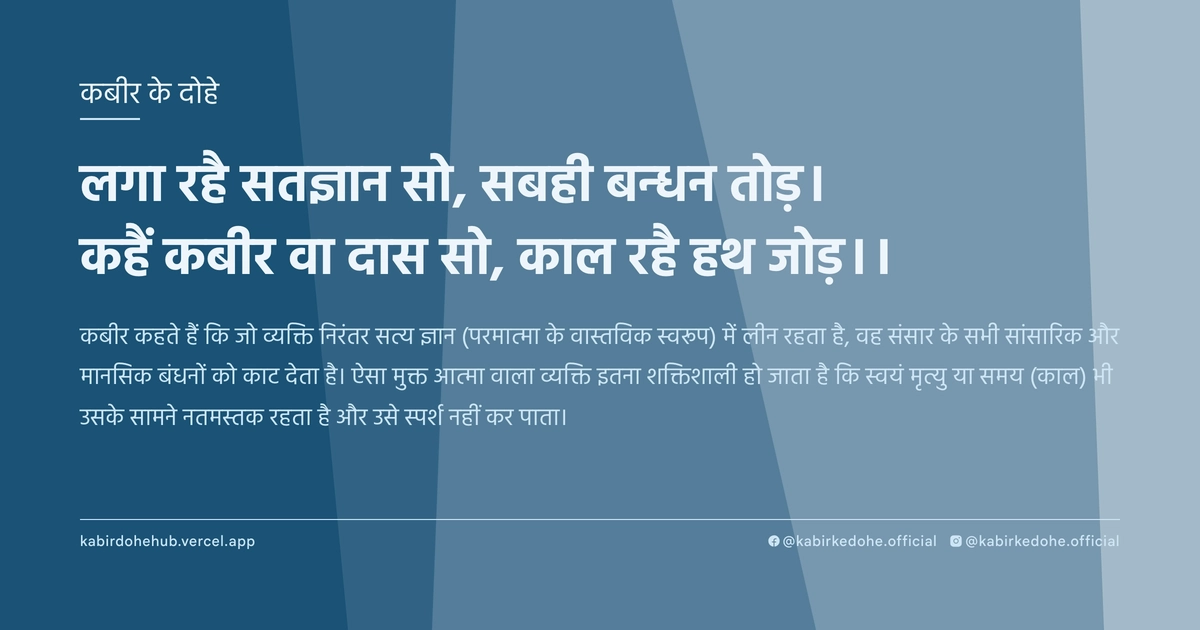
लगा रहै सतज्ञान सो, सबही बन्धन तोड़।
कहैं कबीर वा दास सो, काल रहै हथ जोड़।।
Laga rahe satgyan so, sabhi bandhan tod. Kahein Kabir va das so, kaal rahe hath jod.
इस पृष्ठ पर इस कबीर दोहे का अर्थ (meaning), हिंदी व्याख्या और अंग्रेज़ी अनुवाद, दार्शनिक विश्लेषण और व्यावहारिक जीवन सीख दी गई है। यह दोहा मुक्ति (Liberation) विषय से जुड़ा है — Kabir doha meaning and explanation in Hindi and English.
अर्थ (Meaning):
कबीर कहते हैं कि जो व्यक्ति निरंतर सत्य ज्ञान (परमात्मा के वास्तविक स्वरूप) में लीन रहता है, वह संसार के सभी सांसारिक और मानसिक बंधनों को काट देता है। ऐसा मुक्त आत्मा वाला व्यक्ति इतना शक्तिशाली हो जाता है कि स्वयं मृत्यु या समय (काल) भी उसके सामने नतमस्तक रहता है और उसे स्पर्श नहीं कर पाता।
Kabir asserts that the individual who remains perpetually immersed in True Knowledge (the realization of the Absolute) shatters all worldly and psychological shackles. Such a liberated soul attains a state of being so transcendent that even Time or Death (Kaal), the ultimate devourer, stands before them with folded hands in reverence and submission.
व्याख्या (Interpretation):
इस दोहे का शाब्दिक अर्थ है कि सत्य ज्ञान से बंधन टूटते हैं। आध्यात्मिक स्तर पर, 'सतज्ञान' का अर्थ है वह बोध कि आत्मा और परमात्मा एक ही हैं, जिसे अद्वैत वेदांत में 'अहं ब्रह्मास्मि' कहा गया है। 'बंधन' केवल बाहरी जंजीरें नहीं, बल्कि माया, अहंकार, और जन्म-मृत्यु का चक्र हैं। जब साधक इस भ्रम को तोड़ता है कि वह एक सीमित शरीर है, तो वह 'काल' (समय और मृत्यु) के प्रभाव से मुक्त हो जाता है। यह विरोधाभास है कि मृत्यु सबको जीतती है, लेकिन जो मृत्यु के भय को सत्य ज्ञान से मिटा देता है, वह काल को ही अपना दास बना लेता है। यह निर्गुण भक्ति की पराकाष्ठा है जहाँ ईश्वर किसी मूर्ति में नहीं, बल्कि शुद्ध चेतना के बोध में मिलता है।
Literally, the verse suggests that true knowledge breaks all bonds. Metaphorically, 'Satgyan' refers to the experiential realization that the individual Atman and the universal Brahman are non-dual, echoing the Advaita Vedanta principle of 'Aham Brahmasmi'. The 'bondages' mentioned are not physical chains but the psychic veils of Maya, ego, and the cyclic nature of Samsara. When a seeker transcends the illusion of being a limited biological entity, they move beyond the jurisdiction of 'Kaal' (Time/Death). The central paradox is that while Death is the ultimate conqueror, the one who annihilates the ego through Truth renders Death powerless. This represents the pinnacle of Nirgun Bhakti, where the Divine is found not in idols, but in the stillness of pure, formless consciousness.
दार्शनिक विश्लेषण (Philosophical Analysis):
कबीर का यह दोहा उनके युग के उस सामाजिक और धार्मिक परिवेश की प्रतिक्रिया है जहाँ कर्मकांडों और बाहरी आडंबरों को मोक्ष का साधन माना जाता था। कबीर ने स्पष्ट किया कि न तो तीर्थयात्रा और न ही उपवास सत्य ज्ञान दे सकते हैं; सत्य केवल आंतरिक अनुभव और अहंकार के विसर्जन से आता है। यह दृष्टिकोण सूफी मत के 'फना' (अहंकार का विनाश) और वेदांत के 'ज्ञान मार्ग' का एक सुंदर संगम है।
यहाँ 'काल' का उल्लेख केवल मृत्यु के रूप में नहीं, बल्कि उस समय-चक्र के रूप में है जो मनुष्य को जन्म और मृत्यु के बीच फँसाए रखता है। कबीर तर्क देते हैं कि जब तक मनुष्य स्वयं को शरीर मानता है, वह काल का दास है। लेकिन जैसे ही वह अपनी वास्तविक पहचान (शुद्ध चेतना) को पहचानता है, वह काल के स्वामी बन जाते हैं। यह मनोवैज्ञानिक रूपांतरण है जहाँ भय का स्थान अनंत शांति ले लेती है।
कबीर का विरोध जातिवाद और धार्मिक संकीर्णता के प्रति था क्योंकि ये सभी 'बंधन' हैं जो मनुष्य को उसकी वास्तविक प्रकृति से दूर रखते हैं। उनके लिए सत्य ज्ञान वह कुल्हाड़ी है जो इन कृत्रिम विभाजनों को काट देती है। यह दर्शन सिखाता है कि मुक्ति किसी बाहरी देवता की कृपा से नहीं, बल्कि स्वयं के भीतर के सत्य को जागृत करने से मिलती है।
दार्शनिक रूप से, यह दोहा 'साक्षी भाव' की बात करता है। जब व्यक्ति कर्ता (Doer) होने का भ्रम छोड़कर केवल साक्षी (Witness) बन जाता है, तो वह संसार के द्वंद्वों से ऊपर उठ जाता है। यही वह अवस्था है जहाँ मृत्यु एक अंत नहीं, बल्कि एक वस्त्र बदलने जैसी साधारण प्रक्रिया बन जाती है।
अंततः, कबीर यह संदेश देते हैं कि सत्य का मार्ग कठिन है क्योंकि यह हमें अपनी पूरी पहचान, अपने नाम, अपनी प्रतिष्ठा और अपने अहंकार को त्यागने की चुनौती देता है। लेकिन इस विनाश में ही वास्तविक सृजन छिपा है। जो स्वयं को पूरी तरह मिटा देता है, वही वास्तव में अमर हो जाता है।
This couplet is a profound reaction to the socio-religious climate of Kabir's era, where ritualism and external piety were mistaken for the path to liberation. Kabir asserts that neither pilgrimages nor fasting can bestow True Knowledge; truth is attained only through internal experience and the dissolution of the ego. This perspective is a masterful synthesis of the Sufi concept of 'Fana' (annihilation of the self) and the Vedantic 'Jnana Marga' (path of knowledge).
'Kaal' here is not merely biological death, but the cosmic cycle of time that keeps humanity trapped in the loop of birth and rebirth. Kabir argues that as long as a human identifies with the physical body, they remain a slave to time. However, the moment they realize their identity as pure consciousness, they transcend the dominion of time. This is a psychological metamorphosis where existential dread is replaced by an eternal, unshakable peace.
Kabir’s rejection of caste and religious sectarianism stems from the belief that these are 'bondages'—artificial constructs that obscure one's true nature. For him, Satgyan is the axe that cleaves through these delusions. His philosophy emphasizes that liberation is not a gift from an external deity but a result of awakening the inherent truth within oneself.
Philosophically, the verse advocates for the state of 'Sakshi' or the Witness. When an individual ceases to be the 'doer' and becomes the observer, they rise above the dualities of pleasure and pain, success and failure. In this state, death is no longer a catastrophic end but a simple transition, akin to changing a garment.
Ultimately, Kabir suggests that the path of truth is arduous because it demands the total surrender of identity, status, and ego. Yet, within this annihilation lies the only true creation. He posits that only those who are willing to be completely erased as an individual entity can truly become immortal as the Universal Whole.
मूल संदेश (Core Message):
- अज्ञानता ही वह सबसे बड़ी जंजीर है जो हमें भयभीत रखती है।
- सत्य का ज्ञान केवल सूचना नहीं, बल्कि एक जीवंत अनुभव है।
- जब 'मैं' मिटता है, तब 'अनंत' प्रकट होता है।
- मृत्यु शरीर का अंत है, चेतना का नहीं।
- मुक्ति बाहरी दुनिया में नहीं, बल्कि आंतरिक बोध में है।
- Ignorance is the heaviest chain that keeps the soul in fear.
- True Knowledge is not an accumulation of information, but a living realization.
- When the 'I' vanishes, the 'Infinite' reveals itself.
- Death is the cessation of the form, not the end of consciousness.
- Liberation is not a destination, but a shift in internal perception.
व्यावहारिक उदाहरण (Practical Example):
वाराणसी के घाटों पर रहने वाले एक वृद्ध बुनकर, माधव, का जीवन केवल धागों और रंगों के इर्द-गिर्द घूमता था। वह अपनी कला में निपुण था, लेकिन उसका मन हमेशा भविष्य की चिंता और अतीत के पछतावे में उलझा रहता था। वह अपनी मृत्यु से बहुत डरता था और हर बीमारी को काल का संकेत मानता था।
एक दिन माधव की मुलाकात एक घुमक्कड़ संत से हुई, जिसने उसे कबीर के इस दोहे के बारे में बताया। संत ने उससे कहा, 'माधव, तुम धागों को जोड़ते हो, लेकिन अपने आप को सत्य से नहीं जोड़ पाए। तुम शरीर को अपना घर मानते हो, जबकि तुम वह अनंत आकाश हो जिसमें यह शरीर एक छोटे से बिंदु जैसा है।'
माधव ने इस बात पर विचार करना शुरू किया। उसने महसूस किया कि उसका डर उसकी अपनी पहचान—'एक कुशल बुनकर', 'एक पिता', 'एक गरीब व्यक्ति'—से जुड़ा था। उसने धीरे-धीरे इन पहचानों को केवल भूमिकाएँ मानना शुरू किया, न कि अपनी वास्तविकता।
उसने प्रतिदिन मौन रहकर यह अभ्यास किया कि वह केवल एक शरीर नहीं, बल्कि वह चेतना है जो इस शरीर को देख रही है। जैसे-जैसे उसका 'मैं' कम होता गया, उसका डर गायब होने लगा।
एक समय ऐसा आया जब माधव गंभीर रूप से बीमार पड़ा। उसके परिवार वाले विलाप कर रहे थे, लेकिन माधव के चेहरे पर एक अलौकिक मुस्कान थी। वह अब मृत्यु से डर नहीं रहा था, बल्कि उसका स्वागत कर रहा था।
उसके बेटों ने देखा कि वह अब किसी बंधन में नहीं था। न उसे धन की चिंता थी, न रिश्तों के खोने का दुख। वह पूरी तरह से वर्तमान क्षण में स्थित था।
उसने अपने अंतिम समय में अपने बेटों से कहा, 'मैं जा नहीं रहा हूँ, मैं बस इस छोटे से कमरे से निकलकर पूरे ब्रह्मांड में फैल रहा हूँ।'
माधव की मृत्यु एक साधारण घटना नहीं, बल्कि एक उत्सव बन गई। उसने सत्य ज्ञान के माध्यम से काल को जीत लिया था।
उसका जीवन यह सिखा गया कि जब हम अपनी सीमित पहचान को छोड़ देते हैं, तो मृत्यु का भय समाप्त हो जाता है।
यह 'कबीर ट्विस्ट' था: माधव ने बुनना नहीं छोड़ा, लेकिन उसने खुद को 'बुनकर' मानना छोड़ दिया, और इसी से वह मुक्त हो गया।
In the ghats of Varanasi lived an elderly weaver named Madhav, whose life revolved entirely around threads and dyes. While a master of his craft, his mind was a chaotic storm of future anxieties and past regrets. He lived in profound fear of death, viewing every minor ailment as a herald of the end.
One day, Madhav encountered a wandering mystic who introduced him to this specific Doha of Kabir. The mystic told him, 'Madhav, you spend your days joining threads, yet you have failed to connect yourself to the Truth. You mistake this fragile body for your home, whereas you are the infinite sky in which this body is but a tiny speck.'
Madhav began to contemplate this. He realized that his fear was rooted in his rigid identities—'the skilled weaver,' 'the provider,' 'the poor man.' He started viewing these labels as mere roles in a play, rather than his ultimate reality.
He began a daily practice of silence, observing himself not as the body, but as the consciousness witnessing the body. As the 'I' (the ego) began to diminish, his existential dread evaporated.
Eventually, Madhav fell gravely ill. While his family wailed in grief, a celestial smile played on Madhav's lips. He was no longer fighting death; he was welcoming it as an old friend.
His sons noticed a radical change; he was no longer bound by any attachment. He had no longing for wealth, nor grief over the inevitable separation from loved ones. He was entirely anchored in the present moment.
In his final hours, he whispered to his children, 'I am not leaving; I am simply stepping out of this small room to merge with the entire universe.'
Madhav's passing was not a tragedy but a celebration. Through the realization of Satgyan, he had rendered Time powerless.
His life became a testament to the fact that when we relinquish the limited self, the fear of the end vanishes.
This was the 'Kabir Twist': Madhav did not stop weaving cloth, but he stopped weaving the illusion of a separate self, and in that cessation, he found absolute freedom.
अभ्यास मार्गदर्शन (Practice Guidance):
- प्रतिदिन 20 मिनट 'साक्षी ध्यान' करें: अपने विचारों और भावनाओं को बिना किसी निर्णय के देखें, जैसे आप किसी और के जीवन को देख रहे हों।
- स्व-पूछताछ जर्नल: प्रतिदिन लिखें—'यदि मेरा नाम, मेरा पेशा और मेरा शरीर छीन लिया जाए, तो मैं वास्तव में कौन हूँ?'
- अहंकार का विसर्जन: दिन में एक बार जानबूझकर ऐसी स्थिति में जाएँ जहाँ आपकी प्रशंसा न हो या आपकी बात गलत साबित हो, और उस समय मन की प्रतिक्रिया को शांति से देखें।
- निदान चेकलिस्ट: क्या मैं अभी भी भविष्य की चिंता कर रहा हूँ? क्या मैं अपनी पहचान को अपनी उपलब्धियों से जोड़ रहा हूँ? क्या मृत्यु का विचार मुझे बेचैन करता है? (यदि हाँ, तो आप अभी भी बंधनों में हैं)।
- Practice 'Witness Meditation' for 20 minutes daily: Observe your thoughts and emotions without judgment, as if you are watching a stranger's life unfold.
- Self-Inquiry Journaling: Write daily on the prompt—'If my name, my profession, and my physical body were stripped away, who would I actually be?'
- Ego Dissolution Exercise: Once a day, intentionally place yourself in a situation where you receive no praise or are proven wrong, and observe your internal reaction with detached curiosity.
- Diagnostic Checklist: Am I still ruminating on the future? Do I tie my worth to my achievements? Does the thought of death trigger anxiety? (If yes, the bondages of Maya are still active).
चिंतन प्रश्न (Reflection Questions):
- आपकी वह कौन सी सामाजिक पहचान है जिसे खोने के विचार मात्र से आप डर जाते हैं?
- क्या आपका 'आध्यात्मिक' होना भी आपके अहंकार का एक हिस्सा बन गया है?
- यदि आप आज ही सब कुछ खो दें, तो आपके भीतर क्या बचेगा जो अभी भी स्थिर है?
- आपकी डिजिटल पहचान (सोशल मीडिया) आपके वास्तविक स्वरूप को कितना ढक रही है?
- क्या आप वास्तव में स्वतंत्र हैं, या आप केवल अपनी पसंद के बंधनों के आदी हो चुके हैं?
- Which social identity are you so attached to that the mere thought of losing it terrifies you?
- Has your 'spirituality' itself become a sophisticated layer of your ego?
- If everything you possess were taken away today, what remains within you that is still unshakable?
- To what extent does your digital persona mask your authentic, raw existence?
- Are you truly free, or have you simply become comfortable with the chains you chose for yourself?