
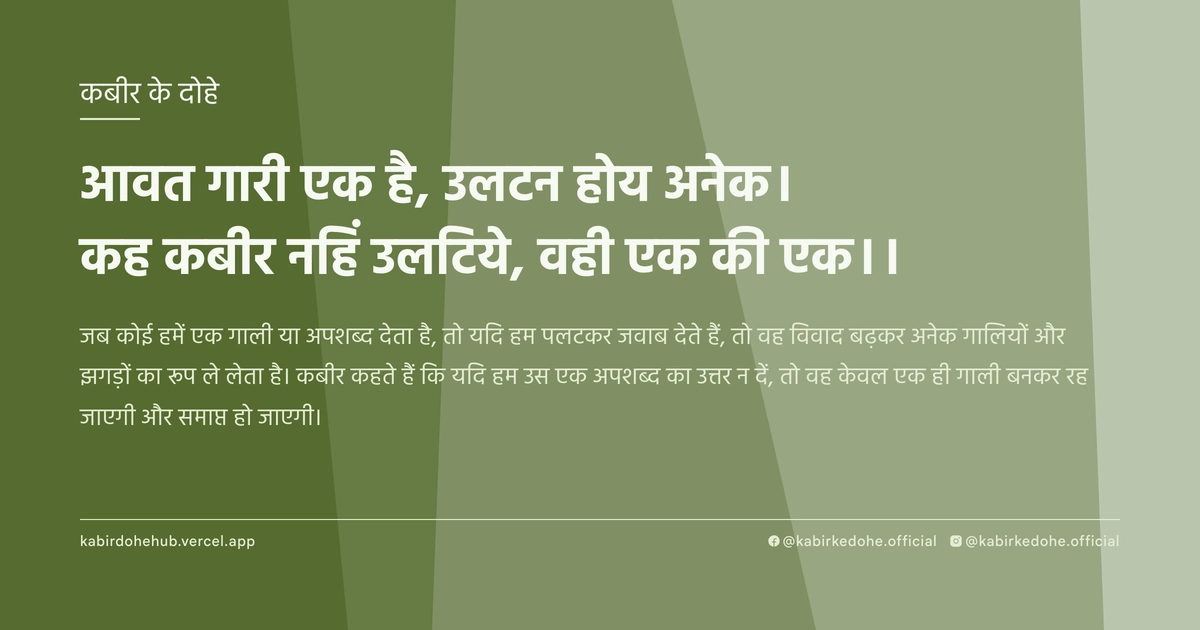
आवत गारी एक है, उलटन होय अनेक।
कह कबीर नहिं उलटिये, वही एक की एक।।
Aavat gaari ek hai, ultan hoye anek. Kah Kabir nahin ulatiye, vahi ek ki ek.
इस पृष्ठ पर इस कबीर दोहे का अर्थ (meaning), हिंदी व्याख्या और अंग्रेज़ी अनुवाद, दार्शनिक विश्लेषण और व्यावहारिक जीवन सीख दी गई है। यह दोहा क्षमा (Forgiveness) विषय से जुड़ा है — Kabir doha meaning and explanation in Hindi and English.
अर्थ (Meaning):
जब कोई हमें एक गाली या अपशब्द देता है, तो यदि हम पलटकर जवाब देते हैं, तो वह विवाद बढ़कर अनेक गालियों और झगड़ों का रूप ले लेता है। कबीर कहते हैं कि यदि हम उस एक अपशब्द का उत्तर न दें, तो वह केवल एक ही गाली बनकर रह जाएगी और समाप्त हो जाएगी।
When someone hurls a single insult at us, responding in kind causes that single spark to ignite a fire, multiplying the conflict into many insults. Kabir advises that if we refrain from retaliating, the insult remains a solitary event and eventually fades away without escalating.
व्याख्या (Interpretation):
शाब्दिक रूप से यह दोहा क्रोध के संवेग और उसके विस्तार की बात करता है। आध्यात्मिक स्तर पर, 'गाली' केवल शब्दों का समूह नहीं, बल्कि बाहरी दुनिया से आने वाला वह नकारात्मक प्रभाव है जो हमारे आंतरिक संतुलन को विचलित करता है। यह माया के उस जाल को दर्शाता है जहाँ प्रतिक्रिया ही बंधन का कारण बनती है। निर्गुण भक्ति के अनुसार, आत्मा जब स्वयं को ब्रह्म के साथ एकाकार महसूस करती है, तो वह बाहरी द्वंद्वों से ऊपर उठ जाती है। यहाँ 'उलटना' अहंकार की उस प्रवृत्ति को दर्शाता है जो अपनी पहचान को बचाने के लिए संघर्ष करती है। जब हम प्रतिक्रिया नहीं करते, तो हम द्वैत (duality) को समाप्त कर अद्वैत की स्थिति में पहुँचते हैं, जहाँ केवल एक ही सत्य शेष रहता है।
Literally, this couplet addresses the momentum of anger and its expansion. Spiritually, the 'insult' is not merely a set of words, but the external negative impulse that disrupts our internal equilibrium. It illustrates the trap of Maya, where reaction becomes the primary chain of bondage. In the path of Nirgun Bhakti, when the soul recognizes its unity with the Formless Brahman, it transcends external conflicts. 'Retaliating' symbolizes the ego's desperate urge to protect a fragile identity. By refusing to react, we dissolve the duality of 'attacker' and 'victim,' returning to the non-dual state of oneness where the conflict ceases to exist.
दार्शनिक विश्लेषण (Philosophical Analysis):
कबीर का यह विचार उनके समय के सामाजिक संघर्षों और धार्मिक कट्टरता के बीच एक क्रांतिकारी मनोवैज्ञानिक उपकरण था। उन्होंने देखा कि कैसे धर्म और जाति के नाम पर होने वाले विवाद केवल इसलिए बढ़ते हैं क्योंकि मनुष्य अपनी अस्मिता (Identity) को शब्दों से जोड़ लेता है। यह दृष्टिकोण सीधे तौर पर अद्वैत वेदांत से जुड़ा है, जहाँ यह माना जाता है कि 'मैं' और 'तू' का भेद केवल एक भ्रम है। यदि मैं यह समझ लूँ कि सामने वाला व्यक्ति भी उसी एक चेतना का हिस्सा है, तो उसकी गाली मुझे चोट नहीं पहुँचाएगी।
सूफीवाद के 'फना' (अहंकार का विनाश) के सिद्धांत के समान, कबीर यहाँ अहंकार के पूर्ण समर्पण की बात कर रहे हैं। जब अहंकार मिट जाता है, तो प्रतिक्रिया देने वाला कोई बचता ही नहीं। यह केवल सहनशीलता नहीं है, बल्कि एक उच्च मानसिक अवस्था है जहाँ व्यक्ति अपनी शांति की चाबी दूसरों के हाथ में नहीं देता।
कबीर ने कर्मकांडों और बाहरी आडंबरों को इसलिए नकारा क्योंकि वे अक्सर अहंकार को बढ़ाते हैं। एक व्यक्ति जो मंदिर या मस्जिद में बहुत समय बिताता है लेकिन घर आकर अपशब्द कहता है, वह वास्तव में आध्यात्मिक नहीं है। वास्तविक भक्ति आंतरिक मौन और करुणा में है।
मनोवैज्ञानिक रूप से, यह दोहा 'रिएक्टिविटी' (प्रतिक्रियाशीलता) को 'रिस्पॉन्सिबिलिटी' (उत्तरदायित्व) में बदलने की प्रक्रिया है। जब हम पलटकर जवाब नहीं देते, तो हम उस ऊर्जा चक्र को तोड़ देते हैं जो हिंसा को जन्म देता है। यह क्रोध के मनोविज्ञान पर एक गहरा प्रहार है।
अंततः, यह शिक्षण हमें सिखाता है कि शांति बाहरी परिस्थितियों पर निर्भर नहीं है, बल्कि आंतरिक स्थिरता का परिणाम है। जब हम 'एक' (परमात्मा/सत्य) में स्थित होते हैं, तो संसार की 'अनेक' विविधताएँ और विवाद हमें विचलित नहीं कर पाते।
Kabir's insight served as a revolutionary psychological tool amidst the social conflicts and religious bigotry of his era. He observed that disputes over religion and caste escalated precisely because humans tethered their identity to external words. This perspective aligns directly with Advaita Vedanta, which posits that the distinction between 'I' and 'Thou' is a mere illusion. If one realizes that the aggressor is also a manifestation of the same universal consciousness, the insult loses its power to wound.
Parallel to the Sufi concept of 'Fana' (the annihilation of the ego), Kabir advocates for the total dissolution of the self. When the ego is extinguished, there is no longer a 'self' left to feel offended or to retaliate. This is not mere passive endurance, but a state of high spiritual sovereignty where one refuses to hand the key to their inner peace to another person.
Kabir rejected ritualism because such practices often inflated the ego rather than diminishing it. A person who spends hours in a temple or mosque but resorts to verbal abuse at home is not spiritually evolved. True devotion resides in internal silence and compassion.
Psychologically, this doha describes the process of shifting from 'reactivity' to 'responsibility.' By refusing to strike back, we break the energetic cycle that fuels violence. It is a profound critique of the psychology of anger and the mechanism of escalation.
Ultimately, this teaching reveals that peace is not dependent on external circumstances but is a result of internal stability. When we are anchored in the 'One' (the Absolute Truth), the 'many' distractions and conflicts of the world cannot shake our foundation.
मूल संदेश (Core Message):
- प्रतिक्रिया ही बंधन है, मौन ही मुक्ति है।
- क्रोध का उत्तर क्रोध से देना अग्नि में घी डालने जैसा है।
- बाहरी शब्द केवल तब चोट पहुँचाते हैं जब आंतरिक अहंकार उन्हें स्वीकार करता है।
- शांति कोई गंतव्य नहीं, बल्कि प्रतिक्रिया न करने का एक चुनाव है।
- अद्वैत का अर्थ है यह देखना कि गाली देने वाला और सुनने वाला एक ही चेतना के दो रूप हैं।
- अहंकार का विसर्जन ही वास्तविक आध्यात्मिक विजय है।
- Reaction is bondage; silence is liberation.
- Responding to anger with anger is like pouring oil on fire.
- External words only wound when the internal ego accepts them.
- Peace is not a destination, but a conscious choice not to react.
- Non-duality is seeing that the insulter and the insulted are two forms of one consciousness.
- The dissolution of ego is the only true spiritual victory.
व्यावहारिक उदाहरण (Practical Example):
वाराणसी के एक पुराने घाट पर रामदीन नाम का एक वृद्ध नाविक रहता था। वह अपनी छोटी सी नाव से पर्यटकों को घुमाता था। रामदीन स्वभाव से अत्यंत शांत और कबीर के पदों का अनुयायी था।
एक दिन, एक अहंकारी और धनी यात्री उसकी नाव पर सवार हुआ। यात्रा के दौरान, नाव एक छोटे से पत्थर से टकराई और यात्री के महंगे जूतों पर थोड़ा पानी गिर गया। वह व्यक्ति क्रोध से पागल हो गया और रामदीन को अत्यंत गंदी गालियाँ देने लगा। उसने रामदीन की गरीबी, उसकी जाति और उसकी अयोग्यता पर व्यक्तिगत प्रहार किए।
आस-पास के अन्य नाविकों ने देखा कि रामदीन चुपचाप अपनी पतवार चला रहा था। उसके चेहरे पर न तो क्रोध था और न ही डर। वह बस एक मंद मुस्कान के साथ यात्री की बातें सुन रहा था।
यात्री और अधिक उत्तेजित हो गया। उसे लगा कि रामदीन की चुप्पी उसका अपमान है। उसने चिल्लाकर कहा, "क्या तुम बहरे हो? क्या तुम्हें सुनाई नहीं दे रहा कि मैं तुम्हें गालियाँ दे रहा हूँ?"
रामदीन ने शांति से उत्तर दिया, "साहब, आप जो शब्द कह रहे हैं, वे आपके भीतर की अग्नि हैं। यदि मैं उन्हें वापस लौटाऊँ, तो आग और बढ़ेगी। मैं केवल एक नाव चलाने वाला हूँ, आपकी क्रोध की अग्नि का ईंधन नहीं बनना चाहता।"
यह सुनकर वह व्यक्ति अचानक निशब्द हो गया। उसे महसूस हुआ कि वह अपनी ही नफरत के बोझ तले दबा हुआ था, जबकि यह गरीब नाविक मानसिक रूप से उससे कहीं अधिक समृद्ध और स्वतंत्र था।
उस यात्री का अहंकार उस क्षण टूट गया। उसने महसूस किया कि उसकी गालियाँ रामदीन को चोट पहुँचाने के बजाय उसके स्वयं के चरित्र को छोटा कर रही थीं।
उसने रामदीन से क्षमा मांगी और उसकी शांति का रहस्य पूछा। रामदीन ने बस इतना कहा, "जब हम यह मान लेते हैं कि सामने वाला केवल एक दर्पण है, तो हम अपनी ही बुराई को देखते हैं और उसे सुधारने की कोशिश करते हैं, न कि दर्पण को तोड़ने की।"
उस दिन के बाद, उस यात्री ने अपने जीवन में क्रोध का त्याग कर दिया और शांति की खोज शुरू की। रामदीन की चुप्पी ने वह काम कर दिया जो हजार उपदेश नहीं कर पाते।
On an ancient ghat in Varanasi lived an elderly boatman named Ramdeen. He earned his living by rowing tourists across the river. Ramdeen was profoundly peaceful and a devoted follower of Kabir's teachings.
One day, an arrogant and wealthy traveler boarded his boat. During the trip, the boat grazed a small rock, causing a splash of water to land on the traveler's expensive shoes. The man exploded in rage and began hurling vile insults at Ramdeen. He attacked Ramdeen's poverty, his caste, and his competence with personal venom.
Other boatmen nearby watched as Ramdeen continued to row steadily. There was neither anger nor fear on his face; he simply listened with a faint, serene smile.
The traveler became even more agitated. He perceived Ramdeen's silence as a further insult. He screamed, "Are you deaf? Do you not hear the insults I am hurling at you?"
Ramdeen replied calmly, "Sir, the words you speak are the fires within you. If I return them, the fire will only grow. I am merely a boatman; I do not wish to be the fuel for your anger."
Upon hearing this, the man was suddenly speechless. He realized that he was crushed under the weight of his own hatred, while this poor boatman was mentally far wealthier and more liberated than he was.
The man's ego shattered in that moment. He felt that his insults, instead of hurting Ramdeen, were diminishing his own character.
He apologized to Ramdeen and asked for the secret of his peace. Ramdeen simply said, "When we realize that the other person is merely a mirror, we see our own ugliness and try to correct it, rather than trying to break the mirror."
From that day forward, the traveler renounced anger and began a quest for inner peace. Ramdeen's silence achieved what a thousand sermons could not.
अभ्यास मार्गदर्शन (Practice Guidance):
- प्रतिदिन 20 मिनट 'साक्षी भाव' का अभ्यास करें: अपने भीतर उठने वाले क्रोध को बिना किसी निर्णय के केवल देखें, जैसे आप किसी और को देख रहे हों।
- जर्नलिंग प्रॉम्प्ट: आज मुझे किस बात पर गुस्सा आया? क्या मेरी प्रतिक्रिया ने समस्या को बढ़ाया या कम किया? यदि मैं चुप रहता, तो परिणाम क्या होता?
- व्यवहारिक परिवर्तन: जब भी कोई आपको अपशब्द कहे, तुरंत प्रतिक्रिया देने के बजाय 10 गहरी सांसें लें और स्वयं से पूछें, 'क्या यह शब्द मेरी शांति से अधिक मूल्यवान हैं?'
- डायग्नोस्टिक चेकलिस्ट: क्या मैं दूसरों के व्यवहार से विचलित होता हूँ? क्या मैं अपनी शांति की जिम्मेदारी दूसरों पर डालता हूँ? क्या मैं विवाद को जीतने की इच्छा रखता हूँ? (यदि हाँ, तो आप अभी भी अहंकार के प्रभाव में हैं)।
- Practice 'Witness Consciousness' for 20 minutes daily: Observe the anger arising within you without judgment, as if you are watching a stranger.
- Journaling Prompt: What triggered my anger today? Did my reaction escalate or diminish the problem? What would have happened if I remained silent?
- Behavioral Change: Whenever someone insults you, instead of reacting instantly, take 10 deep breaths and ask yourself, 'Are these words more valuable than my inner peace?'
- Diagnostic Checklist: Do I get easily disturbed by others' behavior? Do I place the responsibility for my peace in others' hands? Do I feel a need to 'win' an argument? (If yes, you are still under the influence of the ego).
चिंतन प्रश्न (Reflection Questions):
- मेरा 'सार्वजनिक व्यक्तित्व' (Public Persona) कितना इस बात पर निर्भर है कि लोग मेरे बारे में क्या सोचते हैं?
- जब मुझे कोई अपमानित करता है, तो वास्तव में कौन अपमानित महसूस करता है—मेरी आत्मा या मेरा निर्मित अहंकार?
- क्या मैं अपनी डिजिटल पहचान (Social Media Ego) को बचाने के लिए अजनबियों के साथ ऑनलाइन विवादों में अपनी ऊर्जा नष्ट करता हूँ?
- मेरे जीवन में ऐसे कौन से 'अदृश्य घाव' हैं जिन्हें मैं दूसरों पर क्रोध के रूप में प्रक्षेपित (Project) करता हूँ?
- यदि मैं पूरी तरह से मौन हो जाऊँ, तो मेरे भीतर कौन सा डर उभर कर आएगा?
- क्या मेरी करुणा केवल उन लोगों के लिए है जो मुझसे सहमत हैं, या मैं अपने शत्रुओं के प्रति भी तटस्थ रह सकता हूँ?
- How much does my 'Public Persona' depend on what others think of me?
- When I am insulted, who is actually feeling the insult—my soul or my constructed ego?
- Do I waste my energy in online conflicts with strangers just to protect my 'Digital Ego'?
- What are the 'invisible wounds' in my life that I project onto others as anger?
- If I were to become completely silent, what fear would emerge from within me?
- Is my compassion reserved only for those who agree with me, or can I remain equanimous toward my enemies?