
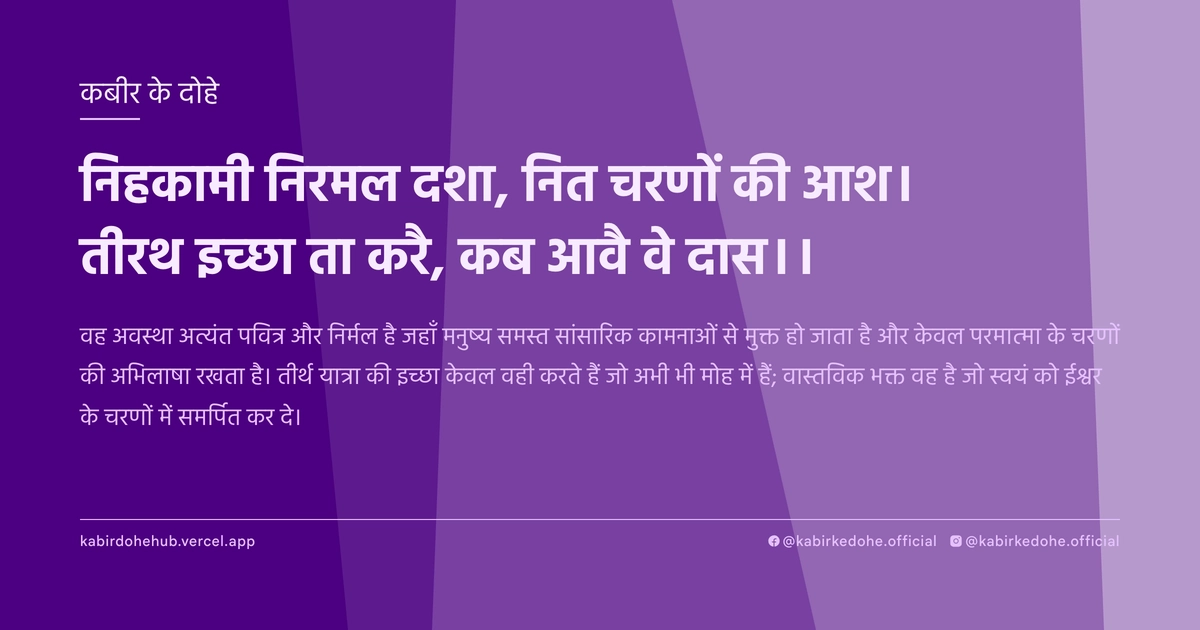
निहकामी निरमल दशा, नित चरणों की आश।
तीरथ इच्छा ता करै, कब आवै वे दास।।
Nihkami nirmal dasha, nit charnon ki aash. Teerath iccha ta kare, kab aavai ve das.
इस पृष्ठ पर इस कबीर दोहे का अर्थ (meaning), हिंदी व्याख्या और अंग्रेज़ी अनुवाद, दार्शनिक विश्लेषण और व्यावहारिक जीवन सीख दी गई है। यह दोहा प्रपत्ति (Surrender) विषय से जुड़ा है — Kabir doha meaning and explanation in Hindi and English.
अर्थ (Meaning):
वह अवस्था अत्यंत पवित्र और निर्मल है जहाँ मनुष्य समस्त सांसारिक कामनाओं से मुक्त हो जाता है और केवल परमात्मा के चरणों की अभिलाषा रखता है। तीर्थ यात्रा की इच्छा केवल वही करते हैं जो अभी भी मोह में हैं; वास्तविक भक्त वह है जो स्वयं को ईश्वर के चरणों में समर्पित कर दे।
The state of a person who is free from all worldly desires is pure and pristine, for their only longing is for the Divine presence. Those who crave pilgrimages to holy sites are still bound by desire; the true devotee is one who has completely surrendered their ego to the Divine.
व्याख्या (Interpretation):
इस दोहे में कबीर 'निहकामी' शब्द के माध्यम से इच्छाविहीनता की स्थिति का वर्णन करते हैं। शाब्दिक अर्थ में, यह बाहरी तीर्थों के त्याग की बात करता है, लेकिन आध्यात्मिक स्तर पर यह 'माया' के प्रभाव से मुक्ति का संकेत है। जब मनुष्य बाहरी कर्मकांडों (तीर्थ) की खोज छोड़कर आंतरिक समर्पण को अपनाता है, तब वह 'निरमल' या शुद्ध हो जाता है। यह निर्गुण भक्ति का सार है, जहाँ ईश्वर किसी भौगोलिक स्थान पर नहीं, बल्कि आत्मा के भीतर निवास करता है। यहाँ 'दास' शब्द दासता नहीं, बल्कि अहंकार का पूर्ण विलीनीकरण है, जो आत्मा और ब्रह्म के अद्वैत मिलन का मार्ग प्रशस्त करता है।
In this couplet, Kabir uses the term 'Nihkaami' to describe a state of desirelessness. Literally, it addresses the abandonment of external pilgrimages, but metaphorically, it signals liberation from the grip of 'Maya' (illusion). When a seeker ceases the search for the Divine in geographical locations and embraces internal surrender, they achieve 'Nirmal' or pristine purity. This is the essence of Nirgun Bhakti, where the Formless Divine resides within the soul rather than in a temple or river. The term 'Daas' (servant) here does not imply servitude but the complete annihilation of the ego, paving the way for the non-dual union of Atman and Brahman.
दार्शनिक विश्लेषण (Philosophical Analysis):
कबीर का यह विचार उनके युग के कट्टर कर्मकांडवाद और बाह्य आडंबरों पर एक तीखा प्रहार है। उस समय समाज में यह मान्यता थी कि गंगा स्नान या तीर्थ यात्रा से पाप धुल जाते हैं, जिसे कबीर 'भ्रम' मानते थे। उनका दर्शन अद्वैत वेदांत से मेल खाता है, जहाँ यह माना जाता है कि आत्मा और परमात्मा एक ही हैं, और उनके बीच की एकमात्र बाधा 'अहंकार' और 'कामना' है।
सूफी मत के 'फना' (स्वयं को मिटा देना) के सिद्धांत की तरह, कबीर यहाँ 'निहकामी' होने पर जोर देते हैं। जब तक व्यक्ति के भीतर 'मैं' और 'मेरी इच्छा' जीवित है, वह परमात्मा का अनुभव नहीं कर सकता। तीर्थ जाने की इच्छा भी एक प्रकार का सूक्ष्म अहंकार है—यह विश्वास कि मैं किसी विशेष स्थान पर जाकर पवित्र हो सकता हूँ।
कबीर का तर्क है कि पवित्रता स्थान में नहीं, बल्कि चित्त की शुद्धि में है। यदि मन कामनाओं से भरा है, तो हज़ारों तीर्थ यात्राएं भी व्यर्थ हैं। यह मनोवैज्ञानिक रूपांतरण की प्रक्रिया है जहाँ साधक बाहरी शोर से हटकर आंतरिक मौन की ओर बढ़ता है।
जाति और वर्ण व्यवस्था के विरोध में, कबीर यह संदेश देते हैं कि ईश्वर की प्राप्ति के लिए किसी विशेष कुल या विधि की आवश्यकता नहीं है, केवल निष्कपट समर्पण पर्याप्त है। यह भक्ति आंदोलन का वह क्रांतिकारी पक्ष था जिसने धर्म को मंदिर-मस्जिद से निकालकर मनुष्य के हृदय में स्थापित किया।
अंततः, यह दोहा हमें सिखाता है कि वास्तविक मुक्ति 'पाने' में नहीं, बल्कि 'छोड़ने' में है। जब हम अपनी सभी पहचानों और इच्छाओं को परमात्मा के चरणों में अर्पित कर देते हैं, तभी हम वास्तव में स्वतंत्र होते हैं।
Kabir's thought here is a sharp critique of the rigid ritualism and external ostentation of his era. During his time, it was widely believed that bathing in the Ganges or visiting pilgrimages could wash away sins—a notion Kabir dismissed as a delusion. His philosophy aligns with Advaita Vedanta, which posits that the Soul and the Absolute are one, and the only barriers between them are 'ego' and 'desire'.
Similar to the Sufi concept of 'Fana' (annihilation of the self), Kabir emphasizes becoming 'Nihkaami'. As long as the 'I' and 'my desire' persist, the experience of the Divine remains elusive. Even the desire to visit a pilgrimage is a subtle form of ego—the belief that one can achieve purity by traveling to a specific coordinate.
Kabir argues that purity does not reside in a location but in the purification of the consciousness. If the mind is cluttered with cravings, thousands of pilgrimages are futile. This represents a psychological transformation where the seeker moves from external noise toward internal silence.
In his opposition to the caste system, Kabir asserts that divine realization requires no specific lineage or ritual; only guileless surrender is sufficient. This was the revolutionary aspect of the Bhakti movement, shifting religion from temples and mosques into the human heart.
Ultimately, this couplet teaches that true liberation is not found in 'acquiring' but in 'relinquishing'. When we surrender all identities and desires at the feet of the Divine, we are truly liberated.
मूल संदेश (Core Message):
- बाहरी यात्राएं केवल भ्रम हैं, वास्तविक तीर्थ हृदय के भीतर है।
- इच्छाओं का त्याग ही आत्मा की वास्तविक शुद्धि का एकमात्र मार्ग है।
- समर्पण का अर्थ हारना नहीं, बल्कि अहंकार का विलीनीकरण है।
- जब 'मैं' मिटता है, तभी 'वह' (परमात्मा) प्रकट होता है।
- निस्वार्थ प्रेम और सेवा ही सर्वोच्च आध्यात्मिक साधना है।
- External journeys are mere illusions; the true pilgrimage lies within the heart.
- The relinquishing of desires is the only path to the soul's true purification.
- Surrender is not defeat, but the annihilation of the ego.
- Only when the 'I' vanishes does the 'Divine' manifest.
- Selfless love and service are the highest forms of spiritual practice.
व्यावहारिक उदाहरण (Practical Example):
वाराणसी के घाटों पर रहने वाले एक वृद्ध विधवा, जानकी, का जीवन इसी द्वंद्व में बीता। उन्होंने अपना पूरा जीवन पवित्र नदियों में स्नान करने और कठिन व्रतों में बिता दिया, इस उम्मीद में कि उन्हें मोक्ष मिलेगा। वे हर साल काशी के हर मंदिर गईं, लेकिन उनके मन में हमेशा एक शिकायत रहती थी कि उनके परिवार ने उन्हें छोड़ दिया और ईश्वर ने उनकी प्रार्थनाएं नहीं सुनीं।
एक दिन, घाट की सीढ़ियों पर बैठे एक साधारण से साधु ने उन्हें देखा और मुस्कुराकर कहा, 'माँ, आप इतनी दूर तक चलकर क्या ढूंढ रही हैं? जिस जल में आप डुबकी लगा रही हैं, वह शरीर को धोता है, लेकिन मन की मैल केवल इच्छाओं के त्याग से धुलती है।'
जानकी को पहले तो यह बात चुभी, लेकिन फिर उन्होंने गहराई से सोचा। उन्होंने महसूस किया कि उनकी तीर्थयात्राएं वास्तव में एक 'सौदेबाजी' थीं—'मैं यह तप करूँगी, तो ईश्वर मुझे वह देगा'। यह भक्ति नहीं, बल्कि एक व्यापार था।
उस रात जानकी ने एक बड़ा निर्णय लिया। उन्होंने अपनी सभी धार्मिक किताबों और तीर्थ यात्रा की सूचियों को किनारे रख दिया। उन्होंने तय किया कि अब वे किसी फल की इच्छा नहीं करेंगी।
उन्होंने अपने जीवन के अंतिम वर्ष शहर के अनाथ बच्चों को खिलाने और उनकी सेवा करने में बिताए। अब वे मंदिर नहीं जाती थीं, लेकिन उनके चेहरे पर एक ऐसी शांति थी जो पहले कभी नहीं देखी गई थी।
वे अब यह नहीं पूछती थीं कि 'मेरा मोक्ष कब होगा?', बल्कि वे बस वर्तमान क्षण में आनंदित रहती थीं। उनकी सेवा में कोई दिखावा नहीं था, कोई पुरस्कार की इच्छा नहीं थी।
एक दिन एक जिज्ञासु ने उनसे पूछा, 'आप अब तीर्थ क्यों नहीं जातीं?' जानकी ने मंद मुस्कान के साथ उत्तर दिया, 'मैं अब तीर्थों में नहीं भटकती, क्योंकि मेरा तीर्थ मेरे भीतर ही मिल गया है।'
उनकी यह 'निहकामी' अवस्था ही उनकी वास्तविक मुक्ति बन गई। उन्होंने पाया कि जब उन्होंने ईश्वर से मांगना बंद किया, तब उन्हें ईश्वर की उपस्थिति का अनुभव होने लगा।
जानकी का जीवन अब एक जीवित उदाहरण था कि कैसे बाहरी कर्मकांडों का त्याग और आंतरिक समर्पण एक साधारण जीवन को दिव्य बना सकता है।
उनकी मृत्यु के समय, उनके चेहरे पर कोई भय नहीं था, केवल एक असीम संतोष था, क्योंकि उन्होंने स्वयं को पूरी तरह से समर्पित कर दिया था।
Janaki, an elderly widow living on the ghats of Varanasi, spent her entire life in this conflict. She dedicated decades to bathing in holy rivers and observing rigorous fasts, hoping for salvation. She visited every temple in Kashi annually, yet her heart harbored a constant grievance—that her family had abandoned her and God had ignored her prayers.
One day, a simple monk sitting on the steps of the ghat looked at her and smiled, saying, 'Mother, what are you searching for by traveling so far? The water you dive into cleanses the body, but the grime of the mind is washed away only by the relinquishing of desires.'
Initially, Janaki felt offended, but then she reflected deeply. She realized that her pilgrimages were actually a 'bargain'—'I will perform this penance, and in return, God will give me that.' It wasn't devotion; it was a transaction.
That night, Janaki made a pivotal decision. She set aside her religious texts and lists of pilgrimages. She decided that she would no longer desire any fruit from her actions.
She spent the remaining years of her life feeding and caring for the orphaned children of the city. She no longer frequented the temples, yet a serenity graced her face that had never been seen before.
She stopped asking, 'When will I achieve salvation?' and instead lived joyfully in the present moment. There was no pretense in her service, no craving for reward.
One day, a curious visitor asked, 'Why don't you go on pilgrimages anymore?' Janaki replied with a gentle smile, 'I no longer wander to holy sites, for I have found the pilgrimage within myself.'
This 'Nihkaami' state became her true liberation. She discovered that when she stopped asking things from God, she began to experience the Presence of God.
Janaki's life became a living example of how abandoning external rituals and embracing internal surrender can transform an ordinary life into a divine one.
At the time of her passing, there was no fear on her face, only an infinite contentment, for she had completely surrendered herself.
अभ्यास मार्गदर्शन (Practice Guidance):
- दैनिक चिंतन: प्रतिदिन 20 मिनट मौन बैठें और अपनी उन इच्छाओं की सूची बनाएं जो आपको मानसिक तनाव देती हैं। उन्हें एक-एक कर 'समर्पण' करने का अभ्यास करें।
- आत्म-पूछताछ जर्नल: लिखें कि 'यदि मुझे जीवन में कुछ भी और नहीं मिला, तो क्या मैं अभी भी शांत रह सकता हूँ?' अपनी आंतरिक रिक्तता को स्वीकार करें।
- व्यवहारिक परिवर्तन: किसी ऐसे व्यक्ति की निस्वार्थ सेवा करें जिससे आपको बदले में कुछ भी मिलने की उम्मीद न हो। फल की इच्छा का पूर्ण त्याग करें।
- निदान चेकलिस्ट: क्या मैं प्रार्थना केवल मांगने के लिए करता हूँ? क्या मेरी शांति बाहरी परिस्थितियों पर निर्भर है? क्या मैं अपनी धार्मिक पहचान का उपयोग दूसरों से श्रेष्ठ दिखने के लिए करता हूँ? (यदि हाँ, तो आप अभी भी 'कामना' में हैं)।
- Daily Contemplation: Sit in silence for 20 minutes daily and list the desires causing you mental stress. Practice 'surrendering' them one by one to the Divine.
- Self-Inquiry Journal: Write about the question: 'If I received nothing more in life, could I still remain at peace?' Embrace the internal void.
- Behavioral Change: Perform selfless service for someone from whom you expect absolutely nothing in return. Completely renounce the desire for fruit.
- Diagnostic Checklist: Do I pray only to ask for things? Is my peace dependent on external circumstances? Do I use my religious identity to feel superior to others? (If yes, you are still bound by 'desire').
चिंतन प्रश्न (Reflection Questions):
- मेरी वे कौन सी 'पवित्र' आदतें हैं जो वास्तव में मेरे अहंकार को संतुष्ट करती हैं?
- क्या मैं ईश्वर की खोज कर रहा हूँ, या केवल अपनी इच्छाओं की पूर्ति का माध्यम ढूंढ रहा हूँ?
- यदि मेरी सभी सामाजिक और धार्मिक पहचान छीन ली जाएं, तो मेरे भीतर क्या बचेगा?
- मैं अपनी डिजिटल उपस्थिति (सोशल मीडिया) के माध्यम से अपनी 'आध्यात्मिकता' का प्रदर्शन तो नहीं कर रहा?
- क्या मेरी करुणा वास्तव में निस्वार्थ है, या यह मेरी अपनी छवि को बेहतर बनाने का एक तरीका है?
- वह कौन सा डर है जो मुझे पूर्ण समर्पण करने से रोकता है?
- Which of my 'holy' habits are actually serving to satisfy my ego?
- Am I searching for the Divine, or merely seeking a medium to fulfill my desires?
- If all my social and religious identities were stripped away, what would remain within me?
- Am I performing my 'spirituality' through my digital presence (social media) for validation?
- Is my compassion truly selfless, or is it a way to enhance my own self-image?
- What is the fear that prevents me from surrendering completely?