
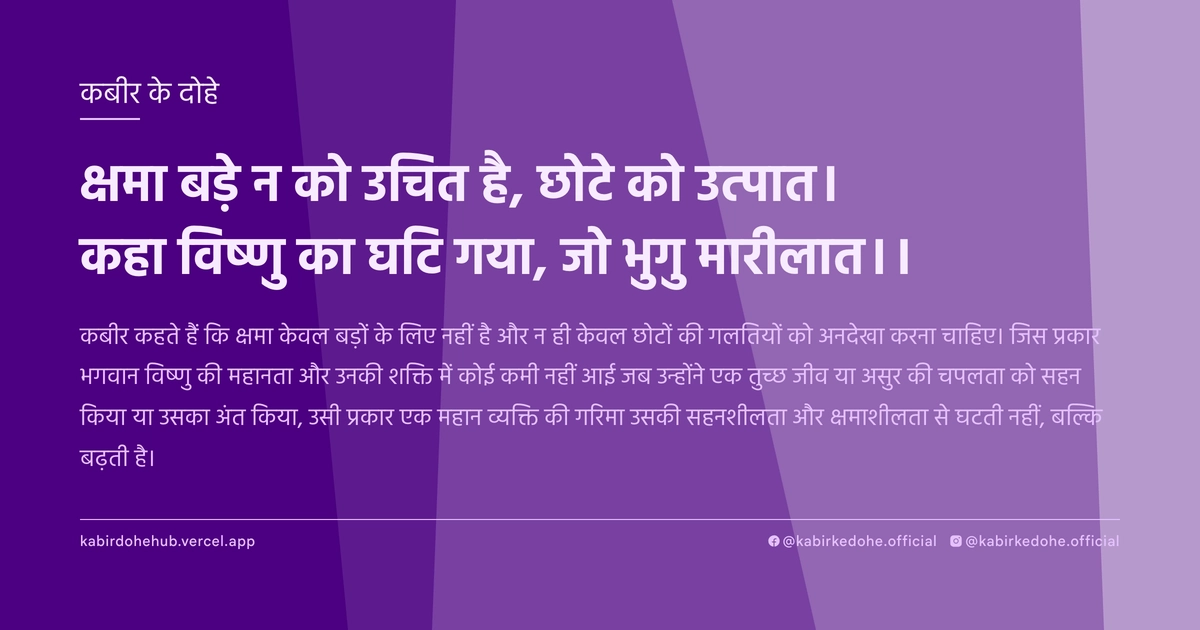
क्षमा बड़े न को उचित है, छोटे को उत्पात।
कहा विष्णु का घटि गया, जो भुगु मारीलात।।
Kshama bade na ko uchit hai, chhote ko utpaat. Kaha Vishnu ka ghat gaya, jo bhugu maarilaat.
इस पृष्ठ पर इस कबीर दोहे का अर्थ (meaning), हिंदी व्याख्या और अंग्रेज़ी अनुवाद, दार्शनिक विश्लेषण और व्यावहारिक जीवन सीख दी गई है। यह दोहा क्षमा (Forgiveness) विषय से जुड़ा है — Kabir doha meaning and explanation in Hindi and English.
अर्थ (Meaning):
कबीर कहते हैं कि क्षमा केवल बड़ों के लिए नहीं है और न ही केवल छोटों की गलतियों को अनदेखा करना चाहिए। जिस प्रकार भगवान विष्णु की महानता और उनकी शक्ति में कोई कमी नहीं आई जब उन्होंने एक तुच्छ जीव या असुर की चपलता को सहन किया या उसका अंत किया, उसी प्रकार एक महान व्यक्ति की गरिमा उसकी सहनशीलता और क्षमाशीलता से घटती नहीं, बल्कि बढ़ती है।
Kabir asserts that forgiveness is not a privilege reserved solely for the powerful, nor should the mischief of the lowly be blindly ignored. Just as the divine essence and sovereignty of Lord Vishnu remained undiminished even when dealing with the audacity of a trivial creature or a demon, the dignity of a realized soul is not diminished by exercising forgiveness; rather, it is the hallmark of true spiritual stature.
व्याख्या (Interpretation):
यह दोहा क्षमा की प्रकृति और अहंकार के द्वंद्व का विश्लेषण करता है। शाब्दिक अर्थ यह है कि क्षमा का संबंध सामाजिक स्तर से नहीं, बल्कि आंतरिक विस्तार से है। यहाँ 'बड़ा' और 'छोटा' केवल सामाजिक पद नहीं, बल्कि चेतना के स्तर हैं। जब एक उच्च चेतना वाला व्यक्ति क्षमा करता है, तो वह अपनी कमजोरी नहीं, बल्कि अपनी पूर्णता प्रदर्शित करता है। यह निर्गुण भक्ति का सार है जहाँ आत्मा स्वयं को ब्रह्म के समान व्यापक मानती है। माया हमें यह विश्वास दिलाती है कि क्षमा करने से हम 'हार' जाते हैं या 'छोटे' हो जाते हैं, जबकि वास्तव में यह अहंकार का विसर्जन है। विष्णु का उदाहरण यह दर्शाता है कि अनंत सत्ता को किसी तुच्छ प्रहार से कोई क्षति नहीं पहुँच सकती, ठीक वैसे ही जैसे आत्म-साक्षात्कारी को किसी के अपमान से कोई फर्क नहीं पड़ता।
This couplet analyzes the nature of forgiveness and the duality of the ego. Literally, it suggests that forgiveness is not tied to social hierarchy but to the expansion of consciousness. Here, 'great' and 'small' do not refer to social status, but to levels of spiritual awareness. When a person of higher consciousness forgives, they demonstrate not weakness, but wholeness. This is the essence of Nirgun Bhakti, where the soul recognizes itself as expansive as Brahman. Maya deceives us into believing that forgiving makes us 'lose' or appear 'small,' whereas it is actually the dissolution of the ego. The reference to Vishnu illustrates that an infinite being cannot be diminished by a trivial attack, just as a self-realized soul remains untouched by the insults of others.
दार्शनिक विश्लेषण (Philosophical Analysis):
कबीर का यह दृष्टिकोण उनके युग के कठोर सामाजिक और धार्मिक स्तरीकरण पर एक प्रहार है। उस समय क्षमा को अक्सर एक 'दान' के रूप में देखा जाता था जो शक्तिशाली द्वारा कमजोर को दिया जाता था। कबीर इस धारणा को उलट देते हैं। वे कहते हैं कि क्षमा वास्तव में उस व्यक्ति की शक्ति है जो स्वयं को इस भौतिक जगत के द्वंद्वों से ऊपर उठा चुका है। यह अद्वैत वेदांत के उस सिद्धांत से मेल खाता है जहाँ ज्ञाता और ज्ञेय का भेद समाप्त हो जाता है; यदि सामने वाला भी मेरा ही स्वरूप है, तो क्रोध करना स्वयं पर क्रोध करने जैसा है।
सूफी मत के 'फना' (अहंकार का विनाश) के सिद्धांत की तरह, कबीर यहाँ अहंकार के पूर्ण समर्पण की बात कर रहे हैं। जब तक 'मैं' मौजूद है, तब तक अपमान और सम्मान का खेल चलता रहता है। जैसे ही 'मैं' मिटता है, क्षमा एक स्वाभाविक अवस्था बन जाती है, न कि कोई सचेत प्रयास। ritualism के विरुद्ध उनका संघर्ष यहाँ स्पष्ट है—वे बाहरी पूजा के बजाय आंतरिक शुद्धि और करुणा को प्राथमिकता देते हैं।
मनोवैज्ञानिक स्तर पर, यह दोहा हमें सिखाता है कि हमारी प्रतिक्रियाएं हमारी पहचान निर्धारित करती हैं। यदि हम किसी के छोटे प्रहार से विचलित होते हैं, तो हम स्वयं को उस छोटे स्तर पर ले आते हैं। विष्णु का उदाहरण यह याद दिलाता है कि हमारी वास्तविक पहचान (आत्मा) अविनाशी और अपरिवर्तनीय है।
कबीर यहाँ यह भी संकेत दे रहे हैं कि क्षमा का अर्थ कायरता नहीं है। विष्णु ने असुरों का संहार भी किया, लेकिन उनकी अपनी दिव्यता कम नहीं हुई। इसका अर्थ है कि धर्म की रक्षा के लिए लिया गया निर्णय और व्यक्तिगत अहंकार की संतुष्टि के लिए किया गया क्रोध दो अलग चीजें हैं।
अंततः, यह विश्लेषण हमें यह समझने पर मजबूर करता है कि क्षमा वास्तव में स्वयं की मुक्ति है। जब हम दूसरों को क्षमा करते हैं, तो हम उस मानसिक बोझ से मुक्त होते हैं जो हमें बंधन में रखता है। यह बंधन ही माया है, और इससे मुक्ति ही मोक्ष है।
Kabir's perspective is a direct critique of the rigid social and religious stratification of his era. At that time, forgiveness was often viewed as a 'boon' granted by the powerful to the weak. Kabir inverts this notion. He posits that forgiveness is actually the power of the individual who has risen above the dualities of the material world. This aligns with the Advaita Vedanta principle where the distinction between the knower and the known vanishes; if the other is a reflection of my own self, then anger toward them is anger toward oneself.
Similar to the Sufi concept of 'Fana' (the annihilation of the ego), Kabir speaks of the total surrender of the 'I'. As long as the ego exists, the game of insult and honor continues. Once the 'I' is extinguished, forgiveness becomes a natural state rather than a conscious effort. His struggle against ritualism is evident here—he prioritizes internal purification and compassion over external rites.
On a psychological level, this doha teaches us that our reactions define our identity. If we are shaken by a trivial attack, we descend to that lower level of consciousness. The example of Vishnu reminds us that our true identity (Atman) is indestructible and immutable.
Kabir also hints that forgiveness is not synonymous with cowardice. Vishnu destroyed demons when necessary, yet his divinity remained intact. This implies a crucial distinction between a decision made for the restoration of Dharma and anger fueled by personal ego.
Ultimately, this analysis compels us to realize that forgiveness is actually one's own liberation. By forgiving others, we release the mental burden that keeps us bound. This bondage is Maya, and liberation from it is Moksha.
मूल संदेश (Core Message):
- अहंकार ही वह पर्दा है जो हमें क्षमा की शक्ति से दूर रखता है।
- क्षमा कमजोरी नहीं, बल्कि चेतना की उच्चतम अवस्था और आंतरिक सामर्थ्य है।
- जब हम स्वयं को ब्रह्म के रूप में देखते हैं, तो शत्रुता स्वतः समाप्त हो जाती है।
- बाहरी अपमान केवल तब तक प्रभावी है जब तक हम उसे अपनी पहचान मान लेते हैं।
- सच्ची महानता दूसरों को क्षमा करने और उनके दोषों को प्रेम में बदलने में है।
- The ego is the only veil that separates us from the power of forgiveness.
- Forgiveness is not weakness, but the highest state of consciousness and inner strength.
- When we perceive ourselves as Brahman, all enmity naturally dissolves.
- External insults are only effective as long as we mistake them for our identity.
- True greatness lies in forgiving others and transforming their flaws into love.
व्यावहारिक उदाहरण (Practical Example):
एक समय की बात है, वाराणसी के घाटों पर माधव नाम का एक वृद्ध बुनकर रहता था। वह अपने काम में निपुण था और स्वभाव से अत्यंत शांत था। उसी बस्ती में एक युवा और अहंकारी व्यक्ति रहता था, जो खुद को शहर का सबसे बड़ा व्यापारी मानता था। वह अक्सर माधव का मजाक उड़ाता और उसकी गरीबी का उपहास करता था।
एक दिन, उस व्यापारी का बेटा गलती से माधव की एक बहुमूल्य रेशमी साड़ी पर स्याही गिरा देता है, जिसे माधव महीनों की मेहनत से तैयार कर रहा था। व्यापारी, अपने बेटे को बचाने के लिए, उल्टा माधव पर चिल्लाने लगता है और उसे अक्षम और बूढ़ा कहकर अपमानित करता है।
आस-पास के लोग उम्मीद कर रहे थे कि माधव क्रोधित होगा या पलटकर जवाब देगा। लेकिन माधव ने केवल एक गहरी सांस ली और शांति से मुस्कुराते हुए कहा, 'बेटा, स्याही तो हट जाएगी, लेकिन मन पर लगा दाग हटाने में समय लगता है।'
व्यापारी स्तब्ध रह गया। उसने माधव को नीचा दिखाने की पूरी कोशिश की थी, लेकिन माधव की शांति ने उसे अपनी ही तुच्छता का अहसास करा दिया। वह महसूस करने लगा कि उसकी धन-दौलत उसे वह मानसिक शांति और गरिमा नहीं दे पाई जो इस गरीब बुनकर के पास थी।
अगले कुछ दिनों तक व्यापारी ने देखा कि माधव ने उस साड़ी को फेंकने के बजाय, स्याही के धब्बों को एक नए डिजाइन में बदल दिया, जिससे वह साड़ी और भी अनूठी और महंगी हो गई।
यह देखकर व्यापारी के भीतर का अहंकार टूटने लगा। उसे समझ आया कि माधव की 'क्षमा' उसकी कमजोरी नहीं, बल्कि उसकी आंतरिक शक्ति थी। वह समझ गया कि वह जिसे 'छोटा' समझ रहा था, वह वास्तव में उससे कहीं अधिक 'बड़ा' था।
व्यापारी माधव के चरणों में गिर गया और अपनी गलती की माफी मांगी। उसने महसूस किया कि असली बड़प्पन दूसरों को दबाने में नहीं, बल्कि उनके द्वारा दिए गए दुखों को पचाकर उन्हें प्रेम में बदलने में है।
माधव ने उसे उठाकर गले लगाया और कहा, 'जब हम यह जान लेते हैं कि हम सब एक ही परमात्मा के अंश हैं, तो क्रोध का कोई स्थान नहीं बचता।'
उस दिन के बाद, व्यापारी ने अपना जीवन परोपकार में लगा दिया और अहंकार का त्याग कर दिया।
यह 'कबीर ट्विस्ट' था—जहाँ एक साधारण बुनकर की क्षमा ने एक अहंकारी व्यक्ति के जीवन की दिशा बदल दी और उसे आत्म-बोध की ओर अग्रसर किया।
Once, on the ghats of Varanasi, lived an elderly weaver named Madhav. He was skilled in his craft and profoundly calm in nature. In the same neighborhood lived a young, arrogant man who considered himself the greatest merchant in the city. He often mocked Madhav and ridiculed his poverty.
One day, the merchant's son accidentally spilled ink on a precious silk saree that Madhav had been weaving for months. Instead of apologizing, the merchant, attempting to protect his son, began shouting at Madhav, insulting him as incompetent and senile.
Bystanders expected Madhav to erupt in anger or retaliate. Instead, Madhav took a deep breath and smiled peacefully, saying, 'Son, the ink will fade, but the stain on the mind takes much longer to remove.'
The merchant was stunned. He had tried his utmost to belittle Madhav, but Madhav's serenity forced him to confront his own insignificance. He realized that all his wealth could not buy the mental peace and dignity that this poor weaver possessed.
Over the next few days, the merchant observed that instead of discarding the ruined saree, Madhav incorporated the ink stains into a new, intricate design, making the garment even more unique and valuable.
Seeing this, the merchant's ego began to crumble. He realized that Madhav's 'forgiveness' was not a sign of weakness, but a manifestation of immense inner strength. He understood that the man he deemed 'small' was, in reality, far 'greater' than himself.
The merchant fell at Madhav's feet and begged for forgiveness. He realized that true greatness lies not in suppressing others, but in absorbing their pain and transforming it into love.
Madhav lifted him up and embraced him, saying, 'When we realize we are all fragments of the same Divine, there is no room for anger.'
From that day forward, the merchant dedicated his life to philanthropy and renounced his arrogance.
This was the 'Kabir Twist'—where the simple forgiveness of a weaver shifted the trajectory of an arrogant man's life, leading him toward self-realization.
अभ्यास मार्गदर्शन (Practice Guidance):
- दैनिक चिंतन: प्रतिदिन 10 मिनट मौन रहकर यह विचार करें कि आपके जीवन में कौन ऐसे लोग हैं जिनसे आप क्रोधित हैं, और यह सोचें कि क्या आपका अहंकार आपको उन्हें क्षमा करने से रोक रहा है।
- आत्म-पूछताछ जर्नल: जब भी आप अपमानित महसूस करें, लिखें: 'इस अपमान से मुझे क्या चोट पहुँची? क्या मेरी आत्मा वास्तव में प्रभावित हुई है, या केवल मेरा सामाजिक मुखौटा?'
- व्यवहारिक परिवर्तन: अगले एक सप्ताह तक, यदि कोई आपकी गलती निकाले या आप पर चिल्लाए, तो तुरंत प्रतिक्रिया देने के बजाय 5 सेकंड का मौन रखें और मन में कहें, 'मैं विष्णु की तरह अनंत हूँ, यह छोटा प्रहार मुझे नहीं बदल सकता।'
- डायग्नोस्टिक चेकलिस्ट: (1) क्या मैं क्षमा करने के बाद भी मन में कड़वाहट रखता हूँ? (2) क्या मैं क्षमा को अपनी कमजोरी मानता हूँ? (3) क्या मैं केवल उन्हीं को क्षमा करता हूँ जो मेरे प्रति अच्छे हैं? यदि हाँ, तो आप अभी भी अहंकार के प्रभाव में हैं।
- Daily Contemplation: Spend 10 minutes in silence daily, reflecting on people you hold grudges against, and ask if your ego is the only barrier preventing their forgiveness.
- Self-Inquiry Journal: Whenever you feel insulted, write: 'What exactly was hurt by this insult? Was my soul affected, or merely my social mask?'
- Behavioral Shift: For the next week, if someone criticizes or shouts at you, instead of reacting instantly, maintain a 5-second silence and tell yourself, 'I am infinite like Vishnu; this trivial strike cannot diminish me.'
- Diagnostic Checklist: (1) Do I still harbor bitterness after claiming to forgive? (2) Do I perceive forgiveness as a sign of weakness? (3) Do I only forgive those who are kind to me? If yes, you are still under the influence of the ego.
चिंतन प्रश्न (Reflection Questions):
- क्या मेरी 'क्षमा' वास्तव में मुक्ति है, या मैं केवल यह दिखाने के लिए क्षमा करता हूँ कि मैं एक 'अच्छा इंसान' हूँ?
- मेरे जीवन का वह कौन सा गुप्त पूर्वाग्रह है जो मुझे कुछ विशिष्ट लोगों को क्षमा करने से रोकता है?
- यदि मेरा सामाजिक पद और प्रतिष्ठा छीन ली जाए, तो क्या मेरी क्षमा करने की क्षमता बनी रहेगी?
- मैं अपनी डिजिटल पहचान (सोशल मीडिया) पर दूसरों के प्रति कितना कठोर हूँ, और क्या यह मेरे वास्तविक स्वरूप का प्रतिबिंब है?
- क्या मैं अपनी गलतियों के प्रति उतना ही उदार हूँ जितना मैं दूसरों से उम्मीद करता हूँ?
- Is my 'forgiveness' truly a liberation, or do I only forgive to maintain the image of being a 'good person'?
- What hidden bias in my life prevents me from forgiving specific types of people?
- If my social status and prestige were stripped away, would my capacity to forgive remain intact?
- How harsh am I toward others in my digital identity, and is this a reflection of my true self?
- Am I as generous toward my own failures as I expect others to be toward me?