
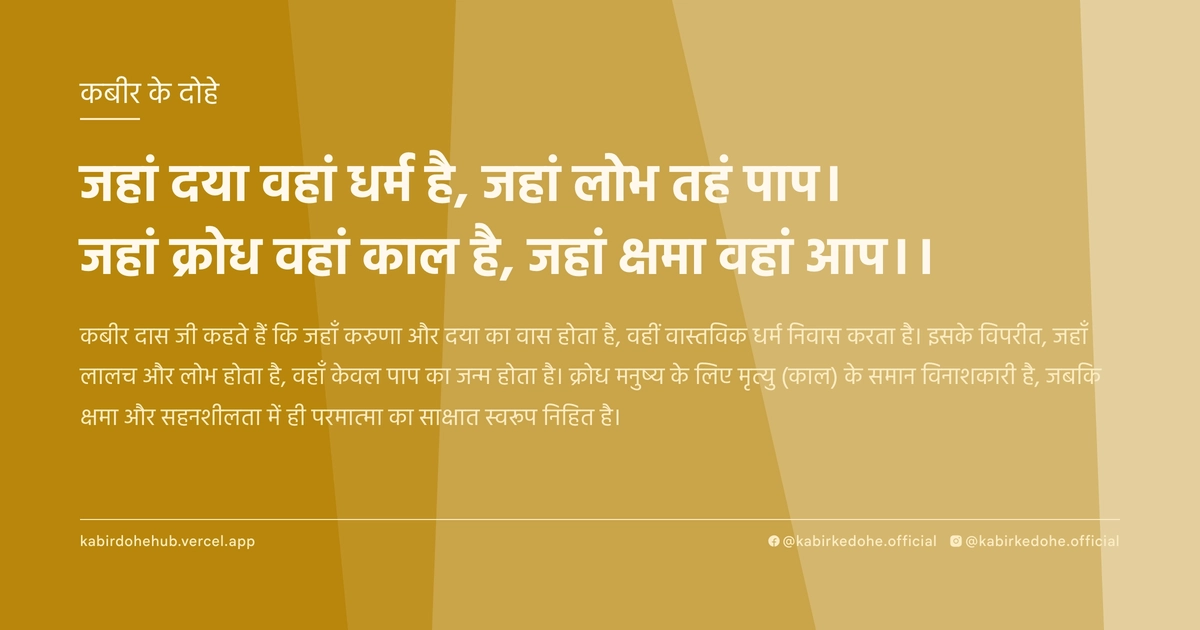
जहां दया वहां धर्म है, जहां लोभ तहं पाप।
जहां क्रोध वहां काल है, जहां क्षमा वहां आप।।
Jahan daya wahan dharm hai, jahan lobh tahan paap. Jahan krodh wahan kaal hai, jahan kshama wahan aap.
इस पृष्ठ पर इस कबीर दोहे का अर्थ (meaning), हिंदी व्याख्या और अंग्रेज़ी अनुवाद, दार्शनिक विश्लेषण और व्यावहारिक जीवन सीख दी गई है। यह दोहा क्षमा (Forgiveness) विषय से जुड़ा है — Kabir doha meaning and explanation in Hindi and English.
अर्थ (Meaning):
कबीर दास जी कहते हैं कि जहाँ करुणा और दया का वास होता है, वहीं वास्तविक धर्म निवास करता है। इसके विपरीत, जहाँ लालच और लोभ होता है, वहाँ केवल पाप का जन्म होता है। क्रोध मनुष्य के लिए मृत्यु (काल) के समान विनाशकारी है, जबकि क्षमा और सहनशीलता में ही परमात्मा का साक्षात स्वरूप निहित है।
Kabir asserts that true righteousness or Dharma resides where there is compassion and mercy. Conversely, greed and avarice are the breeding grounds for sin. Anger is equated to 'Kaal' or the destructive force of time and death, while the act of forgiveness is the highest manifestation of the Divine presence within the self.
व्याख्या (Interpretation):
यह दोहा धर्म की पारंपरिक कर्मकांडीय परिभाषा को बदलकर उसे मानवीय संवेदनाओं से जोड़ता है। 'दया' यहाँ केवल बाहरी मदद नहीं, बल्कि जीव मात्र के प्रति एक गहरे तादात्म्य की भावना है। 'लोभ' को पाप कहा गया है क्योंकि यह आत्मा को संकुचित करता है और पृथकता का बोध कराता है। 'क्रोध' को 'काल' इसलिए कहा गया है क्योंकि यह विवेक को नष्ट कर व्यक्ति के आध्यात्मिक अस्तित्व को समाप्त कर देता है। अंततः, 'क्षमा' को 'आप' (परमात्मा) कहा गया है, जो यह दर्शाता है कि जब अहंकार मिटता है और क्षमा जन्म लेती है, तब साधक और ईश्वर का द्वैत समाप्त हो जाता है। यह निर्गुण भक्ति का सार है जहाँ गुणों के माध्यम से निराकार को प्राप्त किया जाता है।
This couplet redefines Dharma, shifting it from ritualistic adherence to emotional resonance. 'Daya' (compassion) is not mere charity but a profound ontological identification with all living beings. 'Lobh' (greed) is labeled as sin because it contracts the soul and reinforces the illusion of separation (Maya). 'Krodh' (anger) is equated to 'Kaal' (Time/Death) because it obliterates discernment and kills the spiritual essence of the practitioner. Finally, 'Kshama' (forgiveness) is identified as 'Aap' (the Divine Self), suggesting that when the ego dissolves and forgiveness emerges, the duality between the seeker and the Absolute vanishes. This is the essence of Nirgun Bhakti, where the formless is realized through the refinement of internal attributes.
दार्शनिक विश्लेषण (Philosophical Analysis):
कबीर का यह दृष्टिकोण उनके युग के धार्मिक पाखंड और जातिगत श्रेष्ठता के विरुद्ध एक सशक्त प्रहार था। उन्होंने यह स्थापित किया कि धर्म मंदिर, मस्जिद या तीर्थों में नहीं, बल्कि मनुष्य के आचरण में है। यह विचार अद्वैत वेदांत के इस सिद्धांत से मेल खाता है कि आत्मा और ब्रह्म एक ही हैं; अतः किसी अन्य जीव को कष्ट देना स्वयं को कष्ट देने के समान है।
सूफीवाद के 'इश्क-ए-हकीकी' (ईश्वरीय प्रेम) की तरह, कबीर यहाँ करुणा को ईश्वर तक पहुँचने का एकमात्र सेतु मानते हैं। उनके लिए 'पाप' कोई बाहरी दंड नहीं, बल्कि वह मानसिक अवस्था है जो हमें सत्य से दूर ले जाती है। लोभ और क्रोध अहंकार (Ego) के विस्तार हैं, जो माया के जाल को और मजबूत करते हैं।
यहाँ 'काल' शब्द का प्रयोग अत्यंत गहरा है। काल केवल समय नहीं, बल्कि वह विनाशकारी शक्ति है जो अज्ञानता के कारण मनुष्य को जकड़े रहती है। जब मनुष्य क्रोधित होता है, वह अपनी चेतना खो देता है और काल के अधीन हो जाता है।
क्षमा का दर्शन यहाँ केवल एक नैतिक गुण नहीं, बल्कि एक आध्यात्मिक उपलब्धि है। क्षमा तब संभव है जब व्यक्ति यह जान ले कि सामने वाला भी उसी एक परमात्मा का अंश है। यह 'अहं' का विसर्जन है, जो मोक्ष की अनिवार्य शर्त है।
अतः, कबीर एक मनोवैज्ञानिक रूपांतरण की बात कर रहे हैं। वे चाहते हैं कि मनुष्य बाहरी प्रतीकों को छोड़कर आंतरिक शुद्धि की ओर बढ़े। धर्म का अर्थ यहाँ 'कर्तव्य' नहीं, बल्कि 'चेतना का विस्तार' है, जहाँ व्यक्ति स्वयं को ब्रह्मांडीय प्रेम में विलीन कर देता है।
Kabir's perspective serves as a potent critique of the religious hypocrisy and caste-based hierarchies prevalent during his era. He establishes that Dharma does not reside in temples, mosques, or pilgrimages, but within the conduct of the individual. This aligns with the Advaita Vedanta principle that the Atman and Brahman are one; thus, harming another is fundamentally harming oneself.
Mirroring the Sufi concept of 'Ishq-e-Haqiqi' (Divine Love), Kabir views compassion as the only bridge to the Absolute. For him, 'sin' is not an external transgression punishable by a deity, but a psychological state of contraction that alienates the soul from Truth. Greed and anger are extensions of the Ego, which strengthen the veil of Maya.
The use of the term 'Kaal' is particularly profound. Kaal is not merely chronological time but the destructive force of ignorance that binds the human spirit. In a state of rage, the individual loses consciousness and becomes a puppet of this destructive temporal force.
Forgiveness is presented here not as a mere moral virtue, but as a spiritual attainment. True forgiveness is possible only when the practitioner realizes that the 'other' is an extension of the same Divine Essence. It is the annihilation of the 'I', which is the prerequisite for liberation (Mukti).
Consequently, Kabir is advocating for a psychological transformation. He urges the seeker to abandon external symbols in favor of internal purification. Dharma here is not 'duty' in a legalistic sense, but the 'expansion of consciousness,' where the individual dissolves into universal love.
मूल संदेश (Core Message):
- दया ही ईश्वर का सबसे सरल और प्रत्यक्ष रूप है।
- लोभ आत्मा को संकुचित करता है, जबकि करुणा उसे विस्तार देती है।
- क्रोध एक मानसिक आत्महत्या है जो विवेक को नष्ट कर देती है।
- क्षमा केवल एक गुण नहीं, बल्कि अहंकार का पूर्ण विसर्जन है।
- वास्तविक धर्म बाहरी कर्मकांडों में नहीं, आंतरिक गुणों में है।
- Compassion is the simplest and most direct manifestation of the Divine.
- Greed contracts the soul, while mercy expands it toward the universal.
- Anger is a form of psychological suicide that obliterates discernment.
- Forgiveness is not just a virtue, but the total dissolution of the ego.
- True Dharma resides in internal attributes, not in external rituals.
व्यावहारिक उदाहरण (Practical Example):
वाराणसी के एक पुराने घाट पर रामदीन नाम का एक वृद्ध नाविक रहता था। वह स्वभाव से अत्यंत सरल था, लेकिन उसके जीवन में एक गहरा घाव था। वर्षों पहले, उसके सबसे करीबी मित्र ने उसे व्यापार में धोखा दिया था, जिससे रामदीन की सारी जमापूंजी चली गई। तब से, रामदीन के मन में उस मित्र के प्रति गहरी घृणा और क्रोध था। वह अक्सर सोचता कि न्याय तभी होगा जब वह मित्र भी उसी तरह बर्बाद हो जाए।
रामदीन का यह क्रोध उसके जीवन में 'काल' बन गया था। वह नाव तो चलाता था, लेकिन उसका मन हमेशा उस पुराने धोखे की कड़वाहट में डूबा रहता था। उसकी नींद उड़ गई थी और वह अपने परिवार से भी चिड़चिड़ा व्यवहार करने लगा था। वह धर्म का पालन करता था, पूजा-पाठ करता था, लेकिन उसके भीतर की शांति गायब थी।
एक दिन, भारी बारिश के दौरान, एक नाव पलट गई। रामदीन ने देखा कि पानी में डूब रहा व्यक्ति कोई और नहीं, बल्कि वही पुराना मित्र था, जो अब बूढ़ा और असहाय हो चुका था। रामदीन के भीतर एक क्षण के लिए वह पुराना क्रोध जागा। उसे लगा कि यह नियति का न्याय है और उसे मदद नहीं करनी चाहिए।
लेकिन तभी उसे कबीर का एक विचार याद आया कि 'जहाँ क्षमा वहां आप'। उसने महसूस किया कि यदि वह इस समय क्रोध को चुनता है, तो वह स्वयं को फिर से उसी नफरत की जंजीरों में बांध लेगा। उसने अपनी नाव मोड़ी और अपनी जान जोखिम में डालकर उस मित्र को बचा लिया।
जब वह मित्र होश में आया, तो उसकी आँखों में पश्चाताप के आँसू थे। उसने रामदीन से माफी मांगी। उस क्षण, रामदीन ने महसूस किया कि जिस बोझ को वह वर्षों से ढो रहा था, वह अचानक हल्का हो गया है। उसकी घृणा का अंत हुआ और एक असीम शांति उसके हृदय में उतर आई।
उसने पाया कि मित्र को क्षमा करके उसने वास्तव में स्वयं को मुक्त किया था। उसका क्रोध, जो उसे मानसिक रूप से मृत कर रहा था, अब करुणा में बदल चुका था। वह अब केवल एक नाविक नहीं था, बल्कि एक ऐसा मनुष्य था जिसने अपने भीतर के ईश्वर को खोज लिया था।
रामदीन ने अब घाट पर आने वाले हर दुखी व्यक्ति की मदद करना शुरू कर दिया। उसकी नाव अब केवल यात्रियों को पार नहीं कराती थी, बल्कि वह लोगों के बीच प्रेम और क्षमा का संदेश फैलाने लगा।
उसका जीवन अब वास्तव में 'धार्मिक' हो गया था, क्योंकि उसमें दया का वास था। उसने सीखा कि असली मोक्ष किसी तीर्थ यात्रा में नहीं, बल्कि दूसरे के प्रति हृदय खोलने में है।
On an ancient ghat in Varanasi lived an elderly boatman named Ramdin. He was simple of heart, but carried a deep wound. Years ago, his closest friend had betrayed him in business, causing Ramdin to lose all his savings. Since then, Ramdin harbored a profound hatred and anger toward that friend, believing that justice would only be served when the friend suffered a similar ruin.
This anger became 'Kaal' (death/destruction) in Ramdin's life. Though he continued rowing his boat, his mind was perpetually submerged in the bitterness of that old betrayal. He lost his sleep and became irritable with his own family. He followed religious rituals and performed prayers, yet the inner peace he sought remained elusive.
One day, during a torrential rainstorm, a boat capsized. Ramdin noticed that the man struggling in the water was none other than that same old friend, now aged and helpless. For a moment, the old rage flared up within Ramdin. He felt that this was destiny's justice and that he should let the man drown.
However, at that critical juncture, he recalled Kabir's wisdom: 'Where there is forgiveness, there is the Divine.' He realized that if he chose anger now, he would only re-shackle himself to the chains of hatred. He turned his boat around and, risking his own life, rescued the friend.
When the friend regained consciousness, his eyes were filled with tears of repentance. He begged for Ramdin's forgiveness. In that instant, Ramdin felt the heavy burden he had carried for decades suddenly lift. His hatred vanished, replaced by an overwhelming sense of serenity.
He discovered that by forgiving his friend, he had actually liberated himself. The anger that had been mentally killing him had transformed into compassion. He was no longer just a boatman; he had become a man who had encountered the Divine within.
Ramdin began helping every distressed soul who came to the ghat. His boat no longer merely transported passengers across the river; it became a vessel for spreading messages of love and forgiveness.
His life became truly 'Dharmic' because it was now inhabited by compassion. He learned that true liberation is not found in a pilgrimage, but in the act of opening one's heart to another.
अभ्यास मार्गदर्शन (Practice Guidance):
- दैनिक करुणा अभ्यास: प्रतिदिन कम से कम एक ऐसा कार्य करें जिसमें निस्वार्थ दया हो, चाहे वह किसी पशु को भोजन देना हो या किसी अजनबी की मदद करना।
- क्रोध का अवलोकन: जब भी क्रोध आए, उसे दबाने के बजाय एक साक्षी (Witness) की तरह देखें। स्वयं से पूछें, 'यह क्रोध मुझे किससे अलग कर रहा है?'
- क्षमा जर्नल: उन लोगों की सूची बनाएं जिनसे आप क्षमा चाहते हैं या जिन्हें आप क्षमा करना चाहते हैं। उनके प्रति अपनी भावनाओं को लिखें और फिर उन्हें मानसिक रूप से मुक्त करें।
- निदान चेकलिस्ट: यदि आप छोटी बातों पर चिड़चिड़े हो रहे हैं या दूसरों की सफलता से ईर्ष्या कर रहे हैं, तो समझें कि 'लोभ' और 'क्रोध' हावी है। यदि आप दूसरों के दुख में दुखी होते हैं, तो आप 'धर्म' के मार्ग पर हैं।
- Daily Compassion Practice: Perform at least one act of selfless mercy daily, whether feeding a stray animal or assisting a stranger without expectation of reward.
- Observation of Anger: When anger arises, instead of suppressing it, observe it as a witness. Ask yourself, 'Who is this anger separating me from?'
- Forgiveness Journaling: List the people from whom you seek forgiveness or whom you wish to forgive. Write down your emotions and then consciously release them mentally.
- Diagnostic Checklist: If you find yourself irritable over trivialities or envious of others' success, recognize that 'Greed' and 'Anger' are dominating. If you feel a genuine ache for another's suffering, you are aligned with 'Dharma'.
चिंतन प्रश्न (Reflection Questions):
- मेरे जीवन में 'धर्म' का अर्थ केवल सामाजिक नियमों का पालन है या वास्तव में करुणा का अभ्यास?
- वह कौन सा पुराना घाव है जिसे मैं क्षमा न करके अपने भीतर 'काल' (विनाश) की तरह पाल रहा हूँ?
- क्या मेरी दया केवल उन लोगों के लिए है जो मुझे पसंद हैं, या मैं अपने शत्रुओं के प्रति भी करुणा महसूस कर सकता हूँ?
- जब मैं किसी की सफलता पर ईर्ष्या करता हूँ, तो वह लोभ किस चीज का है—वस्तुओं का या पहचान का?
- यदि मैं आज अपनी पूरी पहचान (नाम, पद, प्रतिष्ठा) खो दूँ, तो क्या मेरे भीतर केवल 'क्षमा' और 'प्रेम' बचेगा?
- Is 'Dharma' in my life merely the adherence to social norms, or is it a lived practice of compassion?
- What old wound am I nurturing within me as 'Kaal' (destruction) by refusing to forgive?
- Is my compassion reserved only for those I like, or can I extend it to those I perceive as enemies?
- When I feel envy toward another's success, what is the object of that greed—material possession or social identity?
- If I were to lose my entire identity (name, rank, reputation) today, would only 'forgiveness' and 'love' remain within me?