
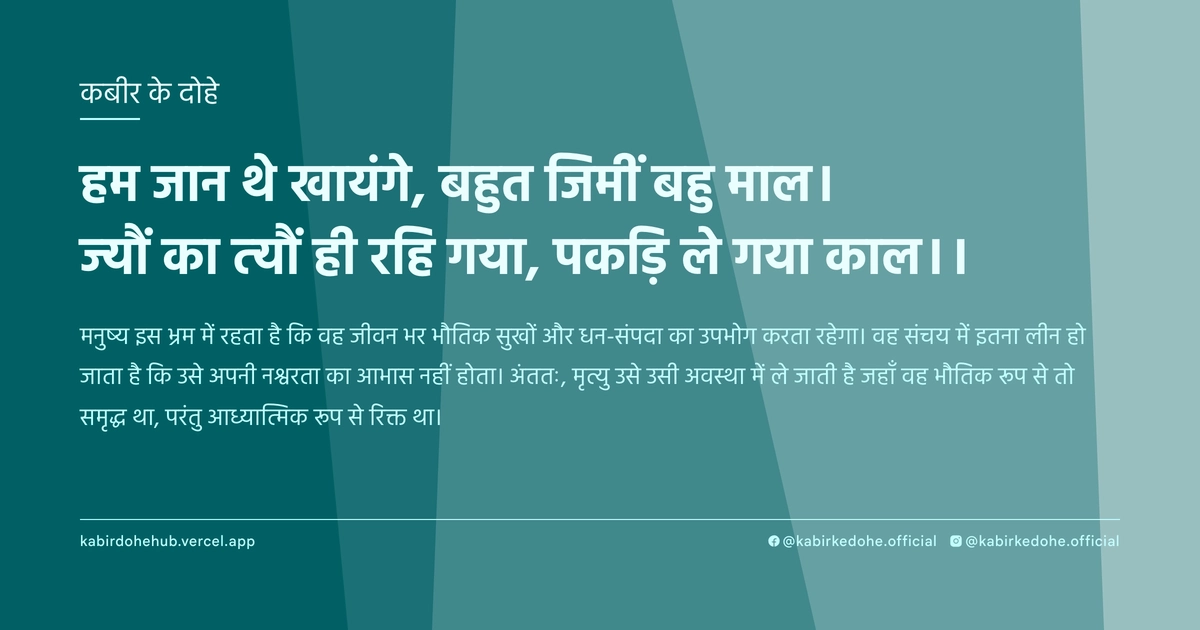
हम जान थे खायंगे, बहुत जिमीं बहु माल।
ज्यौं का त्यौं ही रहि गया, पकड़ि ले गया काल।।
Hum jaan the khayange, bahut jimin bahu maal. Jyon ka tyon hi rahi gaya, pakadi le gaya kaal.
इस पृष्ठ पर इस कबीर दोहे का अर्थ (meaning), हिंदी व्याख्या और अंग्रेज़ी अनुवाद, दार्शनिक विश्लेषण और व्यावहारिक जीवन सीख दी गई है। यह दोहा मृतुक्यता (Mortality) विषय से जुड़ा है — Kabir doha meaning and explanation in Hindi and English.
अर्थ (Meaning):
मनुष्य इस भ्रम में रहता है कि वह जीवन भर भौतिक सुखों और धन-संपदा का उपभोग करता रहेगा। वह संचय में इतना लीन हो जाता है कि उसे अपनी नश्वरता का आभास नहीं होता। अंततः, मृत्यु उसे उसी अवस्था में ले जाती है जहाँ वह भौतिक रूप से तो समृद्ध था, परंतु आध्यात्मिक रूप से रिक्त था।
Man lives under the delusion that he will eternally consume material pleasures and accumulate vast wealth. He becomes so absorbed in gathering possessions that he forgets his own mortality. Ultimately, Death seizes him exactly as he was—materially affluent perhaps, but spiritually empty and devoid of realization.
व्याख्या (Interpretation):
यह दोहा भौतिकवाद और आध्यात्मिक शून्यता के बीच के विरोधाभास को दर्शाता है। 'माल' यहाँ केवल धन नहीं, बल्कि अहंकार और सांसारिक आसक्तियों का प्रतीक है। कबीर कहते हैं कि मनुष्य 'माया' के जाल में फंसकर यह सोचता है कि वह समय को जीत लेगा, जबकि समय (काल) ही एकमात्र सत्य है जो सबको लील लेता है। यह निर्गुण भक्ति का संदेश है कि जब तक आत्मा स्वयं को ब्रह्म के साथ एकाकार नहीं करती, तब तक बाहरी संचय व्यर्थ है। यहाँ 'ज्यों का त्यों' रहने का अर्थ है कि बिना आत्म-ज्ञान के मनुष्य की चेतना में कोई विकास नहीं हुआ। यह अद्वैत वेदांत के उस सिद्धांत की ओर इशारा करता है जहाँ शरीर नश्वर है और केवल शुद्ध चेतना ही शाश्वत है।
This couplet illustrates the paradox between materialism and spiritual void. 'Maal' (wealth) here symbolizes not just currency, but the ego and worldly attachments. Kabir asserts that man, trapped in the web of 'Maya' (illusion), believes he can outrun time, whereas 'Kaal' (Time/Death) is the only absolute that consumes all. This is a core tenet of Nirgun Bhakti: until the soul merges with the Formless Absolute, all external accumulation is futile. The phrase 'as it was' signifies that without self-realization, the consciousness remains stagnant. It aligns with Advaita Vedanta, emphasizing that while the physical vessel is transient, only the pure consciousness—the Atman—is eternal.
दार्शनिक विश्लेषण (Philosophical Analysis):
कबीर का यह दोहा उस युग की उपज है जहाँ धर्म के नाम पर बाहरी आडंबर और संचय को पुण्य माना जाता था। कबीर ने इस सामाजिक और धार्मिक पाखंड पर प्रहार किया है। वे तर्क देते हैं कि मोक्ष किसी बाहरी वस्तु या धन के संचय से नहीं, बल्कि आंतरिक शुद्धि से प्राप्त होता है। उनका दृष्टिकोण सूफी मत के 'फना' (अहंकार का विनाश) से मेल खाता है, जहाँ साधक को अपनी व्यक्तिगत पहचान को मिटाकर ईश्वर में विलीन होना पड़ता है।
यहाँ 'काल' केवल मृत्यु नहीं है, बल्कि वह समय है जो मनुष्य को उसकी वास्तविकता से दूर रखता है। कबीर का दर्शन यह है कि मनुष्य का असली धन उसका 'नाम' (ईश्वरीय स्मरण) है, न कि भौतिक संपत्ति। वे जाति और वर्ग के भेदभाव को नकारते हुए यह बताते हैं कि मृत्यु सबको समान कर देती है। अमीर हो या गरीब, यदि हृदय में प्रेम और ज्ञान नहीं है, तो दोनों ही काल के गाल में समान रूप से गिरते हैं।
अद्वैत वेदांत के परिप्रेक्ष्य में, यह दोहा 'अविद्या' (अज्ञानता) पर प्रहार करता है। मनुष्य को लगता है कि वह 'कर्ता' है और वह सब कुछ नियंत्रित कर सकता है। यह अहंकार ही उसे सत्य से दूर रखता है। जब तक यह 'मैं' (अहंकार) जीवित है, तब तक मनुष्य माया के खेल में उलझा रहता है।
मनोवैज्ञानिक स्तर पर, यह दोहा 'विलंबन' (procrastination) की प्रवृत्ति को दर्शाता है। मनुष्य आध्यात्मिक खोज को कल पर टालता रहता है, यह सोचकर कि अभी तो जीवन बहुत लंबा है। कबीर चेतावनी देते हैं कि यह 'कल' कभी नहीं आता, और मृत्यु अचानक दस्तक देती है।
अंततः, कबीर का संदेश यह है कि जीवन का उद्देश्य संचय नहीं, बल्कि विसर्जन है। स्वयं को मिटाकर ही उस अनंत को पाया जा सकता है। यह भौतिकवाद के विरुद्ध एक क्रांतिकारी घोषणा है, जो मनुष्य को बाहरी दुनिया से हटाकर आंतरिक जगत की ओर मोड़ती है।
Kabir's couplet emerges from an era where external rituals and the accumulation of merit through wealth were often mistaken for spirituality. Kabir strikes at this social and religious hypocrisy, arguing that liberation is achieved not through external acquisition, but through internal purification. His perspective resonates with the Sufi concept of 'Fana' (annihilation of the ego), where the seeker must dissolve their individual identity to merge with the Divine.
In this context, 'Kaal' is not merely biological death, but the temporal illusion that keeps man distanced from his true nature. Kabir’s philosophy posits that the only true wealth is 'Naam' (Divine Remembrance), not material assets. By rejecting caste and class distinctions, he reminds us that death is the ultimate equalizer. Whether rich or poor, if the heart lacks love and gnosis, both fall equally into the maw of Time.
From the lens of Advaita Vedanta, this verse attacks 'Avidya' (ignorance). Man operates under the delusion of being the 'Doer' (Karta), believing he can control the trajectory of existence. This ego is the primary veil preventing the realization of non-duality. As long as the 'I' persists, the soul remains entangled in the play of Maya.
Psychologically, the verse addresses the human tendency toward spiritual procrastination. We defer the quest for truth, assuming life is an endless stretch of time. Kabir warns that this 'tomorrow' is a mirage, and death arrives without appointment, catching the soul in its state of unpreparedness.
Ultimately, Kabir’s message is that the purpose of life is not accumulation, but dissolution. Only by erasing the self can one find the Infinite. It is a revolutionary manifesto against materialism, redirecting the human gaze from the external marketplace to the internal sanctuary.
मूल संदेश (Core Message):
- भौतिक संचय एक मानसिक भ्रम है जो आत्मा को सत्य से दूर करता है।
- समय (काल) किसी की प्रतीक्षा नहीं करता; जागृति अभी आवश्यक है।
- सच्ची समृद्धि आंतरिक शांति और आत्म-साक्षात्कार में निहित है।
- अहंकार का विसर्जन ही ईश्वर से मिलन का एकमात्र मार्ग है।
- नश्वर शरीर के लिए संचय करना, रेत पर महल बनाने जैसा है।
- Material accumulation is a mental illusion that veils the soul from Truth.
- Time (Kaal) waits for no one; awakening is an urgent necessity now.
- True prosperity resides in inner stillness and self-realization.
- The dissolution of the ego is the only bridge to the Divine.
- Hoarding for a mortal body is like building castles on shifting sands.
व्यावहारिक उदाहरण (Practical Example):
एक समय की बात है, वाराणसी के घाटों पर रहने वाला एक पुराना बुनकर था जिसका नाम माधव था। माधव अपने समय का सबसे कुशल बुनकर था और उसने अपनी मेहनत से बहुत धन कमाया था। उसके पास रेशम के बेहतरीन थान थे और शहर के सबसे अमीर लोग उससे कपड़े मंगवाते थे। माधव का पूरा जीवन केवल और केवल अधिक धन कमाने और उसे संचित करने में बीत गया। वह हमेशा कहता था, 'अभी तो मैं केवल अपनी नींव मजबूत कर रहा हूँ, जब मैं पर्याप्त धन जमा कर लूँगा, तब मैं शांति की खोज करूँगा और ईश्वर का ध्यान लगाऊँगा।'
उसका घर कीमती सामानों से भरा था, लेकिन उसके मन में हमेशा एक बेचैनी रहती थी। वह अपने पड़ोस के एक फकीर को देखता था जो केवल एक फटे हुए कंबल में रहता था, फिर भी उसके चेहरे पर एक असीम शांति थी। माधव उस फकीर का मजाक उड़ाता और कहता, 'देखो इस कंगाल को, इसके पास तो खाने को दाना नहीं है, फिर भी यह मुस्कुराता है। असली सुख तो वैभव में है।'
वर्ष बीतते गए और माधव की संपत्ति बढ़ती गई। उसने बड़े-बड़े गोदाम बनवाए और सोने के सिक्कों की पोटलियाँ जमा कीं। वह इतना व्यस्त हो गया कि उसने अपने परिवार से बात करना और प्रकृति को देखना तक छोड़ दिया। उसका पूरा अस्तित्व केवल 'और अधिक' की चाहत में सिमट गया था।
एक दिन, अचानक माधव को तीव्र सीने में दर्द हुआ। वह अपने बिस्तर पर गिर पड़ा। उसके चारों ओर उसके नौकर और परिजन जमा थे, लेकिन वे केवल उसकी संपत्ति के उत्तराधिकार की चिंता कर रहे थे। माधव ने अपने चारों ओर देखा—उसके पास रेशम के ढेर थे, सोने के आभूषण थे, और आलीशान फर्नीचर था, लेकिन वह महसूस कर रहा था कि वह इनमें से कुछ भी अपने साथ नहीं ले जा सकता।
उस क्षण उसे कबीर का वह दोहा याद आया जो उसने बचपन में सुना था। उसे अहसास हुआ कि उसने अपना पूरा जीवन 'माल' जमा करने में लगा दिया, लेकिन अपनी आत्मा को जगाने के लिए एक क्षण भी नहीं निकाला। वह जिस 'कल' का इंतजार कर रहा था, वह 'काल' बनकर उसके सामने खड़ा था।
उसकी आँखों में आँसू थे। उसने महसूस किया कि वह भौतिक रूप से तो बहुत समृद्ध था, लेकिन आध्यात्मिक रूप से वह एक नवजात शिशु से भी अधिक रिक्त था। उसने अपनी पूरी जिंदगी केवल बाहरी आवरणों को सजाने में बिता दी, जबकि आंतरिक मंदिर धूल से भरा पड़ा था।
मृत्यु के अंतिम क्षणों में, माधव ने अपने पास खड़े उस फकीर को देखा जो उसकी अंतिम विदाई के लिए आया था। फकीर की आँखों में करुणा थी। माधव ने कांपते हुए स्वर में कहा, 'मैं कितना मूर्ख था, मैंने रेत को सोना समझकर इकट्ठा किया।'
माधव का शरीर शांत हो गया, लेकिन उसकी यह कहानी उस शहर के लिए एक सबक बन गई। लोग अब केवल धन की बात नहीं करते थे, बल्कि इस बात पर विचार करने लगे कि अंत समय में क्या साथ जाएगा। माधव की संपत्ति तो बंट गई, लेकिन उसकी अधूरी खोज एक चेतावनी बनकर रह गई।
Once, in the sacred alleys of Varanasi, lived an elderly weaver named Madhav. Madhav was the most skilled artisan of his time, weaving exquisite silks that the wealthiest merchants coveted. Through relentless toil and an obsession with profit, he accumulated immense wealth. His house was a fortress of luxury, and he often told himself, 'I am merely building my foundation. Once I have gathered enough gold, I shall seek peace and devote myself to the Divine.'
Despite his riches, a persistent restlessness gnawed at Madhav's heart. He would observe a wandering dervish who lived with nothing but a tattered blanket, yet possessed a radiance of absolute peace. Madhav would mock him, saying, 'Look at this pauper; he has not a grain of rice to his name, yet he smiles. True happiness lies in opulence.'
Years passed, and Madhav's hoard grew. He built vast warehouses and stacked gold coins like mountains. He became so consumed by the act of gathering that he stopped speaking to his family and ceased to notice the changing seasons. His entire existence shrunk to the singular desire for 'more.'
One afternoon, a sudden, searing pain struck Madhav's chest. He collapsed onto his bed. Servants and relatives gathered around, but their whispers were not of his health, but of the inheritance of his estate. As Madhav looked around, he saw the piles of silk and the glint of gold, and he realized with a crushing weight that none of it could follow him across the threshold of death.
In that moment, a couplet by Kabir, heard in his distant childhood, echoed in his mind. He realized he had spent his entire life gathering 'maal' (wealth), but had not spent a single moment awakening his soul. The 'tomorrow' he had been waiting for had arrived as 'Kaal' (Death), standing sternly before him.
Tears streamed down his face. He felt that while he was materially opulent, he was spiritually more bankrupt than a newborn. He had spent his life decorating the outer shell, while the inner temple remained choked with dust.
In his final breaths, Madhav saw the dervish standing by his bedside. The dervish's eyes were filled with profound compassion. In a trembling voice, Madhav whispered, 'How foolish I was... I spent my life collecting sand, believing it was gold.'
Madhav's body became still, but his story became a legend in the city. People stopped talking only of profit and began to contemplate what truly accompanies a soul at the end. Madhav's wealth was divided among heirs, but his unfulfilled quest remained as a haunting warning to all.
अभ्यास मार्गदर्शन (Practice Guidance):
- दैनिक चिंतन: प्रतिदिन 15 मिनट मौन बैठें और विचार करें कि यदि आज अंतिम दिन हो, तो आपके पास संचय के अलावा क्या बचेगा।
- अनासक्ति अभ्यास: सप्ताह में एक बार ऐसी वस्तु का दान करें जो आपको बहुत प्रिय हो, ताकि आप 'पकड़' (attachment) को छोड़ने का अभ्यास कर सकें।
- आत्म-पूछताछ जर्नल: लिखें कि आपकी कौन सी इच्छाएं वास्तव में आपकी हैं और कौन सी समाज द्वारा थोपी गई 'सफलता' की परिभाषाएं हैं।
- निदान चेकलिस्ट: क्या आप अपनी खुशी को भविष्य की किसी उपलब्धि से जोड़ रहे हैं? क्या आप वर्तमान क्षण की शांति को भौतिक लाभ के लिए कुर्बान कर रहे हैं? यदि हाँ, तो आप 'माया' के प्रभाव में हैं।
- Daily Contemplation: Spend 15 minutes in silence daily, reflecting on the question: 'If today were my last day, what would remain of me beyond my possessions?'
- Detachment Practice: Once a week, donate an object you are deeply attached to, practicing the art of letting go of the 'grip' of ownership.
- Self-Inquiry Journaling: Document which of your desires are authentic and which are merely social constructs of 'success' imposed upon you.
- Diagnostic Checklist: Are you tying your happiness to a future achievement? Are you sacrificing present peace for material gain? If yes, you are operating under the influence of 'Maya'.
चिंतन प्रश्न (Reflection Questions):
- आपकी वह कौन सी 'संपत्ति' है जिसे आप खोने के डर से अपनी मानसिक शांति का बलिदान दे रहे हैं?
- यदि आपकी सामाजिक पहचान (पद, पैसा, प्रतिष्ठा) छीन ली जाए, तो आपके भीतर क्या बचेगा?
- क्या आप वास्तव में जीवन जी रहे हैं, या केवल भविष्य की तैयारी में जीवन को खर्च कर रहे हैं?
- आपकी डिजिटल पहचान (सोशल मीडिया) आपके वास्तविक आंतरिक शून्य को कैसे ढकने की कोशिश करती है?
- मृत्यु का विचार आपको भयभीत करता है या यह आपको वर्तमान में अधिक सचेत बनाता है?
- What is that 'possession' you are so afraid to lose that you sacrifice your mental peace for it?
- If your social identity (status, wealth, reputation) were stripped away, what would remain of you?
- Are you actually living your life, or are you merely spending it in preparation for a future that may never come?
- How does your digital persona attempt to mask the internal void within you?
- Does the thought of death frighten you, or does it make you more conscious of the present moment?