
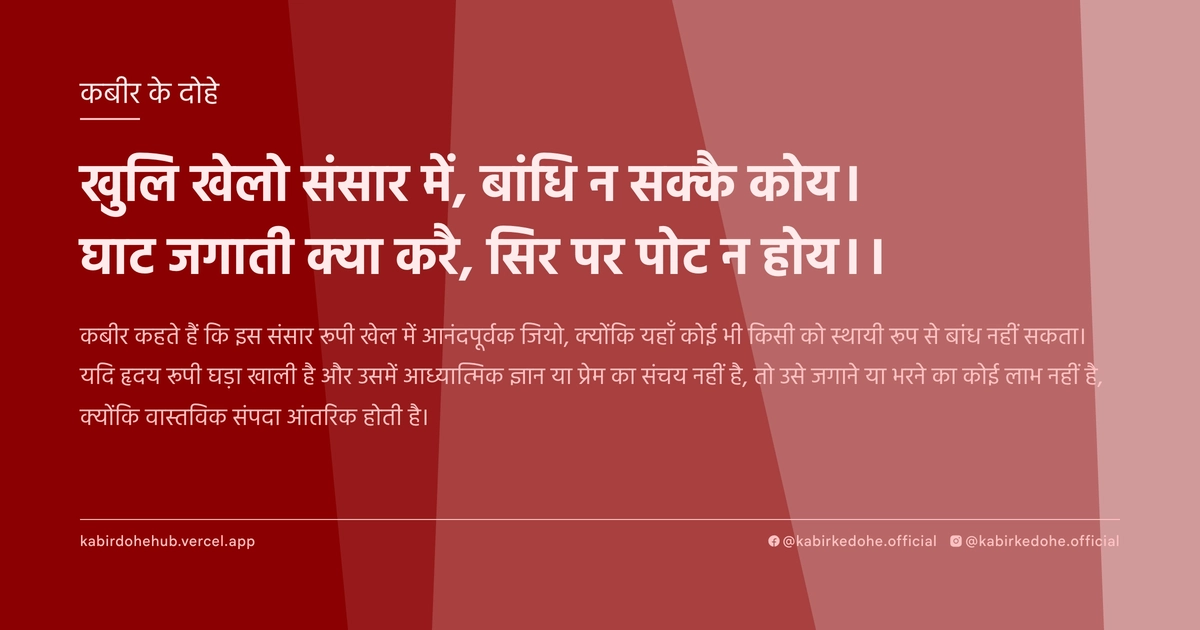
खुलि खेलो संसार में, बांधि न सक्कै कोय।
घाट जगाती क्या करै, सिर पर पोट न होय।।
Khuli khelo sansar me, bandhi na sakke koy. Ghat jagati kya kare, sir par pot na hoye.
इस पृष्ठ पर इस कबीर दोहे का अर्थ (meaning), हिंदी व्याख्या और अंग्रेज़ी अनुवाद, दार्शनिक विश्लेषण और व्यावहारिक जीवन सीख दी गई है। यह दोहा माया (Maya) विषय से जुड़ा है — Kabir doha meaning and explanation in Hindi and English.
अर्थ (Meaning):
कबीर कहते हैं कि इस संसार रूपी खेल में आनंदपूर्वक जियो, क्योंकि यहाँ कोई भी किसी को स्थायी रूप से बांध नहीं सकता। यदि हृदय रूपी घड़ा खाली है और उसमें आध्यात्मिक ज्ञान या प्रेम का संचय नहीं है, तो उसे जगाने या भरने का कोई लाभ नहीं है, क्योंकि वास्तविक संपदा आंतरिक होती है।
Kabir suggests that one should engage with the world as a playful game, for no one can truly bind or imprison the soul. He emphasizes that attempting to awaken or fill a vessel (the heart) is futile if there is no inherent spiritual seed or 'bundle' of consciousness already present to be cultivated.
व्याख्या (Interpretation):
यहाँ 'खेल' का अर्थ है जीवन को आसक्ति के बिना जीना। कबीर पहले यह स्पष्ट करते हैं कि आत्मा स्वतंत्र है और सांसारिक बंधन केवल भ्रम हैं। 'घाट' हृदय का प्रतीक है और 'पोट' उस आध्यात्मिक पूंजी या बोध का, जो मनुष्य अपने भीतर लेकर आता है। यदि व्यक्ति के भीतर सत्य की खोज की तड़प नहीं है, तो बाहरी उपदेश या अनुष्ठान व्यर्थ हैं। यह निर्गुण भक्ति का सार है जहाँ ईश्वर बाहर नहीं, बल्कि भीतर की शून्यता को भरने में है। माया हमें यह विश्वास दिलाती है कि हम बंधे हुए हैं, जबकि वास्तविकता अद्वैत है।
The 'game' refers to living in the world without attachment, treating existence as a divine play (Lila). Kabir asserts that the soul is inherently free; the perceived bonds of society and desire are mere illusions (Maya). The 'ghat' (pot/vessel) symbolizes the human heart, and the 'pot' (bundle) represents the latent spiritual seed or the yearning for Truth. He argues that external awakening is impossible if the internal capacity for consciousness is absent. This aligns with Nirgun Bhakti, where the formless Divine is realized not through ritual, but through the recognition of the Atman-Brahman non-duality within the void of the ego.
दार्शनिक विश्लेषण (Philosophical Analysis):
कबीर का यह दोहा मध्यकालीन भारत के कर्मकांडीय वातावरण पर एक तीखा प्रहार है। उस समय धर्म केवल बाहरी दिखावे और जातिगत श्रेष्ठता तक सीमित था। कबीर ने इस विचार को चुनौती दी कि मोक्ष केवल कठिन तपस्या या पुरोहितों के माध्यम से प्राप्त होता है। उन्होंने 'सहज' मार्ग की बात की, जो सूफीवाद के 'इश्क' और अद्वैत वेदांत के 'अहं ब्रह्मास्मि' का संगम है।
दार्शनिक स्तर पर, यह दोहा 'साक्षी भाव' (Witness Consciousness) की वकालत करता है। जब हम संसार को एक खेल मानते हैं, तो हम कर्ता (doer) से हटकर दृष्टा (observer) बन जाते हैं। यह मनोवैज्ञानिक रूपांतरण अहंकार के विलीनीकरण की प्रक्रिया है। यदि हम स्वयं को शरीर या सामाजिक पहचान मानते हैं, तो हम बंधे हुए महसूस करते हैं; लेकिन यदि हम स्वयं को शुद्ध चेतना मानते हैं, तो बंधन समाप्त हो जाते हैं।
सूफी परंपरा के 'फना' (अहंकार का विनाश) के समान, कबीर यहाँ आंतरिक रिक्तता की बात करते हैं। वे कहते हैं कि जब तक 'मैं' का पोटला (अहंकार) सिर पर है, तब तक सत्य नहीं दिखता। लेकिन विरोधाभास यह है कि यदि हृदय में सत्य की प्यास (आध्यात्मिक पोट) नहीं है, तो ज्ञान का प्रकाश भी उसे नहीं जगा सकता।
यह शिक्षण हमें सिखाता है कि आध्यात्मिक प्रगति के लिए बाहरी गुरु से अधिक आंतरिक तत्परता आवश्यक है। ritualism (कर्मकांड) केवल एक बाहरी आवरण है; वास्तविक परिवर्तन तब होता है जब व्यक्ति अपनी आंतरिक शून्यता को पहचानकर उसे ईश्वरीय प्रकाश से भरने का प्रयास करता है।
अंततः, कबीर यह स्थापित करते हैं कि मुक्ति कोई गंतव्य नहीं बल्कि एक दृष्टिकोण है। संसार से भागना समाधान नहीं है, बल्कि संसार में रहते हुए उससे अप्रभावित रहना ही वास्तविक स्वतंत्रता है। यह अद्वैत का वह शिखर है जहाँ द्वैत (मैं और दुनिया) समाप्त हो जाता है और केवल एक अखंड चेतना शेष रहती है।
This couplet emerges from the socio-religious turbulence of medieval India, where spirituality was often reduced to rigid caste hierarchies and hollow ritualism. Kabir dismantles the notion that liberation is a commodity provided by priests or achieved through external austerity. Instead, he proposes the 'Sahaja' path—a spontaneous alignment with Truth that bridges the gap between the Sufi concept of 'Ishq' (divine love) and the Advaita Vedanta realization of 'Aham Brahmasmi' (I am Brahman).
Philosophically, the text advocates for 'Sakshi Bhava' or Witness Consciousness. By framing existence as a 'game,' Kabir encourages a psychological shift from being the 'doer' (Karta) to being the 'observer' (Drashta). This shift is the primary mechanism for the annihilation of the ego. When one identifies with the social mask or the physical body, they experience bondage; when they identify with the formless consciousness, the bonds dissolve into nothingness.
Drawing a parallel to the Sufi concept of 'Fana' (the extinction of the self), Kabir highlights the paradox of the internal void. He suggests that while the ego must be discarded, there must be an underlying spiritual readiness—a 'bundle' of longing—for the divine light to take root. Without this intrinsic yearning, the most profound scriptures remain mere ink on paper.
Kabir corrects the common misconception that spirituality requires a withdrawal from society. He argues that the highest form of devotion is not found in the forest or the temple, but in the midst of the marketplace, provided one remains unattached. This is the essence of Nirgun Bhakti: finding the formless within the form, the silence within the noise.
Ultimately, the teaching posits that liberation is not a destination to be reached after death, but a state of being to be accessed here and now. By recognizing the illusory nature of the 'bonds' of the world, the seeker transcends the duality of pleasure and pain, arriving at a state of equanimity that is the hallmark of a realized soul.
मूल संदेश (Core Message):
- संसार एक खेल है, इसे गंभीरता से नहीं, सहजता से जिएं।
- आंतरिक तैयारी के बिना बाहरी ज्ञान केवल शोर है।
- बंधन केवल मन का भ्रम है; आत्मा सदैव मुक्त है।
- अहंकार का त्याग ही वास्तविक आध्यात्मिक संपदा है।
- जीवन की सार्थकता बोझ ढोने में नहीं, बल्कि नृत्य करने में है।
- Treat the world as a divine play; live with lightness, not gravity.
- External wisdom is noise if the internal vessel is not ready.
- Bondage is a mental illusion; the soul is eternally free.
- The annihilation of ego is the only true spiritual wealth.
- The purpose of life is not to endure the burden, but to dance with it.
व्यावहारिक उदाहरण (Practical Example):
वाराणसी के एक पुराने घाट पर माधव नाम का एक बुनकर रहता था। वह दिन भर कपड़े बुनता और रात को संतों की बातें सुनता। माधव बहुत परेशान रहता था क्योंकि उसे लगता था कि उसकी गरीबी और उसकी जाति उसके विकास में सबसे बड़ी बाधा है। वह हमेशा इस बात से दुखी रहता कि वह 'बंधा हुआ' है—अपनी परिस्थितियों से, अपने कर्ज से और समाज की नजरों से।
एक दिन उसने एक फकीर को देखा जो घाट की सीढ़ियों पर बैठकर जोर-जोर से हंस रहा था। माधव ने उससे पूछा, 'बाबा, आप इतने दुखी संसार में कैसे हंस सकते हैं? क्या आपको नहीं दिखता कि हम सब दुखों की जंजीरों में बंधे हैं?'
फकीर ने मुस्कुराते हुए माधव के कंधे पर रखे कपड़ों के भारी गट्ठर की ओर इशारा किया और कहा, 'बेटा, तुम इस गट्ठर को सिर पर ढो रहे हो और कह रहे हो कि तुम बंधे हुए हो। जिस दिन तुम यह समझ जाओगे कि यह गट्ठर तुम्हारा बोझ नहीं बल्कि एक खेल है, उस दिन तुम आजाद हो जाओगे। लेकिन समस्या यह है कि तुम्हारे भीतर इस आजादी की कोई चाहत ही नहीं है, तुम तो बस अपनी शिकायतों के पोटले को ढो रहे हो।'
माधव को पहले यह बात समझ नहीं आई। लेकिन अगले कुछ दिनों तक उसने गौर किया कि वह हर काम को एक 'बोझ' की तरह करता था। वह कपड़े बुनते समय केवल पैसों के बारे में सोचता, कला के बारे में नहीं। उसने महसूस किया कि उसका 'पोट' (बोझ) उसकी शिकायतें और उसकी पहचान के प्रति उसका मोह था।
उसने प्रयोग करना शुरू किया। जब वह करघे पर बैठता, तो वह यह सोचता कि वह केवल धागे नहीं बुन रहा, बल्कि ब्रह्मांड के खेल में अपना छोटा सा हिस्सा निभा रहा है। उसने अपनी गरीबी को अपनी पहचान बनाना बंद कर दिया।
धीरे-धीरे उसका नजरिया बदलने लगा। वह अब भी गरीब था, लेकिन वह अब 'दुखी' नहीं था। उसने पाया कि जब उसने अपनी मानसिक जंजीरों को 'खेल' मान लिया, तो बाहरी परिस्थितियाँ उसे बांधने में असमर्थ हो गईं।
उसने अपने आस-पड़ोस के अन्य बुनकरों को भी यह सिखाना शुरू किया कि कैसे काम को पूजा बनाया जाए और अहंकार को त्याग कर सहजता से जिया जाए।
माधव का जीवन अब एक उत्सव बन गया था। वह अब भी वही पुराना बुनकर था, लेकिन उसके भीतर का 'घाट' अब जाग चुका था क्योंकि उसने शिकायतों के पोटले को उतारकर संतोष और प्रेम का संचय करना शुरू कर दिया था।
In the ancient alleys of Varanasi lived Madhav, a weaver of fine cotton. Despite his skill, Madhav was consumed by a sense of entrapment. He felt bound by his poverty, his caste, and the crushing expectations of a society that viewed him as inferior. To Madhav, life was not a journey but a series of heavy chains he was forced to drag.
One afternoon, he encountered a wandering dervish sitting on the stone steps of the Ganges, laughing heartily at the chaos of the marketplace. Perplexed, Madhav asked, 'Baba, how can you find joy in a world so full of suffering? Do you not see that we are all prisoners of our fate?'
The dervish looked at the heavy bundle of cloth Madhav was carrying on his head and replied, 'Son, you carry this bundle and complain of bondage. The moment you realize that this burden is merely a prop in a divine play, you will be free. But the tragedy is that your heart is empty of the desire for freedom; you are too fond of the bundle of your own grievances.'
Madhav was initially confused. However, he began to observe his own patterns. He realized that he approached every task—weaving, eating, sleeping—as a chore, a burden to be endured. His 'bundle' was not the cloth on his head, but the identity of the 'victim' he had carefully constructed over decades.
He decided to experiment. The next time he sat at his loom, he stopped thinking about the meager payment he would receive. Instead, he viewed the interlacing of threads as a metaphor for the cosmic dance of creation. He treated his work as a game, a playful contribution to the world's tapestry.
Slowly, a profound shift occurred. While his financial status remained unchanged, his internal state transformed. The external constraints of his life no longer had the power to bind his spirit because he had ceased to identify with the 'prisoner.'
He began to teach other weavers in the colony to decouple their happiness from their social standing. He showed them that the only real bondage is the belief that one is bound.
Madhav’s life became a celebration. He remained a simple weaver, but his inner vessel (ghat) was now overflowing with peace, for he had replaced the bundle of sorrow with the lightness of spiritual detachment.
अभ्यास मार्गदर्शन (Practice Guidance):
- दैनिक अभ्यास: दिन में तीन बार 5 मिनट के लिए 'साक्षी भाव' का अभ्यास करें। स्वयं को एक ऐसे दर्शक के रूप में देखें जो अपने ही जीवन का नाटक देख रहा है।
- आत्म-पूछताछ जर्नल: प्रतिदिन लिखें कि आज आपने किन परिस्थितियों को 'बोझ' माना और उन्हें 'खेल' में कैसे बदला जा सकता था।
- व्यवहारिक परिवर्तन: जब भी क्रोध या तनाव महसूस हो, मन में कहें—'यह केवल एक खेल है, मैं इस नाटक का केवल एक पात्र हूँ, वास्तविक सत्य इससे परे है।'
- निदान चेकलिस्ट: क्या आप अभी भी अपनी गलतियों के लिए दूसरों को दोष दे रहे हैं? क्या आप अपनी पहचान अपनी समस्याओं से जोड़ते हैं? यदि हाँ, तो आप अभी भी 'पोट' ढो रहे हैं।
- Daily Practice: Engage in 'Witness Consciousness' for 5 minutes, three times a day. Observe your thoughts and emotions as if you are a spectator watching a play of your own life.
- Self-Inquiry Journaling: Record instances where you perceived a situation as a 'burden.' Analyze how that same situation could be viewed as a 'divine game' or a learning opportunity.
- Behavioral Shift: Whenever stress or anger arises, mentally recite: 'This is but a play; I am a character in this drama, but my true essence is the detached observer.'
- Diagnostic Checklist: Do you still blame external circumstances for your unhappiness? Do you define yourself by your struggles? If yes, you are still carrying the 'bundle' of ego.
चिंतन प्रश्न (Reflection Questions):
- वह कौन सा 'मानसिक पोटला' है जिसे आप वर्षों से ढो रहे हैं और जिसे उतारने से आप डरते हैं?
- यदि आपकी सामाजिक पहचान (नाम, पद, जाति) छीन ली जाए, तो आपके भीतर क्या शेष बचेगा?
- क्या आपकी आध्यात्मिक खोज वास्तव में सत्य की प्यास है, या केवल मानसिक शांति पाने का एक स्वार्थी प्रयास?
- आप अपने जीवन के किन हिस्सों को 'खेल' मानकर उनसे मुक्त हो सकते हैं?
- क्या आप वास्तव में स्वतंत्र हैं, या आपकी स्वतंत्रता केवल आपकी पसंद के बंधनों का एक समूह है?
- What is the 'mental bundle' of grievances or identities you have carried for years and are now afraid to let go?
- If your social identity—name, rank, caste—were stripped away, what would remain of your core essence?
- Is your spiritual quest a genuine thirst for Truth, or merely a selfish attempt to escape psychological discomfort?
- Which parts of your life are you treating as a tragedy when they could be viewed as a divine comedy?
- Are you truly free, or is your 'freedom' simply a collection of bonds that you have grown comfortable with?