
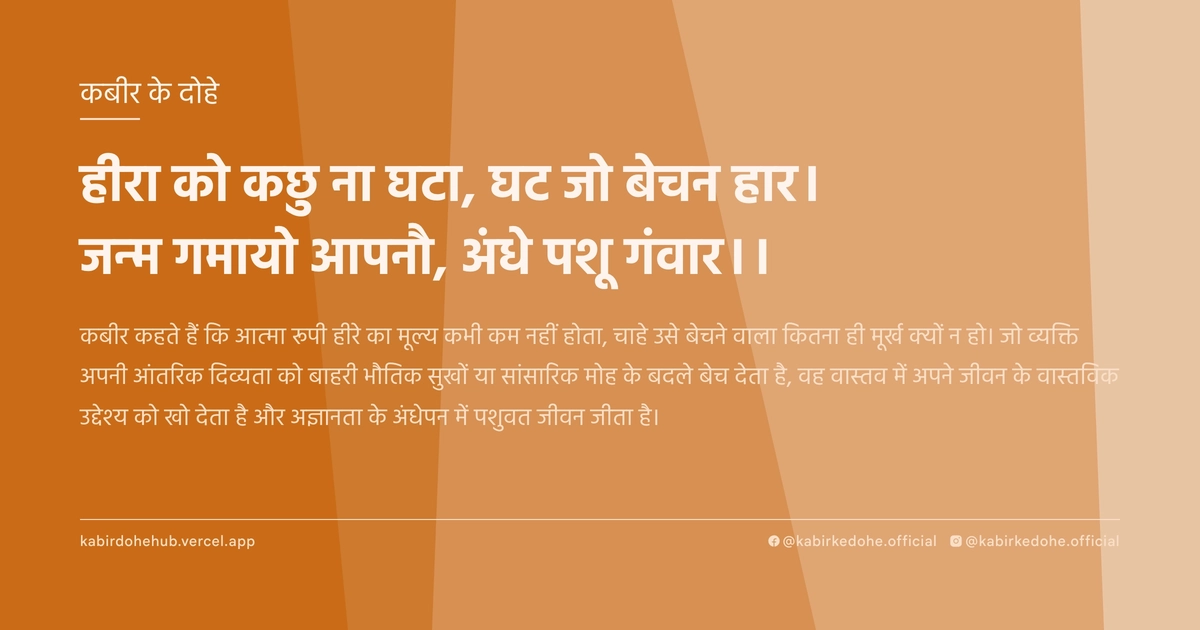
हीरा को कछु ना घटा, घट जो बेचन हार।
जन्म गमायो आपनौ, अंधे पशू गंवार।।
Heera ko kachu na ghata, ghat jo bechan haar. Janm gamayo aapnau, andhe pashu ganvar.
इस पृष्ठ पर इस कबीर दोहे का अर्थ (meaning), हिंदी व्याख्या और अंग्रेज़ी अनुवाद, दार्शनिक विश्लेषण और व्यावहारिक जीवन सीख दी गई है। यह दोहा मृतुक्यता (Mortality) विषय से जुड़ा है — Kabir doha meaning and explanation in Hindi and English.
अर्थ (Meaning):
कबीर कहते हैं कि आत्मा रूपी हीरे का मूल्य कभी कम नहीं होता, चाहे उसे बेचने वाला कितना ही मूर्ख क्यों न हो। जो व्यक्ति अपनी आंतरिक दिव्यता को बाहरी भौतिक सुखों या सांसारिक मोह के बदले बेच देता है, वह वास्तव में अपने जीवन के वास्तविक उद्देश्य को खो देता है और अज्ञानता के अंधेपन में पशुवत जीवन जीता है।
Kabir asserts that the inherent value of the soul, likened to a diamond, never diminishes, regardless of the ignorance of the one attempting to sell it. He who trades his inner divinity for fleeting material pleasures or worldly attachments has squandered the precious gift of human birth, living in a state of spiritual blindness akin to a mindless animal.
व्याख्या (Interpretation):
इस दोहे में 'हीरा' आत्मा की शुद्धता और अनंत मूल्य का प्रतीक है। कबीर यह स्पष्ट करते हैं कि आत्मा का स्वभाव स्वाभाविक रूप से दिव्य है और वह कभी दूषित नहीं होती। 'बेचन हार' वह व्यक्ति है जो माया के प्रभाव में आकर अपनी चेतना को अहंकार और वासनाओं के हाथों गिरवी रख देता है। यहाँ 'अंधे पशू' का अर्थ शारीरिक अंधापन नहीं, बल्कि आध्यात्मिक अज्ञानता है, जहाँ मनुष्य केवल इंद्रिय सुखों की खोज करता है। यह निरगुण भक्ति का सार है, जहाँ ईश्वर बाहर नहीं बल्कि भीतर है। जब हम बाहरी कर्मकांडों में उलझते हैं, तो हम उस आंतरिक हीरे को पहचान नहीं पाते। यह अद्वैत वेदांत के उस सिद्धांत को दर्शाता है जहाँ जीव और ब्रह्म एक ही हैं, परंतु माया के कारण जीव स्वयं को अलग और तुच्छ समझने लगता है।
In this couplet, the 'diamond' symbolizes the purity and infinite value of the Atman. Kabir clarifies that the soul's nature is inherently divine and remains untainted by external circumstances. The 'seller' represents the individual who, under the spell of Maya, mortgages their consciousness to ego and sensory desires. The term 'blind animal' does not refer to physical blindness but to spiritual ignorance, where a human exists solely for instinctual gratification. This encapsulates the essence of Nirgun Bhakti, positing that the Divine is not an external entity but an internal reality. When one becomes entangled in ritualism, the internal diamond remains unrecognized. This mirrors the Advaita Vedanta principle of non-duality, where the individual soul (Jiva) and the Universal Soul (Brahman) are one, yet the illusion of separation leads to a perceived loss of value.
दार्शनिक विश्लेषण (Philosophical Analysis):
कबीर का यह दोहा मध्यकालीन भारत के उस सामाजिक परिवेश में लिखा गया था जहाँ धर्म केवल बाहरी आडंबरों, जातिगत श्रेष्ठता और कठोर कर्मकांडों तक सीमित था। कबीर ने इस व्यवस्था पर कड़ा प्रहार किया, यह तर्क देते हुए कि ईश्वर किसी मंदिर, मस्जिद या तीर्थ में नहीं, बल्कि मनुष्य के अपने हृदय में निवास करता है। उनका दर्शन 'सहज मार्ग' का है, जो किसी विशेष संप्रदाय के बजाय आत्म-साक्षात्कार पर बल देता है।
दार्शनिक स्तर पर, यह दोहा अद्वैत वेदांत के 'तत्वमसि' (वह तू ही है) के विचार से मेल खाता है। कबीर समझाते हैं कि अज्ञान (Avidya) ही वह पर्दा है जो हमें अपनी वास्तविक प्रकृति से दूर रखता है। जब मनुष्य स्वयं को शरीर या सामाजिक पहचान मानता है, तो वह वास्तव में अपनी दिव्यता को 'बेच' रहा होता है। यह सूफीवाद के 'फना' (अहंकार का विनाश) के विचार के समान है, जहाँ व्यक्ति अपनी झूठी पहचान को मिटाकर सत्य में विलीन हो जाता है।
कबीर यहाँ 'पशु' शब्द का प्रयोग उन लोगों के लिए करते हैं जो केवल भौतिक आवश्यकताओं (भोजन, निद्रा, भय, मैथुन) तक सीमित हैं। उनके अनुसार, मनुष्य का जन्म इसलिए हुआ है ताकि वह इस चक्र से मुक्त हो सके। यदि वह अपनी आध्यात्मिक क्षमता का उपयोग नहीं करता, तो वह अपनी मानवीय गरिमा को खोकर पशुवत हो जाता है। यह एक मनोवैज्ञानिक चेतावनी है कि चेतना का स्तर बढ़ाना ही जीवन का एकमात्र वास्तविक लक्ष्य है।
ritualism या कर्मकांडों के प्रति उनकी अस्वीकृति इसलिए थी क्योंकि वे मानते थे कि बाहरी क्रियाएं आंतरिक परिवर्तन नहीं ला सकतीं। एक हीरा चाहे कीचड़ में पड़ा हो, उसका मूल्य कम नहीं होता; वैसे ही आत्मा चाहे पापों से घिरी हो, उसकी मूल दिव्यता अक्षुण्ण रहती है। समस्या हीरे की नहीं, बल्कि उसे पहचानने वाली दृष्टि की है।
अंततः, कबीर का संदेश यह है कि आत्म-मूल्य का बोध ही मुक्ति का द्वार है। जब व्यक्ति यह जान लेता है कि वह स्वयं अनंत है, तो वह बाहरी दुनिया के प्रलोभनों और भय से मुक्त हो जाता है। यह अहंकार का पूर्ण विलोपन है, जहाँ 'मैं' समाप्त होता है और केवल 'सत्य' शेष रहता है।
This couplet was composed during a period in medieval India when religion was largely confined to external rituals, caste hierarchies, and rigid dogmas. Kabir vehemently challenged this system, arguing that the Divine resides not in temples, mosques, or pilgrimages, but within the human heart. His philosophy follows the 'Sahaja Marg' (the Natural Path), emphasizing self-realization over sectarian affiliation.
Philosophically, this aligns with the Advaita Vedanta concept of 'Tat Tvam Asi' (Thou Art That). Kabir explains that ignorance (Avidya) is the veil that separates us from our true nature. When a human identifies solely with the body or a social label, they are effectively 'selling' their divinity for a cheap imitation. This resonates with the Sufi concept of 'Fana' (annihilation of the ego), where the false self is dissolved to merge with the Absolute Truth.
Kabir uses the term 'animal' to describe those limited to basic biological drives—eating, sleeping, fearing, and mating. He posits that human birth is a rare opportunity to transcend this cycle. Failure to utilize this spiritual capacity results in a loss of human dignity, reducing the individual to a state of instinctual existence. This serves as a psychological warning that elevating consciousness is the only authentic purpose of life.
His rejection of ritualism stemmed from the belief that external acts cannot produce internal transformation. Just as a diamond does not lose its value even if buried in mud, the soul's inherent divinity remains intact regardless of perceived sins or failures. The problem lies not with the diamond, but with the vision of the observer.
Ultimately, Kabir suggests that the realization of one's intrinsic worth is the gateway to liberation. Once an individual recognizes their infinite nature, they become immune to the lures and fears of the material world. This is the total dissolution of the ego, where the 'I' vanishes, leaving only the Eternal Truth.
मूल संदेश (Core Message):
- बाहरी दुनिया का शोर आंतरिक हीरे की चमक को धुंधला कर सकता है, मिटा नहीं सकता।
- अहंकार वह अंधापन है जो हमें हमारी अपनी दिव्यता देखने से रोकता है।
- सच्ची समृद्धि भौतिक संपत्ति में नहीं, बल्कि आत्म-बोध में निहित है।
- मानवीय जीवन का उद्देश्य इंद्रिय सुख नहीं, बल्कि चेतना का विस्तार है।
- जब आप स्वयं को जान लेते हैं, तो आप दुनिया के सबसे अमीर व्यक्ति बन जाते हैं।
- The noise of the external world may dim the brilliance of the inner diamond, but it can never extinguish it.
- Ego is the blindness that prevents us from witnessing our own inherent divinity.
- True prosperity lies not in material accumulation, but in the realization of the Self.
- The purpose of human birth is not sensory gratification, but the expansion of consciousness.
- Once you know yourself, you become the wealthiest being in the universe.
व्यावहारिक उदाहरण (Practical Example):
वाराणसी के एक पुराने मोहल्ले में रामदीन नाम का एक बुनकर रहता था। वह अपनी कला में निपुण था, लेकिन उसका मन हमेशा इस बात से दुखी रहता था कि वह एक साधारण बुनकर है और समाज में उसका कोई सम्मान नहीं है। वह अक्सर अमीर व्यापारियों की चापलूसी करता और उनकी छोटी-छोटी खुशियों के लिए अपनी ईमानदारी और स्वाभिमान का सौदा कर लेता। वह अपनी कला को केवल पैसा कमाने का जरिया मानता था, जबकि उसकी बुनाई में एक अद्भुत शांति और लय थी जो उसे ईश्वर से जोड़ सकती थी।
एक दिन उसकी मुलाकात एक घुमक्कड़ संत से हुई, जिसने रामदीन को एक पुराना, धुंधला सा पत्थर दिया और कहा, "इसे संभाल कर रखो, यह एक दुर्लभ हीरा है, बस इसकी धूल साफ करने की जरूरत है।"
रामदीन ने उस पत्थर को अपनी सबसे कीमती चीज मान लिया। उसने उसे रोज साफ करना शुरू किया और उसकी देखभाल में वह इतना मग्न हो गया कि उसने बाहरी दुनिया की चापलूसी करना छोड़ दिया। उसे महसूस हुआ कि जिस तरह इस पत्थर के भीतर एक चमक छिपा है, वैसे ही उसके भीतर भी एक कलाकार और एक दिव्य आत्मा है।
धीरे-धीरे रामदीन का व्यवहार बदलने लगा। अब वह व्यापारियों के सामने झुकता नहीं था, बल्कि अपनी कला के प्रति समर्पित हो गया। उसने महसूस किया कि वह अब तक अपनी आंतरिक शांति और स्वाभिमान को चंद सिक्कों के लिए बेच रहा था।
जब उसने अपनी बुनाई में उस 'हीरे' जैसी एकाग्रता और प्रेम को उतारा, तो उसके कपड़े दुनिया भर में प्रसिद्ध हो गए। लोग अब उसकी गरीबी नहीं, बल्कि उसकी कला की दिव्यता देखने आने लगे।
एक दिन संत वापस आए और उन्होंने बताया कि वह पत्थर वास्तव में कोई हीरा नहीं, बल्कि एक साधारण कंकड़ था। रामदीन चौंक गया, लेकिन संत ने मुस्कुराते हुए कहा, "हीरा तो तुम्हारे भीतर था, जिसे तुमने पहचान लिया। कंकड़ ने तो बस तुम्हें उस हीरे तक पहुँचाने का जरिया बनाया।"
रामदीन समझ गया कि वह अब तक एक 'अंधा पशु' था जो बाहरी दुनिया में मूल्य खोज रहा था, जबकि असली मूल्य उसकी अपनी आत्मा में था।
उसने अपनी पूरी जिंदगी अब दूसरों की सेवा और अपनी कला की शुद्धता में बिता दी। उसने सीखा कि जब हम अपनी आंतरिक दिव्यता को पहचान लेते हैं, तो दुनिया की कोई भी चीज हमें छोटा महसूस नहीं करा सकती।
यह 'कबीर ट्विस्ट' था—एक बाहरी भ्रम का उपयोग करके आंतरिक सत्य को जगाना। रामदीन ने अपनी पहचान को बाहरी पद और प्रतिष्ठा से हटाकर अपनी आत्मा की गहराई में खोजा और वास्तव में स्वतंत्र हुआ।
In an ancient neighborhood of Varanasi lived a weaver named Ramdin. He was skilled in his craft, but his heart was heavy with the belief that he was merely a lowly weaver with no social standing. To gain a semblance of respect, he often flattered wealthy merchants, trading his honesty and self-respect for meager favors and crumbs of validation. He viewed his weaving solely as a means of survival, ignoring the profound peace and rhythm in his work that could have connected him to the Divine.
One day, he met a wandering saint who handed him a dull, dusty stone and said, "Keep this safe; it is a rare diamond. It only needs its dust cleared away."
Ramdin began to treat the stone as his most prized possession. He cleaned it daily with utmost care, becoming so absorbed in this ritual that he stopped seeking the approval of the merchants. He began to feel that just as a brilliance lay hidden within the stone, a divine artist resided within himself.
Gradually, Ramdin's behavior shifted. He no longer bowed to the wealthy out of fear or greed; instead, he became devoted to the purity of his art. He realized that he had been selling his inner peace and dignity for a few coins.
As he infused his weaving with the same concentration and love he gave the 'diamond,' his fabrics became world-renowned. People no longer saw his poverty; they saw the divinity in his art.
One day, the saint returned and revealed that the stone was not a diamond at all, but a common pebble. Ramdin was shocked, but the saint smiled and said, "The diamond was within you all along, and you have finally recognized it. The pebble was merely the tool to lead you to that inner light."
Ramdin realized that he had been living as a 'blind animal,' searching for value in the external world while the true treasure was his own soul.
He spent the rest of his life in service to others and in the pursuit of artistic purity. He learned that once one recognizes their internal divinity, no external circumstance can make them feel insignificant.
This was the 'Kabir Twist'—using an external illusion to awaken an internal truth. Ramdin shifted his identity from a social label to a spiritual reality and attained true freedom.
अभ्यास मार्गदर्शन (Practice Guidance):
- दैनिक आत्म-अवलोकन: प्रतिदिन 15 मिनट मौन बैठें और विचार करें कि आज आपने कितनी बार अपनी आंतरिक शांति को बाहरी प्रशंसा या क्रोध के बदले 'बेचा' है।
- स्व-पूछताछ जर्नल: एक डायरी लिखें जिसमें उन स्थितियों का विवरण हो जहाँ आपने अपने मूल्यों से समझौता किया। स्वयं से पूछें, "क्या यह क्षणिक लाभ मेरी आत्मा के मूल्य से बड़ा है?"
- व्यवहारिक परिवर्तन: किसी ऐसे कार्य को निस्वार्थ भाव से करें जिसमें आपको कोई श्रेय न मिले, ताकि आप 'अहंकार' के बिना कार्य करने की आदत डाल सकें।
- डायग्नोस्टिक चेकलिस्ट: (1) क्या मैं दूसरों की राय से विचलित होता हूँ? (2) क्या मैं अपनी खुशी बाहरी वस्तुओं में खोज रहा हूँ? (3) क्या मैं अपनी सहज प्रवृत्तियों को सामाजिक दबाव में दबाता हूँ? यदि हाँ, तो आप अभी भी 'बेचन हार' की स्थिति में हैं।
- Daily Self-Observation: Sit in silence for 15 minutes daily and reflect on how many times today you 'sold' your inner peace for external validation or reacted in anger.
- Self-Inquiry Journal: Maintain a diary documenting instances where you compromised your values. Ask yourself, "Is this momentary gain more valuable than the integrity of my soul?"
- Behavioral Shift: Perform an act of service completely anonymously, without seeking credit, to cultivate the habit of acting without the interference of the ego.
- Diagnostic Checklist: (1) Am I easily swayed by others' opinions? (2) Am I seeking happiness exclusively in material possessions? (3) Do I suppress my authentic self due to social pressure? If yes, you are still operating as the 'seller' of your divinity.
चिंतन प्रश्न (Reflection Questions):
- मेरी वह कौन सी 'सामाजिक पहचान' है जिसे मैं अपनी वास्तविक आत्मा से अधिक महत्व देता हूँ?
- मैं अपनी शांति और स्वाभिमान को किन छोटी-छोटी चीजों के बदले रोज बेचता हूँ?
- यदि मुझसे मेरी सारी उपलब्धियाँ और पद छीन लिए जाएँ, तो क्या मेरे पास कुछ बचेगा जिसे मैं 'मूल्यवान' कह सकूँ?
- मेरा 'डिजिटल अहंकार' (सोशल मीडिया इमेज) मेरी वास्तविक आंतरिक स्थिति से कितना अलग है?
- क्या मैं वास्तव में जागरूक हूँ, या मैं केवल अपनी आदतों और सामाजिक प्रोग्रामिंग के इशारे पर चलने वाला एक 'पशु' हूँ?
- मेरे जीवन का वह कौन सा हिस्सा है जहाँ मैं अभी भी अज्ञानता के अंधेरे में जी रहा हूँ?
- Which 'social identity' do I value more than my authentic soul?
- What small, trivial things do I trade my peace and self-respect for every day?
- If all my achievements and titles were stripped away, would there be anything left that I could call 'valuable'?
- How far does my 'digital ego' (social media image) diverge from my actual internal state?
- Am I truly conscious, or am I merely an 'animal' acting on habits and social programming?
- Which part of my life is still shrouded in the darkness of spiritual ignorance?