
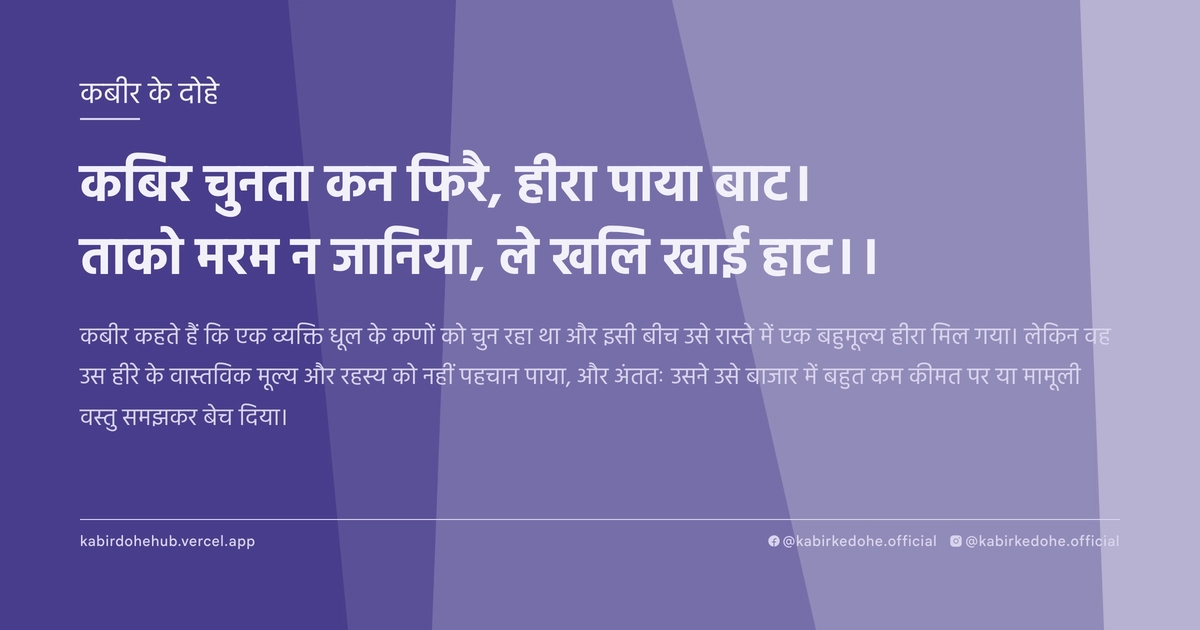
कबिर चुनता कन फिरै, हीरा पाया बाट।
ताको मरम न जानिया, ले खलि खाई हाट।।
Kabir chunta kan phirai, heera paya baat. Tako maram na janiya, le khali khai haat.
इस पृष्ठ पर इस कबीर दोहे का अर्थ (meaning), हिंदी व्याख्या और अंग्रेज़ी अनुवाद, दार्शनिक विश्लेषण और व्यावहारिक जीवन सीख दी गई है। यह दोहा माया (Maya) विषय से जुड़ा है — Kabir doha meaning and explanation in Hindi and English.
अर्थ (Meaning):
कबीर कहते हैं कि एक व्यक्ति धूल के कणों को चुन रहा था और इसी बीच उसे रास्ते में एक बहुमूल्य हीरा मिल गया। लेकिन वह उस हीरे के वास्तविक मूल्य और रहस्य को नहीं पहचान पाया, और अंततः उसने उसे बाजार में बहुत कम कीमत पर या मामूली वस्तु समझकर बेच दिया।
Kabir describes a person searching through grains of dust who happens to find a priceless diamond on the path. However, lacking the wisdom to recognize its true essence and value, the person treats it as a common stone and sells it cheaply in the marketplace, losing a divine treasure for a pittance.
व्याख्या (Interpretation):
यह दोहा प्रतीकात्मक है जहाँ 'कण' सांसारिक मोह-माया और तुच्छ इच्छाओं का प्रतिनिधित्व करते हैं, और 'हीरा' आत्मा या परमात्मा के साक्षात्कार का प्रतीक है। कबीर यह समझाते हैं कि मनुष्य अक्सर बाहरी दुनिया की छोटी-छोटी चीजों में उलझा रहता है, जबकि अनंत सत्य उसके भीतर या उसके ठीक सामने मौजूद होता है। 'मरम न जानिया' उस आध्यात्मिक अज्ञानता को दर्शाता है जो हमें अपनी वास्तविक प्रकृति (Atman) को पहचानने से रोकती है। यह अद्वैत वेदांत के उस सिद्धांत से जुड़ा है जहाँ माया के कारण हम ब्रह्म को नहीं देख पाते। अंत में, 'हाट' या बाजार इस भौतिक संसार का प्रतीक है जहाँ हम आध्यात्मिक शांति को क्षणिक सुखों के लिए बेच देते हैं। यह विरोधाभास है कि हम जिसे खोज रहे हैं, वह हमारे पास है, फिर भी हम उसे खो देते हैं क्योंकि हम उसे पहचानने की दृष्टि नहीं रखते।
This couplet is deeply metaphorical: the 'grains of dust' represent mundane desires and worldly attachments, while the 'diamond' symbolizes the realization of the Soul or the Divine. Kabir illustrates that humans are often so preoccupied with the trivialities of existence that they overlook the infinite truth residing within or right before them. 'Taako maram na jaaniya' refers to the spiritual ignorance (Avidya) that blinds us to our true nature (Atman). This aligns with Advaita Vedanta, where Maya obscures the non-duality of the individual and the universal consciousness. The 'marketplace' (haat) symbolizes the material world where we trade eternal peace for fleeting pleasures. The central paradox is that the seeker possesses the treasure but lacks the discernment (Viveka) to recognize it, thus discarding the infinite for the finite.
दार्शनिक विश्लेषण (Philosophical Analysis):
कबीर का यह दोहा उनके युग के धार्मिक पाखंड और कर्मकांडों के प्रति एक तीखा प्रहार है। उस समय लोग तीर्थयात्राओं और बाहरी अनुष्ठानों (कणों को चुनने) में व्यस्त थे, जबकि वास्तविक ईश्वर उनके हृदय में ही था। कबीर निर्गुण भक्ति के प्रणेता थे, जिनका मानना था कि ईश्वर किसी मंदिर या मस्जिद में नहीं, बल्कि स्वयं के भीतर है। यह विचार सूफीवाद के 'इन्सान-ए-कामिल' (पूर्ण मनुष्य) की अवधारणा से मिलता-जुलता है, जहाँ मनुष्य स्वयं को जानकर ईश्वर को जान लेता है।
दार्शनिक स्तर पर, यह अद्वैत वेदांत के 'तत्वमसि' (तुम वही हो) के सिद्धांत को पुष्ट करता है। हीरा वह शुद्ध चेतना है जो माया की धूल से ढकी हुई है। जब तक अहंकार (Ego) मौजूद है, व्यक्ति हीरे को पत्थर समझता है। कबीर तर्क देते हैं कि ज्ञान केवल किताबों से नहीं, बल्कि अनुभव और आत्म-साक्षात्कार से आता है।
यहाँ 'बाजार' का उल्लेख पूंजीवादी और भौतिकवादी प्रवृत्तियों की आलोचना है। समाज अक्सर सफलता को धन और पद से मापता है, जबकि कबीर के लिए सफलता का अर्थ है 'स्व' का बोध। वे चेतावनी देते हैं कि यदि हम अपनी आंतरिक शांति को बाहरी प्रशंसा के लिए बेच देते हैं, तो हम सबसे बड़े नुकसान में हैं।
यह दोहा मनोवैज्ञानिक रूपांतरण की बात करता है। यह हमें सिखाता है कि हमारी खोज की दिशा गलत है। हम बाहर खोज रहे हैं, जबकि खजाना भीतर है। जब तक हम अपनी दृष्टि (Perception) नहीं बदलते, हम हीरे को भी कंकड़ ही समझेंगे।
अंततः, कबीर यह संदेश देते हैं कि आध्यात्मिक जागृति के लिए केवल अवसर मिलना पर्याप्त नहीं है, बल्कि उस अवसर को पहचानने के लिए पात्रता (Eligibility) और जागरूकता की आवश्यकता होती है। बिना विवेक के, सबसे बड़ा सत्य भी व्यर्थ प्रतीत होता है।
Kabir's couplet serves as a poignant critique of the religious hypocrisy and ritualism prevalent during his era. People were obsessed with external pilgrimages and complex rituals—symbolized by 'picking grains of dust'—while the true Divine resided within their own hearts. As a proponent of Nirgun Bhakti, Kabir emphasized a formless God, accessible not through temples or mosques, but through inner realization. This mirrors the Sufi concept of 'Insan-e-Kamil' (the Perfect Human), where knowing oneself is the gateway to knowing God.
Philosophically, this aligns with the Advaita Vedanta principle of 'Tat Tvam Asi' (Thou Art That). The diamond represents pure consciousness, often obscured by the dust of Maya. As long as the ego persists, the individual perceives the diamond as a mere stone. Kabir argues that true knowledge is not derived from scriptures but from direct experience and self-realization.
The mention of the 'marketplace' is a critique of materialistic tendencies. Society measures success by wealth and status, whereas for Kabir, success is the realization of the Self. He warns that trading internal peace for external validation is the ultimate spiritual bankruptcy.
Psychologically, the poem addresses the misdirection of human longing. We search the horizon for what is already within. Unless we shift our perception from the external to the internal, the most profound truths will remain invisible or be dismissed as trivial.
Ultimately, Kabir suggests that spiritual awakening requires more than just an encounter with truth; it requires the readiness and discernment (Viveka) to recognize it. Without this awareness, the most precious spiritual insight is wasted, much like a diamond sold for the price of a pebble.
मूल संदेश (Core Message):
- बाहरी खोज अक्सर आंतरिक सत्य की बाधा बन जाती है।
- सत्य सबके पास है, पर उसे पहचानने का विवेक विरल है।
- अहंकार वह धूल है जो आत्मा के हीरे को ढक लेती है।
- सांसारिक उपलब्धियाँ आध्यात्मिक शून्यता को नहीं भर सकतीं।
- स्वयं का बोध ही ब्रह्मांड का सबसे बड़ा खजाना है।
- दिखावे के बाजार में अपनी शांति का सौदा न करें।
- External searching often becomes an obstacle to internal truth.
- Truth is accessible to all, but the discernment to recognize it is rare.
- The ego is the dust that obscures the diamond of the soul.
- Worldly achievements cannot fill a spiritual void.
- Self-realization is the greatest treasure in the universe.
- Do not trade your inner peace in the marketplace of vanity.
व्यावहारिक उदाहरण (Practical Example):
वाराणसी के एक पुराने घाट पर रामदीन नाम का एक वृद्ध नाविक रहता था। वह जीवन भर केवल नाव चलाने और पर्यटकों से पैसे कमाने में लगा रहा। वह हमेशा शिकायत करता था कि उसका जीवन खाली है और उसे शांति नहीं मिलती। वह हर साल बड़े मेलों में जाता, महंगे पंडितों को दान देता और कठिन व्रत रखता, यह सोचकर कि शायद इससे उसे ईश्वर मिल जाए।
एक दिन, एक फकीर उसकी नाव पर सवार हुआ। फकीर ने रामदीन को देखा और मुस्कुराते हुए कहा, "तुम पूरी दुनिया की धूल छान रहे हो, जबकि गंगा का असली मोती तुम्हारे अपने हृदय की करुणा में छिपा है।" रामदीन ने इसे एक साधारण बात समझा और अनदेखा कर दिया।
कुछ दिनों बाद, रामदीन ने एक डूबते हुए कुत्ते को बचाने के लिए अपनी नाव के चप्पू को जोखिम में डाला। उस क्षण, जब उसने उस बेजुबान की आँखों में कृतज्ञता देखी, उसे एक ऐसी असीम शांति का अनुभव हुआ जो उसने किसी भी तीर्थयात्रा या दान में नहीं पाया था। उसे अचानक अहसास हुआ कि वह अब तक 'कण' (बाहरी अनुष्ठान) चुन रहा था, जबकि 'हीरा' (करुणा और प्रेम) उसके भीतर ही था।
उसने महसूस किया कि वह अपनी इस आंतरिक शांति को 'बाजार' (सामाजिक प्रतिष्ठा और दिखावे) के लिए बेच रहा था। उसने पंडितों को पैसे देना बंद किया और अपना जीवन निस्वार्थ सेवा में लगा दिया।
उसका व्यवहार बदल गया। अब वह केवल पैसे के लिए नाव नहीं चलाता था, बल्कि हर यात्री में ईश्वर को देखने लगा।
उसकी आँखों में एक नई चमक थी। वह अब घाटों पर बैठकर लोगों को यह नहीं बताता था कि कहाँ जाना है, बल्कि यह बताता था कि कैसे अपने भीतर ठहरना है।
उसकी पत्नी, जो पहले उसकी चिड़चिड़ाहट से परेशान थी, अब उसके शांत स्वभाव की प्रशंसक हो गई।
रामदीन ने जान लिया कि हीरा पाने के लिए कहीं जाने की जरूरत नहीं, बस उसे पहचानने वाली दृष्टि चाहिए।
उसका जीवन अब एक उत्सव बन गया था, क्योंकि उसने बाहरी शोर के बीच आंतरिक संगीत को सुनना सीख लिया था।
यह 'कबीर ट्विस्ट' था—जब बाहरी खोज समाप्त हुई और आंतरिक पहचान शुरू हुई, तब उसका जीवन वास्तव में सार्थक हुआ।
On an ancient ghat in Varanasi lived an elderly boatman named Ramdin. For decades, his life revolved around rowing tourists and accumulating money. He constantly complained that his life felt empty and devoid of peace. Every year, he visited grand fairs, donated heavily to expensive priests, and observed rigorous fasts, believing these external acts would bring him closer to God.
One day, a wandering Sufi dervish boarded his boat. The dervish looked at Ramdin and smiled, saying, "You are sifting through the dust of the entire world, while the true pearl of the Ganges is hidden in the compassion of your own heart." Ramdin dismissed this as a mere platitude and ignored it.
Days later, Ramdin risked his boat and his safety to save a drowning dog. In that moment, seeing the gratitude in the animal's eyes, he experienced a surge of infinite peace that he had never found in any pilgrimage or ritual. He suddenly realized that he had been collecting 'grains of dust' (external rituals) while the 'diamond' (compassion and love) was already within him.
He realized he had been trading this potential inner peace for the 'marketplace' of social prestige and religious validation.
His behavior shifted radically. He no longer rowed solely for profit but began to see the Divine in every passenger.
There was a new luminosity in his eyes. He stopped telling people which temple to visit and started teaching them how to be still within themselves.
His wife, who had long suffered from his irritability, became a devotee of his newfound serenity.
Ramdin understood that finding the diamond didn't require a journey to a distant land, but a shift in vision.
His life became a celebration, as he learned to hear the inner music amidst the external noise of the city.
This was the 'Kabir Twist'—when the external search ceased and internal recognition began, his life finally attained true meaning.
अभ्यास मार्गदर्शन (Practice Guidance):
- दैनिक आत्म-अवलोकन: प्रतिदिन 15 मिनट मौन बैठें और विचार करें कि क्या आप अपनी ऊर्जा बाहरी प्रशंसा (कणों) या आंतरिक शांति (हीरे) पर खर्च कर रहे हैं।
- जागरूकता जर्नल: एक डायरी लिखें जिसमें उन क्षणों को दर्ज करें जब आपने अपनी सहज अंतरात्मा की आवाज़ को सामाजिक दबाव या अहंकार के कारण अनदेखा किया।
- व्यवहारिक परिवर्तन: दिन में कम से कम एक ऐसा कार्य करें जिसमें कोई बाहरी पुरस्कार न हो, केवल निस्वार्थ सेवा हो, ताकि अहंकार का विसर्जन हो सके।
- डायग्नोस्टिक चेकलिस्ट: क्या मैं दूसरों की राय से विचलित होता हूँ? क्या मैं ईश्वर को केवल मंदिर/मस्जिद में खोजता हूँ? क्या मैं अपनी शांति को भौतिक लाभ के लिए बेच रहा हूँ? (यदि हाँ, तो आप अभी भी 'कण' चुन रहे हैं)।
- Daily Self-Observation: Spend 15 minutes in silence, questioning whether your energy is being spent on external validation (dust) or internal peace (the diamond).
- Awareness Journaling: Keep a log of moments where you ignored your intuitive inner voice in favor of social pressure or ego-driven desires.
- Behavioral Shift: Perform at least one act of selfless service daily with no expectation of reward, specifically to dissolve the ego's need for recognition.
- Diagnostic Checklist: Do I feel unsettled by others' opinions? Do I seek the Divine only in external shrines? Am I trading my peace for material gain? (If yes, you are still sifting through dust).
चिंतन प्रश्न (Reflection Questions):
- मेरे जीवन का वह 'हीरा' क्या है जिसे मैं अपनी व्यस्तता और सामाजिक छवि के कारण अनदेखा कर रहा हूँ?
- मैं अपनी आंतरिक शांति को किन बाहरी 'बाजारों' (जैसे सोशल मीडिया लाइक्स या पद) के लिए बेच रहा हूँ?
- क्या मेरी धार्मिकता वास्तव में आध्यात्मिक है, या यह केवल एक सामाजिक मुखौटा है?
- यदि मैं अपनी सभी बाहरी पहचान (नाम, पेशा, जाति) खो दूँ, तो मेरे भीतर क्या बचेगा?
- मैं किन 'कणों' को इतनी शिद्दत से चुन रहा हूँ कि मुझे जीवन का असली उद्देश्य नहीं दिख रहा?
- क्या मैं सत्य को खोजने का दावा करता हूँ, या मैं केवल सत्य के बारे में बात करने का शौकीन हूँ?
- What is the 'diamond' in my life that I am ignoring due to my busyness and social persona?
- In which external 'marketplaces' (e.g., social media validation or status) am I trading my inner peace?
- Is my religiosity truly spiritual, or is it merely a social mask?
- If I were to lose all my external identities (name, profession, caste), what would remain within me?
- Which 'grains of dust' am I pursuing so intensely that I have lost sight of life's true purpose?
- Do I actually seek the truth, or am I merely fond of talking about the truth?